The Executive Lounge That Has Been Reduced to a "Scramble-for-Food Canteen": It Can Be Terrible, But It Must Not Be Liquidated
"Have you ever seen a Happy Hour scene with nearly 100 people? I have." Lao Gao, a seasoned business traveler with premium memberships of multiple international hotel groups, complained to me the other day.
In his words, The executive lounges of some international hotel chain properties in China are turning into large-scale self-service cafeterias where people rush for food. The originally relatively private business social spaces have become as noisy as wet markets.
Lao Sha has reached an age where he can understand both users and empathize with property owners. In fact, many property owners in China have begun to hold fickle, hesitant and wavering attitudes towards executive lounges.
Some property owners forcibly shut down executive lounges to cut costs and improve efficiency, while other international brands "overissue" executive lounge benefits, turning executive lounges into a second "cafeteria" to cater to more user groups.
Obviously, properly handling the issues related to executive lounges is a major matter for both hotel property owners and hotel brands.
Lao Sha's attitude is very clear: do not close executive lounges rashly. Why?
Some brands absolutely cannot shut down their executive lounges
A rumor that Crowne Plaza brand might close its executive lounges spread quickly in the hotel industry a couple of days ago.
However, some media quickly quoted statements from insiders to refute the rumor, "InterContinental Hotels Group will not cancel the executive lounges of this brand."
But for Courtyard by Marriott, more and more properties have closed their executive lounges.
Just a few days ago, Courtyard by Marriott Luoyang announced that it would close the executive lounge starting from August 1, and will no longer provide any form of executive lounge services.
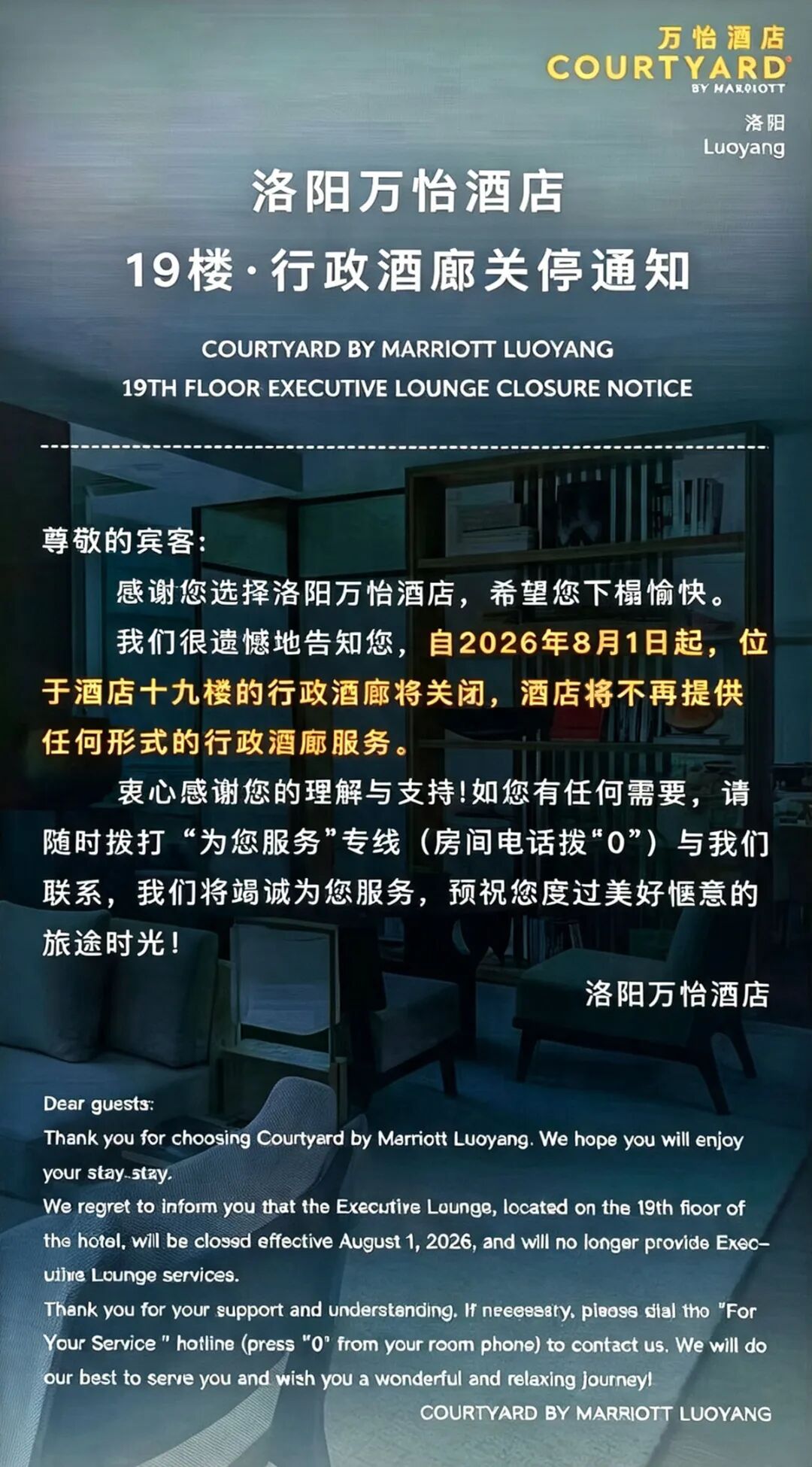
Source: Xiaohongshu
Earlier, properties including Courtyard by Marriott Hangzhou Qianjiang New Town, Courtyard by Marriott Tianjin Lujiazui, and Courtyard by Marriott Shenzhen Liantou Oriental have all shut down their executive lounges, and only some hotels have provided alternative solutions.
Executive lounges are not a standard feature of the Courtyard by Marriott brand, but the moves of shutting down existing properties' lounges and not configuring lounges in newly opened projects also reflect the attitude of domestic property owners towards this product.
In Lao Sha's view, the above-mentioned "rumor" involving the Crowne Plaza brand more or less reveals the preference of many Crowne Plaza property owners.
Whether to close the executive lounge is a game between hotel property owners and brand management parties. At least up to now, international hotel groups have begun to loosen their persistence on this product.
In addition to Courtyard by Marriott, many international hotel brand properties in the market that still have executive lounge products have also reduced their benefits. Some have downgraded product configurations, some have reduced space configurations, and others have shortened opening hours.
Mr. Li, the owner of an international hotel chain project, has mentioned to Lao Sha on multiple occasions that for most properties, the executive lounge is a huge cost burden. Now everyone is carefully calculating floor area efficiency and rate of return, and the executive lounge, as a low-efficiency cost center, has become one of the first items to be cut.
However, Lao Sha, an "outsider" who has one foot in hotel operation, holds a different view.
Take the Courtyard by Marriott brand as an example.
Within the Marriott system, the positioning of the Courtyard by Marriott brand is half a level higher than that of Four Points. In terms of construction cost per room (including public areas), the cost of Courtyard by Marriott, which ranges from 250,000 to 300,000, is much higher than that of Four Points by Sheraton (180,000 to 220,000).
But from the perspective of consumers, a Courtyard by Marriott without an executive lounge, although still having its own characteristics and personality, has a smaller and smaller difference and gap from Four Points by Sheraton. Users would rather choose Four Points which offers higher cost performance.
Lao Gao mentioned that the executive lounge is an important manifestation of experiencing hotel differentiation and uniqueness, far more significant than services like adding two extra bottles of water in the room or free laundry. He will have a much lower willingness to check in at properties that originally had an executive lounge but suddenly shut it down.
In addition, for existing Courtyard by Marriott hotels, the original construction cost per room is already much higher. If they rashly close the executive lounge now, they can only use lower room rates to offset the high costs incurred in the past.
In fact, some clues can also be seen from the investor side.
In 2025, the number of newly opened Four Points by Sheraton hotels in China hit a record high, with more than 30 new properties opened by the end of October, and nearly 40 planned to open for the whole year. By contrast, Courtyard by Marriott is much less impressive.
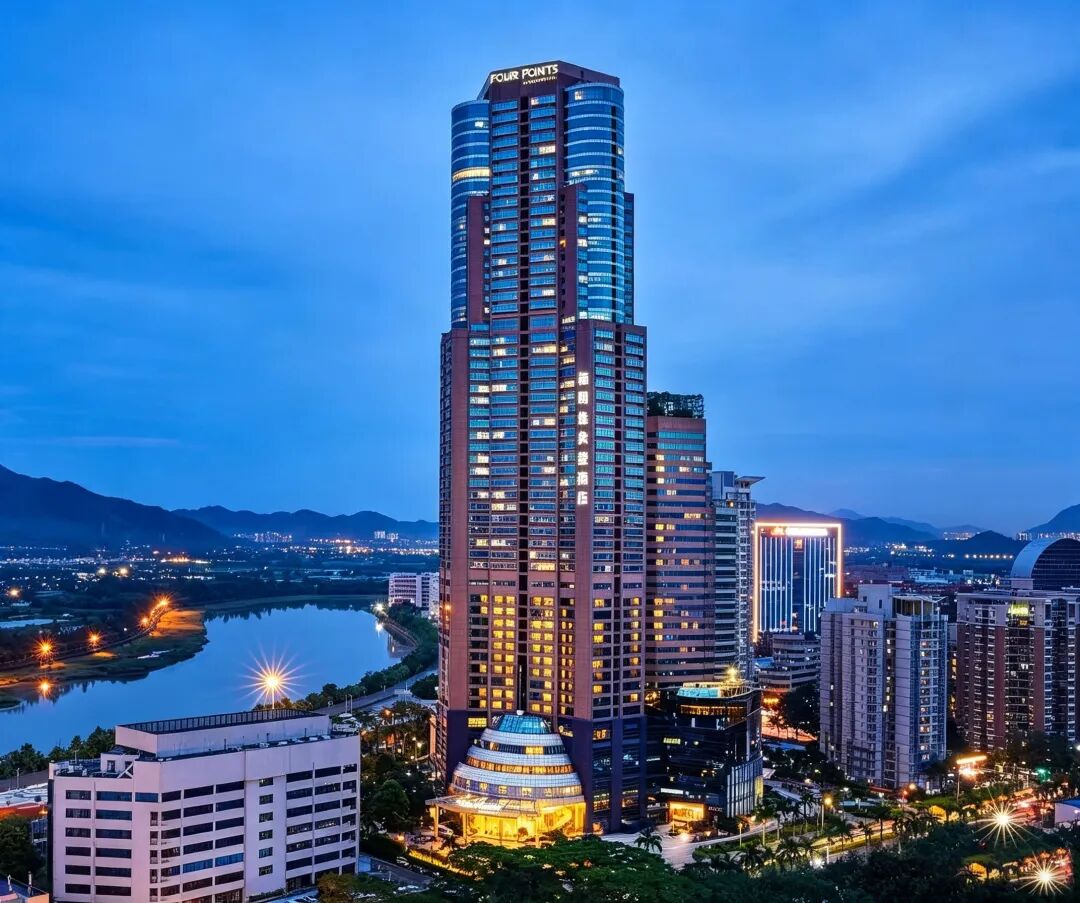
Source: Four Points by Sheraton Shenzhen is the first Four Points hotel in Chinese mainland
Similarly, if other international hotel brands rashly shut down their executive lounges, their customer sources will also flow into similar domestic brands. After all, in the Chinese market, there is no shortage of hotel brands and services at present.
Why have some executive lounges alienated into "cafeterias where people rush for food"?
If you count the international hotel brands that are configured with executive lounges, the proportion of those that directly shut down the lounges is not large. But this does not mean that the game between property owners and hotel groups does not exist.
The scene of nearly 100 people that Lao Gao experienced in the executive lounge, and the cafeteria-like experience, is the external manifestation of this game.
Many hotel groups, in order to attract more people to join the brand loyalty program, will release more "watered-down memberships" to the public. These people obtain high-level memberships through shortcuts such as gifting, trading, challenges, or even system loopholes.
Frankly speaking, such groups are not the core customer base of hotels. But some hotel groups still expand their membership data, and use it as an excuse to claim that they are more competitive.
In the short term, there are not many obvious disadvantages for hotel brand management parties (hotel groups). But in order to cater to these non-core and non-loyal customers, many hotel property owners have to bear more operating costs.
Some time ago, the article pushed by *Hotel Finance* titled "Marriott, which just exceeded 10,000 properties, was jointly 'pressured' by franchisees" talked about the contradiction between hotel brand parties and property owners on this issue.
When a hotel brand cannot directly shut down the executive lounge, and more and more "watered-down members" gather to enjoy relevant benefits, many hotel property owners begin to think about "downgrading configurations".
For example:
Enable time-based access. Some are only open when the occupancy rate is high, and some only serve afternoon tea and happy hour;
Downgrade food and beverage offerings. Including downgrading or reducing ingredients, cutting the number of SKUs, etc. This is especially obvious in the beverage section, where product quality has been degraded;
Downgrade services. Cancel or reduce customized services such as free special printing and small meeting rooms;
However, some smart hotel property owners, in order to maintain a "decent" image of the executive lounge's offerings, have increased investment in the food and beverage sector that users can more easily perceive. On the basis of controlling costs, they try their best to satisfy more users.
This is the core reason why the experience of many current executive lounges has gradually turned into "cafeterias where people rush for food".
However, the refinement of their offerings and services is still difficult to guarantee.
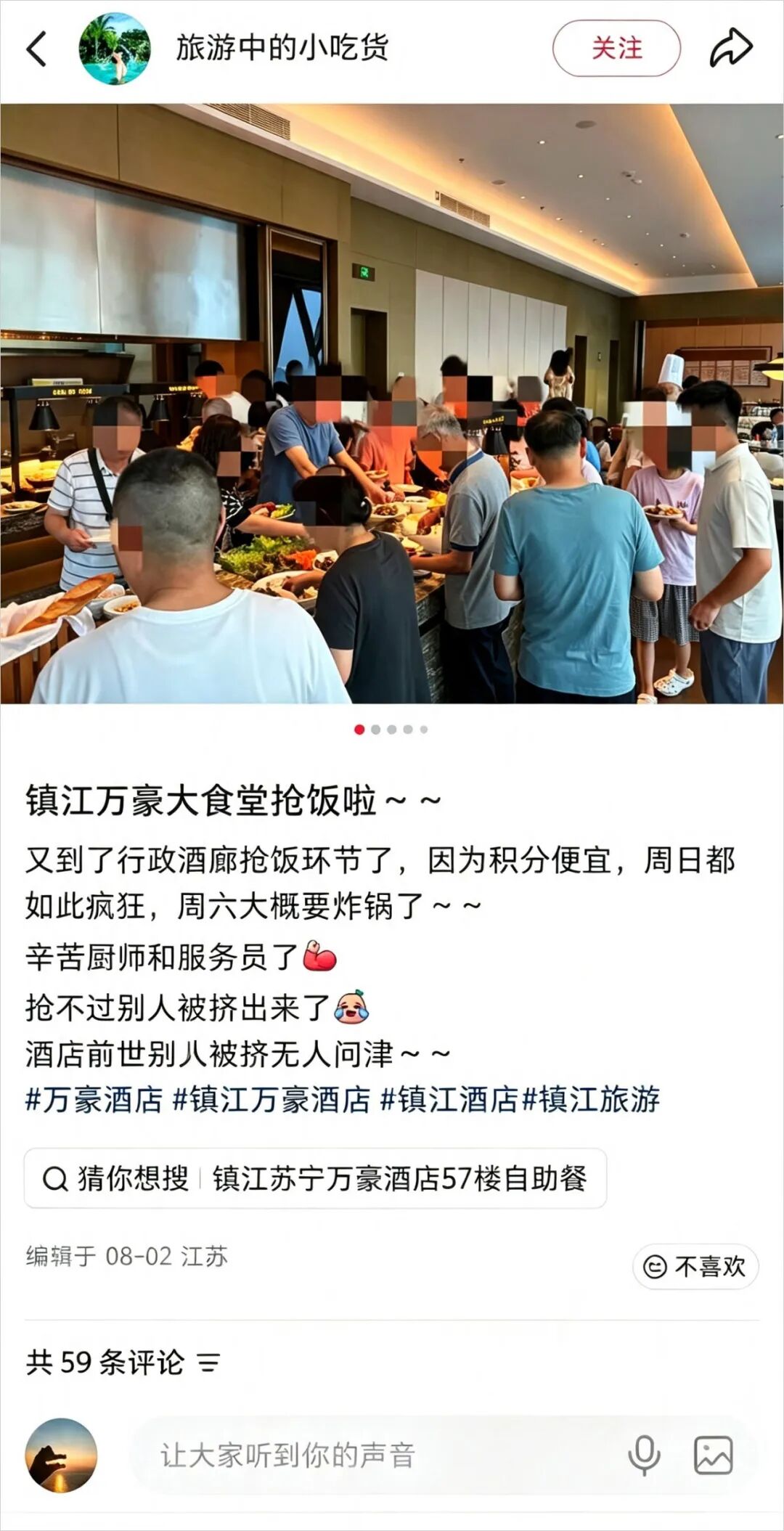
Source: Xiaohongshu
On the one hand, the increase of "watered-down members" has led to a surge in the number of guests received by executive lounges. Any experience will be compromised if there are too many people.
On the other hand, the food and beverage offerings in the executive lounges of many international hotel brand properties have been severely downgraded, with pre-made dishes appearing very frequently. Some properties even reheat the "leftovers" from the morning buffet.
Lao Sha understands this move but does not approve of it in his heart.
This behavior can take care of the feelings of more people, but for truly high-loyalty guests of hotel brands like Mr. Gao, it is actually a kind of overdraft and harm.
After all, an executive lounge is not a buffet restaurant. When a lounge becomes a cheap canteen where people rush for food, crowd together to grab dishes, share tables, face empty plates, and queue up, it will cause harm to loyal members, brand value, and property operation.
Are Executive Lounges Really Just a "Burden"?
The original positioning of executive lounges is a small-scale exclusive rest space for paying executive room guests and high-value loyal members, pursuing quietness, privacy, light social interaction, and moderate light meals.
Lao Sha believes that The core experience and value of an executive lounge lie in its space, not in the food and drinks.
From a localized perspective, it is understandable that executive lounges in the Chinese market weaken beverage offerings and strengthen food quality. After all, here, people even greet each other with the phrase "Have you eaten?".
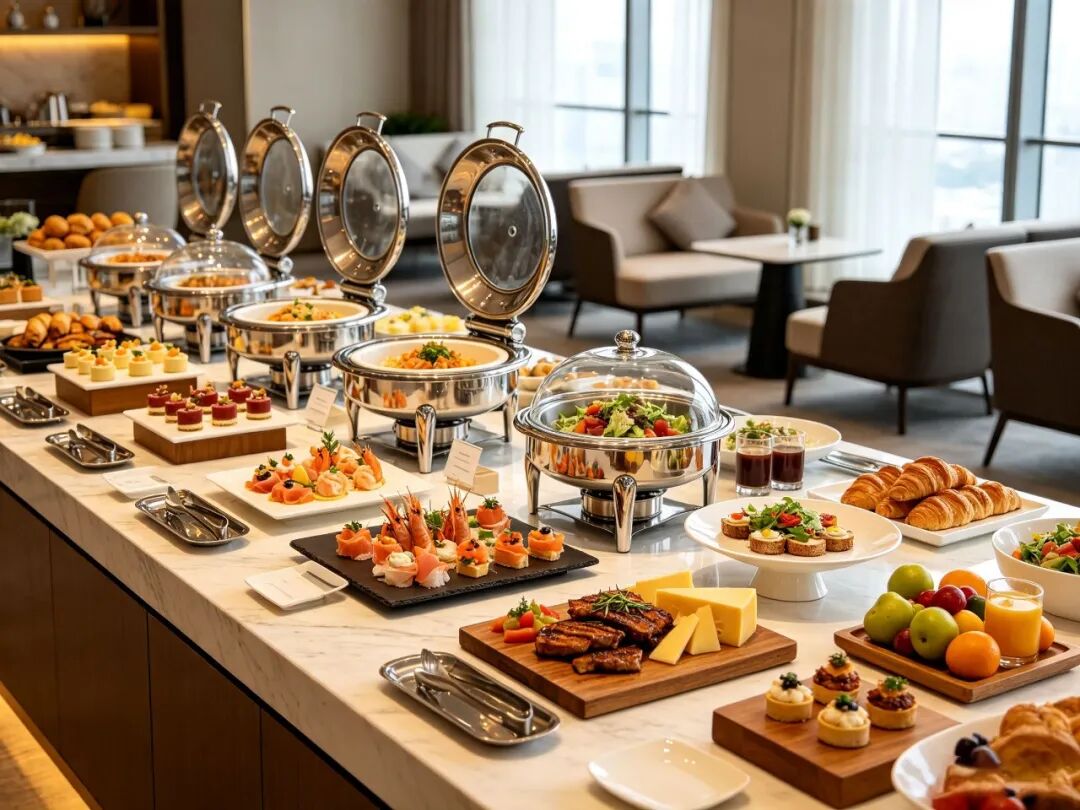
Source: AI
However, food and beverage services should serve the space. At least at the present stage, hotels that turn executive lounges into a second cafeteria are putting the cart before the horse and losing the most important core of executive lounges.
Another point is that The service targets of executive lounges are never the general public, but a small group of people.
This statement may make some people feel uncomfortable, but it is the truth. The service groups of executive lounges are either high-net-worth individuals or high-loyalty brand customers, who can bring premium and revenue to hotel brands and properties.
The harsh reality is that Combined with the actual operation situation of the current hotel industry, this so-called group of high-net-worth individuals can no longer support the daily operation of executive lounges, and hotel property owners cannot afford and are unwilling to maintain executive lounges anymore.
Because in terms of explicit financial data, executive lounges hardly generate any revenue, and are more positioned as cost centers. This includes:
In terms of fixed costs, including labor, energy consumption, depreciation and wear and tear;
In terms of variable costs, mainly including food material costs and labor costs.
In terms of opportunity costs, if the space is not used as an executive lounge, the property space can be converted into other formats to obtain potential revenue.
Lao Sha admits that for most property owners, hotel executive lounges in the Chinese market are a phased "burden".
Therefore, many hotel property owners have found a compromise solution between struggling to maintain the facade of the executive lounge while burning money, and simply shutting it down directly — the "cafeteria where people rush for food".
Lao Sha believes that hotel property owners may have a fourth choice — combine local culture, focus on space and sense of identity, and transform the executive lounge into a social circle space.
Its underlying logic is to weaken the food and beverage-driven model, and strengthen space, culture and exclusive services. Strengthen local cultural narration in the space form; highlight local customs and handmade customization in food supply; pursue personal customization in services to accurately grasp the needs of each user.
When Lao Sha sent this immature viewpoint to Mr. Gao and his hotel owner friend Mr. Li, they gave different replies.
"It sounds vague, but it feels very interesting." said Lao Gao.
"The idea is very romantic, but it may not be financially viable. When there is really no other way, we can try it." said Lao Li.
Therefore, the market has not reached the absolute bottom, the fate of executive lounges will most likely continue to linger on, and the entire industry still has great hope.