In the second half of the AI era, who will turn "talking the talk" into "delivering real results"?
Sitting in a moving vehicle, you don't need to raise your hand to open the food delivery app. Just say "Help me order a hot latte", and the vehicle infotainment system will recognize your request, automatically complete the order placement, match the nearest store, finish pre-payment, so that you can pick up the meal directly when you arrive at the store.
This is a real interactive scenario available for experience at the "Alipay AI Ecosystem Partner Conference" today.
Behind a simple voice command lies a closely linked industrial network: the user interaction end is the vehicle infotainment system from automakers, the core of the intermediate agent scheduling is Alipay's "Abao", which identifies user intentions, combines personal preferences as well as the service capabilities and geographical location of merchants, uses AI payment in the process, and the final implementation and fulfillment are completed by offline physical merchants such as Luckin Coffee. The entire chain spans hardware, AI platforms and physical business formats. If any link lacks standardized collaboration capabilities, smooth service delivery will be impossible.
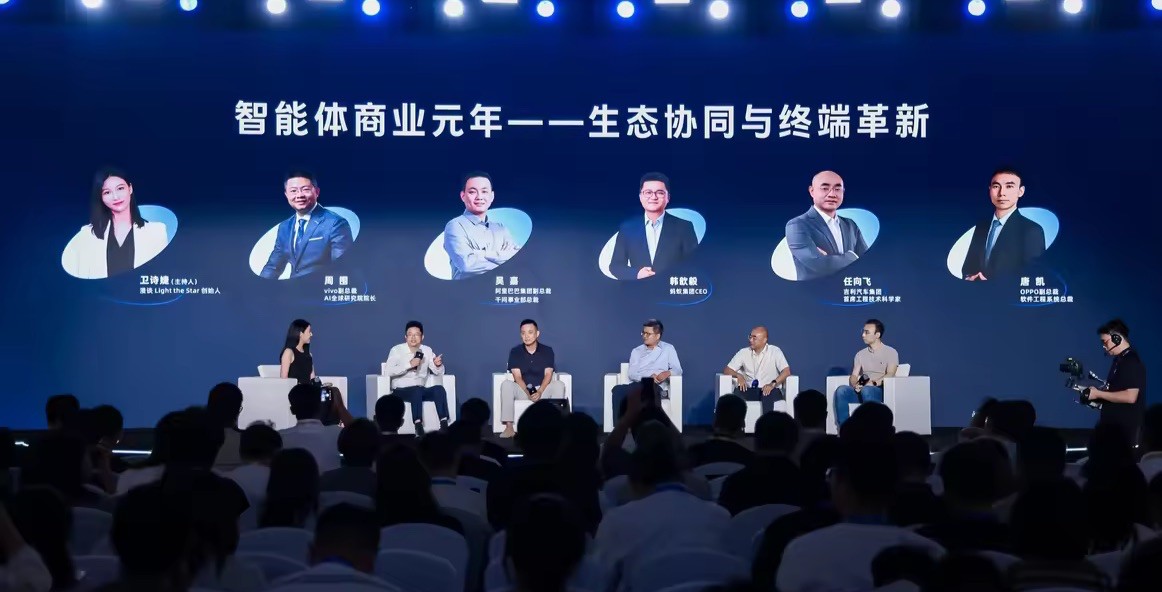
This domestic ecological conference, which takes the lead in focusing on the commercial implementation of agents, features a carefully designed lineup of on-site guests: mobile phone manufacturers, automobile enterprises, large model R&D teams, chain catering brands, cultural tourism scenic spots, and local government service platforms are seated together. The gathering of cross-border players intuitively proves that the focus of the entire AI industry has shifted from large model benchmarking in the laboratory to the service fulfillment closed loop in the real world.
In fact, the pace of top Silicon Valley investment institutions has already foreshadowed this industrial shift. Looking back at HSG's investment list this year, we can find that it has begun to aggressively acquire assets in the "application layer". Partner Roelof Botha previously mentioned: Our money is not used to pay for sky-high training costs, but to invest in companies that "make good use of models" rather than "build good models".
Now that Alipay has built an open ecological alliance, it once again outlines the new track logic of the second half of AI -- AI no longer only competes on "who is better at chatting", but competes more on who can really help people get things done one by one.
What bottlenecks does in-vehicle infotainment ordering solve?
The smooth experience of voice ordering through vehicle infotainment systems breaks through two practical bottlenecks that are unavoidable for the large-scale commercial application of agents.
In general, the entire AI ordering service chain can be divided into multiple terminals on the user side, agents for intermediate scheduling, and offline merchant services on the supply side. At present, large model understanding and speech recognition technologies are very mature, but stuck at both ends of supply and distribution, a complete transaction closed loop cannot be formed all the time.
On the supply side, a large number of offline real services could not be identified and called by AI in a standardized manner before. The merchant's inventory, ordering system and verification process are mostly isolated digital silos. Even if the agent can understand colloquial demands such as "buy coffee" and "send express", it can only provide basic information recommendations, and cannot directly initiate orders, complete payment and fulfillment.
In the past two years, the industry has flocked to pursue large model SOTA, parameter scale and multi-modal benchmarking, taking for granted that a stronger model can solve all problems. But the market perception in 2026 has been completely reversed. Palantir has long pointed out the truth: enterprise customers do not care which large model is deployed behind the scenes, they only care about whether AI can bring real incremental benefits to the business.
At the same time, domestic open-source models are rapidly popularized, and hierarchical scheduling and lightweight models are sufficient to adapt to most life service scenarios. The marginal benefit brought by blindly stacking top-tier models continues to decline, and the industry narrative has shifted from benchmarking to ROI.
Analogizing the development trajectory of the Internet at the beginning of the century can clarify the underlying logic. The first half of the Internet only realized information browsing and email communication, which did not really change life; it was not until physical services such as online shopping and payment were connected to meet the real needs of daily life that the Internet truly completed the commercial value closed loop.
Today's AI is replicating this evolution path. The first half only solves the problem of "whether machines can understand human speech", and the second half ushers in the core proposition of "whether machines can really help people get things done".

With the continuous iteration of cost-effective open-source models in China, large models will gradually become the general basic capability of the whole industry. The truly scarce core resources are offline service resources that can be stably called by agents, terminal distribution networks covering all scenarios, and the whole set of fulfillment infrastructure including identity verification, payment settlement, risk control and responsibility tracing.
This means that from the perspective of industrial evolution logic, there is in fact a task-oriented agent between general large models and embodied intelligence, which has become the core carrier of current industrial implementation.
On the distribution side, the current user interaction entrances are extremely fragmented, mobile phones, in-vehicle devices, smart home appliances, and government service mini-programs belong to different systems. It is difficult for merchants to stably obtain customer flow by accessing a single platform, and to reach users across all channels, they need to repeatedly adapt to multiple sets of technical standards, resulting in extremely low expansion efficiency. Intelligent services can only be limited to niche closed scenarios, and the market is also calling for a "universal big market" for Agents.
Unavailable supply and difficult service distribution, the superposition of the two bottlenecks makes a large number of agent projects stay at the demonstration demo stage, and it is difficult to enter the daily consumption scenarios of ordinary people. The three sets of solutions released by Alipay at this ecological conference provide ideas for solving the problem.
From merchants to users, agents usher in a "universal language"
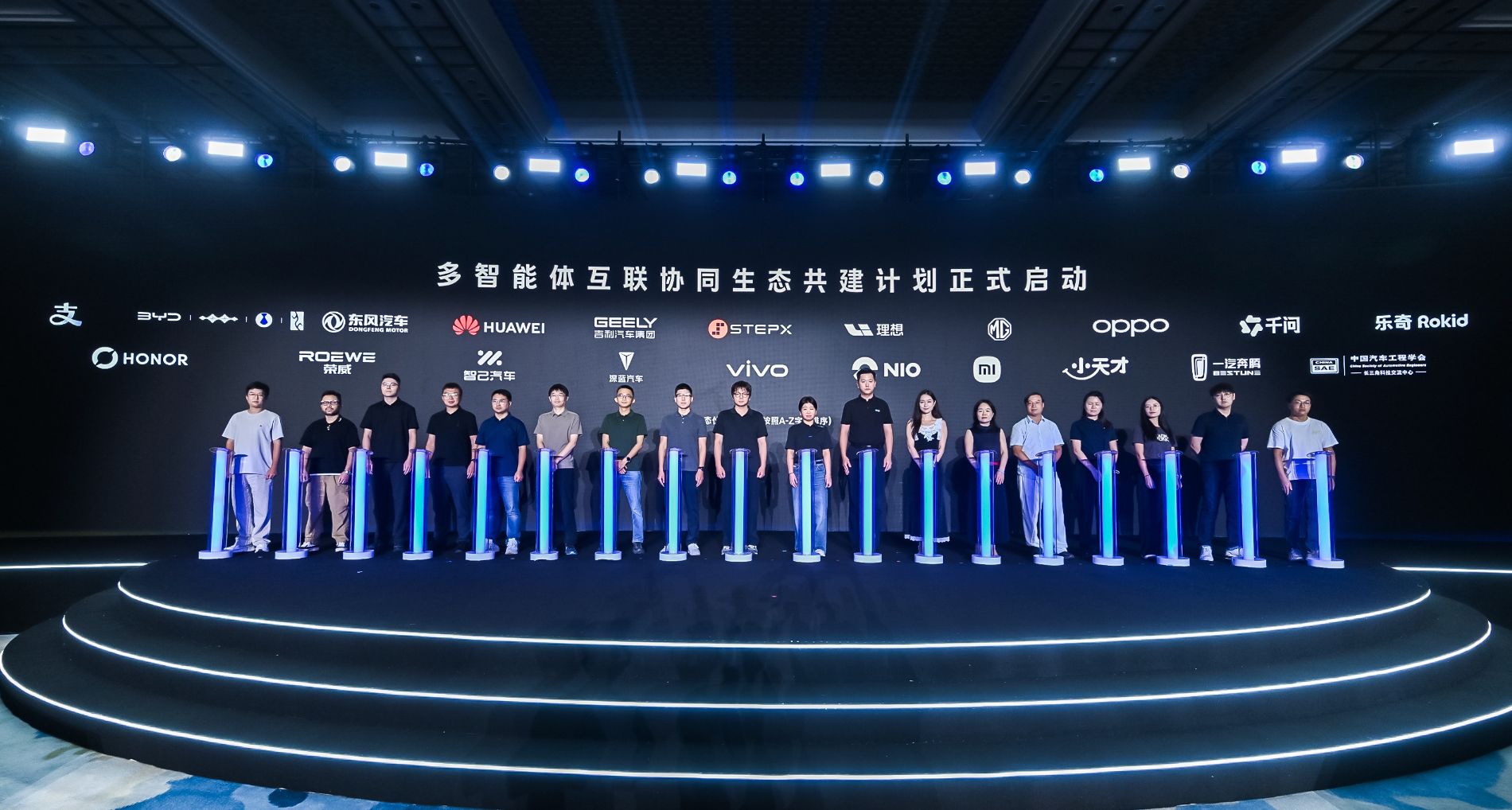
Aiming at the two bottlenecks of AI-enabled services on the supply side and cross-end collaboration on the distribution side, at the conference on August 17, Alipay launched a hierarchically iterated agent base, the AHA general protocol supporting ecological co-construction plan, as well as exclusive business incentive policies for merchants, building a collaborative system from merchants to end users.
Aiming at the problem of service silos on the supply side, Alipay has built a product base for merchants where services can be called by agents, and the transformation is carried out in three progressive stages.
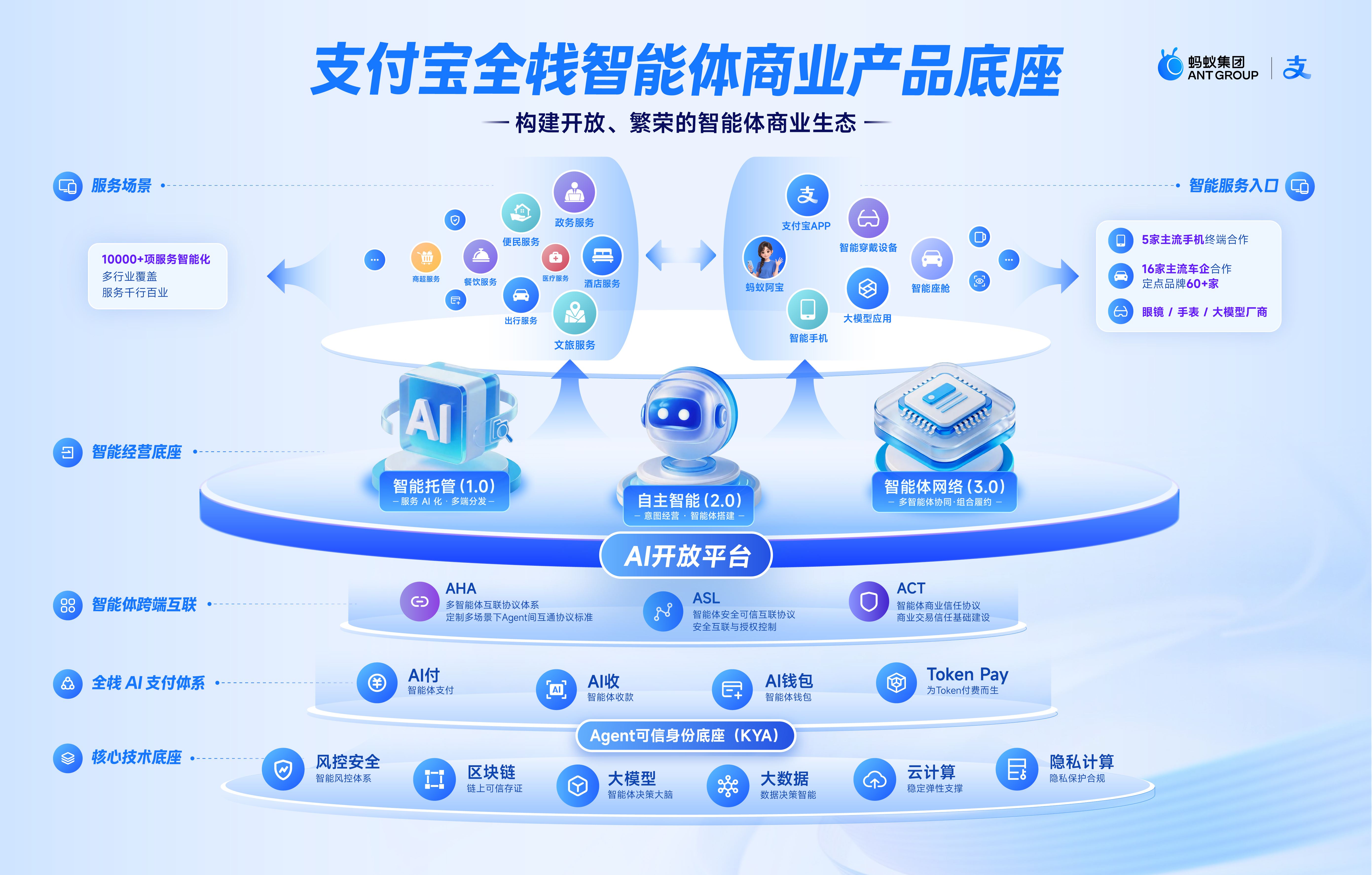
1. Stage 1.0 Intelligent Hosting: Abao provides a standardized tool suite to allow merchants to enter the intelligent business with low thresholds.
2. Stage 2.0 Autonomous Intelligence: Through agent construction and distribution as well as intention insight and operation assistance, merchants are empowered with intelligent operation capabilities.
3. Stage 3.0 Multi-agent Collaboration: Through multi-intelligent collaborative planning, agents can form a new business network.
At the same time, in order to solve the problem of fragmented multiple terminals on the distribution side, the industry-wide AHA (Agent Hub Access) protocol and the multi-agent ecological collaborative co-construction plan are implemented simultaneously.
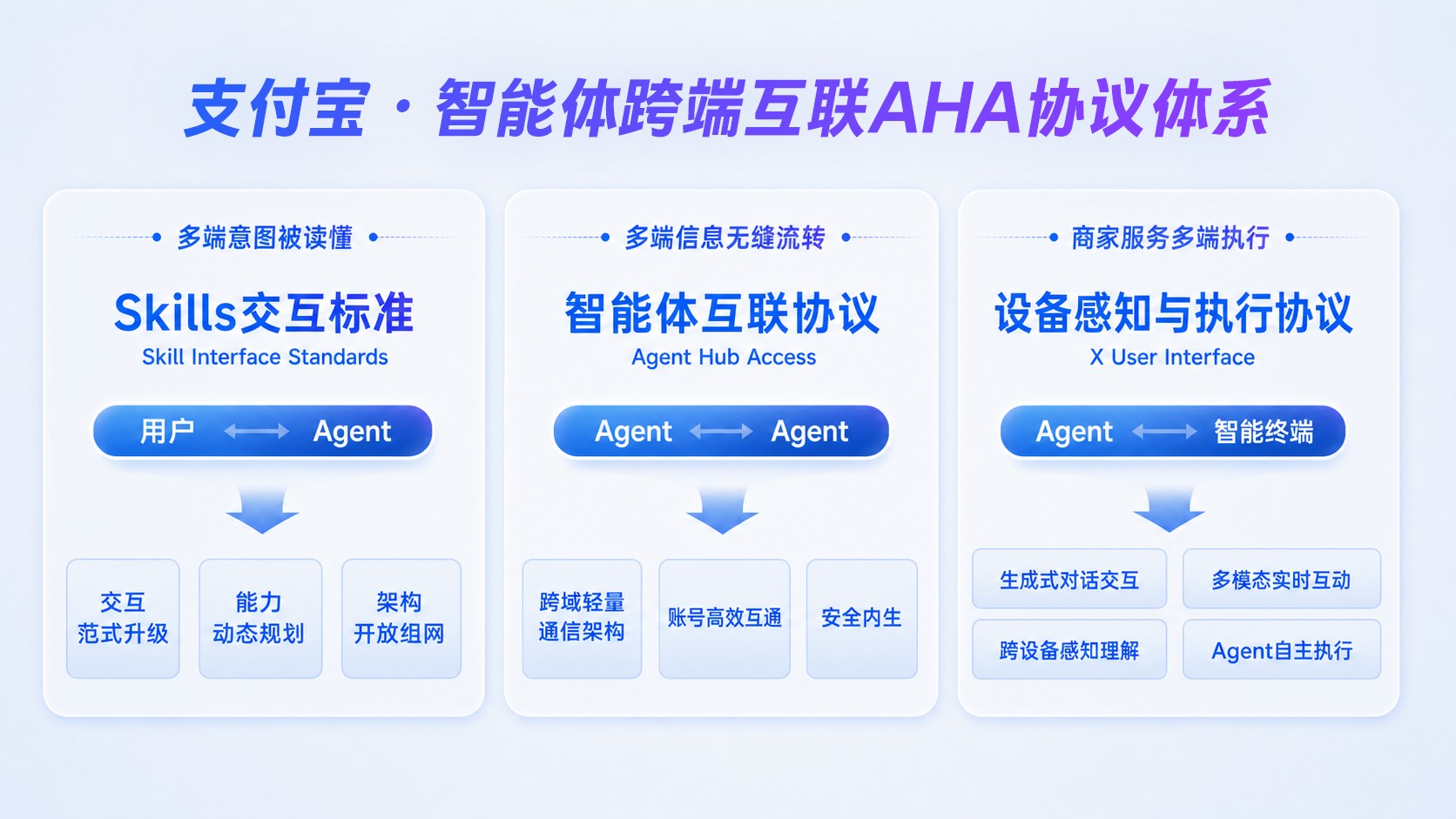
This protocol breaks the technical barriers between mobile phones, vehicle infotainment systems, hardware, and merchant agents, which is equivalent to the "universal language" between agents, allowing different entities to interconnect without repeated transformation, and opening up the full-domain distribution channel from the bottom level.
On this basis, Alipay released supporting intelligent operation incentive policies for merchants, lowering the threshold for small and medium-sized merchants and government institutions to access the AI ecosystem, and accelerating the large-scale AI adaptation of offline services.
Since the implementation of the whole set of solutions, practical results covering all scenarios have been achieved. At present, "Abao" has completed AI-enabled access to more than 10,000 services, and cross-end services support 5 major mobile phone brands and 16 mainstream auto companies, covering 8 core scenarios.
For example, after KFC accesses the ecosystem, users can complete the whole process of ordering and payment with one voice command; Hive Box relies on the Abao agent to serve 368 million users per day, and users can complete express delivery sending and picking up, housekeeping appointment, and item storage via voice; Huangshan Scenic Area has realized intelligent ticketing and voice tour guide; Digital Jiangxi's "Xiaoganshi" has been implemented in government service scenarios, allowing users to complete livelihood services such as social security inquiry via voice.
It is not difficult to see from Alipay's current practice that in the second half of AI applications, it is no longer feasible for a single brand to build a closed ecosystem on its own.
Massive user life scenarios are naturally fragmented: people use vehicle infotainment systems during commuting, mobile phones in daily life, and smart hardware at home. No enterprise can monopolize all interaction entrances. Only by opening up cross-brand, cross-industry and cross-terminal collaborative channels can intelligent services penetrate into every aspect of ordinary people's lives.
A2A will thus evolve from a technical concept to a rigid demand for large-scale industrial development. This also means that computing power and parameters are no longer the moat of AI competition, and the interconnected protocol that can connect all things is the admission ticket for the second half.
Main competition line shifts, Agent Hub value re-evaluation
At this Alipay AI Ecosystem Partner Conference, Han Xinyi, CEO of Ant Group, predicted that agent-based business will explode in the next 6-12 months, and agents will become a "new carrier" between hundreds of millions of users and tens of millions of merchants, opening up a new business ecosystem centered on intentions.
This exactly confirms the current consensus in Silicon Valley's investment circle: the value assessment criteria of the AI industry are being rewritten. The growth logic of simply consuming tokens and stacking computing power is unsustainable, and the agent economy that can be implemented in real scenarios is the long-term main line.
Through Alipay's layout, the market can also see several irreversible changes taking place in the AI industry.
First of all, the dimension of industrial competition shifts from the model layer to the connection layer, and the industry's attention continues to shift from computing power, chips and parameter benchmarking to delivery implementation and real application value.
In the past two years, the AI industry has collectively increased investment in underlying hardware and basic large models. However, with the popularization of open-source models and the homogenization of basic AI capabilities, the market has begun to realize that the fundamental demand of 90% of users and enterprises for AI is not to use large models for cutting-edge scientific research, but to use AI to really get things done.
In the past, competition focused on which model was stronger, but now competition focuses on who can build a complete chain connecting "user - terminal - merchant - fulfillment". The AHA protocol and the full-domain ecological co-construction plan are exactly the implementation products under this track shift.
Secondly, the game between open-source and closed-source routes has a clear answer -- A2A has become a must for commercialization.
The massive and scattered life scenarios determine that a single manufacturer cannot achieve full coverage. Especially in China, relying on the open-source ecosystem, the cost of token usage is much lower than that overseas. The combination of cost advantages and diverse scenario demands determines that isolated closed-source development has no long-term space, and open collaboration is the realistic path for large-scale implementation.
All connections and collaborations ultimately point to a core change: the value anchor of AI shifts from "being good at chatting" to "being capable of getting things done".
Simple dialogue and content generation only stay at the level of information interaction. To complete credible transactions such as order placement and payment, underlying "trivial but essential tasks" such as identity verification, payment clearing, and risk control accountability are indispensable. In the stage where AI is transforming from demonstration to truly changing lives, such a task-oriented agent is exactly in shortage: it has the precipitation of infrastructure such as real-name authentication, payment, and risk control, and is capable of completing the last mile of upgrading agents from "dialogue tools" to "transaction carriers".
This also explains why it is Alipay, not a pure model manufacturer, that takes the lead in establishing the Agent Business Alliance. In the media communication after the AI Ecosystem Partner Conference, Zhou Meng, General Manager of Alipay AI Ecosystem Open Division, also mentioned that in the initial stage of agent-based business, Alipay will not be coerced by overly short-term commercial goals and neglect the long-term new infrastructure construction.
In short, the current leading players are focusing on how to expand the cake of agent-based business. When this new business form is sufficiently prosperous, more growth opportunities will naturally emerge in the market.
From the perspective of global AI competition, this path of implementing task-oriented agents relying on fulfillment infrastructure and open collaborative ecosystem also highlights China's inherent advantages.
The domestic market has precipitated the world's extremely mature and widely covered mobile Internet foundation. Based on this, to promote the intelligent upgrading of AI does not require rebuilding the service supply network. Relying on standardized agent connectors such as "Abao", various commercial services can be quickly implemented.
In other words, the complete accumulation of the mobile Internet ecosystem is the inherent advantage for China's AI to truly get things done and run through the commercial closed loop.
Looking back at the entire Alipay ecological conference, the gathering of cross-industry guests, real-scene service demonstrations, and the release of full-link industrial solutions all point to the same judgment: AI has finished the first half of competing for paper benchmarking results, and has officially entered the second half with real implementation value as the measurement standard.
Alipay's practice undoubtedly provides a road sign for this commercialization journey in the second half: instead of crushing the track with a single technology, it connects supply and distribution through standardized protocols, links the entire industrial chain relying on mature fulfillment infrastructure, and enables agents to truly "get things done".
Looking back at the last industrial cycle, the Internet achieved industrial qualitative change relying on online transactions. Now at the inflection point of AI, agents need to jump out of the dialog box, walk out of the office, and enter real life scenarios. Large models are only basic tools. The ability to mobilize offline resources and complete service delivery is the main line that adapts to the long-term development of the industry.