Pouring 2.1 billion yuan into the renovation of The Peninsula, why do luxury hotels "only renovate instead of replacing their properties"?
In August, The Hongkong and Shanghai Hotels, Limited released an announcement, stating that it would invest HK$2.1 billion to renovate two Peninsula Hotels. This huge investment is not an isolated case. From Four Seasons Hotel Guangzhou to The PuLi Hotel and Spa Shanghai, from Mandarin Oriental Hong Kong to The Ritz-Carlton Shenzhen, several landmark luxury hotels across the country have simultaneously launched renovation projects, making 2026 seemingly the year of luxury hotel renovations. Why did they all choose to start construction collectively in this year? Why are owners willing to spend hundreds of millions of funds on renovations rather than rebrand their properties? Behind this choice, is it just brand obsession, or a far-sighted capital game?
The Hongkong and Shanghai Hotels, Limited Invests HK$2.1 Billion to Renovate Two Peninsula Properties
It is another financial reporting season, and new moves of a time-honored hotel group have drawn close attention from the whole industry.
At the beginning of August, The Hongkong and Shanghai Hotels, Limited disclosed in its performance report that its board of directors has approved the renovation projects of The Peninsula Hong Kong and The Peninsula Tokyo in Japan, with a total estimated investment budget of about HK$2.1 billion.
This budget is by no means a small amount, but the group dares to make the decision at this moment, and its confidence probably comes from the obvious recovery of its operating performance.
According to the unaudited interim results released by The Hongkong and Shanghai Hotels, Limited for the period ending June 30, the group's consolidated revenue reached HK$3.929 billion during the period, a year-on-year increase of 20%; EBITDA reached HK$770 million, a year-on-year increase of 20%; and profit attributable to shareholders was HK$23 million. A series of performance figures show that the group has successfully turned losses into profits. It is worth noting that its loss in the same period last year was as high as HK$289 million.
When we break down this financial report carefully, we will find that the book profit is supported by two non-recurring gains. The first one is the additional sale of two residential units in The Peninsula London Residences during the period, with proceeds of about HK$395 million; the second one is the revaluation gain of investment properties of HK$66 million recorded during the period, while the figure was a loss of HK$61 million in the same period last year.
However, even excluding these two one-off gains, the profit of the hotel sector still provides strong support, showing a solid operational foundation.
Specifically, the revenue of the hotel sector reached HK$3.116 billion, up 10% year on year; hotel EBITDA was HK$579 million, up 24% year on year. The improvement was driven by the steady increase in occupancy rate, the rise in average room rate and rigorous cost management. This part of revenue has become the strongest engine for the overall operating revenue in the first half of the year.
Among them, the performance in the Greater China region is the most outstanding. The Peninsula Hong Kong has maintained its stable performance relying on its profound historical brand heritage and superior geographical location, and The Peninsula Arcade has also delivered remarkable performance driven by the recovery of consumer flow of luxury brands; The Peninsula Shanghai is boosted by individual travelers and international customer groups; while The Peninsula Beijing has witnessed a marked rebound in demand from diplomatic delegations and MICE tourism.
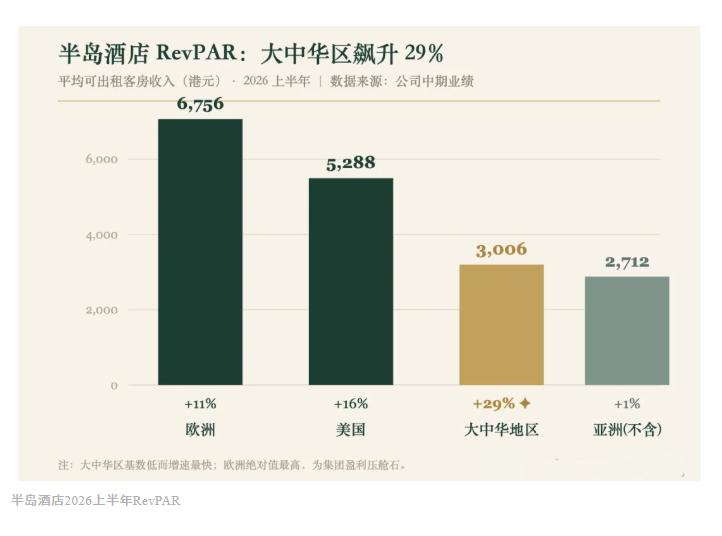
This recovery trend is mutually confirmed with the macro environment.
Official sample surveys and industry reports from the Ministry of Culture and Tourism show that the number of tourist trips in the first half of 2026 reached 3.463 billion, a year-on-year increase of 5.4%, an increase of 178 million trips compared with the first half of 2025; the total tourism expenditure reached 3.21 trillion yuan, a year-on-year increase of 2.0%, an increase of 0.06 trillion yuan compared with the first half of 2025. The domestic tourism market generally presents a steady growth trend with a steady increase in tourist trips and a slight increase in total expenditure.
On the other hand, from the perspective of asset maintenance, the two hotels have indeed reached the time node for renovation. Since its opening in 1928, The Peninsula Hong Kong has only undergone a large-scale renovation when the new wing was completed in 1994, and a comprehensive renovation and intelligent upgrading from 2012 to 2013.
Now that a new ten-year cycle has arrived, launching the renovation in due course not only conforms to market rules, but also is a necessary move to maintain the brand tone.
The recovery of performance brings sufficient cash flow, and the cycle node puts forward hard demand. For The Peninsula Hotels, it has made profits in the past six months and the time is ripe, so the renovation project has indeed reached a critical point that has to be promoted.
Three Renovations and Two Expansions in 99 Years of History
When mentioning The Peninsula Hong Kong, people always remember its alias "the Dame of the Far East".
At the opening ceremony in 1928, the then acting Governor of Hong Kong once called it "the finest hotel east of Suez". This praise at that time was not a polite remark, but an accurate summary of the architectural ambition of this property.
In the 1950s and 1960s, after going through the gloomy years during World War II, The Peninsula regained its former grandeur, and new restaurants settled in the hotel one after another, including those Michelin-starred restaurants that are still in operation today.
With the further development of the aviation industry in the 1960s, The Peninsula not only provided catering services for Cathay Pacific, but even became the first hotel in the world to set up an in-town check-in counter. This pioneering move to extend aviation services to the ground was quite avant-garde at that time.
From the 1960s to the 1990s, a large-scale reconstruction was carried out in Kowloon, Hong Kong, and many historical buildings were demolished in the wave of urbanization, but The Peninsula still retained its original Baroque-style architecture.
What has been preserved is not only the architectural style, but also the lifestyle it represents. Having afternoon tea in the lobby on the first floor of The Peninsula has gradually become a fashion among celebrities, so this place is known as the "Movie Stars' Tea Lounge". Countless celebrities including US President Richard Nixon, Queen Elizabeth II, Charlie Chaplin and other famous figures stayed here when they visited Hong Kong. These names, when linked together, almost form a celebrity chronicle of the second half of the 20th century.
Then in 1994, a new renovation plan was implemented. A 30-story tower was added to the top of the hotel, increasing the number of guest rooms from 168 to 300, and two helicopter pads were installed, which can send VIPs to the airport in just seven minutes. This three-dimensional transportation configuration pushed the convenience of the hotel to a new height.
In 2006, The Peninsula Hotels deepened its cooperation with Rolls-Royce, purchased 14 Phantom cars, and adopted its iconic "Peninsula Brewster Green" finish, making this fleet a moving landscape in front of The Peninsula.
In 2012, on the 85th anniversary of the founding of The Peninsula Hong Kong, the group spent 450 million US dollars on a large-scale renovation, and strengthened digital functions to adapt to the new era, continuing to set hospitality standards around the world.
During that renovation, the guest rooms and suites in the new wing building were redesigned with new facilities, and the audio-visual and communication systems were fully upgraded; iPod and iPad sockets, card readers, Soundbar audio systems and four-in-one fax, print, scan and copy machines were installed in the guest rooms to meet business needs; the bathroom design was also optimized, using luxurious marble materials, equipped with double washbasins, independent shower rooms, bathtubs and emergency call systems, and some bathrooms are also equipped with displays that can play TV programs.
The overall design was led by the design department of The Peninsula Hotels Group, with Gettys company assisting in the implementation, emphasizing simplicity, elegance and modernity.
However, this set of equipment is undoubtedly unable to keep up with the current era. Replacing more cutting-edge software and hardware in due course has become a necessary move for The Peninsula to maintain its brand tone.
Multiple Luxury Hotels Launch Collective Renovations in 2026
At this point, some people may have glimpsed the historical weight and cultural significance of The Peninsula Hong Kong, so it is not surprising that the owner insists on renovating it.
But the 2026 luxury hotel renovation boom is not a single action of one property. Many luxury hotels in the Greater China region have joined this wave of renewal, as if the entire industry pressed the restart button at the same moment.
In May this year, Four Seasons Hotel Guangzhou located in the West Tower of Zhujiang New Town, which has been open for 14 years, carried out public area upgrading and renovation, and once suspended operations.
The suspension of operations of Four Seasons Hotel Guangzhou this time is mainly to upgrade the lobby public area and Michelin restaurants. The announcement shows that the original Yu Yue Heen restaurant on the 71st floor will be moved to the 2nd floor of the hotel, the entire floor of the restaurant will be upgraded, and the project is expected to be completed in September. In addition, the sky afternoon tea restaurant on the 70th floor will be moved to the 100th floor, offering guests a more cloud-like panoramic view.
In fact, the renovation of this Four Seasons Hotel started as early as last year. Wimberly Interiors, a design firm under WATG, has taken charge of the renovation of all 340 guest rooms and suites. After integrating all constraints of the renovation, the design team formulated a renovation plan of "minimizing demolition and relocation, and prefabricating new items into easily transportable modules for on-site assembly", so as to minimize transportation pressure and environmental pollution.
Four Seasons Hotel Guangzhou, which opened in 2012 on floors 69 to 100 of the West Tower of Guangzhou International Finance Center, still holds the title of the world's highest Four Seasons Hotel. This title has actually brought considerable difficulties to its renovation. "It takes as long as 17 to 22 minutes for a piece of material to be transported from the unloading platform to the guest room floor", Liu Haoyang, executive associate director of Wimberly Interiors, the interior design firm under WATG that presided over the renovation project of Four Seasons Hotel Guangzhou, listed the pain points of the renovation of this high-altitude hotel one by one.
However, even with such high renovation difficulties, the owner still chose to retain this landmark hotel, continue the brand and endow it with a new look.
Turning our sight from the north bank of the Pearl River to Shanghai, another silent renewal is also underway.
The PuLi Hotel and Spa Shanghai, which settled in the core of Jing'an business district in Shanghai on the eve of the 2010 Shanghai World Expo, has long become a textbook case for urban hotels with its secluded atmosphere and innovative application of traditional Chinese elements.
Although The PuLi Hotel and Spa Shanghai has the timeless charm that less than 1% of hotels around the world possess, which makes it impossible to be better no matter how you renovate it, after repeated consideration, it still decided to launch its first large-scale renovation in the 17 years since its opening. The firm in charge of this renovation is Layan, the original creator of the hotel interior.
Simultaneously with this renovation, there has also been a major change in the group that The PuLi Hotel and Spa Shanghai belongs to — the group originally named URC (Urban Resort Concepts) has been renamed The Puli Group. This shows how important The PuLi Hotel and Spa Shanghai is to the entire brand, and the renovation of the hotel itself also undertakes the mission of renewing the brand image and spirit.
The ongoing renovation has completely moved the hotel's front office to the space of the original library; a central island long couch will be added in the middle of the new front office, and the separate concierge desk and concierge posts will be completely removed; although the classic long corridor-style lobby will try its best to retain its original appearance, a new chef's table restaurant will be added at the end of the lobby.
On the basis of being loyal to the original style, the guest rooms will retain the original signature "lucky dog" wood carving ornaments, and at the same time inject the new concept of "private residence of collected furniture"; in addition, the living space will be replaced with wider and more relaxed wrap-around couches...
If the renovation of The PuLi Hotel and Spa is a restrained upgrade of Eastern aesthetics, then the recent renewal of Mandarin Oriental Group is more radical, and this renovation can be said to be the boldest brand refresh since its founding.
Specific measures include updating the font of the brand logo, designating the new brand logo color "Celadon Green", and deeply renovating many original landmark properties in London, Bangkok, Singapore and other places. Even the trendsetting property of the group, Mandarin Oriental Hong Kong Landmark, has undergone a closed-door renovation that lasted nearly two years.
This also makes the new look interpretation of Mandarin Oriental Hong Kong, the historical starting point of the Mandarin Oriental brand, more concerned and curious.
Mandarin Oriental Hong Kong has actually carried out a thorough renovation of its executive lounge and many classic dining spaces in recent years, including "Man Li" and "Café Causette", and cooperated with Maximal Concept to create a unique new Japanese izakaya "The Aubrey".
But the real highlight is undoubtedly the closed-door renovation launched in June this year, which will completely renew the lobby, fitness facilities and all guest rooms, and even add new suites that did not exist before.
The biggest highlight is undoubtedly the public area renewal led by French designer Hubert de Malherbe. The designer's main battlefield before was not hotels, but retail commercial spaces, which also shows Mandarin Oriental's determination to subvert and break through the traditional hotel space through the renewal of its Hong Kong flagship property.
Turning our sight further, Hyatt on the Bund Shanghai was renovated from the end of 2024 to 2026, and is expected to reopen at the end of October 2026. This renovation has carried out large-scale renewal of the hotel building, public areas and guest rooms, retained the integration advantage of the original building and the surrounding river view, rebuilt the lobby, restaurants and guest rooms, and revived the vitality of this gold-medal hotel with a new look.
Conrad Shanghai has also carried out partial upgrading and renovation of the hotel on the premise of retaining the Conrad brand. The renovation covers some guest rooms, upgrades dining spaces, such as adding a new French bistro, renewing the Mediterranean restaurant, and optimizing public areas, so as to enhance brand premium and customer experience.
A little earlier, the renovation project of The Ritz-Carlton Shenzhen Xinghe started on January 22, 2024, mainly to renew and upgrade guest rooms and suites. The renovation is carried out in phases, some guest rooms were completed and reopened successively in 2025, and the overall renovation project is expected to be completed within 2026.
Kimpton Hotel Hainan Qingshui Bay completed the renovation and officially opened in May 2025. This project was originally a resort hotel that was capped in 2013 and then suspended construction. After comprehensive transformation, it operates with dual brands of Kimpton and Hotel Indigo. The project retained the main structure of the original building, and carried out overall renewal of the building facade, functional layout, landscape and interior space. The total investment is about 220 million yuan, and it took 3 years to complete.
Sufficient cases show that 2026 is indeed a year of large-scale renovations for luxury hotels.
What is Precipitated is Long-term Value
When we integrate these luxury hotel projects scattered in Hong Kong, Guangzhou, Shanghai, Shenzhen and Hainan one by one, a clear picture emerges.
In the past two years, it is no coincidence that major luxury hotels have carried out large-scale renovations at the same time, but the result of the combined effect of industry cycle and market logic.
But why do these "Ferraris" that are getting old still have their owners decide to keep them as Ferraris?
In fact, behind every hotel door that is being closed and about to open, there is the same proposition: in the stock era, the core competitiveness of luxury hotels is no longer just the thickness of history or the scarcity of location, but whether it can continuously inject new content that conforms to contemporary lifestyles while retaining classic genes.
Therefore, renovation has become a comprehensive game of time, capital and aesthetics.
Seeing so many luxury hotels choosing to renovate rather than rebrand, most people can't help but have doubts. It seems self-evident that "surrendering" to chain high-end hotels with a larger membership system will bring more benefits, but this group of luxury