Many years after graduation, the entire online community is scrambling to redo a Chinese language test question.
For years after graduation, the entire internet has suddenly been scrambling to answer a fill-in-the-blank question from a primary school Chinese exam.
The question goes like this: (xxx) save money steadily, (xxx) travel around the world. Fill in the proper conjunction.
This is a question at the second-grade primary school level. Yet this very question has sparked fierce debate across the entire internet.
Most people's first reaction is to fill in "Only if you save money steadily, can you travel around the world". The logic is straightforward: how can you travel without money? But soon some people push back: "Why can't I fill in 'While saving money steadily, I travel around the world'? Why do I have to suffer enough before I get to enjoy life?" Then others sneer: "Instead of saving money steadily, it's better to travel around the world. The whole point of saving money is to live a more enjoyable life, isn't it? Why put the cart before the horse?"
All these answers are marked as correct by the official side.
This question appeared in Burger King's "Crazy Buddy Day" campaign on Alipay on August 17. Users can tap their phones with Alipay at Burger King stores to answer the question and win rewards. The official side has made full preparations and listed a large number of valid correct answers.

However, many netizens still take their "wrongly marked" answers to social media to argue their case, explaining their logic thoroughly and reasonably. This fill-in-the-blank question has virtually turned into a debate on attitudes towards life, with people taking sides in different camps.
Which camp do you belong to?
The comment section has long been flooded with countless replies. After browsing through them, roughly three camps can be identified.
The largest group is the "delayed gratification camp".
"Only by saving money steadily can you travel around the world." "You must save money steadily in order to travel around the world." "Save money steadily first, then travel around the world."
The core idea of this group is to endure hardship first and then enjoy the rewards. Money is a hard threshold, and you can't go anywhere without it. Young people who have just graduated have a deep understanding of this: saving money is like a mandatory target, and they feel anxious if the number in their bank account doesn't go up. @G, a college student who is still interning, says the workplace is like a game where you fight monsters and level up, and getting paid is the only motivation, but he doesn't dare to spend the money he earns randomly. "I want to save a large sum of money first, then reward myself with a trip." Students don't have much money or vacation, and new employees dare not take long leave, so they choose to endure, save, and wait.

Another group completely disagrees with this idea.
"While saving money steadily, I travel around the world." "Not only do I save money steadily, but I also travel around the world."
Happiness and hard work must come at the same time, no one wants to play the delayed gratification game. Youth has an expiration date, and the desire to travel fades away easily. @X, a primary school teacher who has worked for five years, left a comment in the answer section: "By the time I save enough money, I might have lost the urge to travel." She has winter and summer vacations, so she can easily manage both. People who choose this answer either have good luck in their career or have a clear plan for their life.

Shui Tian filled in "(While) saving money steadily, (while) traveling around the world". He said this is exactly what he has been doing all along. He bet that his daughter would write "(Dad) saves money steadily, (I) travel around the world", but his daughter filled in "(First) save money steadily, (then) travel around the world". The little girl explained seriously that traveling around the world is the result of saving money steadily.
The father lost the bet completely.

There is another group that rejects all the above views directly.
"Instead of saving money steadily, it's better to travel around the world." "I would rather save money steadily than travel around the world."
Pick one of the two, and no one can force me to change my mind. Some people have no savings plan at all, spend all they earn and enjoy life to the fullest; others have no interest in distant scenery, they just want to stay at home, feel safe with enough savings in hand, and it's nice to sunbathe downstairs.

In the final analysis, the answer to this question is not about the conjunction at all. What you fill in is your own attitude towards life. The core of the question puts "saving money" and "traveling around the world" together, forcing you to answer a cliché question: suffer first, or enjoy first?
Don't attribute everything to generational differences
At first glance, this question seems to divide people by age groups.
The older generation always puts hardship before happiness, and there is not even the word "travel" in their dictionary, they think traveling is a waste of money; the post-90s generation started backpacking on a budget, while the post-00s generation is bolder, they challenge traveling around the world at low cost, and balance saving money and seeing the world at the same time.
Jiang Sida filled in: "(Save money steadily later, travel around the world now)". He added the order manually. The reason is very straightforward: money is definitely needed, and traveling around the world is not cheap, but more important than saving money is the courage to spend money on the road. You can earn money again if you run out of it.
This is almost a declaration of the lifestyle of young people.
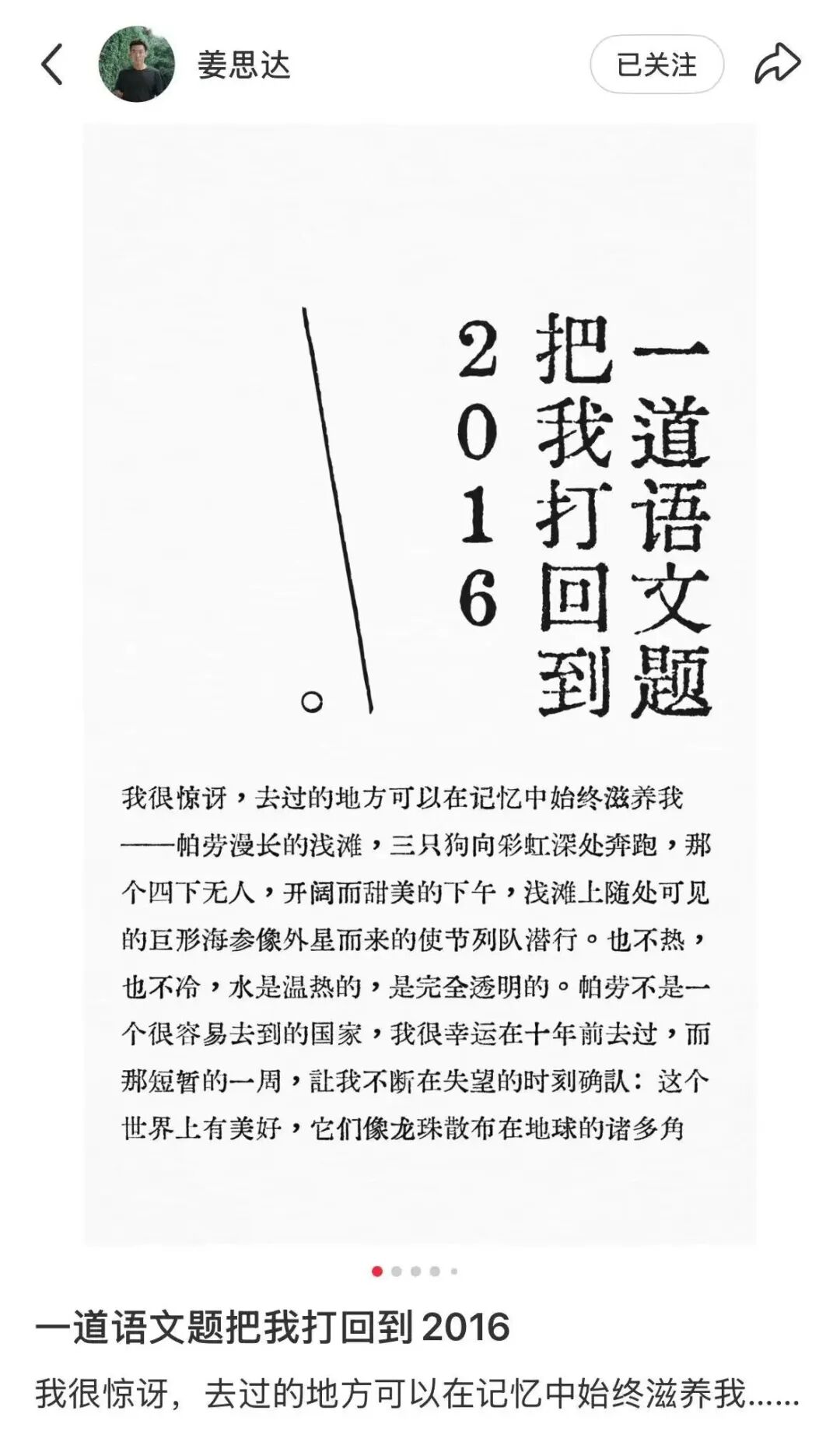
But after browsing all the comments, you will find that generational differences cannot explain this phenomenon at all.
Many post-95s who have entered the workplace filled in "Only by saving money steadily can you travel around the world". They have some savings in hand, but they are still afraid of uncertainty, afraid that they will have no income one day. They are not old, but they are not bold enough.
On the contrary, many post-80s who have saved enough confidence filled in the "while...while..." answer. Especially the awakened middle-aged women, who have worked hard when they were young, now have stable families and sufficient savings, and start to reward themselves. They fly to other cities for vacation on weekends, even go to Singapore to watch concerts, more frequently than anyone else.
What's more, the same person will give different answers in different moods.
On the 15th, the payday:
As long as I save money steadily, I can travel around the world. When the balance is empty at the end of the month:
Only by saving money steadily can I travel around the world. Just coming back from vacation:
Instead of saving money steadily, it's better to travel around the world. After working 996 for a year without going anywhere:
I must save money steadily, in order to travel around the world.
So don't talk about generational differences. This question tests your current state — how well do you get along with your life? Is the balance in your account enough to make you feel relaxed? Is money still your top anxiety?

There is a sentence in *The Extraordinary Lifestyle* that is very touching. Yoshii Shin spent seven years interviewing people who live outside the mainstream track, and she wrote in the preface: "I am also in no hurry to find the answer for now. As things stand, the road has narrowed, but it is still passable."
The people in the book face the trivialities and irritability of daily life, don't rush to find answers, accept themselves in an ambiguous state, and deal with uncertainty with their existing abilities.
Life is not a game that only starts after you have saved enough money.
Standard answer? It doesn't exist.
The official side has prepared enough correct answers, but still can't cover all possibilities.
On the answer page, many people received "wrong answer" prompts and immediately posted on social media: "Why is my answer not considered correct?"

Someone filled in: "I can both save money steadily and travel around the world." — Why not find a job that allows you to travel around the world? Digital nomads have moved their workstations to Dali, Chiang Mai, Bali, and balance work and play perfectly.
Someone filled in: "No matter whether I save money steadily or not, I must travel around the world." — What's wrong with giving up on saving? I can't save much anyway, so it's better to enjoy life first. Money can be earned again, but lost time will never come back.
Others filled in: "I just want to save money steadily, and I don't want to travel around the world." — Why do I have to see the whole world? I just want to save enough money to retire early, become a FIRE group member, stay in my own world to watch dramas and play games, and breathe fresh air downstairs, is that not allowed?

These off-syllabus answers often lead to more specific lives, and specific lives are often more touching.

Chinese exams can have standard answers, but life does not. In the face of real difficulties, there is never a simple either-or choice. Young people are balancing saving money and enjoying life, making their lives more and more like what they want.
The smartest part of this question raised by Alipay and Burger King is that it does not intend to teach you how to live. It only gives half a sentence, and leaves the brackets for you to fill in.
And this generation of young people picked up the pen and filled in their own "non-standard life".
So, what will you fill in?