"Outrageous Private Fund" Exposed: All Fund Managers Are "Borrowed"
In recent years, the Asset Management Association of China (AMAC) and multiple local securities regulatory bureaus have handled a number of cases where the leverage ratio of unstructured private equity funds exceeded the 200% upper limit. Retrospective investigations show that excessive leverage is rarely an isolated violation, and is often accompanied by systematic governance defects such as entrusting external investment research, false information disclosure, nominal staffing, and related party transactions. If early regulatory warnings are not substantially rectified, it may evolve into redemption defaults or even criminal risks in extreme scenarios.
The latest disclosure from AMAC shows that due to three types of violations, private equity manager Shenzhen Dingcheng has been suspended from accepting fund product filings for 12 months. Meanwhile, MAO Yu, the current legal representative, ZHANG Tianle, the current head of compliance and risk control, and XIE Yiying, the then investment manager, have all been given public condemnation as disciplinary sanctions.
The private equity firm was found to have a leverage ratio exceeding the 200% regulatory red line for 197 trading days. The investment decisions of some of its products were led by external personnel, while XIE Yiying, the nominal fund manager, only performed auxiliary work. What is more deceptive is that there is no real labor relationship between the private equity firm and XIE Yiying, and the so-called labor contract is purely fictitious. XIE Yiying was seconded by the shareholder side.
Through equity penetration, Shenzhen Dingcheng has the background of state-owned assets in Hainan Province, but it failed to prevent the private equity firm from losing control of governance in investment, personnel and risk control. AMAC issued a red-font reminder that Shenzhen Dingcheng has abnormal information submission, administrative regulatory measures within three years, and the situation that its registered address and office address are not in the same jurisdiction.
In March this year, the Shenzhen Securities Regulatory Bureau has issued a warning letter to Shenzhen Dingcheng, confirming two types of violations: first, delegating investment management duties to others, which means the company failed to fulfill its duties of prudence and diligence in the process of managing and using private equity fund assets; second, failing to properly preserve some private equity fund investor suitability management materials.
A private equity practitioner in Shanghai said bluntly that for institutions with long-term excessive leverage and internal control failure, the buffer zone for compliance rectification has disappeared. The transition period of the Private Equity Operation Guidelines expired at the end of July this year, and the private equity industry has entered a new development stage of "stock clearing and increment standardization". Private equity regulation, including the leverage red line, has formed a whole-chain supervision model of pre-penetration, in-process monitoring, and multi-dimensional post-punishment. Stock products that have not been fully rectified will face mandatory constraints of "no new fundraising scale, no new investors, no extension" until forced liquidation.
Three Types of Violations: External Operation, False Employment, Excessive Leverage
The penalty notice from AMAC points out that Shenzhen Dingcheng has the following violations:
First, failing to fulfill the duties of prudence and diligence. Dingcheng Value No.7, Dingcheng Value No.10 and Dingcheng Fuzhong No.1 under Shenzhen Dingcheng are mainly responsible for investor fundraising by external personnel Lin Mou 1 and Lin Mou 2, and the actual investment decisions of Value No.7 and Value No.10 funds are also led by the two. XIE Yiying, the nominal investment manager of these three funds, only undertakes relevant supporting work. In March 2023, the above three products were invested in products under another private equity firm Shenzhen Dingtai Sifang according to the instructions of Lin Mou 1 and Lin Mou 2, and paid the subscription fees.
Second, the information submitted to the association contains false records. In February 2020, Shenzhen Dingcheng registered the fund practice qualification for XIE Yiying. In the process of filling in the information, the two parties falsely claimed that they had signed a labor contract or entrustment agency contract, and that XIE Yiying was a formal employee of Shenzhen Dingcheng, and made a commitment to the association on the authenticity and validity of the submitted information. However, XIE Yiying is actually an employee of Kai Finance and Investment Holding Co., Ltd. (hereinafter referred to as "Kai Finance"), the shareholder of Shenzhen Dingcheng, and was dispatched by Kai Finance to Shenzhen Dingcheng to participate in investment research and operation work, and has not signed a labor contract or entrustment agency contract with Shenzhen Dingcheng.
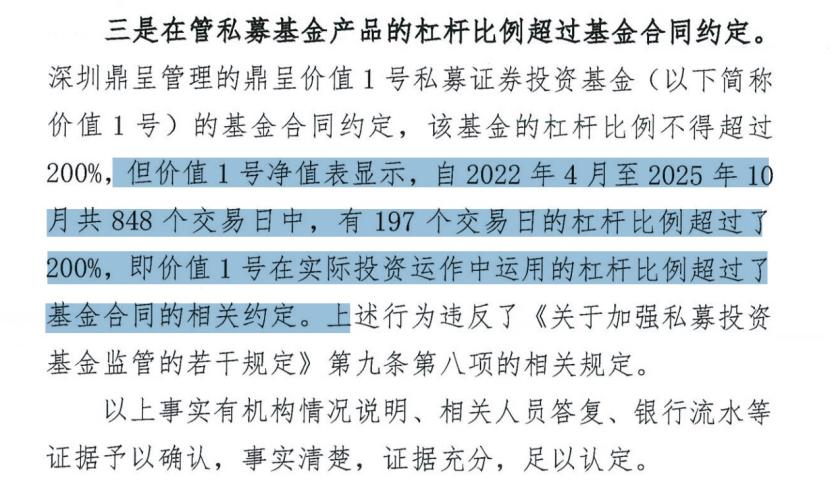
Third, the leverage ratio of the private equity fund products under management exceeds the agreement in the fund contract. The fund contract of Dingcheng Value No.1 under Shenzhen Dingcheng stipulates that the leverage ratio shall not exceed 200%. However, the net value table shows that among the 848 trading days of the product from April 2022 to October 2025, the leverage ratio exceeded 200% for 197 trading days, breaking the upper limit agreed in the contract.
Shenzhen Dingcheng was established in July 2015 and completed its registration in September of the same year. The management scale range disclosed by AMAC is 1-2 billion yuan, and the last update time of the institutional information is August 2025.
According to Tianyancha, Shenzhen Dingcheng is wholly owned by Kai Finance. Through equity penetration, Kai Finance is wholly owned by Hainan Huaying Investment, which is mainly funded by the State-owned Assets Supervision and Administration Commission of Hainan Province and the Department of Finance. Public information shows that Hainan Huaying Investment is mainly engaged in state-owned assets management, with 27 wholly-owned, holding and participating enterprises under its jurisdiction, and its main business scope includes state-owned assets disposal, project and equity investment, industrial investment operation, etc.
Public information shows that Kai Finance has been included in the list of restricted high-consumption, and multiple judicial documents and court hearing announcements have been disclosed to the public. The equity of its subsidiaries has been subject to judicial auction by the court, and the core investment assets may face disposal risks.
Leverage Violation Is Never a "Single Point of Failure"
Looking at a number of cases, excessive leverage is often an explicit manifestation of the collapse of institutional governance, and it is often superimposed with multiple underlying risks, such as the loss of control of investment functions and false management of employees exposed by Shenzhen Dingcheng. Other cases also reflect problems such as nominal risk control, false information disclosure, and failure of account isolation in private equity institutions.
Due to the leverage breaking the regulatory red line, Hangzhou Yuyao, HE Guoqing, its then legal representative and general manager, and YANG Zebin, its then investment manager, were all issued a warning letter by Zhejiang Securities Regulatory Bureau in June 2022 and recorded in the integrity file of the securities and futures market. The penalty notice points out that Yu Yao Zhangu No.5 under the private equity firm had a situation where the ratio of total assets to net assets exceeded 200% from July 2021 to March 2022.
A year and a half later, Hangzhou Yuyao experienced a redemption crisis and broke out. As one of the core involved subjects in the "30 billion quantitative private equity run-away incident in Hangzhou", it was filed for investigation by the China Securities Regulatory Commission and the public security organs intervened in the investigation. According to the disclosure of AMAC, before founding Hangzhou Yuyao, the actual controller HE Guoqing's entire professional experience was concentrated in the textile industry, and he had no public professional background in the securities fund industry.
In addition to Hangzhou Yuyao, a number of private equity firms including Zhejiang Bite and Hangzhou Laixing Yuanpin were issued warning letters for the leverage ratio of some of their products exceeding 200%, and the violations were recorded in the integrity file of the securities and futures market.
In November 2022, Zhejiang Bite voluntarily cancelled its registration. More than three months later, LI Yong, the actual controller of the private equity firm, actually controlled and used 17 securities accounts including Zhejiang Bite and its private equity products Bite No.1, Bite No.2, Bite No.3 to hold shares beyond the required proportion and trade Shaanxi Jinye stocks during the restricted period, and was fined more than 30 million yuan by the China Securities Regulatory Commission. It is worth noting that although the private equity firm was not directly subject to administrative penalties, its securities accounts were misappropriated by the actual controller for large personal transactions, and the fund accounts deviated from the positioning of entrusted management of investors' property, exposing the loopholes in the risk control isolation mechanism and the failure of internal control.
Other penalty notices show that private equity firms also have the situation of failing to adjust in time after the leverage ratio exceeds the limit.
In December 2025, the Jiangxi Securities Regulatory Bureau found that the product Huarui Purui No.1 under Xinyu Huarui had a situation where the ratio of total fund assets to net assets exceeded 200% during March and April 2025, and failed to adjust in time as agreed in the contract. It was given an administrative regulatory measure of issuing a warning letter and recorded in the integrity file of the securities and futures market; the private equity firm had received a warning letter for the same type of problem in October 2024, which was a repeated violation after repeated investigations.
As mentioned earlier, leverage violation is never a "single point of failure", and is often accompanied by false records of information disclosure.
Due to three types of violations including failing to truthfully provide investors with the fund leverage operation situation, the Shanghai Securities Regulatory Bureau ordered Shanghai Linling to make corrections, gave a warning, and imposed a fine of 30,000 yuan in November 2024; MAO Rong, the legal representative, executive director and general manager, was also given a warning and imposed a fine of 30,000 yuan.
The bureau pointed out that the two private equity products under Shanghai Linling Assets had long-term leverage operation, but the leverage operation records in some annual reports from 2018 to 2022 were inconsistent with the actual situation. Some quarterly reports from the fourth quarter of 2017 to the second quarter of 2023 also failed to truthfully provide the leverage operation situation.
In fact, the warning letter failed to stop the violations. As early as 2023, Shanghai Linling had been issued a warning letter for failing to truthfully disclose the fund leverage operation situation to investors.
This article is from the WeChat official account "CLS.cn", author: FENG Qijuan, published with authorization from 36Kr.