Surpassing Elon Musk, the largest IPO in history is coming.
Musk's record for the largest IPO in history only stood for three months.
In June this year, Musk's SpaceX was listed with a valuation of 1.77 trillion US dollars, refreshing the global IPO record. Before it could even settle in the top spot, an AI company that was founded just five years ago is about to overtake it.
According to reports from the UK's *Financial Times*, multiple investors revealed that Anthropic will officially go public as early as October this year, and some investors have set a valuation expectation of 2 trillion US dollars or even higher. If this is realized, it will surpass SpaceX to become the largest initial public offering in the history of global business.
What does 2 trillion US dollars mean? It exceeds the combined market value of Meta, Tencent, and Kweichow Moutai. And this company was only founded in 2021.
Valuation: 47x Growth in Five Years
Anthropic's valuation trend can be described as "steeply rising" without any exaggeration.
At the beginning of 2023, its valuation was about 4.1 billion US dollars; it rose to about 18.5 billion US dollars in 2024. The real craze started in 2025: after the financing in March, the valuation reached 61.5 billion US dollars, and it soared to 183 billion US dollars in September. Entering 2026, the pace became even more rapid: it completed a $30 billion Series G financing in February, with a valuation of $380 billion; in May, it raised another $65 billion in Series H financing, with a post-investment valuation of $965 billion, officially surpassing OpenAI and becoming the most valuable AI unicorn in the world.
From 4.1 billion to 965 billion, it has increased 234 times in less than three years. The 2 trillion US dollars figure put forward by investors now means more than doubling on the basis of 965 billion.
What supports all this is revenue.
Anthropic's annual recurring revenue (ARR) started at 1 billion US dollars in January 2025, climbed to 9 billion US dollars by the end of the year, reached 14 billion US dollars in February 2026, exceeded 30 billion US dollars in April, and broke through 47 billion US dollars in May. It achieved 47 times growth in less than 18 months.
Revenue in the second quarter alone exceeded 11.5 billion US dollars, about 14 times the 787 million US dollars in the same period last year. More critically, the adjusted operating profit in the second quarter reached 559 million US dollars, marking the first time a leading large model company has achieved real single-quarter operating profitability.
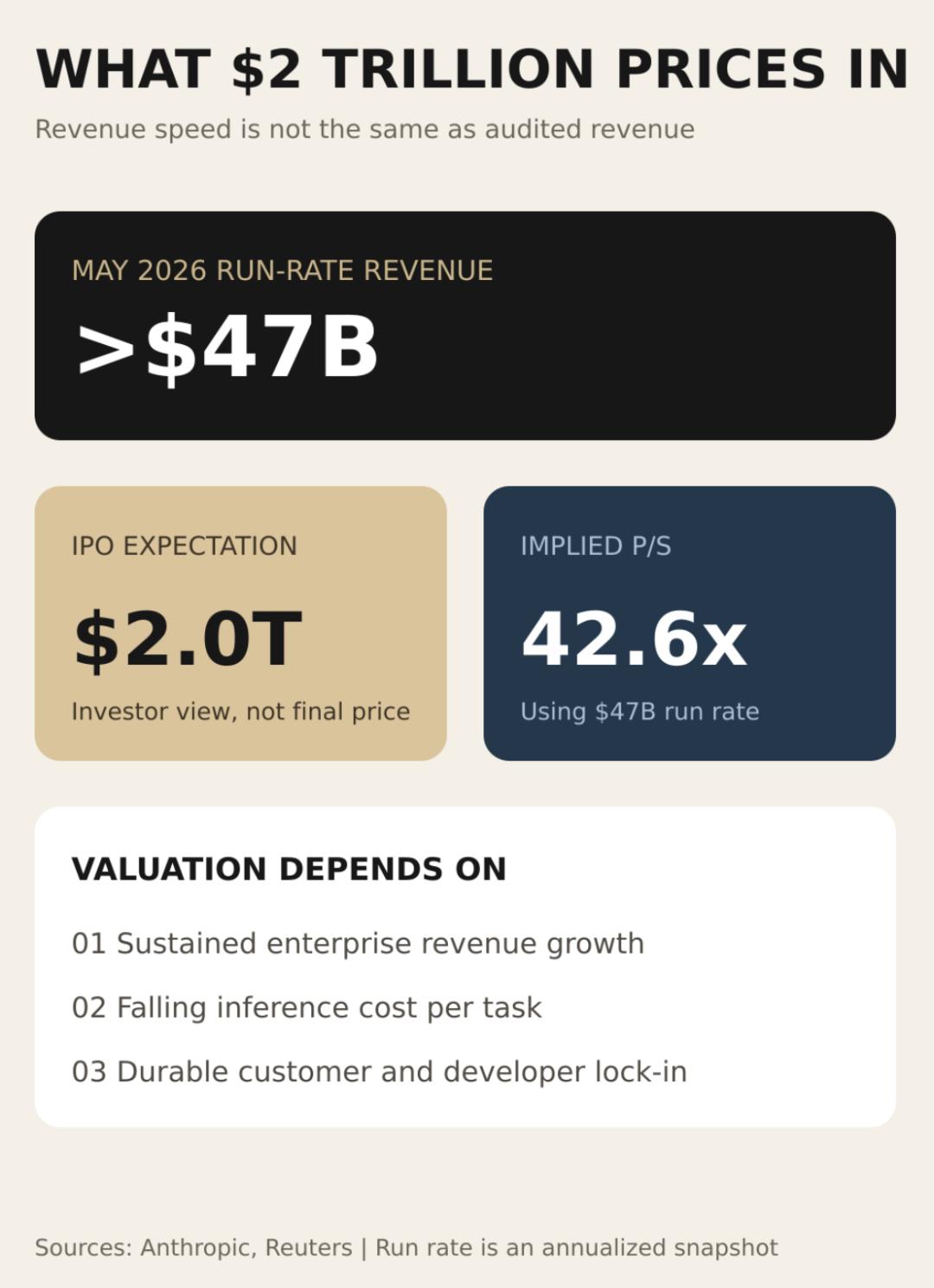
The most aggressive prediction from investors is that the annualized revenue will reach 100 billion to 120 billion US dollars by the end of 2026. Based on a valuation of 2 trillion US dollars, the price-to-sales ratio is about 17 to 20 times.
Considering that Anthropic's annual revenue growth rate is as high as 800%, this multiple is not exaggerated. One investor even stated: "If Anthropic can maintain an 800% annual growth rate, even with a conservative 30x revenue multiple, the company's valuation will be close to 3 trillion US dollars."
Defected from OpenAI and Overtaken Its Former Employer
Anthropic's story began with a breakdown of philosophy.
In January 2021, Dario Amodei, then Vice President of Research at OpenAI, resigned collectively with his sister Daniela and more than a dozen core researchers. The core reason for the split was dissatisfaction with OpenAI's radical commercialization path, as well as concerns that "capabilities are expanding too fast while safety control lags behind."

Dario is an interesting figure. With a background in physics and biophysics, he has done neuroscience research and was recruited by Andrew Ng to work on speech recognition at Baidu. He runs Anthropic with the temperament of a researcher, saying he spends "one-third, maybe 40% of his time" ensuring the company's culture stays on track.
His AI vision is "a nation of geniuses in the data center", gathering a huge number of super-intelligent AI "avatars" to work collaboratively. Instead of fearing the arrival of genius-level AI, it is better to first establish a "Constitutional AI" to allow the model to achieve safety and controllability through self-alignment.
This "safety first" philosophy is in sharp contrast to OpenAI's "rapid expansion" path.
The difference in paths also determines the divergence of business models. OpenAI wants to become the entry point of the AI era, focusing on the C-end consumer market; Anthropic bets on programming, Agents and enterprise workflows, with enterprise users contributing the vast majority of revenue.
The "defector" who left OpenAI five years ago now has a valuation that exceeds that of his former employer.
Claude Code: A Money Printing Machine
The core product that supports Anthropic's counterattack is the Claude Code programming assistant.
Programming is the most certain scenario for AI commercialization: enterprises are willing to pay a premium for higher code generation quality and lower security risks. Claude Code's ARR exceeded 1 billion US dollars half a year after its launch, and reached 2.5 billion US dollars in February 2026. This single product alone has an annualized revenue run rate of over 2.5 billion US dollars.

Claude's overall performance is equally impressive. According to Sensor Tower data, as of May 2026, Claude has about 245 million monthly active users, with a 452% year-on-year increase in global audience. What is more notable is its monetization ability: 13% of Claude users pay for subscriptions, the highest conversion rate among major AI assistants.
In the enterprise market, Anthropic's breakthrough is even more staggering. As of the second quarter of 2026, Anthropic's market share in the enterprise-level large model API market has reached 32%, surpassing OpenAI's 25% for the first time to rank first in the industry. Giants such as Amazon, Google, JPMorgan Chase, and Salesforce are all its core customers. More than 1,000 enterprise customers spend over 1 million US dollars per year on Anthropic's products.
A string of tech giants stand behind Anthropic.
Google was the first to enter: it invested 300 million US dollars in 2022, and added positions in multiple subsequent rounds, with a total investment of about 3 billion US dollars. By October 2025, the book value of this stake had exceeded 124 billion US dollars, representing a return of about 40x.
Amazon has invested more than 130 billion US dollars in total and reached a ten-year in-depth computing power cooperation agreement with Anthropic. Microsoft (up to 50 billion US dollars) and NVIDIA (up to 100 billion US dollars) also entered the market with capital in 2025.
In 2026, the financing pace suddenly accelerated. The $30 billion Series G financing in February was led by GIC and Coatue; the $65 billion Series H financing in May was led by Altimeter Capital, Dragoneer, Greenoaks and HSG. Since the beginning of the year, the total amount of funds invested in Anthropic by various institutions has approached 1 trillion US dollars.
If the $2 trillion IPO goes ahead, according to the widely circulated equity structure in the market: the founding team holds about 21% of the shares, corresponding to a book value of about 420 billion US dollars.
Industry Landscape: Two Titans Competing, Countless Competitors Lurking
The AI large model market is moving from the "hundred-model battle" to "winner takes all".
In the first five months of 2026, AI startups raised about 80 billion US dollars in financing, 89% of which went to OpenAI and Anthropic. The market is highly concentrated. A Sensor Tower report shows that ChatGPT's global AI assistant market share fell below 50% for the first time to 46.4%, Google's Gemini rose to 27.7%, and Anthropic's Claude climbed to 10.3%.
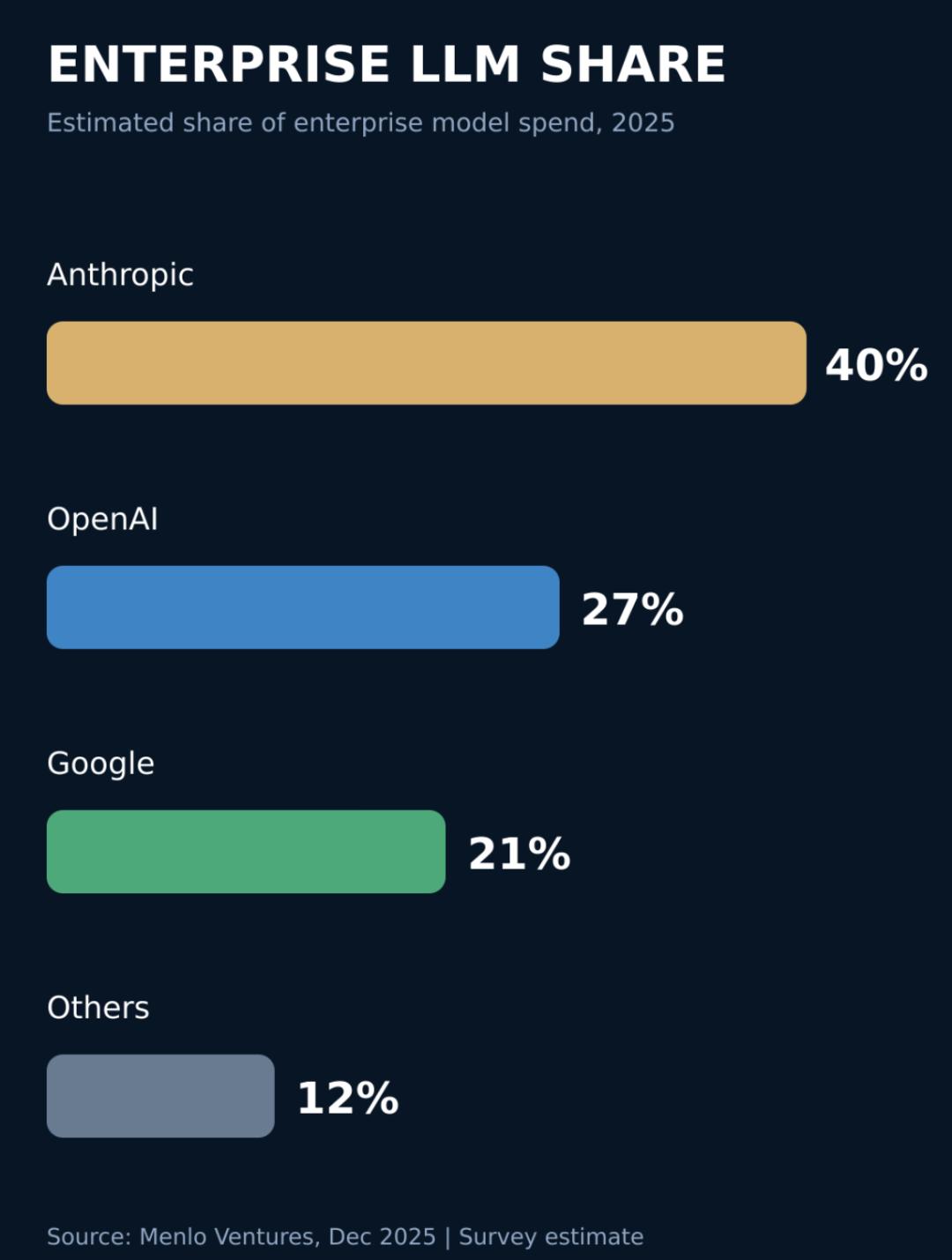
In terms of enterprise AI adoption rate, Anthropic has made a historic breakthrough, reaching 40%, surpassing OpenAI's 27% for the first time. Among new AI procurements, 65% of enterprises chose Anthropic, while only 32% chose OpenAI.
But the challenges Anthropic faces are equally severe.
The price war is intensifying. OpenAI recently announced an 80% price cut for GPT-5.6 Luna; Anthropic launched Claude Opus 5, priced at about half of its previous flagship model.
What is more tricky is the "price butcher" from China: DeepSeek's V4 Pro model has performance close to Anthropic's Fable 5 (only 0.1 points behind), but its cost is nearly 99% lower. Fable 5 charges 50 US dollars per million output Tokens, while DeepSeek charges only 3.96 US dollars.
Regulatory risks are always present. US Department of Commerce export controls once led Anthropic to suspend two top models, Fable 5 and Mythos 5, in June. The company also has ongoing litigation with the US Department of Defense. Anthropic often puts ideology above commercial interests, and has had multiple conflicts with the Trump administration.
Valuation disputes cannot be ignored either. Some analysts pointed out that the $2 trillion valuation has already priced in most of the growth expectations. The company has not yet achieved net profit (positive adjusted operating profit does not equal net profit). According to the common valuation multiples of large-cap companies in the Nasdaq 100, Anthropic needs an annual profit of 59 billion to 79 billion US dollars to support its current valuation.
Anthropic's adjusted operating profit in the second quarter of 2026 was only 559 million US dollars.
What Will Happen to Global AI If the Market Accepts the $2 Trillion Valuation
Investment in computing power will be reignited. Chips, HBM, optical modules, data centers, power and liquid cooling equipment will all gain stronger financing logic. The higher Anthropic's valuation is, the easier it is for the industrial chain to capitalize on long-term demand in advance.
The relationship between cloud giants and model companies will become more complex. Amazon and Google not only invest in Anthropic, but also provide it with computing power and distribute its models. After going public, related party transactions, revenue sharing, minimum purchase commitments and customer concentration will all face public disclosure requirements.
The "strategic synergy" that was previously hidden in financing news will later become contracts that investors interrogate item by item.
AI valuation methods may be rewritten. If a model company that is still in the heavy investment period can go public at a valuation of 2 trillion US dollars, the market will further shift from "focusing on profits" to "focusing on revenue growth rate, computing efficiency and ecological control".
But this will also raise the valuation anchor of the entire industry. The more the valuation depends on the future, the more severe the pullback caused by any slowdown in growth will be.
Global AI competition will accelerate stratification. Leading companies use capital to purchase computing power and talent, while small and medium-sized model companies are more likely to turn to vertical industries, open source routes, or become acquisition targets for cloud vendors and large technology companies.
The opportunity for Chinese AI enterprises is to form differentiation through lower costs and local application scenarios. The challenge they face is the comprehensive gap in capital, chips and global enterprise channels.
Conclusion
The most worthy recognition of Anthropic's listing is not that it has pushed its valuation to 2 trillion US dollars, but that it is transforming enterprise AI from technical demonstrations into billable, deployable and auditable production tools.
This direction has more commercial value than simply competing for chat duration.
But the capital market should not misinterpret growth speed as eternity, misinterpret annualized revenue as revenue that has already been collected, nor misinterpret the model's temporary lead as permanent monopoly.
2 trillion US dollars is not an award for Anthropic, but an extremely difficult exam for it.
The public market will ask how much money it has actually earned, how much cash it has consumed, how much the cloud vendors have taken, whether its customers are sufficiently loyal, and whether reasoning costs can continue to decline.
If it answers well, it may become a new infrastructure giant in the AI era.
If it fails to answer well, this sky-high valuation will also become the most expensive stress test for the entire AI industry.
A truly mature AI bull market is not one where all companies rise based on imagination, but one where the best companies dare to open their books and let their growth stand trial.
The answer will be revealed in October.
This article is from the WeChat official account "Investment Banking Circle", the author is Senior Sister of Investment Banking, and it is published with authorization from 36Kr.