Hard Krypton Exclusive Release | A robotic force sensor enterprise has completed a D-round financing of hundreds of millions of yuan, led by GAC Group and backed by HSG, with its market share exceeding 70%
36Kr learned recently that Bluepoint Touch, a domestic Chinese robotic force sensor enterprise, has closed a D-round financing of several hundred million RMB. This round of financing is led by GAC Capital, an affiliate of GAC Group, with Deye Co., Ltd. and Xichen Capital participating as follow-on investors. The proceeds will be mainly used for R&D of new-generation robotic force sensor products, production capacity expansion and global market layout.
Since the end of 2025, the company has completed multiple rounds of financing worth over 100 million yuan each, with its shareholder roster including financial and industrial capital players such as HSG, CATL, Agibot, Galaxy Universal, GAC Group, SAIC Motor, and SMIC.
Founded in 2019, Bluepoint Touch is one of the earliest domestic enterprises engaged in force sensor R&D in China. Its core team members come from research institutions including China Aerospace Science and Technology Corporation, Chinese Academy of Sciences, Beihang University, and Northwestern Polytechnical University, who have applied the high-precision force control technology originally developed for aerospace scenarios to the robotics field.
Zhang Pengling, Vice President of Bluepoint Touch, told 36Kr that up to now, the company's shareholder roster has formed diversified coverage across the whole industrial chain, ranging from power battery players (CATL) to complete vehicle manufacturers (GAC Group, SAIC Motor), from leading robot integrators (Agibot, Galaxy Universal) to high-end semiconductor manufacturing (SMIC) and new energy energy storage industry (Deye Co., Ltd.). "Among our shareholders, Agibot and Galaxy Universal were core clients of Bluepoint Touch before. Their transition from 'clients' to 'shareholders' demonstrates their recognition of our products and full recognition of the company as a whole."
(Source: the enterprise)
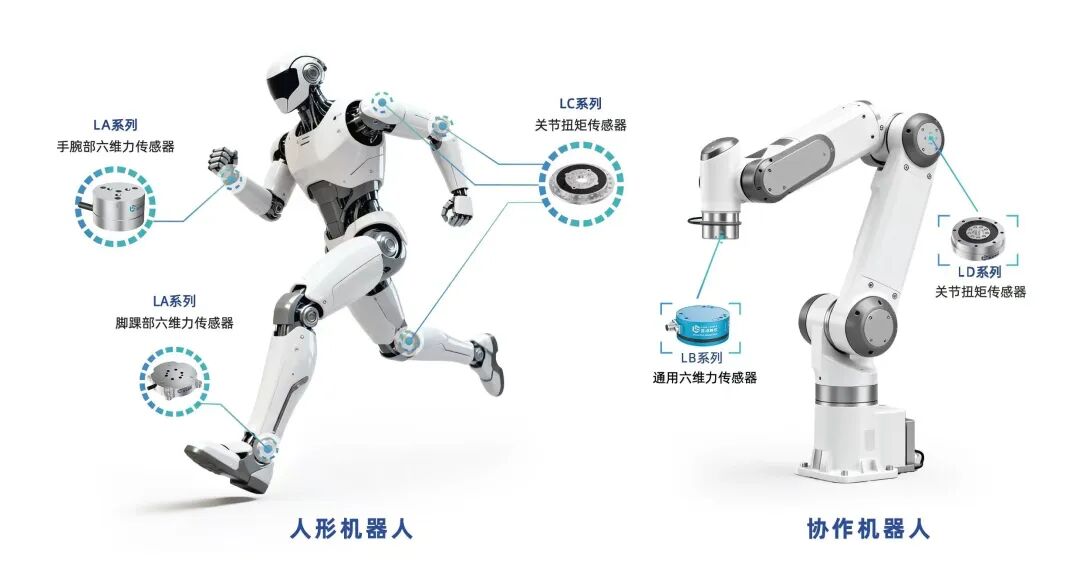
To enable robots to evolve from "being able to walk" to "being capable of performing practical tasks", a critical prerequisite is to endow them with tactile perception capabilities similar to human beings, and force sensors are exactly the core entry point for such capabilities. They can help robots perceive the interaction force with the external environment, so as to achieve more accurate and safer motion control. Especially when humanoid robots are deployed in real scenarios such as industrial manufacturing and household services, high-precision force feedback is indispensable for everything from maintaining walking balance to completing precision assembly and flexible grasping tasks.
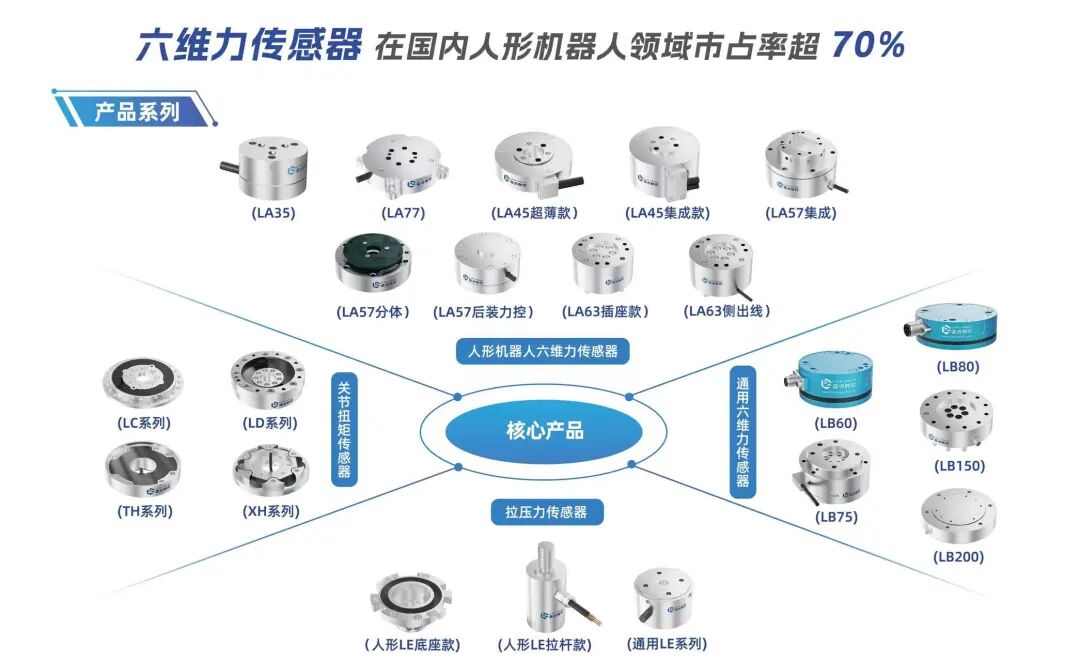
According to the 2025 China Humanoid Robot 6-Axis Force Sensor Market Analysis Report released by GGII, Bluepoint Touch's 6-axis force sensors hold a 72.6% market share in China's humanoid robot market. Leading humanoid robot manufacturers including Agibot, Galaxy Universal, Xiaomi Robotics, Ubtech, Qiantuo Robotics, and Starsea Diagram all deploy Bluepoint Touch force sensing products in batches.
(Source: the enterprise)
At present, the self-developed 6-axis force sensors and joint torque sensors of the company have achieved 0.1%FS accuracy, high-frequency response of over 10kHz, and 500% overload resistance. The products have also undergone extreme miniaturization and lightweight transformation, which reduces the sensor volume by 90% and weight by 80%, reaching the world's top level.
Zhang Pengling introduced that the company has now built a complete product matrix covering humanoid robot 6-axis force sensors, general-purpose 6-axis force sensors, joint torque sensors, tension and pressure sensors and other related products.
On the production capacity side, Bluepoint Touch has launched the first fully automatic production line for robotic force sensors in China in Guangdong. At present, Bluepoint Touch's designed annual production capacity reaches 1 million sets of joint force sensors and 200,000 sets of end-effector 6-axis force sensors. The delivery cycle has been shortened to 2-3 weeks, compared with the 6-8 weeks lead time of overseas brands.
The following are excerpts from the interview between 36Kr and Zhang Pengling, Vice President of Bluepoint Touch:
36Kr: This round of financing has introduced GAC Group and Deye Co., Ltd. What are your special considerations in selecting investors?
Zhang Pengling: Industrial capital brings not only funds, but more importantly, deterministic application scenarios. Our investors, such as GAC Group and SAIC Motor, represent the automobile manufacturing scenario, CATL represents the power battery production line, SMIC represents the semiconductor and high-end manufacturing production line, and Deye Co., Ltd. represents the new energy energy storage industry. This means that Bluepoint Touch's 6-axis force sensors can be deployed in batches in these industrial scenarios first, enabling robots to enter the broader field of intelligent manufacturing.
36Kr: As humanoid robots move from demonstration scenarios to actual practical work, what new requirements have been put forward for force sensors?
Zhang Pengling: These requirements include integration and lightweight design, high dynamic response capability, high precision and low coupling, balancing high resolution and strong overload resistance, long-term operation stability, and stronger environmental adaptability. When robots are actually deployed in work scenarios, high-frequency dynamic response becomes a rigid demand, which needs to keep up with the force feedback rhythm of the robot's dynamic operations, and realize millisecond-level force signal collection and output. Real work scenarios also require robots to be more flexible while reducing their own load, so the sensors need to be made smaller and lighter. When robots enter open environments such as factories and households, they will face complex working conditions such as falling, impact and temperature changes. Our products can provide 5 times overload resistance and aerospace-grade temperature control compensation technology, which ensures the long-term stable operation of sensors in real work scenarios.