After securing 200 million yuan in financing, Pan Yuyang and OdyssLife set out on their odyssey journey of hardware entrepreneurship.
In Homer's Epic, Odysseus, who returned victorious from the war, spent ten years before he finally set foot on the shore of Ithaca. Later, Stanley Kubrick borrowed the name "Odyssey" in his film *2001: A Space Odyssey*, turning the interstellar spaceship into the spiritual expedition of modern people, and restoring humanity's most authentic vision of evolution.
The Odyssey is a long journey home. After leaving Troy, Odysseus passed through storms, straits and no-man's lands, and spent ten years finally returning to Ithaca. More than 2,700 years later, the Odyssey is no longer a story exclusive to heroes. It has become a broader metaphor that depicts the journey of anyone who ventures into the unknown, keeps evolving, and eventually re-recognizes themselves through continuous adventures.
This is also the story behind the name OdyssLife.
A year ago, Pan Yuyang left a large tech company and started developing a smart necklace that records eating behaviors. He tried to use AI hardware to capture the most daily yet hardest-to-digitize behavior of "eating", so that in an era where technology keeps intervening in people's lives, people can regain perception of their body and health, and re-understand themselves.
During the year of exploration, Pan Yuyang shifted from the grand vision of a multimodal entry point to focusing on the trivial matter of "eating"; he stepped back from the excitement brought by external feedback such as valuation, and returned to the front line of products, technology and users. This process is a story of how a team finds its route in uncharted territory, stays sober amid public adoration, and keeps supporting each other to move forward when the product is not yet mature and the destination is still far away.
After completing a 200 million yuan financing in the first quarter of this year, Pan Yuyang entered a state of "seclusion" instead, rarely speaking publicly or meeting investors. On the occasion of the release of *Odyssey*, we talked with Pan Yuyang for a whole morning last week, covering topics about products, technology, the team, as well as their new reflections on the first anniversary of their entrepreneurship.
01 Departure: Questions That Large Tech Companies Cannot Answer
The starting point of every Odyssey never comes from the belief that the distance is better, but from the fact that the original life can no longer answer new questions.
When we got to know Pan Yuyang, he had already left ByteDance to start his own business. As a product manager, he built the Coze intelligent glasses and Doubao smart glasses from 0 to 1 at ByteDance. Before that, he worked on Xiaoyi algorithm and HarmonyOS at Huawei. Large platforms, mature business chains, and the AI boom — in the eyes of outsiders, this was already the optimal career path.
But he always felt a sense of restlessness of being constrained by the system. Hardware development follows its own rules: a sufficient verification cycle must be reserved from concept to mass production, but the business lines cannot afford to wait. The result of not being able to wait is often simplifying the problem to "replacing people". Over time, no one is willing to place bets on things that will take effect half a year later.
"People who do hardware may need three pies to get full, but most people always want to skip the first two and eat the third one directly," he said. "The collaboration mode of large companies is more like a group of people gathered together through a huge organization; but for things that are done from 0 to 1, everyone still needs to work together to overcome difficulties side by side."
After starting the business, the most intuitive change is the soaring speed of decision-making.
For example, they need to produce a hardware-software integrated mainboard. The factory cycle is two months, and there is a certain probability that the prototype will be scrapped. The choice is: whether to start three to four production lines in parallel, at the cost of multiplying the cost by three or four times.
"We only spent 15 minutes making this decision internally. We had a meal that night, talked it through, and transferred the money right away." The same thing in the past would take one or two weeks to prepare materials, communicate with each party, and go through the financial process — three weeks would be wasted.
On the other side of high speed, no one will bear the consequences of these decisions for them. The judgment is theirs, and the result is also theirs. But if you don't take the first step, you will never know what the result will be.
"You have to take a step forward to be qualified to judge whether it is better to stay here or move forward."
02 Subtraction: Narrow the Entry Point Down to One Trivial Task
In the wearable device market, Oura has made great achievements in the sleep tracking track, and Whoop has taken the lead in the sports tracking track. Only the "eating" segment, which has the highest weight in health management, is still a blank market. Traditional diet apps require you to take out your phone, aim at the food, take a photo, search for the food, and estimate its weight before you start eating. But in reality, no one will complete this whole set of operations for a handful of potato chips they grab casually.
At the very beginning, Odyss wanted to do far more than that. Social functions and task management once appeared in the first version of the business plan, and diet tracking was only the entry point. But entrepreneurship does not believe in assumptions, it only believes in user feedback.
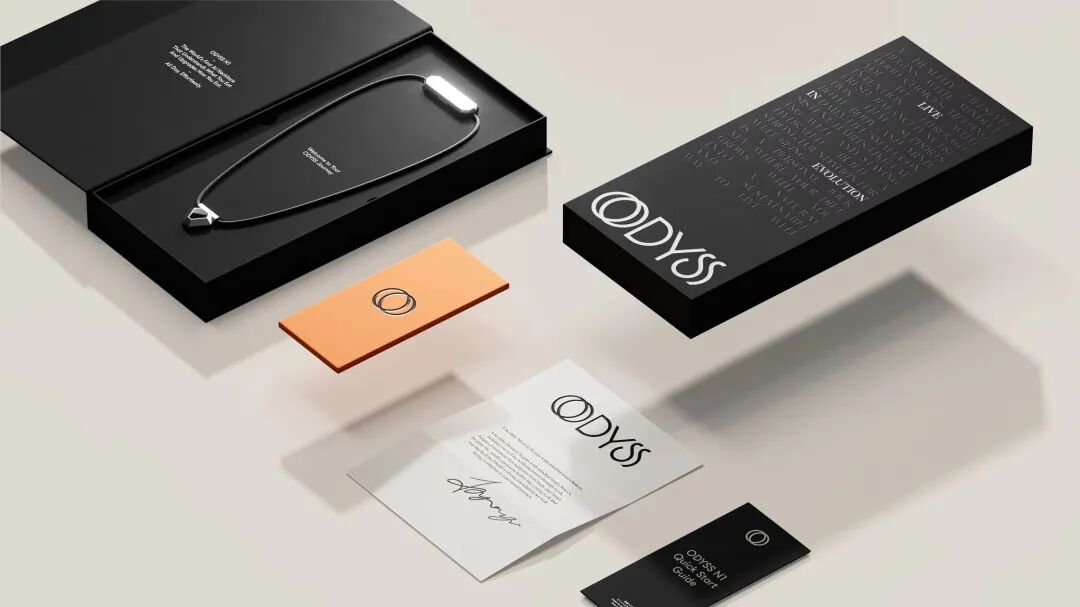
Once, the team handed the prototype to users, and observed them from the moment they unpacked the package, all the way to wearing the device, downloading the app, and registering and logging in. Soon, some problems that had never been discovered before began to emerge. Some users did not know how to remove the lanyard, and tried to put the whole device over their head directly; although the app was designed to be as concise as possible, users found the interface too clean to know what to do next.
"Things that are beautifully designed must be simple, the fewer words the more beautiful. But when the number of words is reduced to a certain level, the user's understanding cost will rise sharply."
A more important discovery came later: users do not want a device to manage them all the time.
"The users who were interested in our product in the very early stage only need you to act as an observer by their side, tell them what is happening and what they should do. Don't judge them, don't give them scores, or compare them with others — that kind of thing is, to some extent, a kind of harm or burden to users."
So the team started to do subtraction, and even removed the heart rate and blood oxygen tracking functions. "Sports products do not build a closed loop for diet tracking, so why should our diet tracking product necessarily build a closed loop for sports tracking?" In the end, they only kept the one thing that everyone does every day but has never been truly recorded.
"Eating is the most important thing in health, but right now you don't know how you eat." After realizing this point, Odyss found its clear direction for the first time.
As for the product form, he has never wavered. Users have complained about comfort, paint peeling and wear, but almost no one has said "the necklace form is not feasible, you should change to another form" in the past year — because users cannot think of any other form that can complete this task.
What the product form determines is a more fundamental thing: "How long you can wear the device does not depend on how long the data you provide to users lasts, but depends on how low the friction of using this device is." Just like Oura was originally a sleep product, theoretically it can be taken off during the day, but no one actually does that. When the friction is low enough, the always-on usage will become a natural cycle without extra thinking.
03 Narrow Path: Between the Whirlpool and the Sea Monster
In the narrow strait, Charybdis, the whirlpool that swallows ships, is on the left, and Scylla, the sea monster that devours sailors, is on the right. When navigators face a desperate situation, they cannot force their way through, and can only find an extremely delicate route.
After they really started to develop a necklace that only tracks eating behaviors, the problems became more and more specific.
A single photo can recognize a dish, but it is difficult to tell how much food you have actually eaten. The best multimodal models on the market have an accuracy of about 70% to 80% in recognizing the weight of food from a single image; the error of ordinary diet apps is often between 50% and 100% — the same portion of food tested by ten different products may get results ranging from 100 grams to 20 grams. Obsessing over the accuracy of a single photo is almost a dead end.
"Human eating is a continuous process, we should not only look at a single moment."
The team turned to record the continuous image stream of the eating process, and developed a chewing sound algorithm — just like a voice assistant recognizes wake words, it captures the eating action from the ambient sound, marks postures such as leaning forward, aligns them with the images, and feeds all the data to the model. Instead of processing a single image, it processes the whole image stream, and can split every single bite of food.
For the widely recognized difficult problem of Chinese food, Pan Yuyang's solution is also very pragmatic: "I changed the situation where other products cannot recognize Chinese food, to a situation where they can recognize Chinese food. This is a breakthrough from 0 to 1, and we will slowly work on the phase from 1 to 100 later."
Polishing the hardware is another narrow path that tests judgment. "As long as you have even a little requirement for power consumption and volume, you will definitely encounter a situation where the factory tells you that it cannot be done — but in fact it can be done. The factory says it cannot be done, maybe it really cannot, or it can be done after you negotiate and polish the solution a little bit."
The lanyard was made after such repeated polishing. The team originally used a silicone shell similar to that of a charging cable, which directly wrapped the copper wire. In the internal test, many users reported that the lanyard would rub back and forth on their neck like a bath towel. When users wanted to take off the necklace, they would subconsciously pull the lanyard, which made the line very easy to break. So they wanted to add a supporting material inside, which can resist pulling without affecting the transmission of current and signals.
The supply chain almost unanimously replied that it could not be done. In the end, with the efforts of the team, they solved the problem with a brand new wiring method, which has become their own patent. For the Pro series, they added a new mainboard, one more chip, and a larger camera, but the volume is even smaller and the power consumption is lower. "If you showed me this solution a year ago, I would think how is that even possible?"
03 Siren: The Dangerous Temptation of the Sea Monster
In *The Odyssey*, the sea monster Siren never hurts people by force. She just sings, singing out the most hidden desires and vanity in the sailors' hearts, and repeatedly telling them "come a little closer, you will get more". All the people who have heard the song sail towards her without exception, and die around the island. Odysseus asked his sailors to seal their ears with wax, and tied himself to the mast, so that he survived.
Earlier this year, Odyss completed a 200 million yuan financing led by top-tier institutions, and its valuation kept rising. It was reasonable for them to press on the gas pedal, but Pan Yuyang voluntarily pressed the pause button.
During that period, he met investors and entrepreneurs very frequently, and he more and more easily got a feeling that "he has a good judgment of the market". But when he returned to the company, he found that the people in charge of the model know best how far the model has developed, and the people in charge of hardware know where the supply chain is stuck. Many things he talked about with certainty outside were already outdated when he came back — the company's iteration speed is faster than the stories he told investors.
"If you bring the positive feedback too far forward, when the whole company's positive feedback reaches its peak the moment the financing is completed, then the subsequent entrepreneurial journey will go downhill all the way."
He is also alert to another more hidden thing: excessive resources will make people lazy. "When resources are sufficient, you don't need to use your brain, you just need to do everything. But human mental energy is limited, you will definitely lose focus — this is not a problem of money, but a problem of human energy and excitement points."
Watching his peers raise hundreds of millions of dollars in financing rounds one after another, Pan Yuyang has also experienced moments of anxiety, "But these things in the early market are all obstacles you set for yourself. Most of the time you are just taking a reassurance pill for yourself, which does not mean it is really useful for the company."
The smooth numbers on the financial statements often also hide the problems behind them. Odyss did cold start in overseas markets in the early stage by collecting email addresses, and the cost was surprisingly low. Logically, the subsequent conversion rate of the funnel should not be too bad. But once they started to charge deposits, some new problems slowly emerged.
"We were wondering at that time, why these two data do not match? Later we found that users are very interested in the product and have demand for it, but they have concerns: this product I have never seen before, can it really work? This company I have never heard of, is it a fraud?"
This is probably the original sin of all new product categories. When a smart ring appears online, even if there is only one picture, you know what it can do; but a necklace that tracks your eating behavior has never existed before. The fork in the road is very cruel: is it because the market education has not been completed, or is there a fundamental problem with the product category itself. Odyss's choice is not "think about it again", but "finish the work first".
"Many products need a lot of work to be done between the time they are invented and the time they are proved to be right or wrong. If you don't finish all these work, you will never know whether this thing is right or wrong."
That is also why, when some large tech companies announced earlier this year that they would develop necklace form products, he was not anxious at all, and even a little excited — "When large companies enter the track with me, users will trust the product more."
The birth of a new product category requires market education costs, and the entry of more players means the acceleration of market education. As for who can stay in the market in the end, the answer always lies in the product itself.
Pan Yuyang joked, "Your first batch of sales data will be the page in your competitors' project initiation reports. Plagiarism is unavoidable, and it is useless to worry about it, but the advantage of the first mover is that you can decide when to turn over your cards."
05 Companions: Things Harder Than Reaching the Destination
What impressed him most in the whole epic is not the Cyclops, nor the Siren, but a bag.
The wind god put all the headwinds into a leather bag and gave it to Odysseus, leaving only the favorable wind blowing westward. When the coastline of Ithaca was almost in sight, the exhausted Odysseus fell into a deep sleep. The crew members had an idea at this moment: he held the bag tightly all the way, there must be treasures inside, it should be fine to take a little bit. The bag was opened, all the winds rushed out, and the ship was blown back to the vast ocean.
"So most of the time, the difficulties Odysseus encountered on the road are not objective — not the Cyclops, nor Poseidon. What really hinders them is human nature." Pan Yuyang said, "At a certain node, the journey is not over yet, but people can't sit still anymore." That is also why he values the team more than the product.
At the end of *The Odyssey*, Odysseus finally returned in triumph, but he was the only one who returned to Ithaca alive.
"When I first read this part, I actually didn't understand it. Why didn't the gods just curse him to die, but let him live, and watch the people around him die one by one?" Pan Yuyang said. Later he realized that some losses