Has the AI computing power feast become a "high interest rate poison" for global capital?
Over the past few weeks, market indicators measuring inflation-adjusted borrowing costs in the world's major economies have surged to the highest level in more than a decade.
Over the past few weeks, market indicators measuring inflation-adjusted borrowing costs in the world's major economies have surged to the highest level in more than a decade. As AI enterprises and governments around the world are ramping up bond issuance, risks facing the stock market and the global economy are continuously accumulating...
The real yield, which refers to the return on investment that bond investors demand above the inflation rate, is a core indicator to measure the real financing cost of governments and enterprises. This indicator usually depends on expectations for economic growth, interest rate trends and the supply-demand relationship of capital.
At present, the 30-year US real yield linked to inflation-protected securities has approached an 18-year high -- around 3%, while the 10-year real yields of the UK and Germany are also near the highest levels in more than a decade.
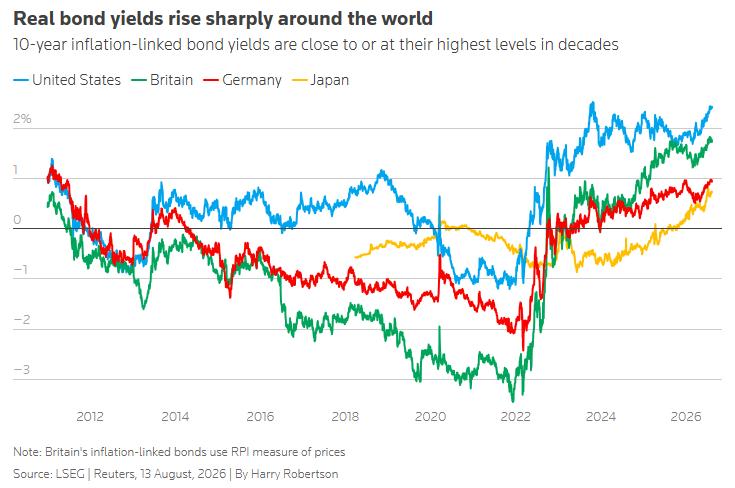
Investors and analysts pointed out that against the backdrop of governments maintaining high fiscal spending, the explosive growth in borrowing scale of "super-large computing power giants" in the AI sector is becoming the latest factor pushing up yields, as buyers are demanding higher returns before they are willing to continue purchasing the massive amount of bonds flooding into the market.
Despite ongoing conflicts in Iran, inflation expectations generally remain stable, which also means the rise in real yields has pushed up the nominal yields of global bonds in recent months. The 30-year US Treasury bond auctioned by the US Treasury Department last Thursday recorded a winning bid rate of 5.22%, marking the highest borrowing cost for this maturity bond auction since 2001.
The Surging Wave of AI Bond Issuance
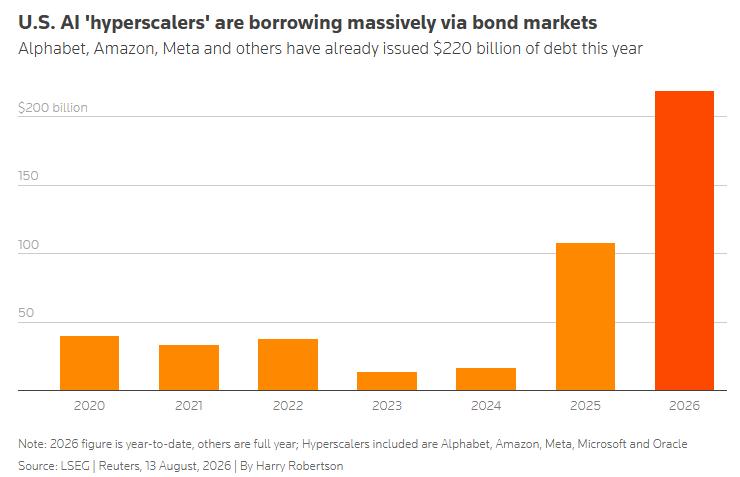
Statistics from LSEG show that US tech giants including Alphabet, Amazon and Meta have issued nearly 220 billion US dollars worth of bonds so far this year, more than double the 108 billion US dollars recorded in the whole year of 2025.
"We are experiencing a battle for capital that is unprecedented in recent years," said Vivek Paul, Chief Investment Strategist for the UK at BlackRock Investment Group.
"Driven by factors such as the continuous acceleration of artificial intelligence infrastructure construction, this competition pattern of capital scarcity is evolving at an accelerated pace, which is directly reflected in the climbing bond yields."
At the same time, governments around the world are also continuing to borrow heavily. This year, the US fiscal deficit is expected to account for about 6% of its GDP (around 1.9 trillion US dollars), the figure for France is projected at 5%, and that for the UK at 4%.
Al Cattermole, Senior Fixed Income Portfolio Manager at Mirabaud Asset Management, pointed out: "In Europe, compared with special expenditures in the AI sector, defense spending, energy security and infrastructure investment are more critical driving forces."
In addition, the market is also pricing in expectations for future interest rate hikes, which under other unchanged conditions will usually further push up real yields.
Max Kitson, European Rates Strategist at Barclays, analyzed that relatively strong economic growth -- especially in the United States -- is a key factor. He also noted that major central banks have stopped bond purchases, which previously suppressed yields for a long period of time.
Stay Alert to Stock Market Risks
The real yield is the benchmark for measuring the inflation-adjusted real borrowing costs of governments and enterprises.
Assuming a bond has a nominal yield of 3% and an expected inflation rate of 2%, its real yield is roughly 1%. Analysts said that nominal yields were previously mainly dominated by inflation expectations, but in recent periods, real yields have become a more core determinant.
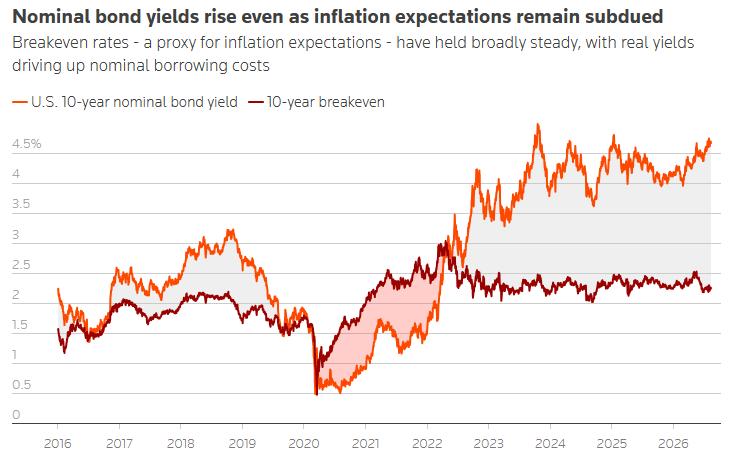
Theoretically, the rise in real yields will weaken the relative attractiveness of stocks. On one hand, investors can obtain higher inflation-adjusted returns in the bond market; on the other hand, the future cash flow of enterprises, whose present value is calculated by discounting against yields, will also appear far less attractive.
However, so far, thanks to strong corporate performance and resilient economic performance, the stock market that has repeatedly hit new highs has not been brought down by these concerns. JPMorgan Chase recently raised its earnings forecast for the S&P 500 index of US stocks; data from LSEG I/B/E/S also shows that the profit growth rate of European blue-chip enterprises is expected to hit the highest level since the end of 2022.
Nevertheless, Matt King, Founder of Satori Insights, holds a more prudent attitude. He pointed out that major tech giants are currently accelerating the consumption of their cash reserves and will become more dependent on the credit market in the future, at which point the rise in real interest rates will start to bring substantial impacts.
He wrote in the research report: "We expect real yields to continue rising until the elevated costs completely suppress this round of borrowing boom that drives yields up -- and put an end to the rotation of funds into risk assets that previously boosted the stock market rebound."
In addition, after the inflation-adjusted borrowing costs rise to a certain critical point, they may also force enterprises and households to cut consumption and investment, thereby dragging down the overall economic growth.
Ashok Bhatia, Chief Investment Officer at Neuberger, said that the current real yield in the US is still below the 3%-4% range he estimated to generate a substantial impact on economic growth. "But the current yield level is already a warning sign: although the current 1.5% to 2% economic growth is fairly robust, there is a risk that it may be eroded in the future."
Bhatia added that given concerns about fiscal policy, he remains cautious about long-term bonds; while Kitson from Barclays believes that due to the general lack of willingness among politicians to reduce fiscal deficits, real yields may continue to climb in the future.
Kitson concluded: "The structural factors supporting the rise in yields are still deeply entrenched, and there is no sign that they will subside in the short term."
This article is from WeChat Official Account "Sci-Tech Innovation Board Daily", Author: Xiaoxiang, published by 36Kr with authorization.