On the eve of its listing, OpenAI is hit by a "wave of executive departures".
Since the beginning of 2026, 12 senior executives have left OpenAI.
OpenAI is entering a critical juncture.
On one hand, its business continues to grow rapidly, with annualized revenue exceeding 40 billion US dollars, and revenue from enterprise business has surpassed consumer business for the first time; on the other hand, the company's core management team is undergoing continuous adjustments.
According to foreign media reports, at least 12 senior executives and business leaders have left OpenAI since 2026, including Chief Revenue Officer Denise Dresser and Chief Operating Officer Brad Lightcap, who resigned consecutively in the most recent week.
This round of personnel changes takes place as OpenAI prepares for its IPO.
OpenAI has secretly submitted IPO documents to the U.S. Securities and Exchange Commission in June this year. For a company that is sprinting for listing while expanding its business scale rapidly, the concentrated departure of core senior executives has naturally aroused public attention to the stability of its management.
However, these resignations are not simple personnel loss. Some left for health reasons, some are preparing to start their own businesses, and some exited after the adjustment of their internal responsibilities in the company. At the same time, OpenAI's safety, ethics and mission alignment teams are also being restructured.
This means that OpenAI is expanding its business while rebuilding a new management system.
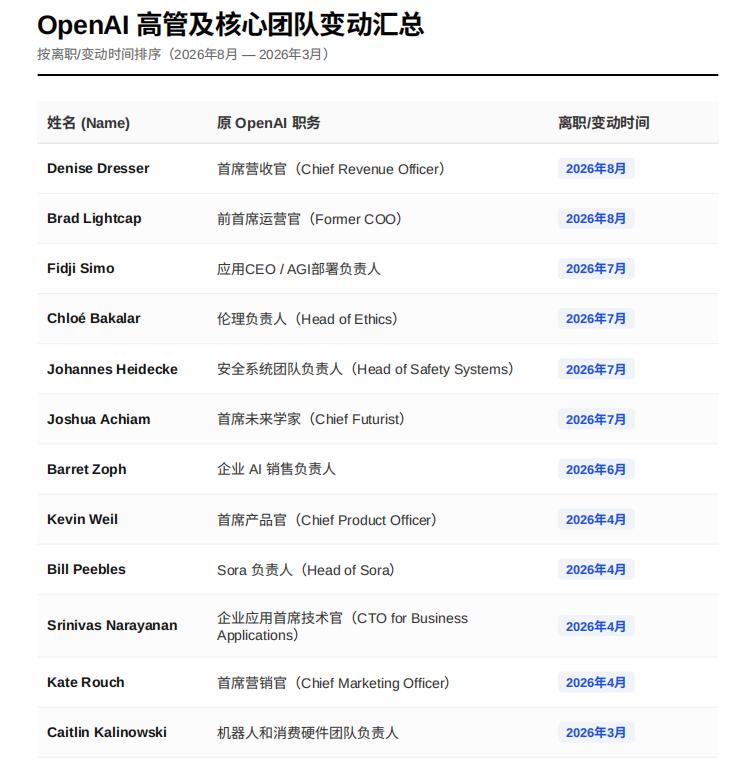
The first thing that needs attention is the personnel changes in OpenAI's core management team.
01 Concentrated departure of senior executives, OpenAI restructures its management team
The first thing that needs attention is the personnel changes in OpenAI's core management team.
Lightcap joined OpenAI in 2018, successively serving as Chief Financial Officer and Chief Operating Officer, and is one of the longest-serving core managers of the company. In April 2026, he moved from the position of Chief Operating Officer to special projects, and announced his departure from the company a few months later.
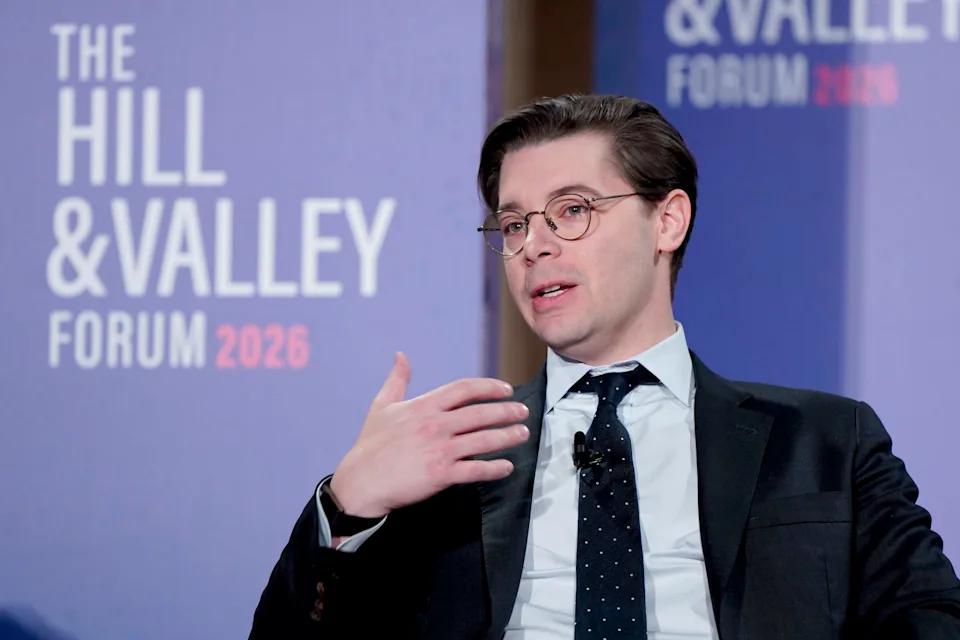
Brad Lightcap, former Chief Operating Officer of OpenAI
Lightcap stated on X that he is preparing to "start something new", and said that he "believes in OpenAI more than ever".
His departure was quickly linked to the change of another senior executive.
Dresser joined OpenAI in December 2025 as Chief Revenue Officer, mainly in charge of enterprise business. After Lightcap transferred to a new post, she took over more of the work that was originally under his responsibility. But only a few months later, Dresser also announced her departure.
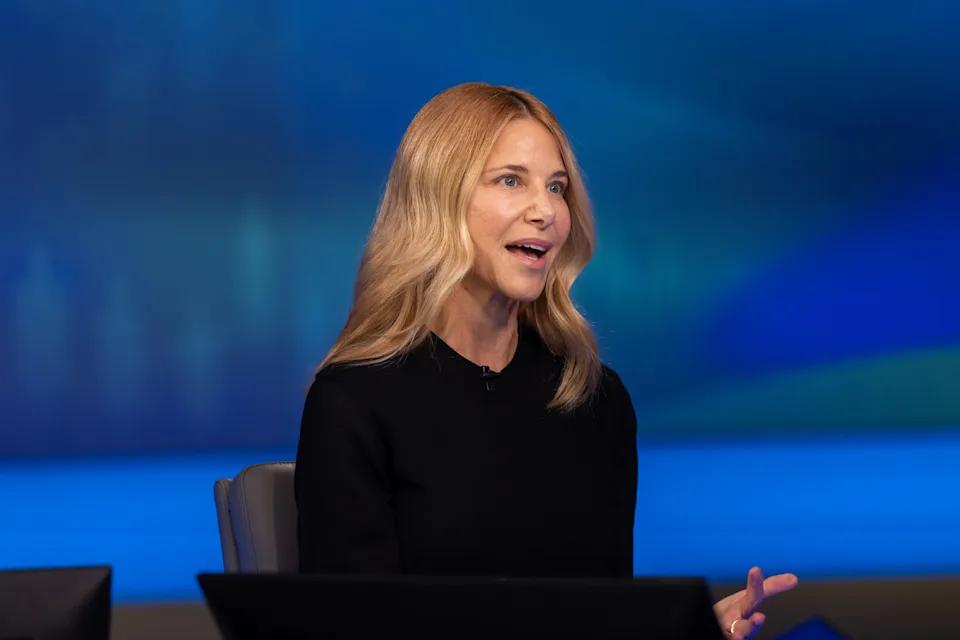
Denise Dresser, former Chief Revenue Officer of OpenAI
OpenAI stated that Dresser will continue to cooperate with the business team during the transition period before looking for other opportunities. The company has appointed Dali Rajic to take over as Chief Revenue Officer. Rajic previously served as President and Chief Operating Officer of cybersecurity company Wiz.
Before the two left, Fidji Simo, CEO of the Application Business, had also withdrawn from daily management.

Fidji Simo, former CEO of OpenAI Application Business
Simo joined OpenAI in May 2025, and previously served as CEO of Instacart. In April this year, she took a leave of absence due to long-term health problems, and announced in July that she would switch to a part-time consultant. Her situation of leaving is different from that of Lightcap and Dresser, which is mainly for health reasons.
While the three core senior executives withdrew one after another, other business leaders of OpenAI are also undergoing changes.
Kevin Weil, Chief Product Officer, left in April. He joined OpenAI in 2024, later moved to the OpenAI for Science project, and is currently running an AI science startup.
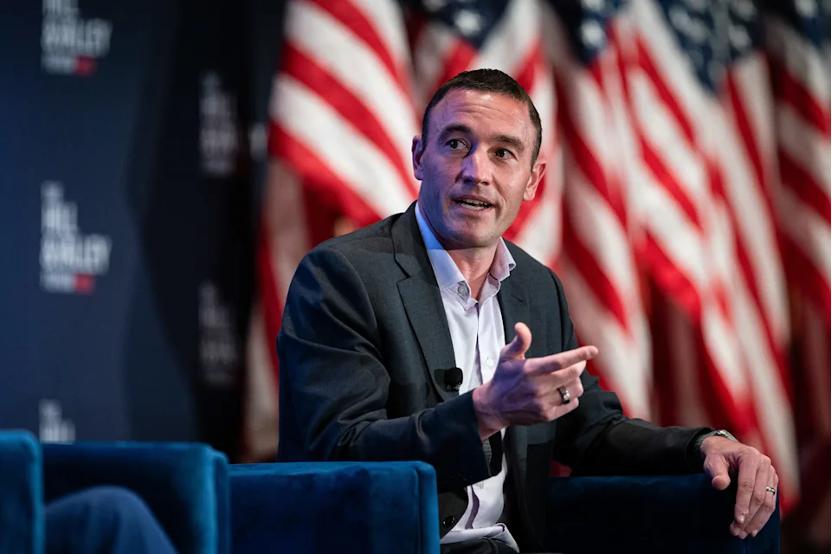
Kevin Weil, former Chief Product Officer of OpenAI
Bill Peebles, head of Sora, also left in April. He was in charge of the Sora video generation model, and OpenAI subsequently shut down Sora and its applications in April this year.
Srinivas Narayanan, who was responsible for commercial application technology, also left in April. He previously led the B2B engineering team and participated in the development of ChatGPT and enterprise products.
Kate Rouch, Chief Marketing Officer, left in April to continue recovering her health. She joined OpenAI in December 2024, and previously led global brand and product marketing at Meta.
Among all the recently departed senior executives, Barret Zoph has a special experience. He left OpenAI in 2024 and co-founded Thinking Machines Lab with former CTO Mira Murati. He rejoined OpenAI in January 2026 to lead enterprise AI sales, but left again in June.
In addition to business and management positions, OpenAI's safety and ethics teams have also seen personnel changes this year.
Chloé Bakalar, head of Ethics, left in July. She joined OpenAI in August 2025, responsible for researching model behavior, the relationship between humans and AI, and whether advanced AI systems could have moral significance.
Johannes Heidecke, who was in charge of the safety system, also left in July. He joined OpenAI in 2021 and began to lead the safety system team in 2024, mainly responsible for evaluating the potential dangerous capabilities of models and developing safety protection measures.
Following Heidecke's departure, OpenAI rearranged the safety team, and Mia Glaese, Vice President of Research and Safety, took over the post.
Joshua Achiam, Chief Futurist, also left in July. Previously, he was in charge of the mission alignment team. After OpenAI disbanded the team in early 2026, he was adjusted to the position of Chief Futurist.
Caitlin Kalinowski, head of the robotics and consumer hardware team, resigned in March. She publicly stated that she had governance concerns about OpenAI's agreement with the U.S. Department of Defense, especially focusing on domestic surveillance in the United States and lethal autonomous capabilities without human authorization.
Counting in this way, OpenAI has had at least 12 important senior executives and business leaders leave this year.
The adjustments cover a fairly wide range from operations, revenue, applications and products to enterprise business, safety, ethics and hardware. But from the results, OpenAI is indeed restructuring multiple departments.
At the same time, Greg Brockman, co-founder and President of OpenAI, is putting more energy back into the company's daily management. Insiders described that he is now in "Founder Mode".
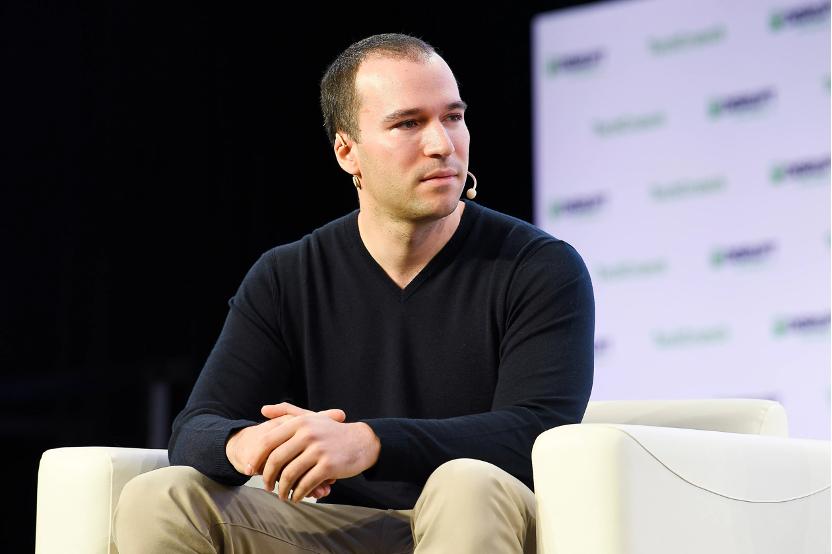
Greg Brockman, co-founder and President of OpenAI
Brockman has started to contact more customers and internal teams, and participate in rebuilding the management team. Over the past year, he mainly focused on computing infrastructure and model execution, and now he is shifting his focus to the "compute-powered economy".
It is worth noting that this round of changes took place when OpenAI was preparing for IPO, which also made "management stability" a concern of the outside world.
Kevin McCormick, founder of SignAudit.AI, believes that a large number of senior executives leaving before IPO is a signal worthy of attention.
However, OpenAI's investors do not fully regard this round of personnel changes as a crisis. Two investors said they were surprised by Dresser's departure, but also believed that such rapid changes are in line with OpenAI's long-standing corporate culture.
Two former OpenAI employees described the company's management environment as "hire fast, fire fast", and one of them said the working environment was like a "pressure cooker".
For OpenAI, the problem is no longer just which senior executives leave, but whether the new management structure can support a company with an annualized revenue of more than 40 billion US dollars that is preparing for IPO.
At present, what OpenAI most needs to stabilize is exactly the fastest-growing enterprise business.
02 Enterprise business becomes the new growth engine
OpenAI's current revenue structure is changing.
Sarah Friar, Chief Financial Officer of OpenAI, recently introduced the company's situation to investors, saying that at the beginning of this year, the revenue share of consumer business and enterprise business was about 60% and 40% respectively. But as the growth rate of enterprise business exceeded expectations, the two lines have crossed, and the revenue contributed by enterprise business has now surpassed that of consumer business.
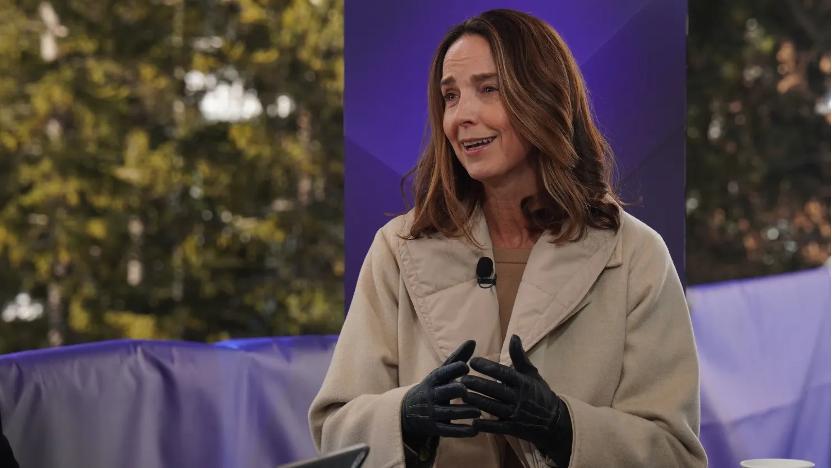
Sarah Friar, Chief Financial Officer of OpenAI
This change came earlier than OpenAI previously expected. In April this year, then Chief Revenue Officer Dresser said in an interview with CNBC that enterprise business accounted for about 40% of the company's revenue at that time, and it was expected to reach roughly the same level as consumer business by the end of 2026. Now, this goal has been achieved ahead of schedule.
The scale of enterprise customers is also expanding rapidly. OpenAI said that the number of enterprise customers has reached 2 million, twice as many as a year ago. In July, the company's annualized revenue increased by more than 20% month-on-month, and the enterprise customer business grew faster, reaching 32%.
In terms of products, enterprise customers' demand for AI programming and agent tools is increasing. Enterprise usage driven by products such as Codex continues to grow, and the ChatGPT subscription business is also expanding. At the same time, the advertising business has begun to generate revenue, and Friar revealed that its annualized revenue is close to the scale of 1 billion US dollars.
However, after the growth of enterprise customers, what OpenAI is facing is no longer simply "how many more Tokens to sell".
Friar mentioned at the investor meeting that the era of "tokenmaxxing" is coming to an end. In the past, enterprises may have paid more attention to the usage of AI tools, and even allowed employees to call the model in large quantities. Now, enterprises are starting to calculate the cost per unit of intelligence, paying more attention to how much work AI can actually complete, and the actual output brought by these works.
This has also changed the way model companies compete. OpenAI is competing for enterprise customers by lowering the price of some models and improving model efficiency. Friar said that the latest model has improved efficiency by 54% on agent programming tasks.
Anthropic is OpenAI's most direct competitor in the enterprise market. As enterprise customers pay more and more attention to complex tasks such as programming, both companies are competing in the enterprise software and AI agent market. OpenAI is currently focusing on promoting products such as Codex and ChatGPT Work, and lowering the threshold for enterprise use through price adjustments.
This is also why OpenAI now needs to rebuild its enterprise business team. After Dresser left, Dali Rajic took over as Chief Revenue Officer. Compared with simply expanding the number of customers in the past, OpenAI now needs to convert the formed enterprise demand into stable revenue, and prove that enterprise customers are willing to continuously pay for AI capabilities.
This matter ultimately falls on a more realistic problem: to support more and more enterprise customers and more complex AI tasks, how much computing power OpenAI needs, and who will pay for this computing power.
03 Computing power pressure behind 40 billion US dollars in revenue
Another problem OpenAI faces in the next stage is that the computing infrastructure requires continuous investment of huge amounts of capital. The company is advancing a 10 GW data center project in Ohio, USA.
This project is developed by SB Energy, a subsidiary of SoftBank. OpenAI is still discussing signing a formal lease agreement for the 10 GW project. If it is finally implemented, it will become an important infrastructure for OpenAI to expand its computing capabilities.
But the 10 GW project also requires a huge amount of capital.
The currently discussed plan shows that the first phase of the project, about 5 GW of construction, will first get financing support, and the subsequent scale will be determined according to the progress of the project. Nvidia originally considered providing a financial guarantee of up to 250 billion US dollars for the entire project, but the current plan has been reduced to less than 120 billion US dollars, covering the construction of the first phase.
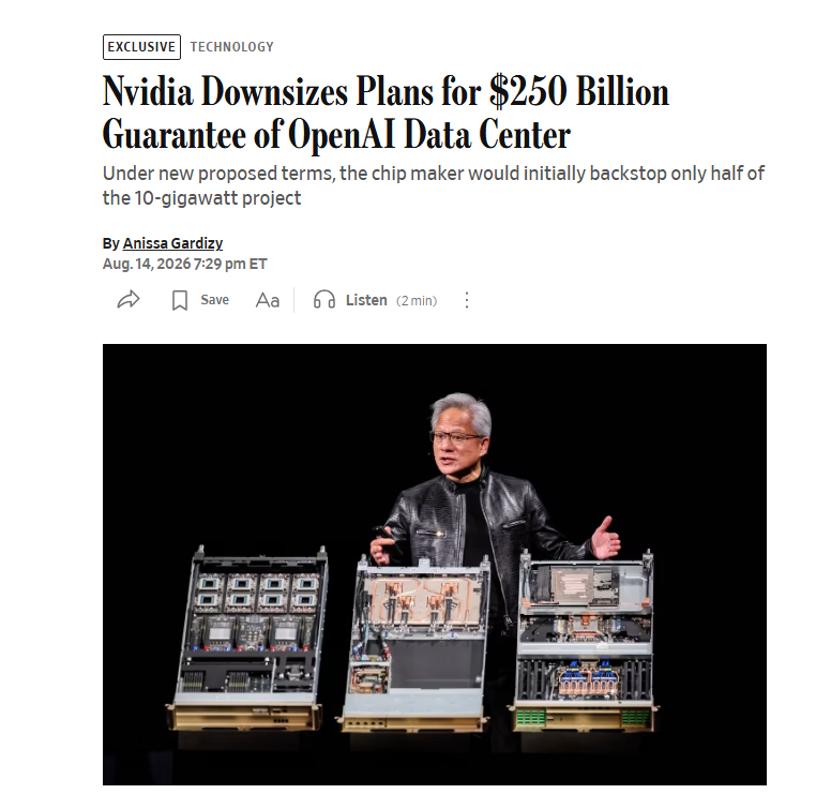
In addition, OpenAI is also discussing financing arrangements for chip procurement, and the total chip procurement scale of the entire project may reach 350 billion US dollars.
This