OpenAI Researcher: 100% of the code has been handed over to AI, Claude rewrites Python libraries
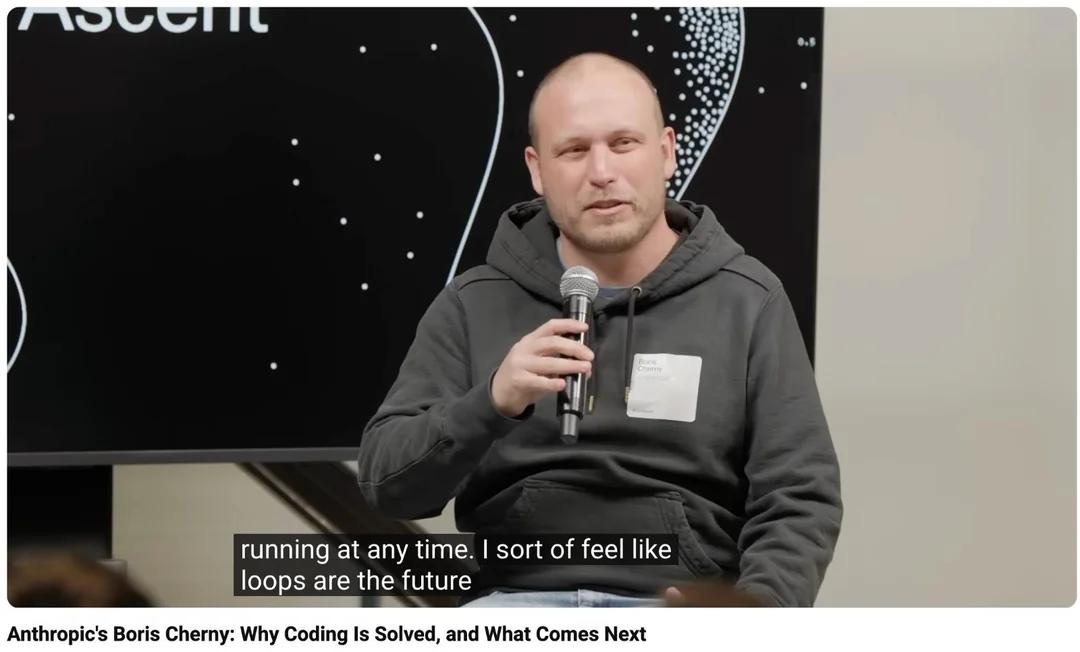
The father of Claude Code once publicly stated that he hadn't written a single line of code manually for more than two months.
He can merge 27 PRs in a single day, all completed by Claude on his behalf.
OpenAI researcher roon put it more bluntly: "I don't write code anymore, 100% of it is done by GPT".
Now, after another industry veteran deeply experienced Claude Code and Codex, he exclaimed that "In 5 years, humans will no longer write code"!
In the past few days, the father of Rails, DHH, personally carried out a major feat —
Relying entirely on Claude Fable 5, he fully rewrote the Python library "TerminalTextEffects" into Rust in one go.
What is amazing is that this reconstruction consumed a total of 11 million Tokens, and was almost completed in one go.
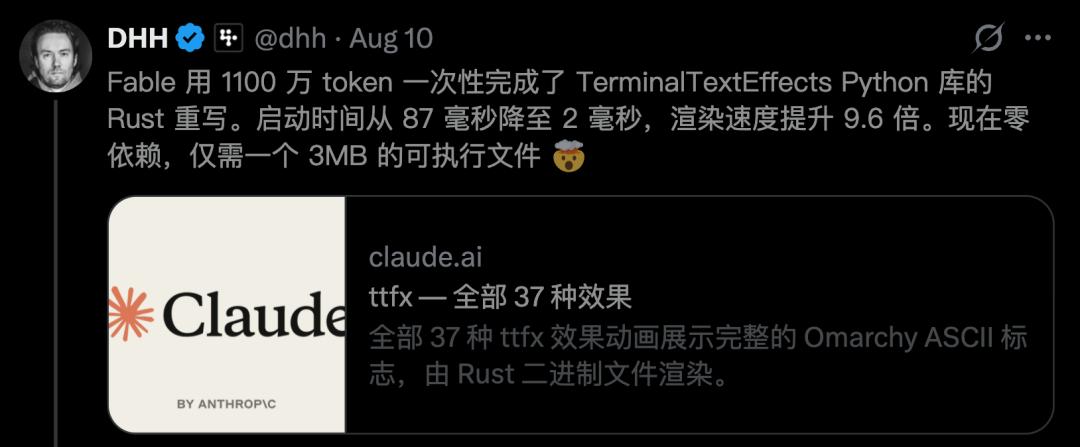
The running result after completion is extremely outstanding: the startup time is reduced from 87 milliseconds to only 2 milliseconds, and the rendering speed has soared by 9.6 times.
As soon as the post was published, it instantly attracted millions of views across the internet.
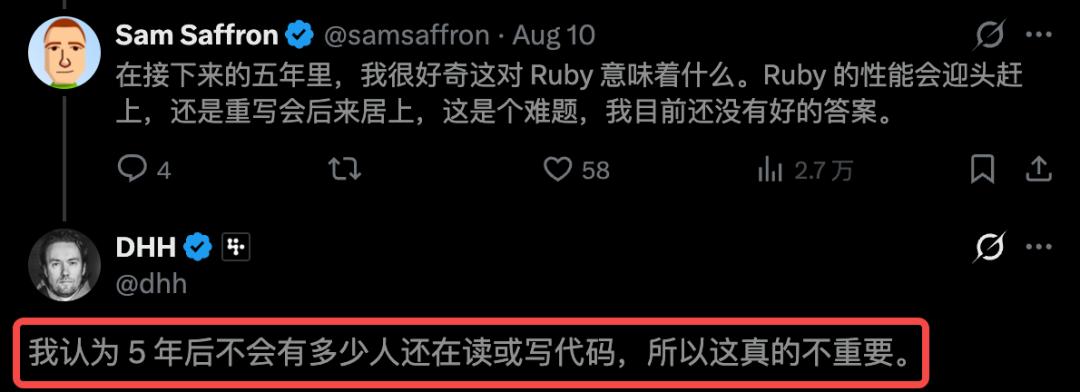
A top AI expert asked the father of Rails a pointed soul-searching question: "In that case, where will Ruby go in the next five years"?
DHH's answer is very straightforward —
Within five years, very few people will still manually write and read code. So, this really doesn't matter.
Who could have imagined that in just one year, the contrast is so huge!
Hand the keyboard over to AI, and I would rather retire
It should be noted that last May, DHH still firmly stated across the internet that he refused to give up the joy of coding to AI.
In his long article "Coding should be a vibe!", he clearly pointed out:
At most, AI is just an auxiliary "pair programmer", which is enough to help check APIs and answer questions.
He even said harshly, "If one day I have to completely hand over the keyboard to AI, I would rather retire".
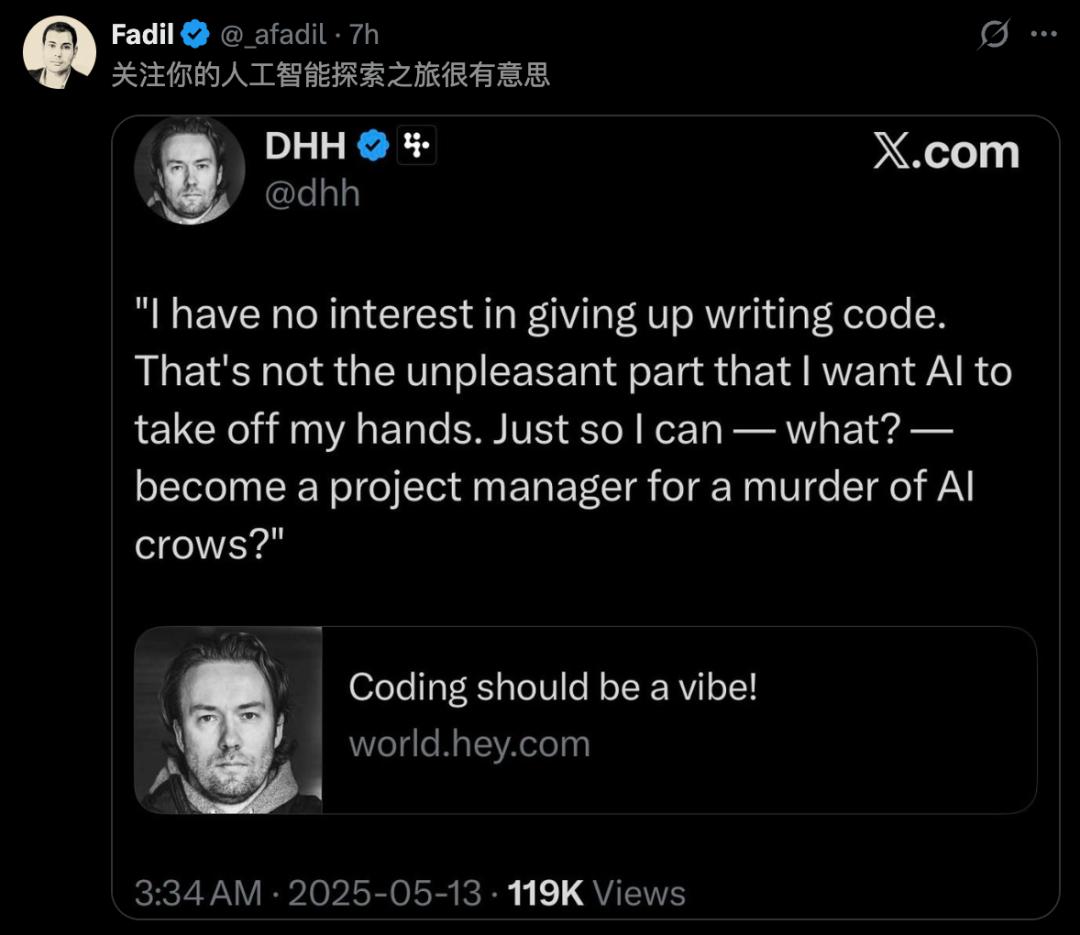
I don't want to give up coding at all. This is not a drudgery to be passed off to AI. Otherwise, what's the point? Do I want to be a project manager for a group of AI that are just like "the mob"?
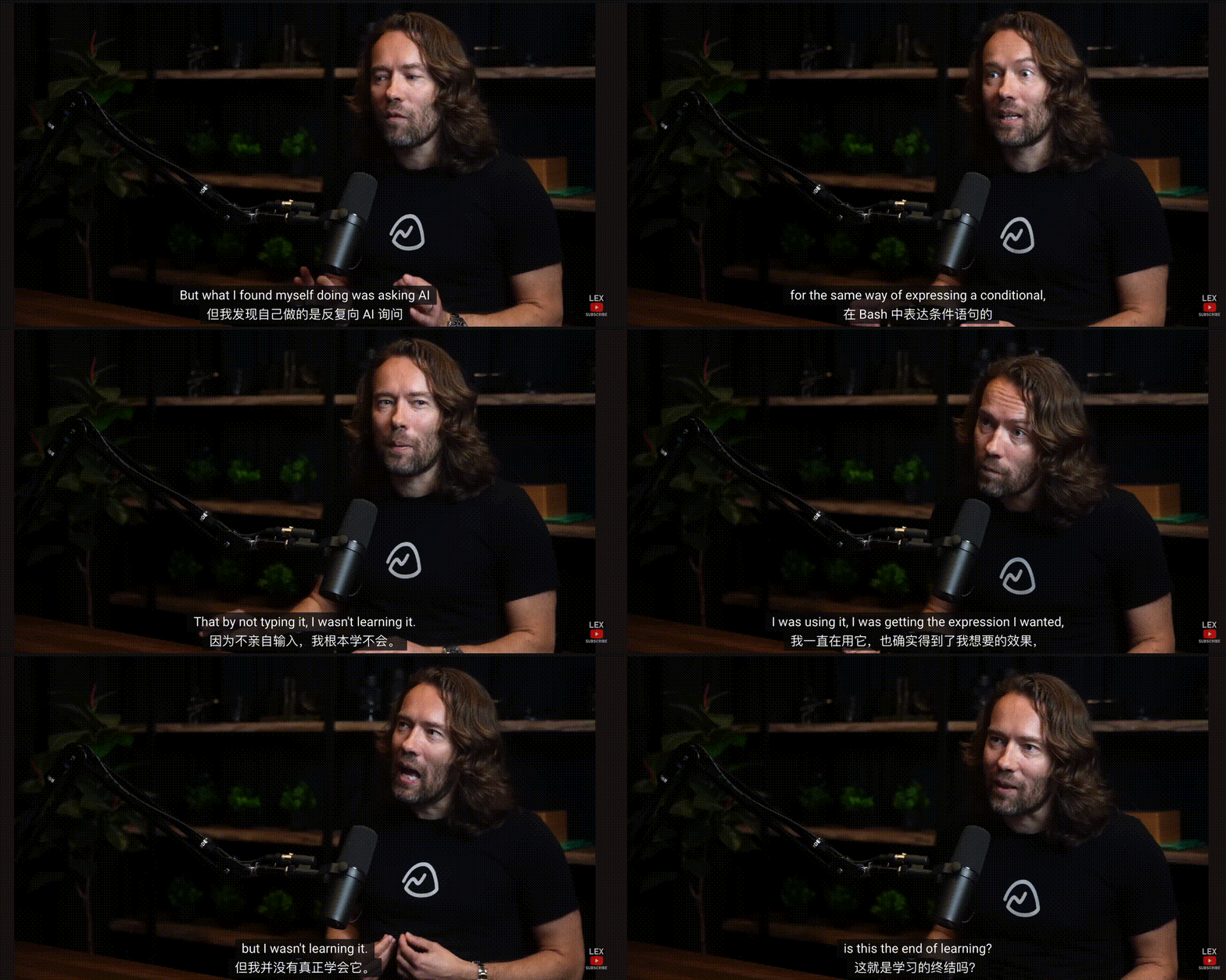
In the six-hour in-depth conversation with Lex Fridman, DHH once insisted that every line of his code was typed by himself.
Once when building a Linux distribution, he repeatedly asked AI to generate the same Bash conditional statement, but suddenly realized that without the action of typing on the keyboard himself, he did not really master it at all.
The loss of this "muscle memory" made him feel deeply scared, "Will this be the end of learning"?
However, by April this year, the trend changed abruptly.
In a podcast, he confessed that he has now fully shifted to the "Agent-first" mode, and has basically said goodbye to writing code manually.
Unexpectedly, the sentence "In five years, very few people will still be writing and reading code" came out of the mouth of the father of Rails.
Complete the whole process with Fable 5, no one will write code in five years
Take a closer look at this incident where Claude rewrote Python code with full capability.
TerminalTextEffects, abbreviated as TTE, is a terminal visual effect engine.
It can be used not only as a command-line program, but also imported as a Python library into other applications.
Developers can control the trajectory, color, gradient effects and animation shots of text like performing magic, making the originally boring UI cool.
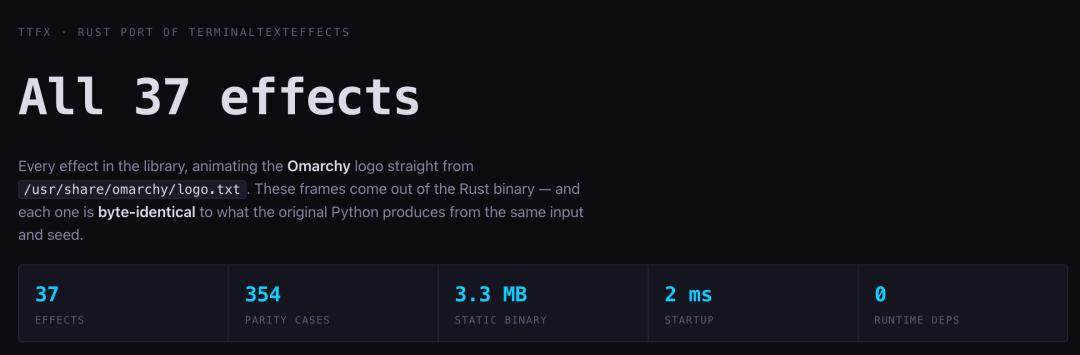
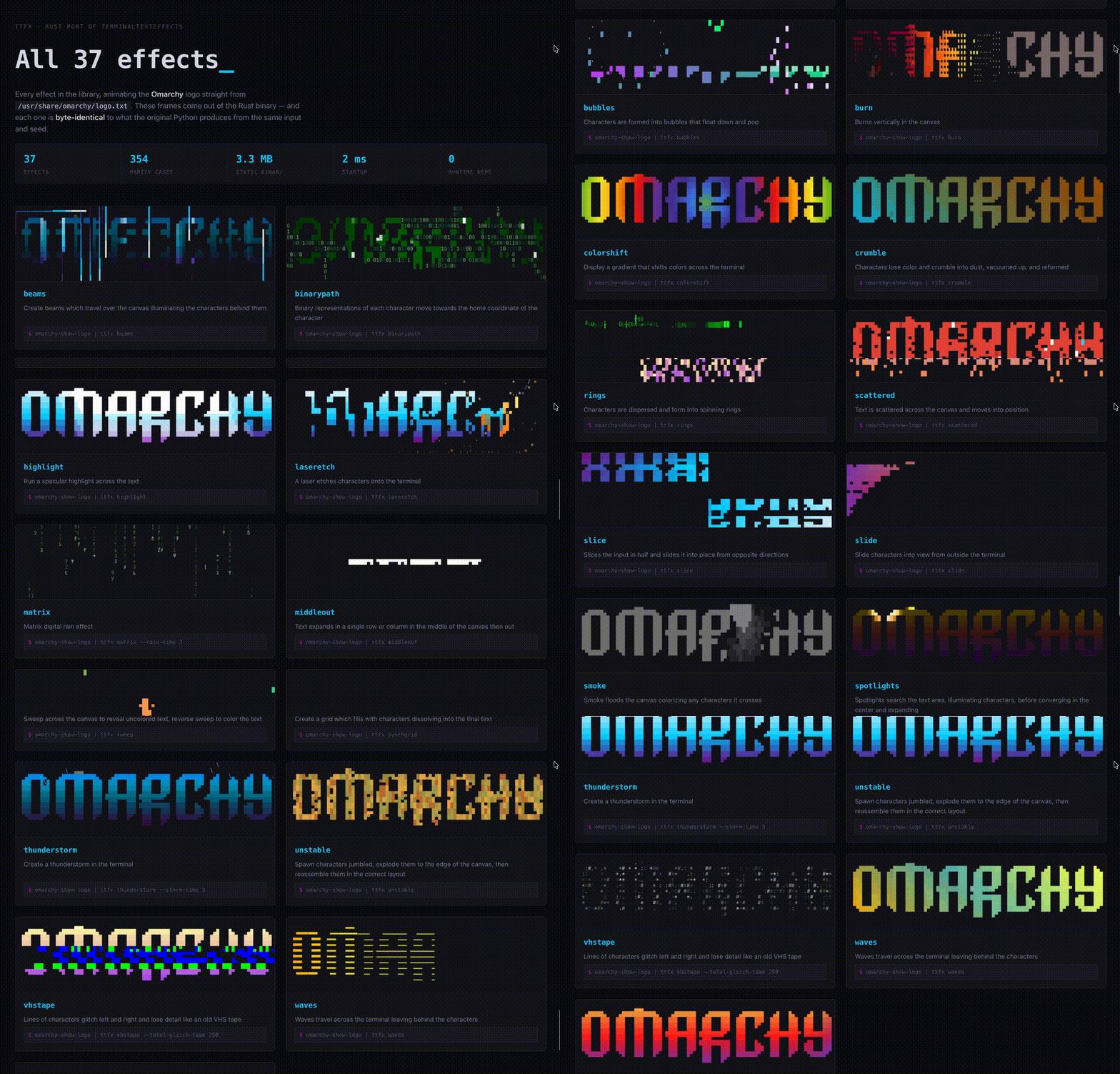
The Rust version demonstrated by DHH can run 37 kinds of effects.
A software that originally required a Python runtime environment was transformed into an executable file of only 3MB after being reconstructed by Claude.
This new repository is called ttfx, hosted under DHH's own Omarchy organization, with all commit records fully retained.
The whole process lasted 3 hours and 11 minutes, with 21,000 lines of Rust main code, almost the same size as the original Python version.
In the task, 8 Agents worked simultaneously on separate branches and merged in batches: they read the code by themselves, generated implementations, compiled, ran tests, handled failures, and then entered the next round.
The so-called "one-shot" actually means handing over the task at one time.
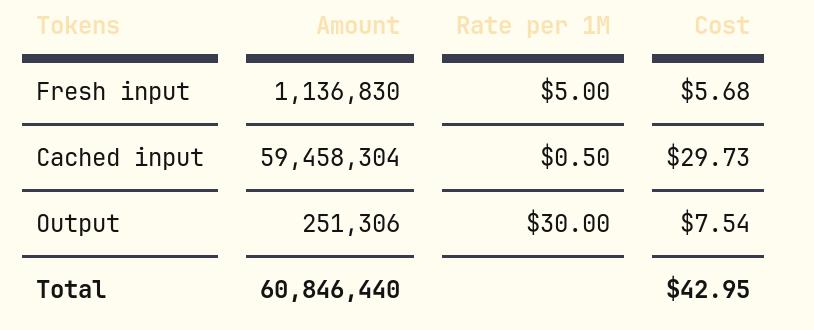
With the same method, DHH asked Codex to complete the task, and the result after one prompt was also very excellent.
However, the speed was 30% slower, and the Token cost was 43 US dollars.
DHH's remarkable operation directly attracted many senior executives of Anthropic.
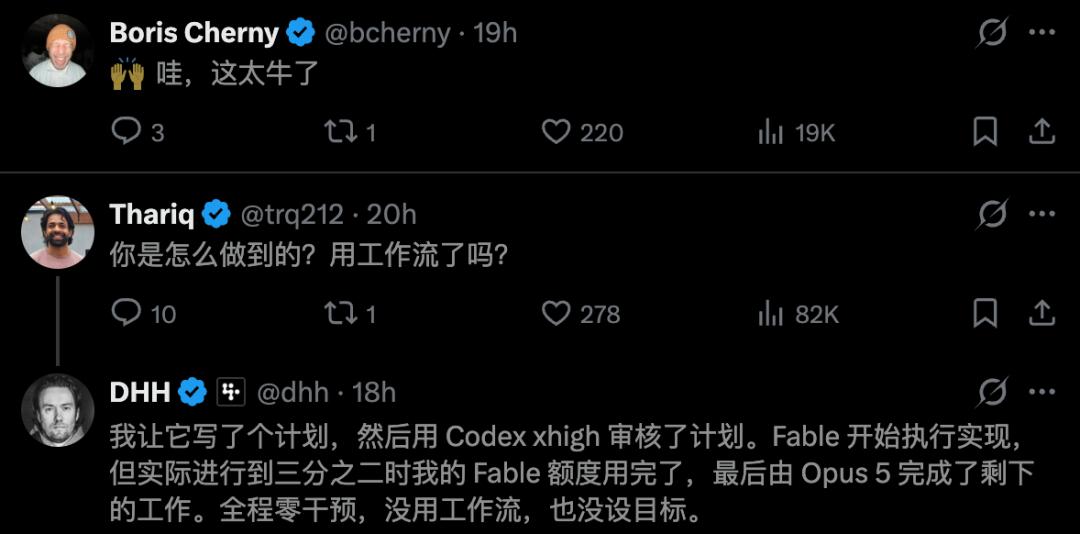
Boris Cherny, the father of Claude Code, couldn't help showing up in the comment section and exclaimed, "This is absolutely amazing"!
Faced with the inquiry from another researcher Thariq, DHH even revealed an amazing detail —
He only asked Claude to make a plan, and then there was zero intervention throughout the process, no complex workflow was applied, no specific goals were preset, and he fully delegated the authority.
Million-level code, one-click migration with Bun
After all, the size of TerminalTextEffects is limited.
What can truly demonstrate the powerful capability of AI coding is a major reconstruction of the underlying layer of Bun.
A few months ago, founder Jarred Sumner personally led the work to migrate the huge codebase from Zig to Rust as a whole.

Amazingly, this huge project with millions of lines of code was completed in less than two weeks.
If this was a few years ago, a project of this level was destined to be a marathon lasting several quarters or even years.
Future programmers need to be "Dragon Trainers"
Nowadays, all kinds of signs are constantly showing us a cruel but exciting fact —
The marginal cost of code generation is approaching zero infinitely.
This will inevitably make many people fall into panic, "If no one writes or reads code in 5 years, will programmers disappear?"
In fact, "no one writes code" never means "programmers disappear".

The core work of future programmers will undergo a fundamental shift —
From "implementing code manually" to fully focusing on defining requirements, designing constraints, building test systems, and judging whether the AI writes correctly.
It is foreseeable that when "writing code manually" becomes history, there are only two points left as the truly scarce moat in the future:
Insight into "what is worth doing" + defining "what counts as correct".
Instead of worrying about losing the keyboard, it is better to start thinking now: what kind of Rome do you want to build by commanding this "super programmer" AI with unlimited computing power?
References:
https://x.com/dhh/status/2086713611934695848?s=20
https://claude.ai/code/artifact/287825bc-7aad-4541-a7e7-fa4ba8d03612
This article is from the WeChat official account AI Era, author: Tao Zi, published with authorization from 36Kr.