Grain, all related stocks hit the daily up limit.
On August 17, the grain concept sector is undoubtedly one of the leading players in the market.
Qiule Seed, Shennong Seed rose by more than 10% during the trading session, Jinjian Rice Industry, Nongfa Seed hit the daily limit strongly, and a number of stocks such as Kangnong Seed, Deep Grain Holdings, Dunhuang Seed followed the uptrend one after another.

The sector's gain once surged above 3%, drawing investors' attention back to the core issue related to people's daily food.
The most direct trigger on the news front is a heavyweight report released by JPMorgan Chase a few days ago.
JPMorgan Chase warned that the next global food crisis may be brewing and could break out next year.
Led by Nora Sentivai, a senior global economist based in London, the team attributed the driving factors to the "five Ws" — War, Weather, Warehousing, Water and Waste.
The report predicts that the disruption of shipping in the Strait of Hormuz, coupled with the potential emergence of a historic super El Niño event, could severely weaken crop yields and restrict agricultural production.
JPMorgan Chase estimates that the global food inflation rate will accelerate from 2.8% in the first half of 2026 to 5% in the first half of 2027. In other words, the cost of food consumption may rise further.
The tense situation in the Strait of Hormuz directly affects the fertilizer supply chain —
The Middle East is a major global production hub for potash and urea. Once transportation is blocked, fertilizer prices will inevitably rise, further pushing up global planting costs.
The impact of the "super El Niño" is even more direct. The latest forecast from the U.S. National Oceanic and Atmospheric Administration (NOAA) shows that the probability of a "historic" El Niño event from October to December 2026 is as high as 69%.
Major grain producing areas in South Asia, Southeast Asia and Europe are facing the risk of production reduction, while China will also face climatic challenges featuring more frequent rainstorms, high temperatures and typhoons.
Once the expectation of supply-side contraction takes shape, there will naturally be upward room for grain prices.
If the international early warning is a "long-term concern", domestic policies are the tangible support close at hand.
On August 5, Jiangxi and Hunan launched the 2026 early indica rice minimum purchase price implementation plan; on August 11, Henan Province launched the 2026 wheat minimum purchase price implementation plan.
Within a week, the three major producing areas intensively launched market-supporting purchases, injecting a strong boost into the grain market that has been under continuous pressure.
The importance of this "market support" measure is even more self-evident at this moment.
Affected by consecutive years of good harvests, abundant inventories and weak demand growth in China, grain prices once moved down under pressure. Coupled with the Middle East conflict pushing up international fertilizer, pesticide and crude oil prices, the cost of grain cultivation in China is also rising.
The dual pressure of falling grain prices and rising production costs has put farmers in a difficult position.
The launch of market-supporting purchases is to use government intervention to cut off the vicious transmission chain of the cobweb effect in the market, preventing the phenomenon of "cheap grain harming farmers" from gradually evolving into a systemic risk.
From a deeper perspective, this institutional design of "providing a bottom guarantee without capping upside potential" secures the basic income of farmers and leaves sufficient market premium space for high-quality grain. With the policy bottom clearly established, market expectations will be stabilized.
In terms of fundamentals, grain prices have already started to rise.
Since 2026, the prices of four major staple grain varieties, including soybeans, corn, wheat and rice, have successively bottomed out and rebounded.
As of mid-May, the average corn price in China was 2,439 yuan per ton, up 3.52% from the beginning of the year; the average prices of japonica rice and wheat were 2,992 yuan per ton and 2,551 yuan per ton respectively, up 2.89% and 1.41% from the start of the year.
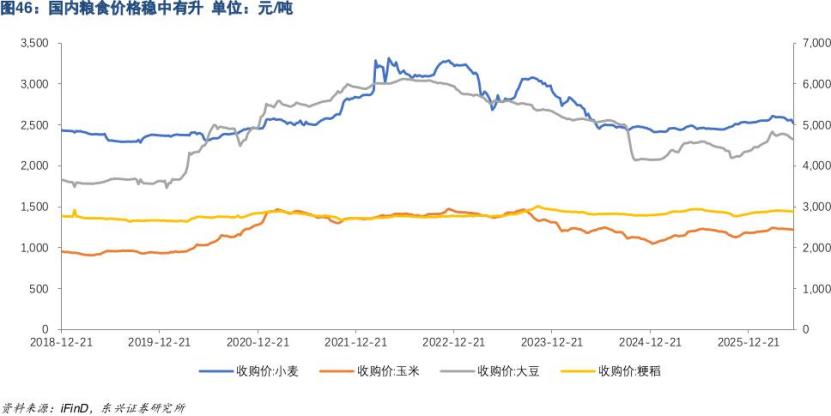
Corn leads the uptrend, rice and wheat follow the rise, and the risk premium of soybeans climbs under external disturbances. The four varieties have formed a rare synchronous upward pattern that has not been seen for many years.
However, rationality is needed amid the market frenzy. While the rising logic of grain concept stocks is clear, we also need to see the other side of the coin.
On the one hand, JPMorgan Chase's warning is after all a prediction for next year, and there is still a long gap between expectation and actual reality.
On the other hand, the fundamentals of some grain concept stocks are not optimistic.
Take Jinjian Rice Industry, which hit the daily limit today, as an example. This "first listed grain enterprise in China" has encountered continuous operational troubles in recent years.
In February 2026, it was ordered to make rectification by the Hunan Regulatory Bureau of the China Securities Regulatory Commission because its subsidiary had falsely increased its total revenue by more than 586 million yuan from 2020 to 2022; in April, it was exposed that two of its subsidiaries needed to pay supplementary taxes and overdue fines totaling more than 5.5 million yuan.
In terms of fundamentals, Jinjian Rice Industry expects a loss of 8.5 million to 11.5 million yuan in the first half of 2026.
There is often a significant mismatch between the popularity of the investment theme and the actual quality of the company.
Nowadays, the fragility of the global supply chain has been repeatedly verified, and the threat of extreme weather is getting increasingly close. The capital market's re-pricing of the grain concept may have just begun.
This article is from the WeChat official account "Gelonghui APP" (ID: hkguruclub), authored by the editor team of Gelonghui, and 36Kr publishes it with official authorization.