A new round of ratings is approaching. Can medical informatization extend its industry lifecycle?
With the DRG payment reform overlapping the anti-corruption campaign in the healthcare sector, the medical IT track has faced increasingly difficult operating conditions over the past two years.
The cash flow of public hospitals remains persistently tight, and cost pressures are transmitted upward layer by layer along the supply chain. As a non-mandatory cost item, informatization construction has been indefinitely postponed by hospitals.
The result is that informatization bidding projects have shrunk year by year, the first payment for winning bids has been directly cut in half, the accounts receivable period of enterprises has been extended longer and longer, and the entire industry has generally fallen into the dilemma of revenue growth without profit growth.
Under this situation, a policy on the change of regulatory authority has opened a gap in the sluggish market. In July, the Electronic Medical Record Grading Evaluation work was officially transferred from the Hospital Management Institute of the National Health Commission to the Statistics and Information Center of the National Health Commission.
As early as during the 2026 SHAQ Conference, the Statistics and Information Center of the National Health Commission clearly released the message: the 2025 annual Electronic Medical Record Grading Evaluation work will be fully transferred, the on-site audit for level 5 and above will be cancelled and replaced by remote online audit, and all work will be completed before the end of 2026.
The more core reform lies in the reconstruction of the grading system, which integrates and iterates the four previously separately operated standards of Electronic Medical Record Grading, Smart Service Evaluation, Interconnection and Interoperability Testing, and Smart Management Evaluation into a unified framework — the *Evaluation Standards for the Construction and Application of Digital-Intelligent Hospitals*.
Eight years ago, the dual grading of electronic medical records and interconnection and interoperability once supported a boom cycle of medical IT. Now the underlying logic of the entire evaluation rules has been completely rewritten. Is this new wave of grading a life-saving remedy for the industry, or a short-term effect that fades in a flash?
Complete Overhaul of Underlying Rules
The core changes of this round of grading reform are concentrated in the two underlying logics of verification mode and evaluation criteria, completely bidding farewell to the past exam-oriented routine of "building systems and rushing for grades".
First look at the verification logic: on-site review is withdrawn, and remote audit reshapes fairness.
Previously, level 6 and above grading of electronic medical records had always retained on-site audits, while the new regulation applies a blanket rule: all hospitals at level 5 and above are changed to remote system demonstration audits, and offline on-site verification is completely cancelled.
The remote online mode brings two-way values.
On the one hand, the whole process of remote audit leaves traces, the process is supervisable and the results are traceable, which ensures that the review work itself can be audited;
On the other hand, remote audit can avoid biased evaluation to a certain extent, reduce the space for human intervention, and make the audit environment more fair and just.
The benefits on the cost side are particularly intuitive. All costs generated by the expert team's on-site presence, including reception, scenario simulation, and manpower preparation, are completely eliminated.
Survey data shows that 81% of tertiary hospitals have incremental investment in manpower + hardware for a single evaluation that accounts for more than 10% of the annual regular budget of the information department. After the on-site review is cancelled, part of the budget space will be released and can be reallocated to regular informatization construction.
The second is the evaluation logic: in the future, the focus will shift from "whether the system exists" to "how well the system is used".
For hospitals, the core assessment of the old version of the evaluation system is "whether the function is launched": experts check the ledger, screenshots, and system demonstrations, and as long as the modules are complete, they can get scores, without paying attention to the actual implementation and usage of the system.
A large number of informatization tools launched hastily by hospitals to rush for grades have full of loopholes in actual operation data — the director of the information department of a tertiary hospital in Zhejiang reported that the closed-loop management system built for grading back then could only automatically capture complete data for 60% of business nodes, and the remaining 40% relied entirely on manual entry, but the grading agency could not identify the false implementation.
The new standard directly overturns this logic, and the core of evaluation is switched to objective operation data.
The data completeness, logic consistency rate, and time accuracy of the whole links of outpatient, inpatient, laboratory, and pharmacy are all automatically captured and verified from the hospital data center and information platform, without the need for hospitals to manually fill in materials.
Therefore, the review no longer looks at how many systems the hospital has purchased, but reads the real business data accumulated in daily diagnosis and treatment to judge whether the hospital truly has the corresponding level of digital-intelligent operation capability.
Under the forced pressure, hospitals must open the data interfaces of various business systems to activate the idle clinical data lake; data governance and data interconnection are no longer bonus items, but hard thresholds for passing the grading.
Do Hospitals Still Have Budget to Invest in Grading?
The grading reform on the policy side continues to heat up, but the capital constraint on the hospital side remains severe.
Over the past five years, the information departments of hospitals have carried out large-scale procurement driven by the grading system and the artificial intelligence wave, and related projects have extended from hospital-wide data centers to specialist-specific CDSS.
However, the return cycle of informatization investment is extremely long. A CT device can generate examination revenue in the month of installation, while the business value of a clinical data repository (CDR) often takes three years to appear.
A large number of systems launched at high cost have not brought direct operational gains to hospitals, and the willingness of management to invest in informatization has continued to decline.
However, hospitals cannot abandon their investment in grading.
Because the grading results are directly linked to the tertiary hospital re-evaluation, public hospital performance assessment, and medical insurance DRG prepayment quota, which directly determine the ceiling of hospital revenue and belong to the mandatory compliance tasks.
The market procurement logic has also changed accordingly. An enterprise said: "Under the new situation, hospitals may abandon tens of millions of yuan of large grading orders, and instead conduct detailed investigations when formulating grading requirements, formulate refined procurement requirements, to ensure that the purchased products can be successfully launched and put into use after completion."
In addition, hospitals will also consider the priority of application and system construction during the construction process.
For example, artificial intelligence-related applications or smart operation-related systems that can not only meet the grading requirements, but also bring benefits to hospitals in the short term, will be given higher priority in the new round of grading construction.
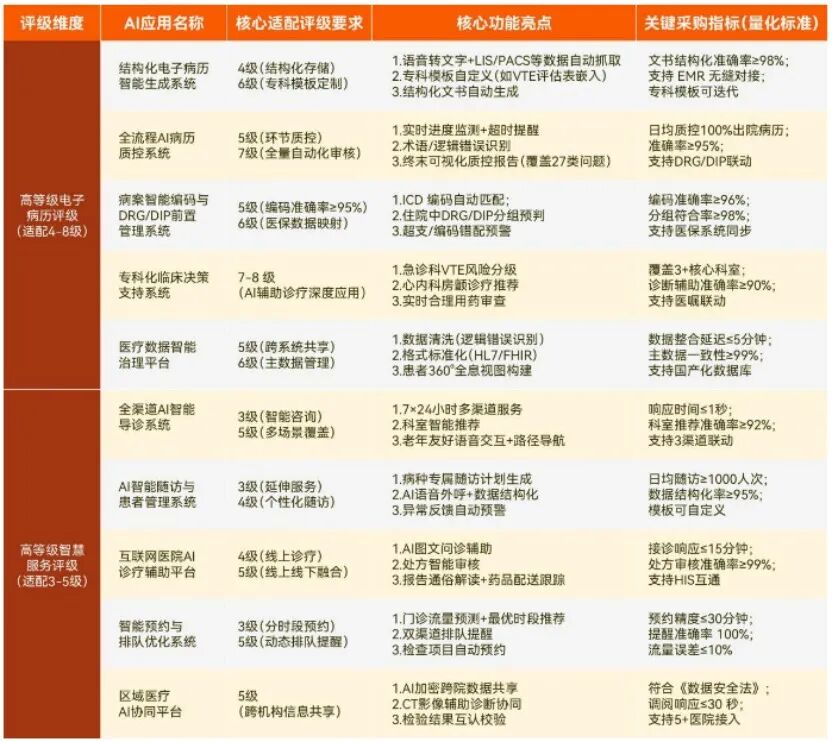
Summary of AI indicators related to grading (Produced by VBear)
More Than Just Rushing for Grades, Turning Data Into Hospital Cash Flow
The new grading regulations do release a number of incremental orders, which can alleviate the shrinking pressure of medical IT enterprises' orders in the short term. However, the long-term breakthrough of the industry cannot only rely on selling systems and undertaking grading projects.
The rigid demand for data governance brought by the new regulations is the real long-term growth point of the industry.
The new standards mandatorily require the completeness, unity and chronological accuracy of full-link data, forcing hospitals to activate the dormant data scattered in various business systems, which opens up two brand new commercialization paths for medical IT:
The first is to use data governance + trusted data space to help hospitals turn cost departments into revenue-generating units.
In the past, the information department of a hospital was purely a cost-consuming department. Now, with standardized data governance, clinical data can be packaged into compliant data assets for external monetization.
According to VBear, a tertiary hospital in Beijing, with the assistance of an enterprise, obtained more than 1.5 million yuan of out-of-hospital cooperation revenue in the first year only by relying on a set of governed real-world diabetes data sets, successfully turning the information department from a cost department into a revenue-generating department.
When the grading pushes hospitals to complete data standardization, many leading manufacturers have started to launch integrated "data governance + trusted data space" solutions. By completing data inventory, desensitization, right confirmation, and packaging in one stop, the special disease data sets are authorized to pharmaceutical R&D and insurance actuarial institutions for use under the compliance framework.
Hospitals will no longer make one-time purchases only to cope with grading. The continuous monetization revenue of data assets will drive long-term repurchase demand.
The second is to bind the hospital's revenue indicators to create high-value AI applications.
The new version of the *Standards for the Construction of Digital-Intelligent Hospitals* embeds AI quantitative indicators in the whole process, covering all scenarios such as triage, auxiliary diagnosis, medical record quality control, and operation decision-making.
If enterprises want to break through the involution, the core is to make products directly linked to hospital revenue and medical insurance costs, and implement quantifiable incremental value.
There are also mature implementation cases at present:
AI medical record homepage quality control tool: Correct the main diagnosis errors in real time through NLP, increase the hospital's CMI value, and directly optimize the national examination performance, financial allocation and medical insurance prepayment quota; DRG intelligent pre-grouping cost early warning system: Intercept medical insurance illegal charges in advance, and a single tertiary hospital can avoid nearly 10 million yuan of denial of payment losses every year.
Data Assetization Is the Cornerstone of Long-term Development of Medical IT
Generally speaking, the new round of digital-intelligent hospital grading reform will release informatization transformation orders in the short term, temporarily alleviate the downward pressure on the industry, but relying only on the rigid demand of grading can only earn short-term dividends.
The underlying change brought by the new regulation is essentially to push hospitals to shift from "procuring systems" to "operating data".
For medical IT manufacturers, the real turning point is not how many grading projects they can win, but to seize the two main lines of data governance and AI clinical revenue growth, and provide hospitals with solutions that can continuously create cash flow.
When informatization products can not only meet the grading compliance requirements, but also bring replicable and quantifiable revenue-increasing benefits to hospitals, the entire industry can get rid of the continuous sluggish cycle.
This article is from the WeChat official account "VBear" (ID: vcbeat), Author: Zhao Hongwei, published with authorization from 36Kr.