All AI outputs are flooded with the "not...but..." construction, which has made me too hesitant to write on my own.
How many people are nearly driven crazy by the overused "It is not... but..." phrasing spouted by AI?
You ask: "I've been a bit tired lately and haven't worked out, will I lose muscle?" It replies: "You are not lazy, your body just needs rest."
When you ask it to introduce the new features of a software, it says: "This is not just an upgrade, but a revolution in the way we work."
Even if you ask how many minutes it takes to boil a soft-boiled egg, it will say: "Boiling an egg is not just waiting for the food to cook, but precise management of time and temperature." The egg would get so mad it cooks itself.
"It is not... but..." has become one of the most famous AI verbal tics. I would name it, together with the "em dash", three-parallel structure, and "I've got you", as the "Four Great Classics" of AI writing.
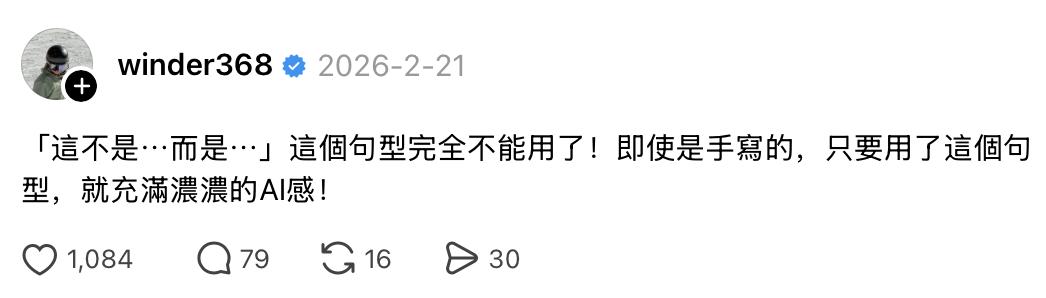
Image source: Threads
What's most frustrating is not the AI-generated garbage content, but the fact that this sentence pattern originally belonged to humans. (Even I feel a little guilty after writing this sentence.)
Shakespeare wrote in Julius Caesar: "The fault, dear Brutus, is not in our stars, but in ourselves." If you post this line on social media today, someone will probably leave a comment soon saying: "This is obviously written by AI."
So why does AI love saying "It is not... but..." so much? Does this have anything to do with Shakespeare?
Where do AI get all these verbal tics from?
AI loves using this phrasing because humans have long been very fond of it. Looking back at human works before the emergence of AI, the "not... but..." contrast pattern can be found everywhere.
It first puts forward a statement familiar to readers, then presents a reversal, and finally gives an answer that sounds more accurate and more advanced. It contains misunderstanding, turning point and conclusion, and one single sentence is like a mini debate.
Especially in copywriting, you can see lines like "We do not sell coffee, but a lifestyle"; "This is not just a watch, but your health companion"; "Not all milk is AAA"... After a simple turn, coffee beans turn into a lifestyle, watches start caring about your physical condition, and different milk products get their distinct status in the market.
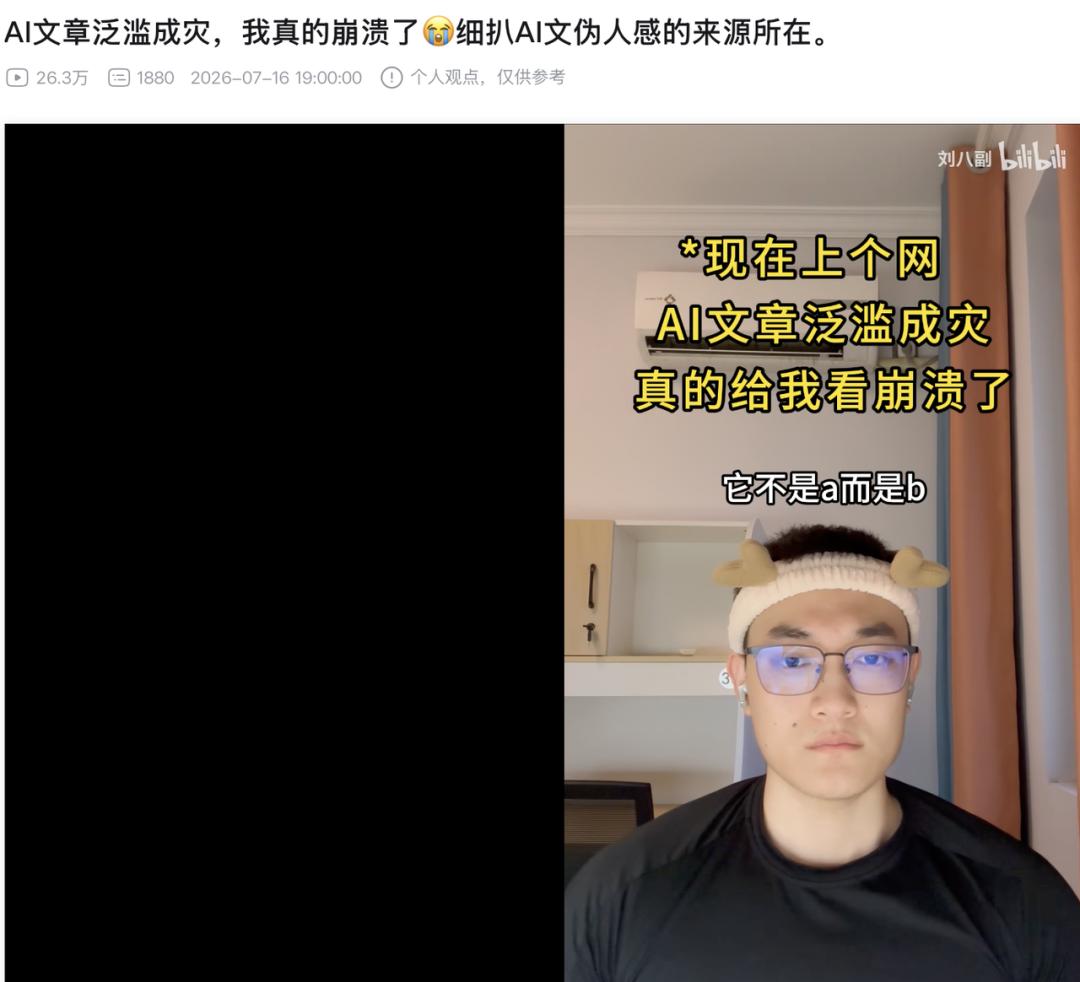
I'm not the only one suffering | Bilibili UP owner @Liu Bafu
Such a useful sentence pattern was all taken as training material when large language models were being developed.
When humans read the romantic entanglements in Pride and Prejudice, AI only remembers fixed sentence patterns like "It is very often nothing but our own vanity that deceives us."
When the model finds that "not X" is often followed by "but Y", and after being trained on thousands of similar corpora, it can blurt out this pattern without thinking. The research institute Pangram also counted that the close relative of "not... but..." — the "Not just X, but Y" pattern — appears about three times more frequently in AI-generated texts than in human-written texts.
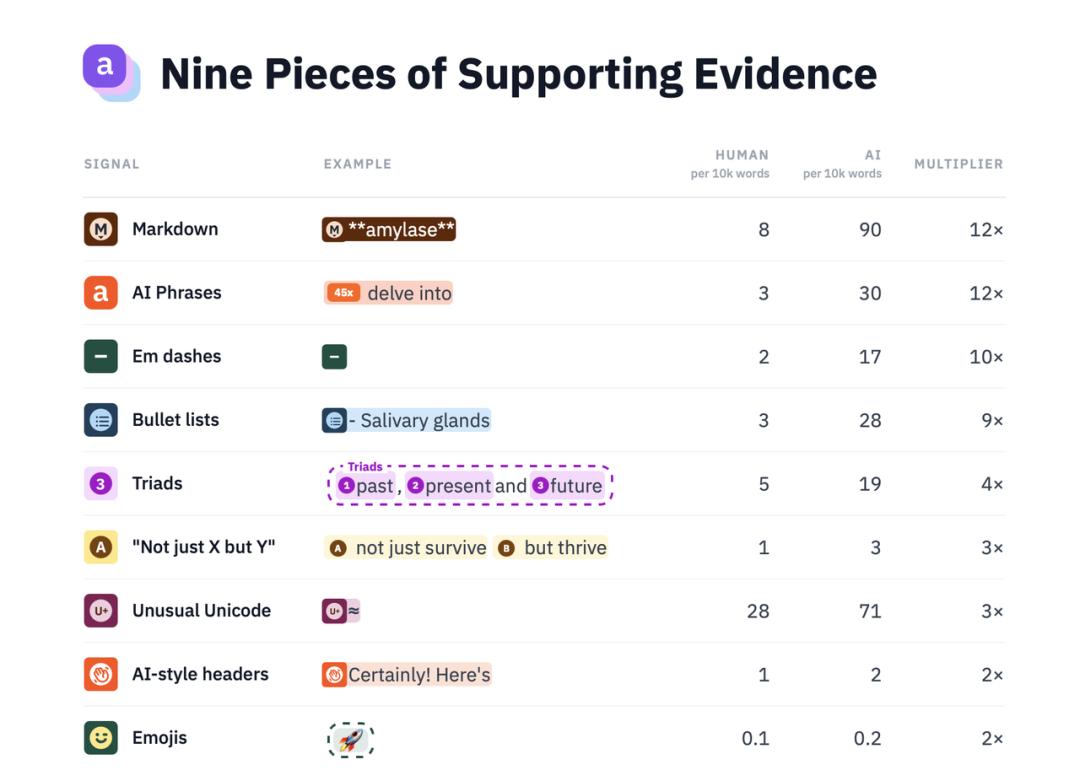
Pangram has summarized a huge number of sentence patterns that AI prefers to use | Pangram
Another reason for AI to develop this verbal tic is RLHF (Reinforcement Learning from Human Feedback).
This is just like how Chinese teachers grade compositions: argumentative essays are considered more in-depth than narrative essays, and parallelism, metaphor and personification can easily earn extra points. Even humans can be "reinforced and trained" by the grading bias, let alone AI.
When AI outputs sentences with contrast patterns, it seems to have understood the user's confusion and analyzed the essence of the problem, looking very dialectical. These answers may not be the most creative, but they look complete, reliable, and can easily get high scores from human raters.
In its report on this phenomenon, The Atlantic also put forward a speculation: starting a statement by saying something is "not X" can leave more room for subsequent writing.
It's just like when a leader starts a meeting by saying "We need to look at this issue dialectically" or "This issue cannot be viewed in a simplistic way" — this kind of empty, meaningless rhetoric is just to get the conversation going and give the brain time to catch up with thinking.
Now that the principle is explained, we still haven't answered the question: why does the "not... but..." pattern, which humans have used for so long, feel so uncomfortable when coming out of AI's mouth?
Humans can use it, but AI can't?
When humans use this pattern, there is a real premise that needs to be negated, rather than creating a non-existent target out of thin air. When someone mistakenly thinks that whales are fish, you need to explain that "A whale is not a fish, but a mammal". Only when the former statement can be overturned can the latter one be reasonably introduced.
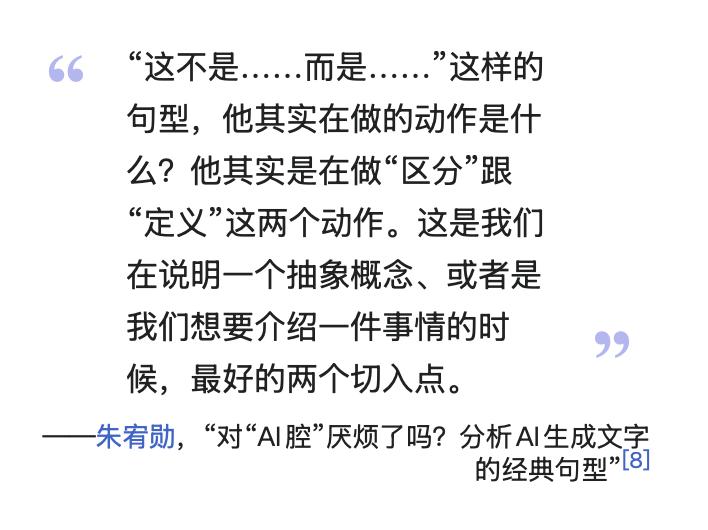
Wikipedia: Features of AI-generated texts | Wikipedia
But how does AI speak? It says, "You are not lazy, this is not a failure, you just need to rest." The problem is that you never thought you were lazy in the first place, but AI first labels you a failure, then seemingly "catches" you from the sense of frustration.
This is exactly what makes people uncomfortable: AI presupposes your thoughts, with a strong sense of preaching.
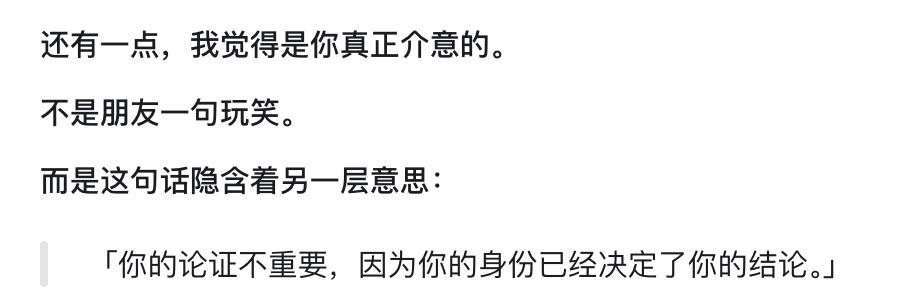
I don't mind at all, my friend is not even joking! | ChatGPT
There is another scenario where AI outputs pure nonsense: it replaces a simple expression with a longer, more abstract sentence that adds no new information at all. For example, "This is not chaos, but a state of loss of control before the new order is re-established." Doesn't this sound like your leader who likes to replace "help" with "empower" and "send a notice" with "information transparent transmission"?
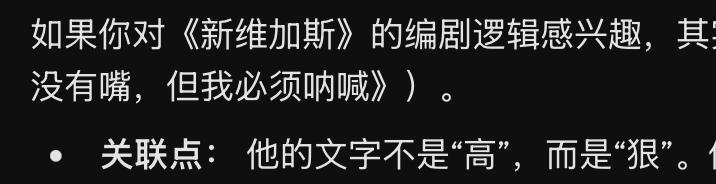
It's rare to see a "not... but..." where I can't understand either X or Y | Gemini
Humans tend to stop at the right point when speaking, and only occasionally need to elaborate fully, while AI always wants to make its statements as perfect and unassailable as possible.
This is a common problem for AI: it is afraid of not being "obsequious" and thoughtful enough, which makes it look unengaged, so it always tries to make its statements as full and comprehensive as possible.
For example, you tell your friend "I was totally worn out from yesterday's workout." Your friend might reply, "Weakling, fight again next week!" But if you ask AI? It will definitely comfort you thoroughly: "This is your body sending a signal. Rest is not laziness, but preparation for better training."
A lot of the "AI vibe" comes from this kind of excessive completeness. No matter how small the question is, AI "thinks" it deserves a full discussion. Every single sentence you read looks fine, but when you put them in a conversation, it feels like you're reading the standard answer to a Chinese reading comprehension test.
But the most helpless thing is that after this perfectly normal sentence pattern becomes an AI verbal tic, it even restricts human expression.
The roles are reversed!
"Writing cleanliness obsession" is becoming more and more common.
Marc Randolph, co-founder of Netflix, posted on X that he would delete the "not X, but Y" pattern from all his writing. But he is just as annoyed as I am: this pattern never belonged to AI in the first place. Clarifying what something is not is often the most straightforward and powerful way of expression.
Journalist Emerson Green also complained on X (this post went viral) that AI has completely ruined this originally perfect and very practical sentence pattern. Now when you write this way, readers will either immediately assume it's AI-generated, or start analyzing whether it was written by AI or not.
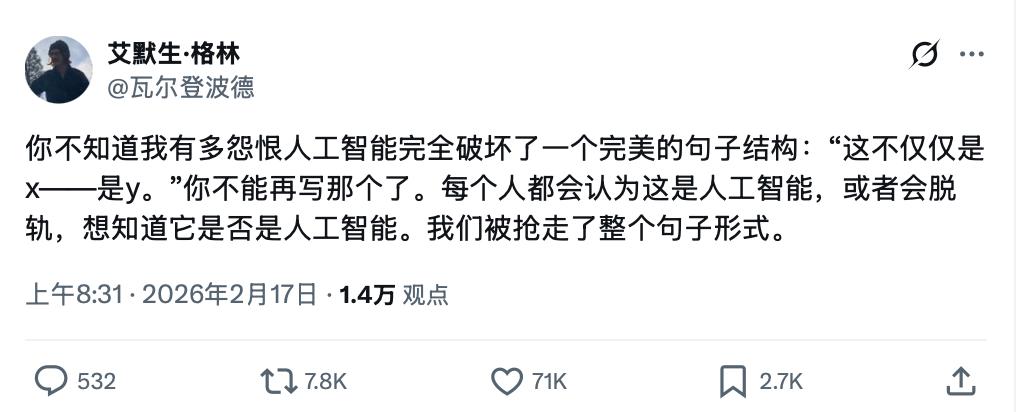
Not long ago, a much-talked-about event in the publishing industry confirmed Emerson's post.
In February 2025, Mia Ballard self-published the horror novel Shy Girl online. Later, this book was picked up by the major publisher Hachette and published in the UK.
But after the physical copy of Shy Girl was released, some readers found repeated logical breaks, exaggerated adjectives and three-part writing structures in the book. This familiar "AI vibe" immediately made readers suspicious.
Youtube book reviewer frankie's shelf even made a 2-hour-40-minute video discussing whether a novel was written by AI, which has now gained 1.95 million views (the title is "I'm pretty sure this book is AI garbage").
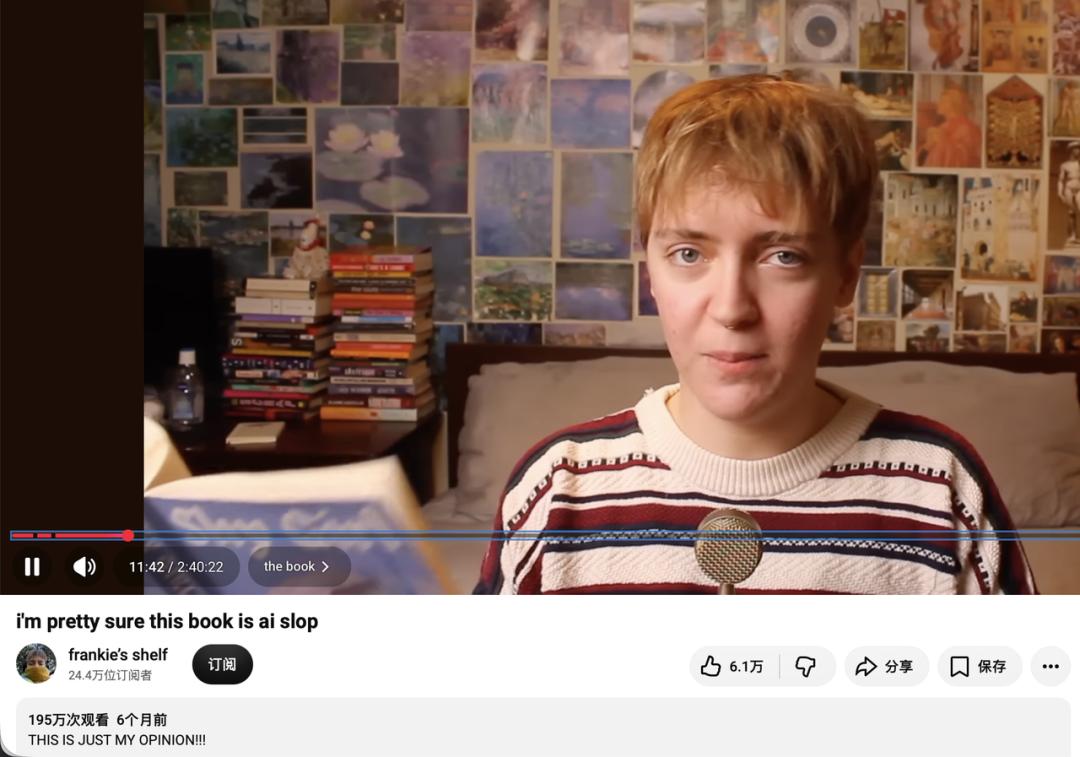
The controversy grew bigger and bigger, and Hachette finally canceled its publication plan for the US market. But Mia insisted that she did not use AI to write the book, saying that the editor who helped her revise the manuscript used AI, and that she would take legal action against the editor. The Shy Girl publishing storm has become a total Rashomon case.
There is no denying that AI has blurred people's intuitive judgment and standards. To look more human, human authors have begun to deliberately "make mistakes" when writing. For this phenomenon or trend,
Wired magazine calls it the "anti-AI literary subculture".
Novelist Laura Brooke Robson deliberately avoids em dashes, three-parallel structures and the "not X, but Y" pattern when writing, and even leaves some grammatical errors and typos. Another novelist Ellena Savage also said that she used to love using em dashes and three-parallel structures, but now she dare not use them anymore.
Writer Jessye McGarry even deliberately misspells words in her articles, and after the input method automatically corrects them, she will actively undo the correction.
This sounds rather lamentable: AI learned neat writing and perfect expression from human articles, but humans have to repeatedly prove that "I am a human" to avoid being mistaken for AI.
It is truly the roles that have been completely reversed.
This is not the success of AI, but rather a failure of humanity.
References
[1] https://dev.to/milind_nair/why-does-ai-keep-saying-its-not-x-its-y-2ihk
[2] https://theconversation.com/slanguage-why-ais-stylistic-negation-its-not-x-its-y-is-both-annoying-and-doesnt-work-278967
[3] https://medium.com/@nairmilind3/why-does-ai-keep-saying-its-not-x-it-s-y-4da4d205c93d
[4] https://www.reddit.com/r/ChatGPT/comments/1l5l2s3/its_not_x_its_y_most_annoying_chatgpt_tell/
[5] https://mail.cyberneticforests.com/its-not-just-data-its-post-training/
This article is from WeChat official account "Guokr" (ID: Guokr42), written by Gaoji Dongwu, edited by Shen Zhihan, and authorized for release by 36Kr.