Neither joining the AI rat race nor carrying out share repurchases, can the "stingy" JD still make it?
Perhaps JD (JD.US), arguably the "most solid" e-commerce platform in China at present, released its financial results for the second quarter of 2026 on the evening of August 13. Overall, the performance can be described as "stable" or "unremarkable". From the perspective of expectation deviation, both revenue and overall profit slightly outperformed Bloomberg's forecasts, but compared with the estimates of some major financial institutions, they only met or slightly underperformed expectations.
In terms of trends, as the overall domestic consumption weakened in the second quarter, the total revenue of this quarter fell into negative growth. However, since the weak performance of total retail sales of consumer goods had long been anticipated, this result is not surprising. Although the profit of the mall segment declined year on year, compared with the profit that was almost completely wiped out due to the food delivery war last year, the overall profit of the group saw a notable year-on-year recovery instead.
Details are as follows:
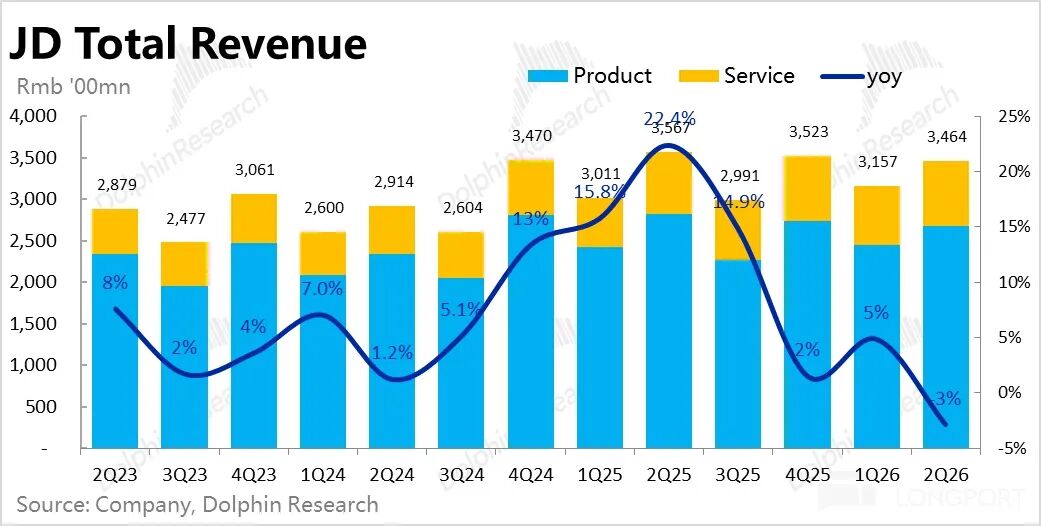
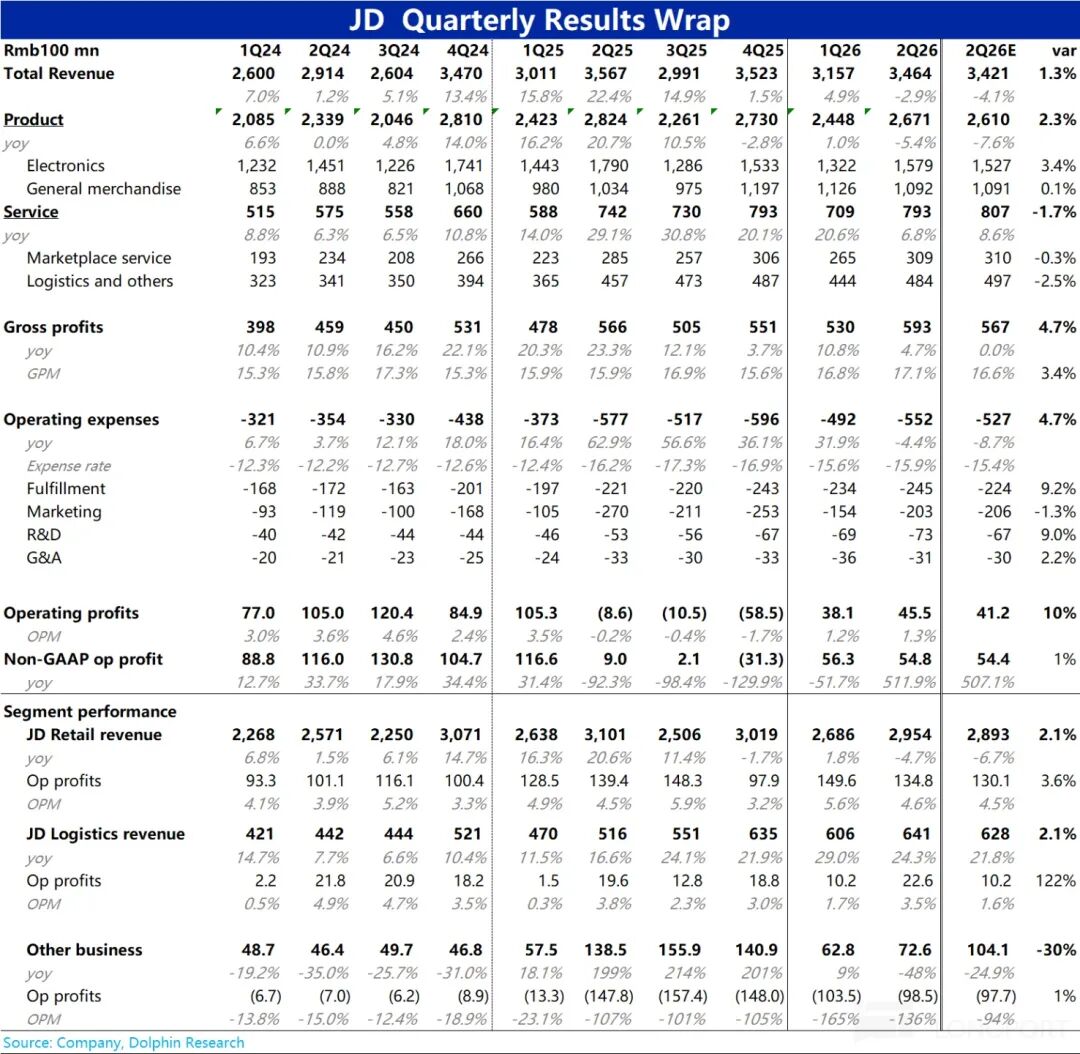
1. Both revenue and profit declined, but no negative surprises: JD's total revenue in this quarter was about 346.4 billion yuan, down 3% year on year, a more obvious drop compared with the 5% decline in the previous quarter, which is roughly in line with market expectations and not a negative surprise, consistent with the trend of the overall growth rate of total retail sales of consumer goods in this quarter.
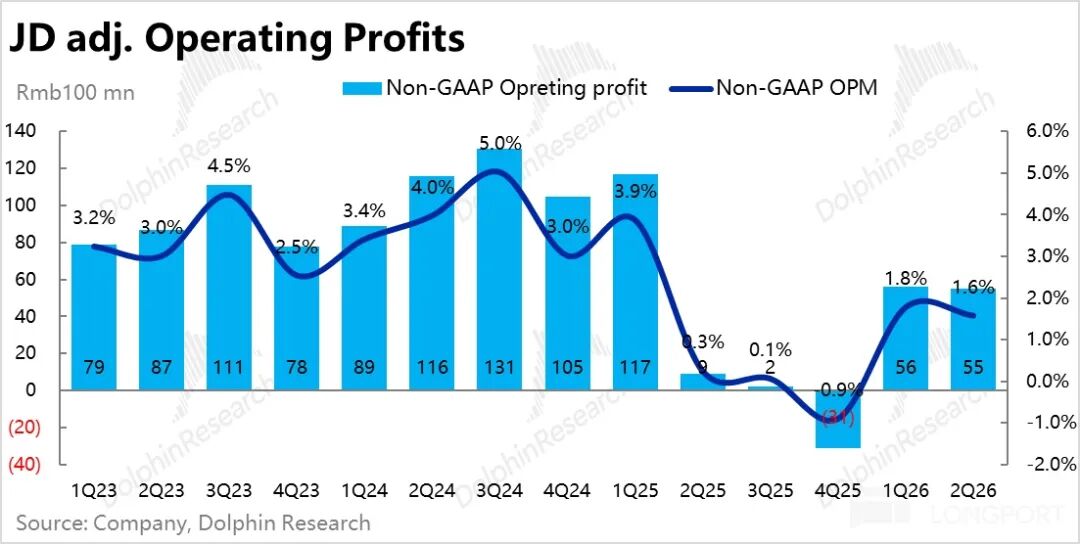
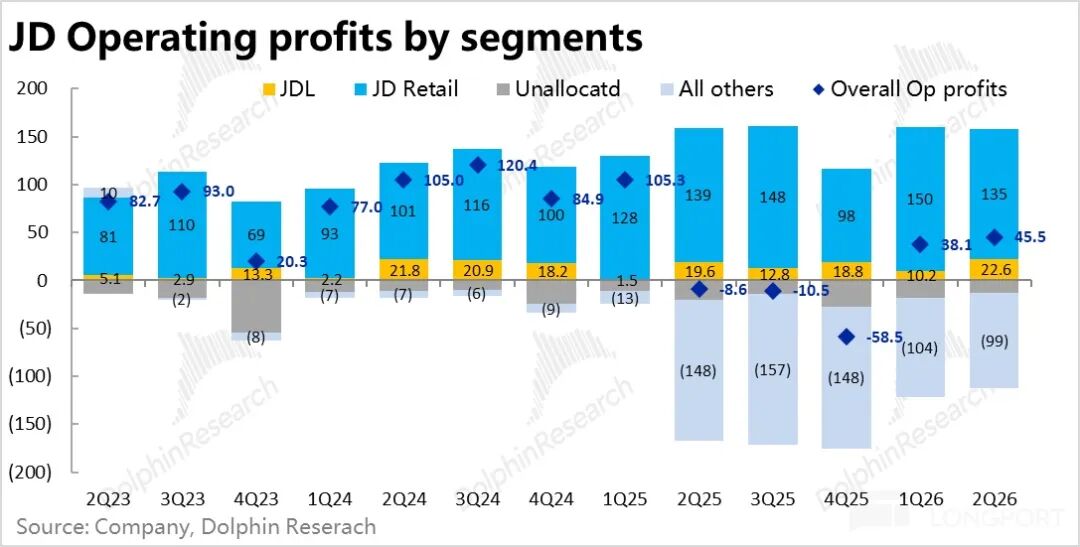
The group's overall operating profit reached 45.5 billion yuan, and the adjusted operating profit was 54.8 billion yuan. According to the adjusted standard, it is slightly better than Bloomberg's expectation, but weaker than the forecasts of some major institutions. Specifically, it is mainly dragged down by higher-than-expected losses from new businesses.
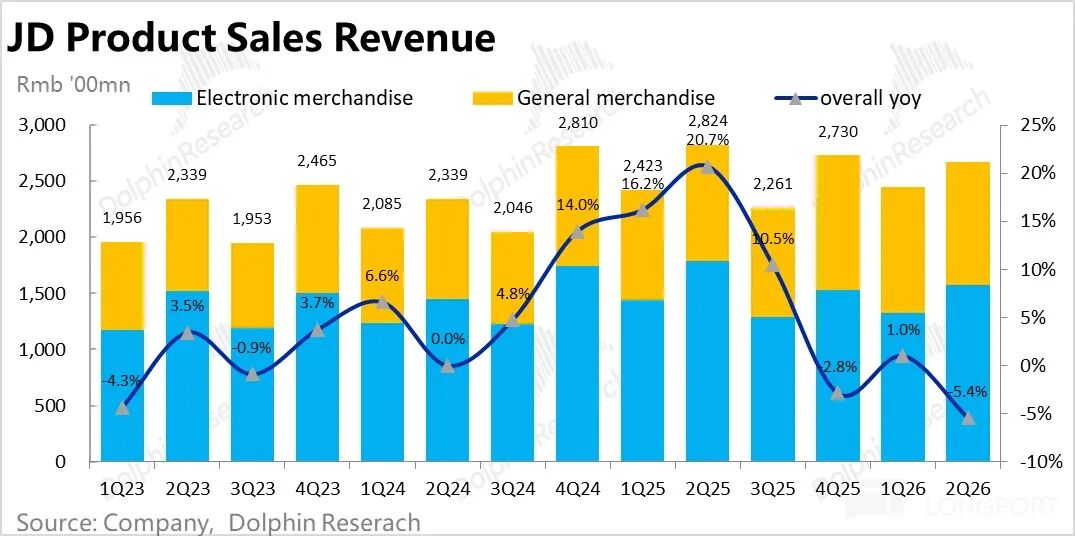
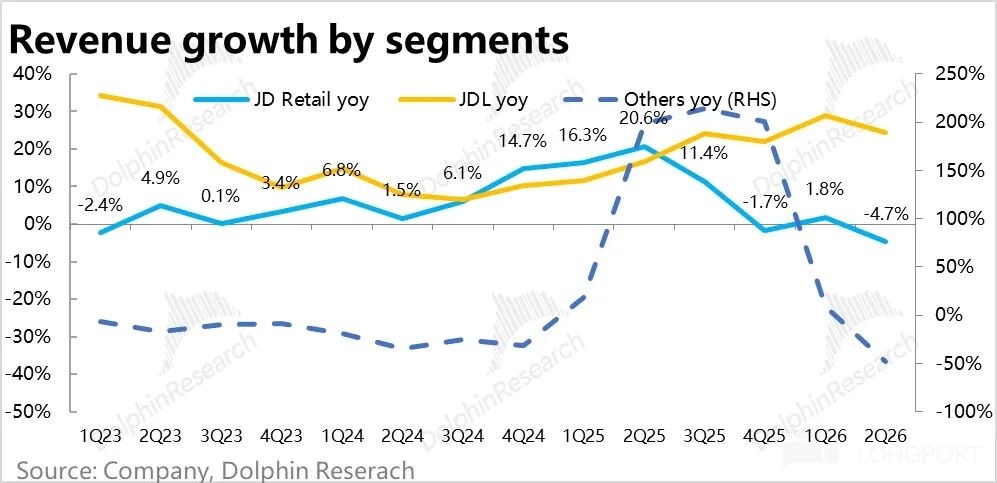
2. The growth of daily necessities and advertising dropped more sharply: The most important domestic mall segment recorded a year-on-year revenue decline of about 4.7% in this quarter, and the growth rate continued to deteriorate as expected. The decline was smaller than market expectations but roughly in line with the forecasts of top-tier institutions.
Specifically, the actual deterioration of sales of home appliances and consumer electronics products, which is the most worrying part, is limited. The year-on-year decline in this quarter was less than 12%, compared with the 8.4% drop in the previous quarter. This may be due to the marginal rebound driven by favorable national subsidies, which were previously mainly allocated to offline channels and have recently started to flow back to online channels.
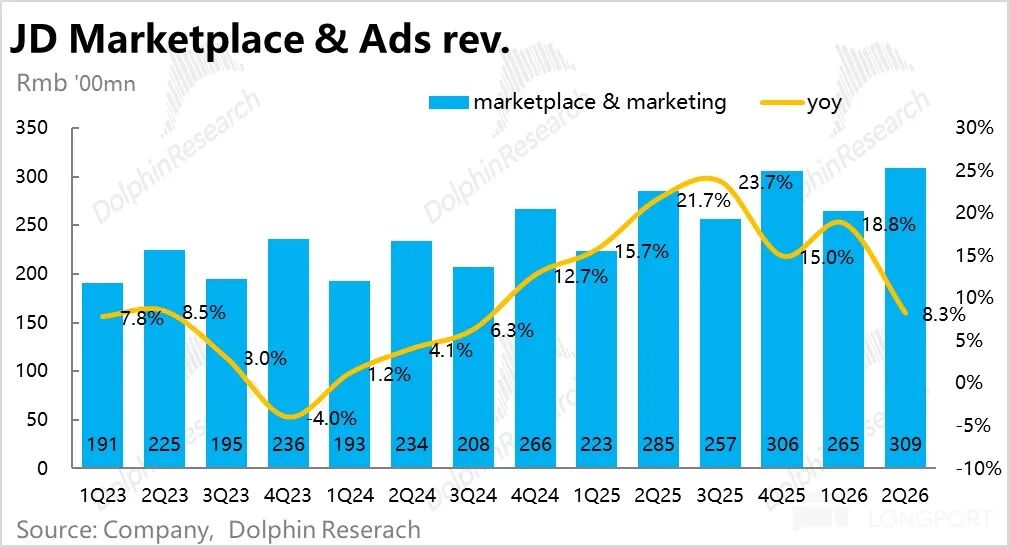
In contrast, the sales of daily general merchandise and service advertising revenue, two businesses that theoretically are not directly impacted by the phase-out of national subsidies, saw a more significant decline in growth rate instead. The sales growth rate of daily general merchandise dropped from 15% to 5.6%, and the growth rate of advertising services fell from nearly 19% to about 8%. The decline in the growth rate of both businesses reached around 10 percentage points.
Although the market had anticipated this slowdown and the slowdown has reasonable causes (the diversion effect of home appliances, consumer electronics products and food delivery on the overall platform has weakened), these two businesses are the main driving force for JD's mid-term performance growth, which may make the market question whether after the negative impact of the national subsidy phase-out passes, the core growth rate of JD Mall can accelerate again (for example, return to above 10%).
3. The food delivery war cools down, and the growth of logistics and new businesses is also slowing down: As it has entered the high base period caused by the food delivery war, and the number of food delivery orders this year has decreased instead of increasing, the growth rate of logistics revenue and new businesses both declined in this quarter.
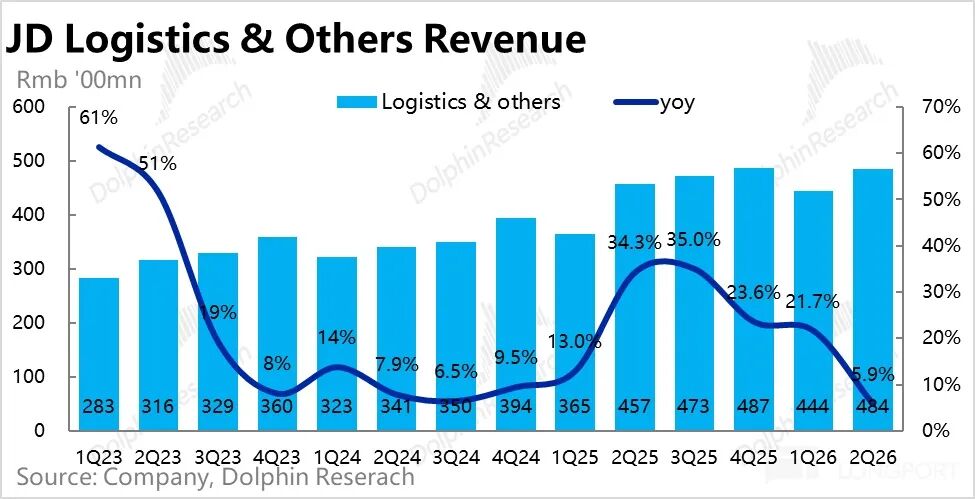
Among them, the growth of logistics and other revenues slowed to 5.9%, and after the pulling effect of food delivery faded, it basically returned to the normal mid-to-high single-digit growth level before 2025.
However, if we only look at the revenue of innovative businesses, it increased by about 15% quarter on quarter, which suggests that the revenue contributed by overseas businesses should have increased to some extent.
4. The profit margin of the mall segment can still improve, and the loss of new businesses is slightly higher than expectation: Overall, the group's profit in this quarter is basically in line with expectations.
From the perspective of different segments, the operating profit of JD Mall segment in this quarter was nearly 13.5 billion yuan, slightly outperforming Bloomberg's expectation of about 13 billion yuan. In terms of trends, failing to resist the contraction of revenue, the profit also decreased by about 3% year on year, failing to deliver a result that far exceeded expectations again.
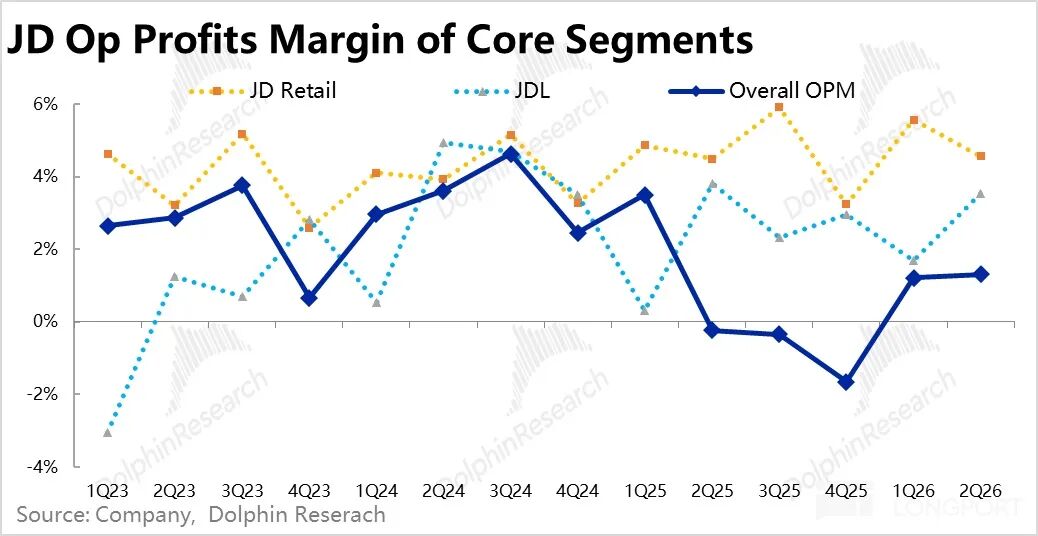
However, the profit margin still increased slightly by less than 0.1 percentage point year on year. For optimists, it can be said that JD is still improving its profit margin while its revenue is shrinking; for pessimists, it can be argued that the room for profit margin improvement in the mall segment seems to be very limited.
Combined with the company's explanation, the continued rise in profit margin is mainly attributed to the revenue structure tilting to high-margin businesses and the optimization of the supply chain.
For the innovative business segment including food delivery, the loss in this quarter was nearly 9.9 billion yuan, which did not narrow much compared with the previous quarter as Dolphin Research expected, and was slightly higher than the loss in Bloomberg's consensus expectation.
According to the general expectation in the market, the loss of JD's food delivery business in this quarter should have decreased by about 1 billion yuan quarter on quarter, which suggests that the investment in other businesses such as overseas operations increased by about 500 million yuan quarter on quarter (which does not seem to be a very large amount).
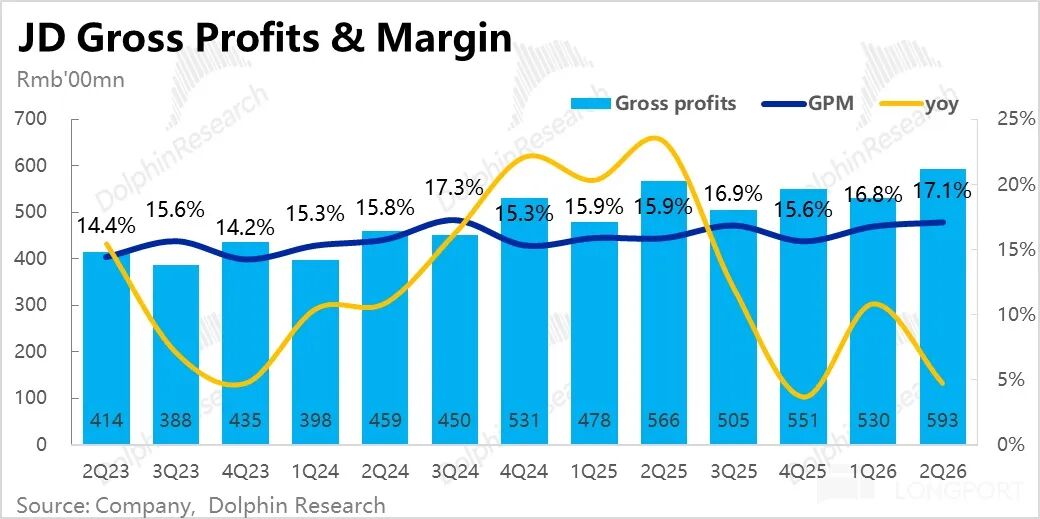
5. Perspective of costs and expenses: First of all, in terms of gross profit margin, the group's overall gross profit margin continued to rise quarter on quarter in this quarter, from 16.8% to 17.1%. As a result, gross profit still achieved a positive growth of about 5%.
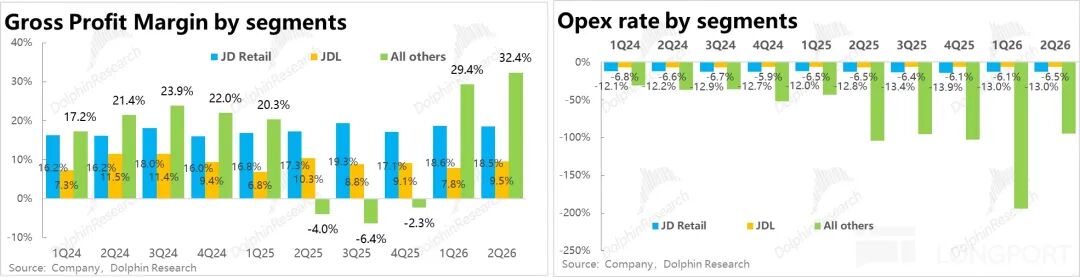
Specifically, this is mainly because after the reduction of food delivery subsidies, the gross profit margins of the innovative business segment and the logistics segment have both improved, among which the new business contributed more, with the gross profit margin rising by 3 percentage points quarter on quarter. In contrast, the gross profit margin of the mall segment decreased slightly by about 0.1 percentage point quarter on quarter (of course, it still rose significantly by 1.2 percentage points year on year), which shows that there is little room left to increase gross profit by optimizing the upstream supply chain.
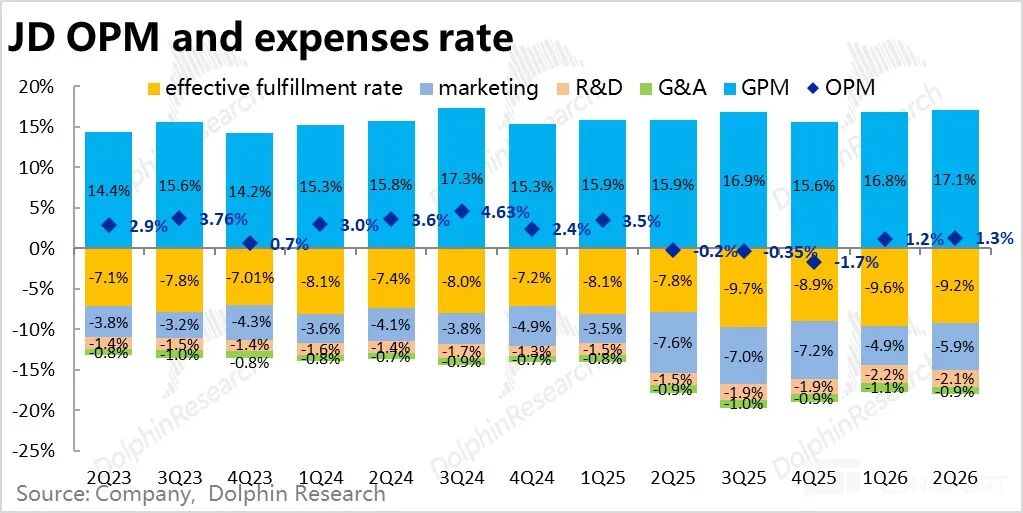
From the perspective of expenses, the company's overall expense expenditure in this quarter also decreased by 4.4% year on year, a larger decline than the revenue, which helps the release of profits. Specifically, the marketing expenditure decreased by 25% year on year as expected. Another noteworthy point is that R&D expenditure still maintained a rapid growth of 38%. It seems that although JD has not made large-scale investment in AI model R&D, it has made investment in some internal AI applications.
From the perspective of different segments, the total expense ratio of the mall segment increased by about 1 percentage point both year on year and quarter on quarter, which shows that after the phase-out of national subsidies, the company faces greater pressure to subsidize users on its own, which is also the main reason why the profit margin of the mall segment failed to rise further significantly.
The overall expense reduction of the group is mainly due to the reduction of investment in new businesses, which decreased by about 1.8 billion yuan year on year.
6. Shareholder returns decline, no large investment in AI but increased investment in overseas business: Another previous advantage of JD is that it ranks among the top companies in terms of shareholder returns among Chinese concept stocks. However, in the whole first half of 2026, the company only repurchased a total of about 1 billion US dollars, with an annualized rate of return of only about 5% relative to the current market value, which decreased significantly.
And unlike Alibaba or Tencent, JD does not have massive AI capital expenditure, so its cash flow pressure is not large. In the cash flow statement of this quarter, JD's investment capital outflow was about 29.5 billion yuan, but the vast majority of this was used to purchase short-term investments, wealth management products, etc., which is not investment in the real sense. The impression that it would rather buy wealth management products than distribute profits to shareholders is obviously not good.
Dolphin Research Insights:
1. As can be seen from the above content, JD's current performance is unremarkable from the perspective of expectation deviation, with no bright spots. In terms of trends, the growth is slowed down due to macro drag. Although the overall profit seems to improve due to the reduced loss of food delivery, the profit of the core mall segment is declining. So the overall performance is definitely not good.
In summary, the core shortcomings are as follows: a. The decline in mall revenue is expected, but in the past, the profit of the mall segment generally far exceeded expectations and guidance, and this time it is quite flat, which seems to show that the trend of increasing profits in the mall segment has hit a bottleneck; b. Although the loss of food delivery has narrowed, due to overseas investment, the overall loss of new businesses has basically not decreased; c. The growth rate of daily general merchandise and advertising revenue has decreased significantly, which is reasonable but bad news for the mid-term revenue growth outlook; d. The company would rather buy wealth management products than pay dividends to shareholders.
2. Follow-up outlook & logical judgment
The current performance is not good, so what about the follow-up outlook? Dolphin Research believes that the decisive factors affecting the subsequent performance and stock price are roughly two points:
1) Whether the prosperity of the domestic e-commerce business in the second half of the year can see a clear inflection point. From the macro data of total retail sales of consumer goods, whether the overall consumption or online consumption in the second quarter was indeed the worst in recent years. But the latest growth rate of total retail sales of consumer goods in June has improved compared with that in May. The overall growth rate recovered from -0.6% to +1%, and the online physical goods consumption growth rate rose from 2.6% to 3.9%.
For home appliances and consumer electronics products, which are particularly important for JD, the National Bureau of Statistics disclosed that the sales growth rates of household appliances, furniture and communication products also saw significant improvement in June (the