Personal branding will become your most valuable asset in the AI era
The Translate Division is a professional translation team under 36Kr, focusing on sectors including technology, business, workplace and daily life, with a core focus on introducing cutting-edge overseas new technologies, novel perspectives and emerging trends.
Editor's Note: In the era where everyone has access to the exact same AI tools, technology is no more than a basic underlying standard configuration. The unique personal brand, aesthetic perspective and personal charisma are the most stable and core lifelong assets in the AI era. This article is translated from overseas sources, and we hope it can bring you valuable insights.
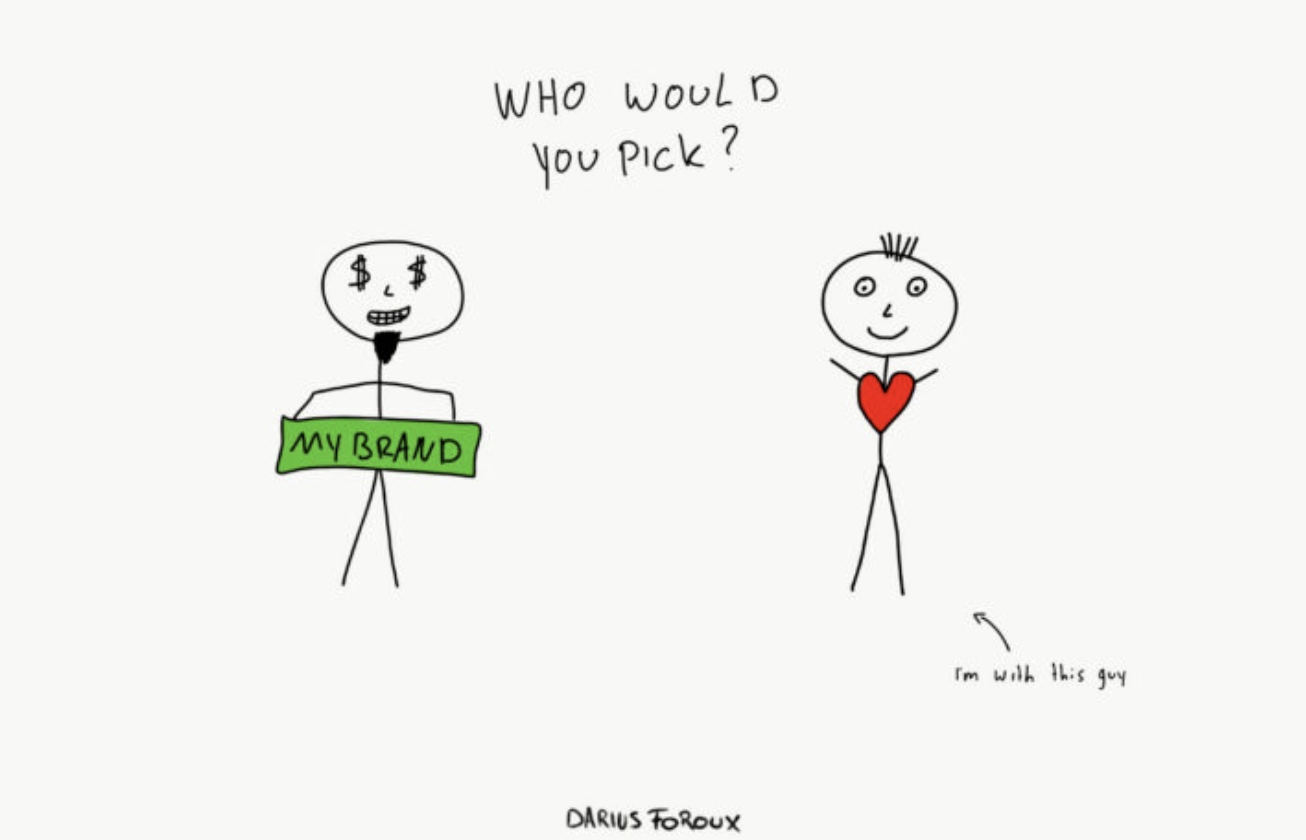
I firmly believe that artificial intelligence will not eliminate human beings' desire for interpersonal connection, human warmth, narrative storytelling and self-expression.
The reason why I am so certain lies in one single word: culture.
When people talk about artificial intelligence, they often underestimate the power of culture.
The culture referred to here means shared values and thinking patterns. It is a slow and intangible force that determines which things can truly take root in our lives and which will eventually be eliminated.
Most people have overlooked one point: after new things emerge, they must go through cultural screening to bring real changes, and the evolution of culture has always been slow-paced.
How Exactly Do Things Become the Norm
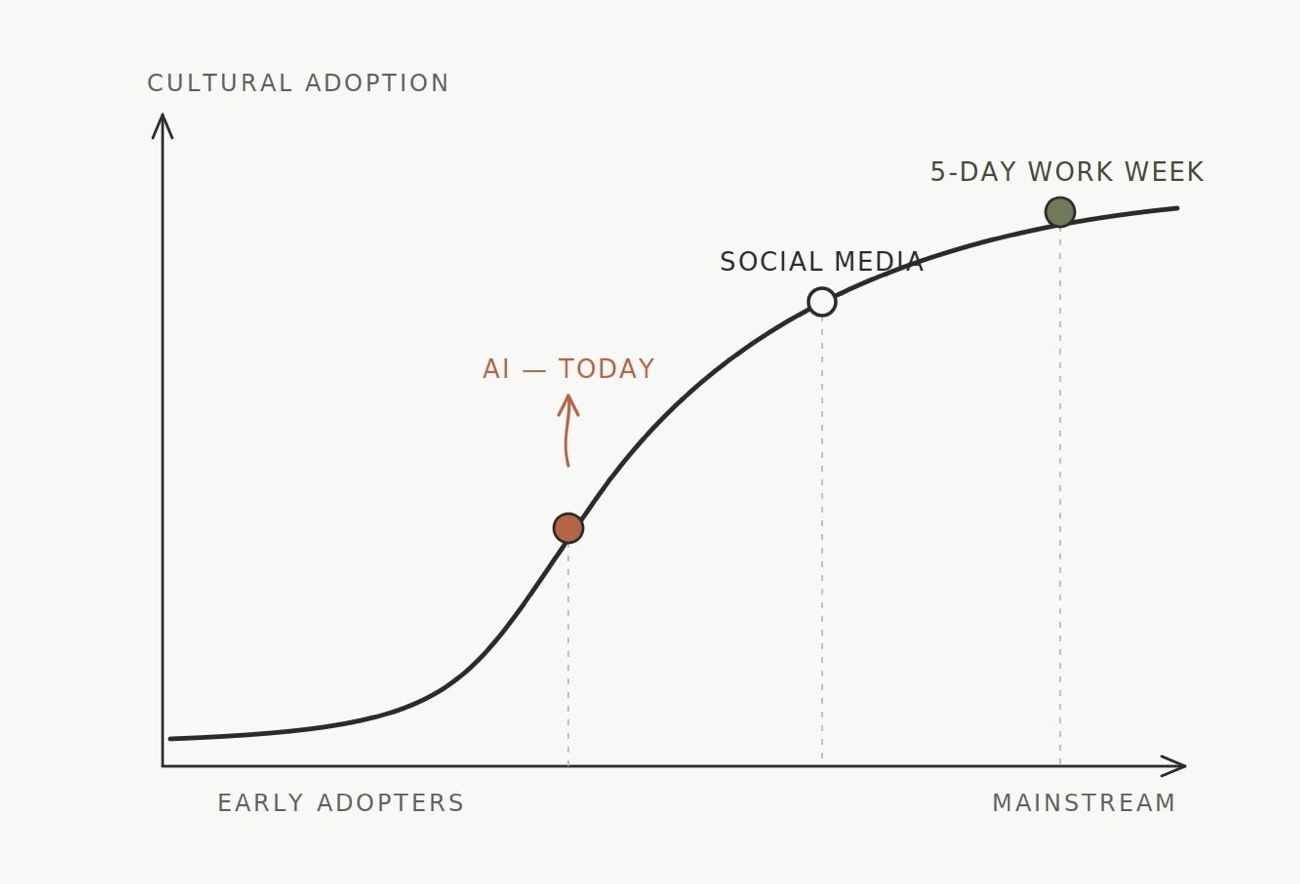
Let's think about the dissemination rule of new things. The first group of people who try them out are early adopters, but at this stage the new things have not yet entered the mainstream. As long as they have not become popular among the public, we cannot judge what impact they will really have on culture.
This is what researchers call the Diffusion of Innovations theory. New ideas spread along a predictable S-curve from a small group of testers to the general public: the progress is slow at the initial stage, then ushers in rapid growth, and enters a stable plateau period after being fully integrated into daily life.
Take the five-day workweek as an example. Now we take it for granted that it has existed since ancient times, but that is not the case. Henry Ford put forward this idea in 1922, and it was not officially implemented until 1926.
Before that, working six days a week for a total of 60 hours was the social norm. It took decades for this system to evolve from a heretical idea to an unshakable social rule today.
Social media follows the same development path. At first, it was just a tool to connect with acquaintances in real life, and then it gradually reshaped the way we communicate, fall in love, argue, consume and perceive ourselves. This is not the result of deliberate planning by anyone, but has penetrated into the culture little by little over several years.
Take drinking as another example. Once, going out for drinks was the main way for young people to maintain social bonds. Nowadays, the coffee shop industry is booming.
Abstaining from alcohol or avoiding drinking is becoming a new trend. A whole set of fitness culture has emerged accordingly, spawning a large number of new brands and a large group of practitioners worth millions of dollars, who sell supplements and sportswear, and spread healthier life concepts to the public.
None of the above social transformations happened overnight. They all accumulated strength slowly before breaking out intensively.
The current artificial intelligence is right in this development process. It has only been four years since AI entered the lives of ordinary people, and the supporting social culture has just started to take shape. To form a stable and unified public perception, such social changes usually take five to ten years, and we are now in a chaotic and changeable transition stage.
I have seen a lot of resistance, and many people strongly reject the claim that "AI can replace human beings", and I fully understand this concern. The term "artificial intelligence" itself is easy to make people feel uneasy.
Artificial intelligence can learn all the existing recorded materials of human beings, but it is only good at looking back at the past rather than predicting the future. It only rearranges and combines existing content. It is a top mixer and re-creator, but it cannot create a brand new genre, nor can it produce unprecedented art forms.
This difference is far more important than most people think.
Insights I Gained After In-depth Use of AI
In recent weeks, I have used automation tools to complete work that originally required a team of three people to undertake.
Most of the output-oriented work such as scheduling, secondary content processing, proofreading, reference citation, illustration production and title design can now be handled by AI. The only thing I need to do manually is to write the article itself.
But the key point is: the core of the content you read still belongs to me. The viewpoints, thinking and life experiences all come from me. AI only optimizes the presentation effect. This part can be automated, but thinking itself cannot be replaced by machines.
The traditional enterprise run by my family, which mainly deals in industrial washing equipment, is also using AI to realize automation, such as invoicing and bookkeeping, meeting minutes and customer follow-up.
All of these are the tedious tasks in work that no one wants to take over.
Artificial intelligence is getting better and better at taking over the work we never wanted to do in the first place, and this is exactly what everyone has been looking forward to for a long time.
The Economic Logic Shifts From "Having Competence" to "Being Favored"
When everyone can use the same tools, simply having processing ability is no longer an advantage, but has become the basic threshold for entering the industry. If everyone can write decent emails, design images and launch products with the help of AI, these skills will no longer help you stand out from the crowd.
So what is the remaining core competitiveness?
It is yourself.
Your name, your reputation, your aesthetic taste, and your unique perspective on things. It is the reason why others would rather give up the automated solution and choose you instead.
Nowadays, many positions can be completely replaced by AI from the technical level. But the real question has become: are we willing to be replaced by AI?
And this is exactly the proposition that personal brand needs to answer. Building a personal brand does not mean pursuing fame, but making others want to choose you from the bottom of their hearts. When you have a strong personal brand, clients do not just want to get a task done, they want you to do it.
In this era where everyone can accomplish a lot of things, "being needed and favored by others" is the only real sense of security left.
Go build your personal brand, output your thoughts, leave your mark on your works, and let people see the real living you behind the works.
After all, the tools are open to everyone, and only you yourself cannot be replicated.
Translator: Teresa