Lenovo is back as the ultimate heartthrob of the "uncle fan circle"
By | Gong Zheng Editor | Yang Jing
Many young people born after 2000 are barely familiar with Lenovo. But this does not prevent the company founded in 1984 from making a sensational comeback and becoming a "silver fox celebrity" in the first half of the year, with its market value jumping from over 100 billion Hong Kong dollars at the beginning of the year to more than 400 billion Hong Kong dollars today.
Public opinions note that Yang Yuanqing, a graduate of Shanghai Jiao Tong University, made the decision to acquire the x86 server business from IBM more than a decade ago, which caught up with the AI boom and drove the company's market value to rise by more than 280% cumulatively within the year. At that time, many voices questioned that the acquisition was just "picking up junk".
Currently, from Doubao to Qwen, from Kimi to DeepSeek, all players are competing for the "entry point". Only the "entry point" value of Lenovo is easily overlooked.
Up to now, its cumulative global sales of personal computers alone have exceeded 1.1 billion units, accompanying three generations of users spanning the young, middle-aged and elderly to grow. No matter which large model or server is connected to Lenovo's "entry point", it can generate huge value on the end side.
But it should also be noted that this entry point is not omnipotent. In the arena of interest games, how much right of discourse the entry point value can have remains to be seen. Besides, a large number of software and hardware companies are gearing up to seize Lenovo's entry point business.
It is never easy to be the "top player".
Lenovo, who has built entry points for three eras
Lenovo never wants to grow old. On second thought, it has actually strived to be the "entry point" for young people across three different eras.
In 1984, Liu Chuanzhi was 41 years old. He led 10 people, with 200,000 yuan granted by the Institute of Computing Technology of the Chinese Academy of Sciences, to start their business in a small bungalow.

Figure | The small bungalow where Lenovo started its business
At that time, computers were "precision instruments" exclusive to scientific research institutions, which ordinary people had no access to. The earliest thing Lenovo did was to enable computers to display Chinese characters — the "Chinese character system". This was its first attempt to build an "entry point", whose value lies in translation.
In 1994, Liu Chuanzhi appointed 29-year-old Yang Yuanqing. Yang Yuanqing raised Lenovo's PC market share from less than 2% to the top spot in China. In 2004, Lenovo acquired IBM's PC business for 1.25 billion US dollars. Yang Yuanqing said: "I don't need to invent computers, I need to sell computers to the whole world."
Nowadays, one out of every four people buying computers globally chooses a Lenovo product. This time, the value of Lenovo's "entry point" lies in connection.
In 2014, Lenovo made another widely mocked decision — to purchase IBM's x86 server business for about 2.3 billion US dollars.
For Yang Yuanqing, PC is the entry point for individual users, and servers are the entry point for enterprise data centers and cloud computing. Lenovo aims to take control of both entry points. This time, the value of Lenovo's "entry point" lies in cross-border expansion.
In the AI era, Lenovo has deeply integrated large models such as DeepSeek 7B into its own computers, and transformed them into the core capabilities of AI PCs through collaborative optimization of software and hardware. Users can directly call AI functions locally without connecting to the Internet.
Now, AI PCs account for more than 30% of Lenovo's total PC shipments, which means roughly one in every three computers sold by Lenovo is an AI PC. In the more segmented Windows AI PC market, Lenovo holds a share of about 31%, ranking first in the world.
If products such as WorkBuddy, Qwen Office, and Baidu Buddy all take AI capabilities as their core competitiveness to compete for user interaction entry points, Lenovo takes a different path.
While independently developing its Tianxi Personal Agent System (Tianxi AS), it also matches third-party models and hardware, distributes AI services with the scale advantage of global PC shipments, and tries to build an entry point barrier based on device ownership and using its own intelligent agent as the interaction interface.
This time, the value of Lenovo's "entry point" lies in inclusive AI.
Value and Cost of the Entry Point
In the workplace, there is a type of colleagues who do not have much core competitiveness, but master part of the business resources, carefully guard them, and will not hand them over easily.
What Lenovo does is essentially similar to the capability model of this type of young people, which is called "connection".
It connects chips and operating systems into computers that ordinary people can use, connects computing power and large AI models into services that enterprises can purchase, and bridges the gap between technological inventions and end users.
This kind of connection is the value of the "entry point".
Lenovo's intention may be: In an industrial chain with clear division of labor, the safest position is not the strongest one, but to strive to become the most indispensable one.
At present, Lenovo has built several foundations for its indispensability:
Scale effect. With a quarter of the global PC shipment volume, it has a dominant say in the upstream supply chain.
Accumulation of comprehensive resources. The channel and after-sales networks covering more than 160 countries around the world have been built through decades of deep cultivation. This system is more difficult to replicate than any technical patent.
Potential transformation. When the demand for AI computing power explodes, customers who have used Lenovo servers in their data centers will naturally continue to turn to Lenovo for upgrades. This is because the migration cost of changing suppliers is too high, and Lenovo has been in this position for a long time.
Of course, Lenovo has also paid a price. Just like those colleagues in the workplace who master resources but do not master core technology capabilities, Lenovo always has a sense of "insecurity".
For Lenovo, it indeed has not grown into a company like GREE that holds core technologies in its own hands. It relies on Intel and NVIDIA for chips, and on Windows for operating systems.
For a long time, the essence of Lenovo's business is like a super "intermediary", which is most afraid of being replaced and ignored.
When NVIDIA itself is also penetrating into the entry point field, and ByteDance is also using software to fight back against hardware, more people are participating in the market, and the flow of water will no longer be controlled by only one person.
Therefore, we may need to adopt a flexible perspective to look at Lenovo. If we only focus on its nature as an "assembly plant", Lenovo is indeed not the strongest player.
But in an industrial chain with clear division of labor, at least for now, no one can easily replace Lenovo. Lenovo does not manufacture chips, but it is the largest shipment channel for chip manufacturers. Lenovo does not develop large models, but it is one of the largest terminals for large models to reach users. This kind of "two-way dependency" is more difficult to be replaced than any single technology.
When the Entry Point Finally Meets the Boom
Last December 31, Lenovo's closing price was fixed at 12.92 Hong Kong dollars, with a market value of just over 100 billion Hong Kong dollars. Now, Lenovo's market value has exceeded 400 billion Hong Kong dollars.
Most public comments believe that the correct decision made by Yang Yuanqing more than a decade ago has finally borne fruit.
In January 2014, Lenovo acquired IBM's x86 server business for about 2.1 billion US dollars. At that time, Yang Yuanqing's plan was that Lenovo in the future must form three major engines: PC, mobile devices and enterprise business, and cannot rely solely on PC for development.
At that time, for this acquisition of Yang Yuanqing, the proponents argued that it was a "cost-effective deal that directly pushed Lenovo into the top three": Lenovo only spent about 2.1 billion US dollars to obtain the world's third largest server market share, annual revenue of 5 billion US dollars, 6500 employees and thousands of patents.
The pessimists also existed, claiming that Lenovo entered a red ocean market with fierce competition through a "snake swallowing elephant" approach, without core technological breakthroughs.
Now it seems that the answer to whether this decision is right or wrong has come out.
According to the first quarter financial report just released this year, Lenovo's AI-related business revenue (the broadest total revenue of AI business) increased by 60% year on year, reaching 63.4 billion RMB, accounting for about 35% of the group's total revenue.
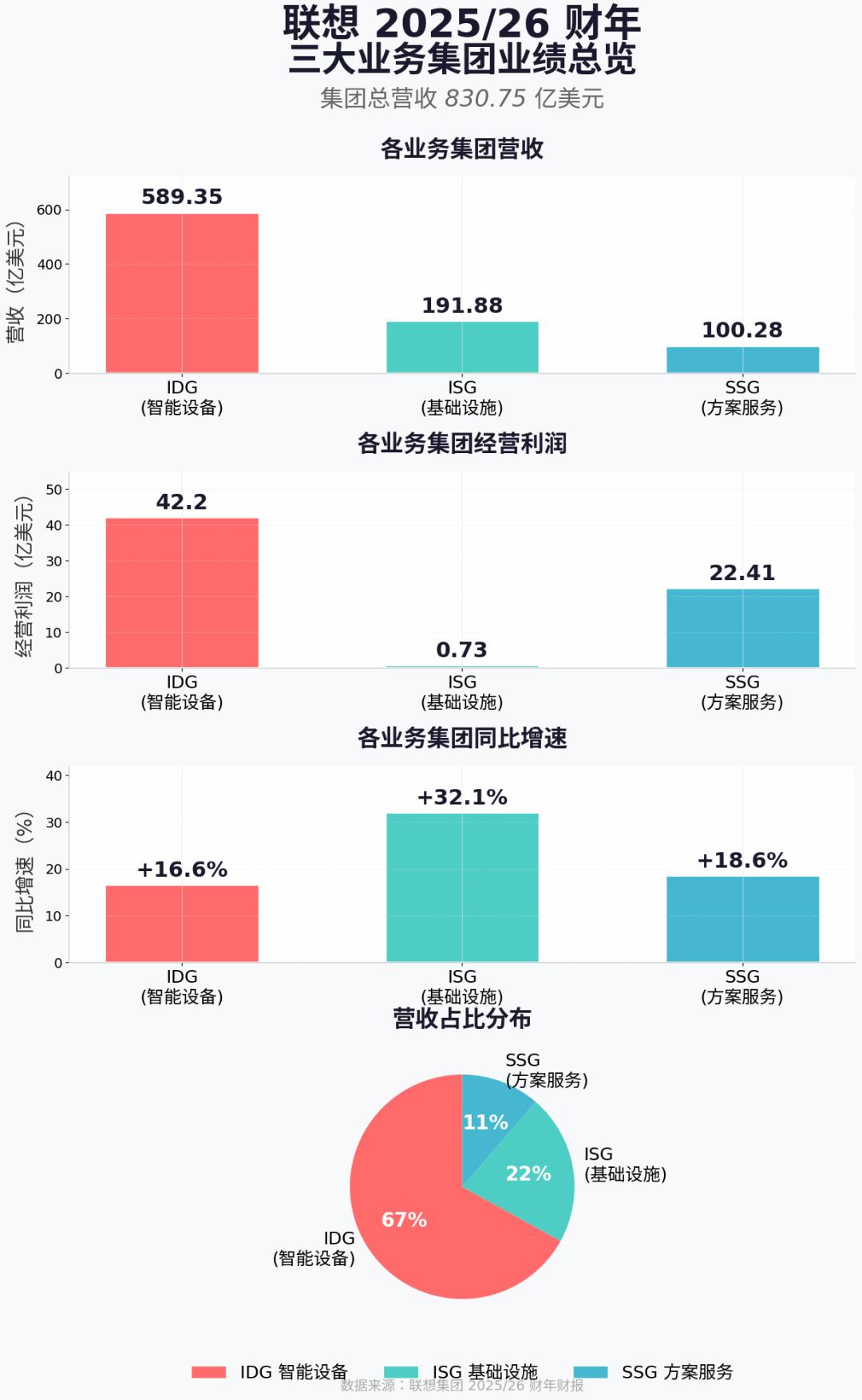
Lenovo's core business consists of three major business groups, namely Intelligent Devices Group (IDG), Infrastructure Solutions Group (ISG) and Solutions & Services Group (SSG).
Among them, the Infrastructure Solutions Group (ISG) that sells AI servers posted revenue of 8.5 billion US dollars in the first fiscal quarter, a year-on-year increase of 98%, almost doubling. Its operating profit reached about 5.3 billion RMB, and the operating profit margin soared to 9.1% — while it was still in a loss in the same period of the previous fiscal year.
If performance is the reward for Lenovo's "production and sales capabilities", then the stock price is the capital market's pricing of Lenovo's "entry point".
For a long time, Lenovo's valuation has been discounted — it was regarded as a "PC cyclical stock", and the market has long given it a low price-to-earnings ratio. But after the release of this financial report in August 2026, Lenovo has become a company included in the AI server prosperity narrative.
Citi gave Lenovo's server business a valuation multiple of 16.7 times, while only 10 times for its PC business. Since the beginning of this year, Lenovo's stock price has risen by 290%, making it the best-performing constituent stock of the Hang Seng Index.
It seems that the market rewards not only "inventors", but also "connectors". In the AI industrial chain, "connection" itself is a huge business.
Of course, Lenovo's role as a "connector" is not exclusive to it. In fact, it is facing fierce competition amid the boom. In the AI era, the definition of "entry point" is being rewritten by various newly emerged software and hardware vendors.
Upstream, NVIDIA released the PC super chip RTX Spark at its GTC conference in June this year, which is targeted at notebook products and integrates GPU, Arm CPU, unified memory and AI software stack into a new platform.
Jensen Huang compared this PC reshaping to the upgrade from feature phones to smartphones in the past.
This means for Lenovo that the chip landscape is shifting from the dominant "Wintel Alliance" to parallel multi-architecture development. NVIDIA is trying to become the platform definer in the AI PC era, while Lenovo, as a hardware OEM, will degrade from an "entry point" to a "channel" if it only carries other people's platforms. Because users recognize NVIDIA's computing power and the Windows ecosystem, not the Lenovo brand.
Software giants including ByteDance, Alibaba and Tencent are also actively making layout in the hardware field. In December 2025, Doubao Mobile Assistant was launched, entering the AI mobile phone track through the "operating system-level cooperation" model.
In January 2026, the Alibaba Cloud Tongyi Intelligent Hardware Exhibition attracted more than 200 brands to participate, showcasing over 1000 categories of intelligent hardware ranging from AI mobile phones to AI companion toys. Alibaba plays the role of an "ecosystem enabler".
These software giants share the same goal: to embed AI capabilities directly into terminals, bypass hardware brands, and become the "entry point" that users truly recognize.
If this pattern really takes shape, as a hardware manufacturer, if Lenovo is only a carrier for "pre-installed AI", its entry point value will be diluted.
The cards in Lenovo's hand are hardware scale, channel network and supply chain capabilities, but whether these are sufficient in the AI era depends on whether it can establish deeper irreplaceability at the position of "connector".
This is the key task for Lenovo to tackle in the next stage.
This article is from the WeChat official account "Muhe Business and Finance", Author: Gong Zheng, published with authorization from 36Kr.