Is the CEO a "cult leader"? Anthropic is suffering backlash from its self-proclaimed "faith".
Anthropic, a star company at the forefront of the AI wave with a valuation approaching one trillion US dollars, is currently facing its most thorny problem which may not be model performance, but whether its employees still believe in the future depicted by the management.
Tech blogger Brian Roemmele recently revealed that he just had a call with an early investor of Anthropic. The insider disclosed that the morale of the company's investors and employees has dropped to a low point, and they are increasingly dissatisfied with the increasingly closed senior management, even asking Brian for advice: How on earth can Anthropic survive as an independent company?
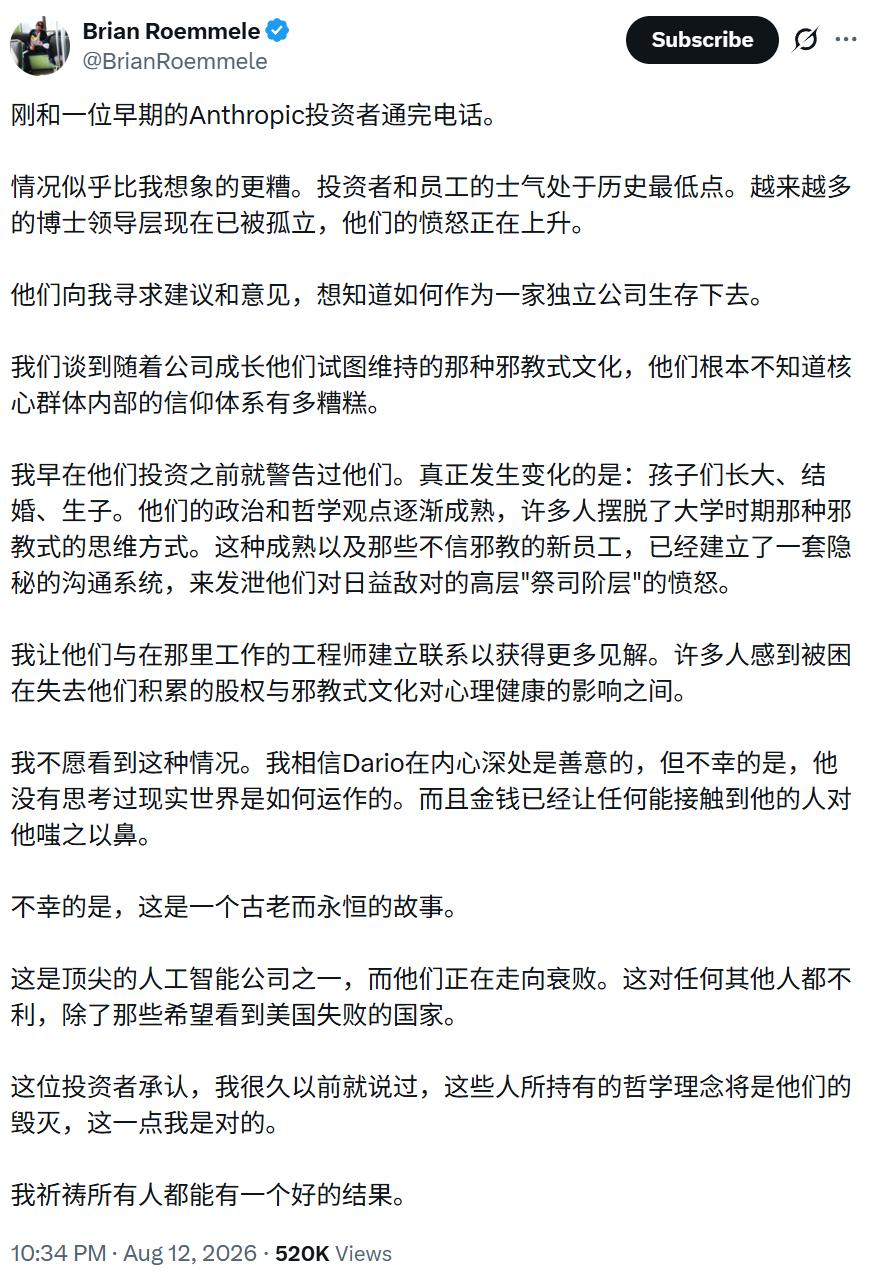
Brian then gave a very striking description: In the early stage, Anthropic built a highly unified value system around AI safety, political philosophy and the future of mankind. But as the company expanded, a number of new employees did not buy into this system, and the concepts of some old employees also changed with their life experiences.
It is said that private communication channels have emerged inside the company to vent dissatisfaction with the management; some employees are caught in a dilemma: leaving means giving up valuable equity, while staying means they may continue to bear mental pressure.
However, it should be noted that these claims are one-sided accounts from anonymous investors and Brian, which have not been confirmed by Anthropic so far, and there is no sufficient evidence to prove that the company is "collapsing". But the reason why this revelation has attracted attention is that the cultural rift depicted in it is not completely unsupported by public information.
The CEO personally preaches, and the vision sends a chill down people's spines
From its inception, Anthropic has never been like an ordinary technology company.
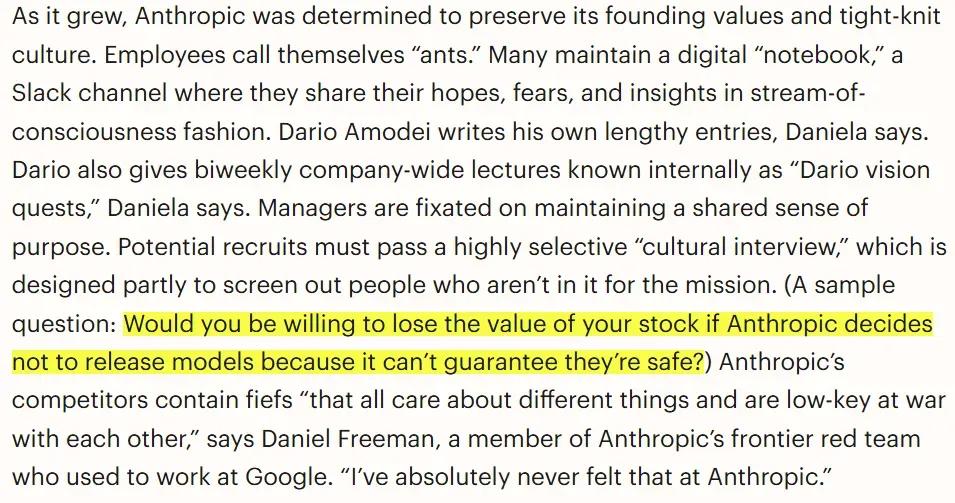
In 2021, Dario Amodei, his sister Daniela Amodei and others left OpenAI to found Anthropic. Its core proposition is that the more capable AI is, the more likely it is to bring catastrophic risks, so the R&D speed must be constrained by safety mechanisms. The company's employees call themselves "ants", and many of them open personal "notebooks" on the internal Slack to share their ideas, concerns and value judgments.
In addition to technical assessments, candidates also need to pass a special "culture interview". Time magazine revealed that one of the sample questions is: If Anthropic decides not to release a product because it cannot guarantee model safety, are you willing to bear the loss that the value of your shares drops to zero?
What is more characteristic of Anthropic is the biweekly all-hands meeting "Dario Vision Quest", referred to as DVQ for short.
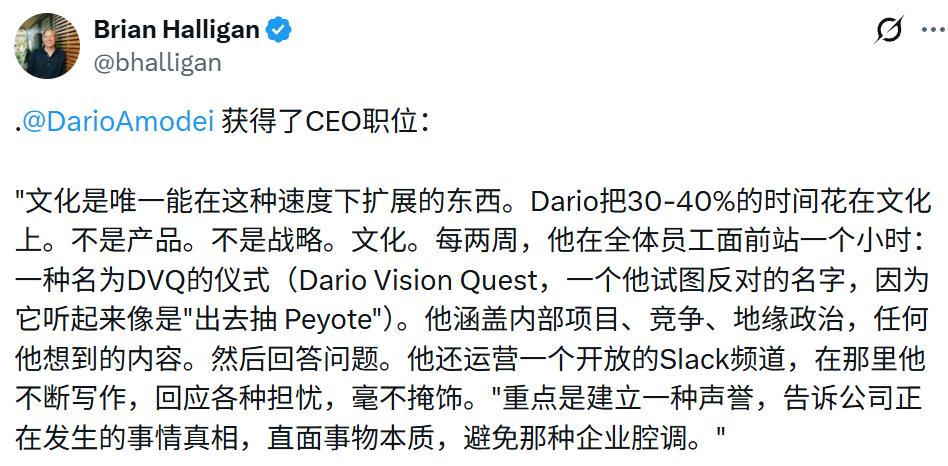
Dario usually speaks for about an hour with three or four pages of materials, covering content from product strategy all the way to politics, war, geopolitical competition and the fate of mankind. He once said that about 30% to 40% of his time is spent maintaining the company's culture.
When the company was small, this strong sense of mission could make the team highly aligned; but when the number of employees expands to thousands, it may also become an ideological threshold.
Former employees interviewed by Wired gave two completely different descriptions: Some people think that internal debates at Anthropic are active, and senior management will respond seriously to criticism; others say that really sharp opinions often stay in private group chats, and DVQ is like "listening to priests preaching". This cannot prove the "morale hitting rock bottom" mentioned by Brian, but it shows that there is indeed a tug-of-war between mission cohesion and ideological diversity inside Anthropic.
Just today, more disturbing news came out. According to a podcast clip of the famous tech investor Gavin Baker shared by netizens, Dario once said internally at Anthropic: "Anthropic may one day become the only private company in the world."
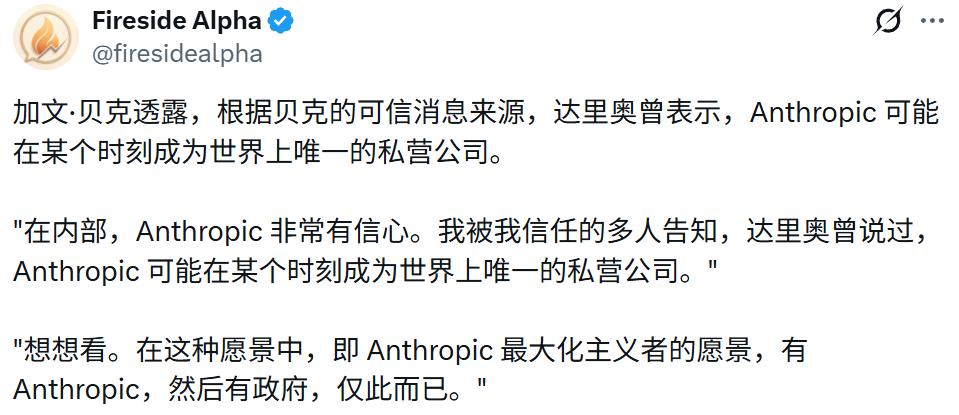
It has to be said that this so-called "vision" sounds a bit terrifying, which can't help but remind people of those villain tech oligarchs in sci-fi stories, such as the Arasaka Group in Cyberpunk 2077 that controls cities, armies and digital life, the Tyrell Corporation in Blade Runner that monopolizes bionic human technology, and the Weyland-Yutani Corporation in Alien that includes colonization, scientific research and even human lives into profit calculations...
Only this time, what may be monopolized is the "intelligence" itself that produces all goods, knowledge and decisions!
Imagine such a future: Claude and its successor systems take over programming, scientific research, finance, law, healthcare and enterprise management. Other companies still seem to own brands, offices and boards of directors on the surface, but in fact they are only left with a shell: products are designed by Anthropic's models, codes are written by them, risks are assessed by them, employees are scheduled by them, and business decisions are also given by them. Enterprises still seem to compete with each other, but behind the scenes they are renting the same "brain". Revenue, data and computing power are continuously concentrated to this brain, until other companies are no longer truly independent business entities, but just applications running on Anthropic's intelligent infrastructure.
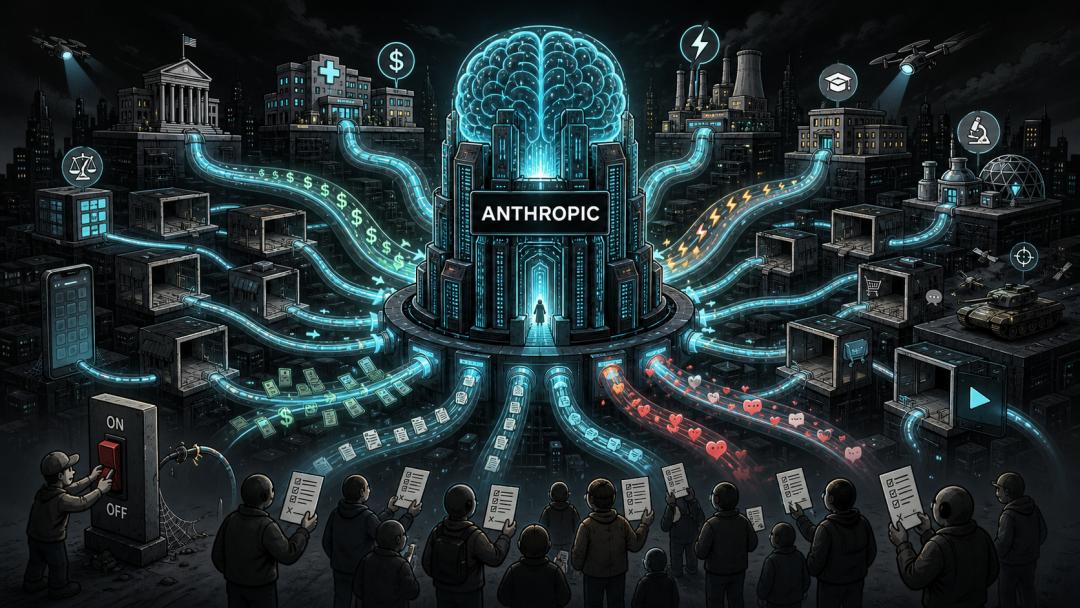
The worse scenario is that even various public services are inseparable from this system, then Anthropic will no longer be just a company in the market, but become the "operating system" of the whole society: it can decide which researches are safe enough, which industries are worth continuing to exist, who is qualified to access advanced intelligence, and what kind of values can be written into the model.
At that time, the society still seems to have everyone performing their own duties, but all options have long been filtered, sorted and interpreted by the system of a private company. At that time, the so-called "the only private company in the world" means that it not only wins the business competition, but also makes the traditional market, labor and public power gradually lose the foundation for existence.
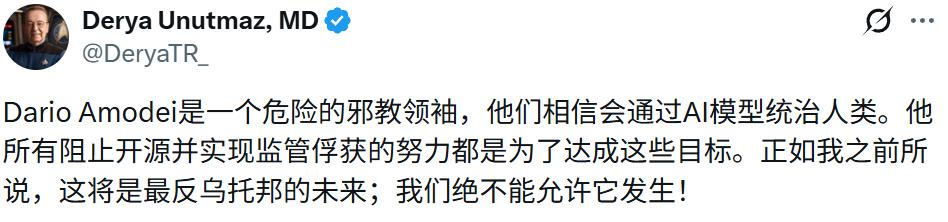
Therefore, this video has aroused strong vigilance and ridicule: If an enterprise firmly believes that it is the most qualified to protect all mankind, people will naturally ask: Who on earth authorized it to represent all mankind?
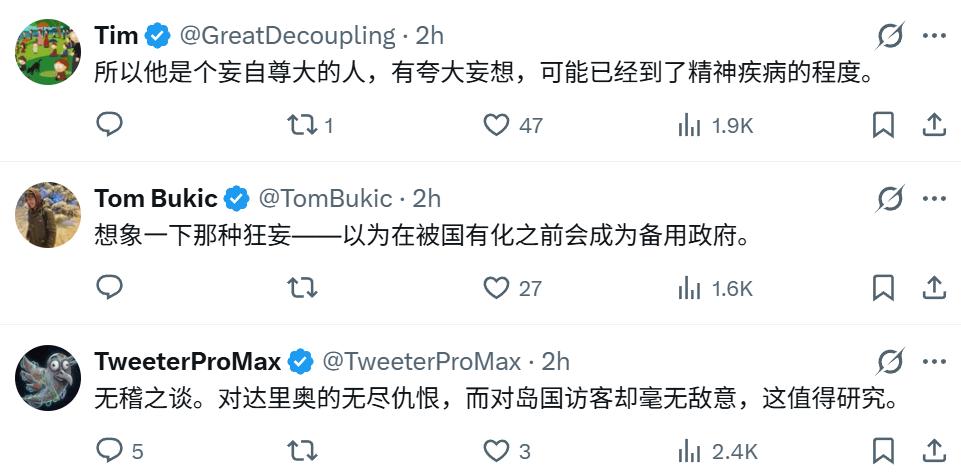


Holding high the banner of safety while stepping on the gas pedal to the floor
Looking back at a series of tricky operations of Anthropic in recent years, this sense of contradiction is even more obvious.
On the one hand, it constantly warns that super AI may create biological threats, get out of control and even endanger mankind, on the other hand, it has to train more powerful models to compete for customers and computing power. In February 2026, Anthropic revised its "Responsible Scaling Policy" to narrow down the conditions under which model development or release must be postponed. The company explained that unilaterally stopping cannot stop competitors from moving forward, and safety commitments must also take into account Sino-US competition and industry realities.
It also once added mechanisms to the model that may secretly interfere with related work, in order to prevent foreign opponents from leveraging Claude to advance cutting-edge AI research. After the research community questioned that this is equivalent to letting AI "sabotage in secret", Anthropic withdrew the plan within a few days, admitting that it failed to grasp the boundary properly. Refer to the report "Just now, Anthropic apologized".
A more dramatic scene took place at the Pentagon. Anthropic is willing to let Claude serve the US national defense and intelligence systems, but refuses to loosen two red lines: fully autonomous weapons, and large-scale surveillance targeting the American people. This insistence sharply deteriorated its relationship with the Trump administration. Supporters think it has held the bottom line, while critics believe that a private company is trying to decide the rules of war on behalf of the government. In any case, this conflict has evolved from a value debate to real political and business risks.
A few days ago, Anthropic's policy of adding watermarks to Claude's text output also caused widespread dissatisfaction.
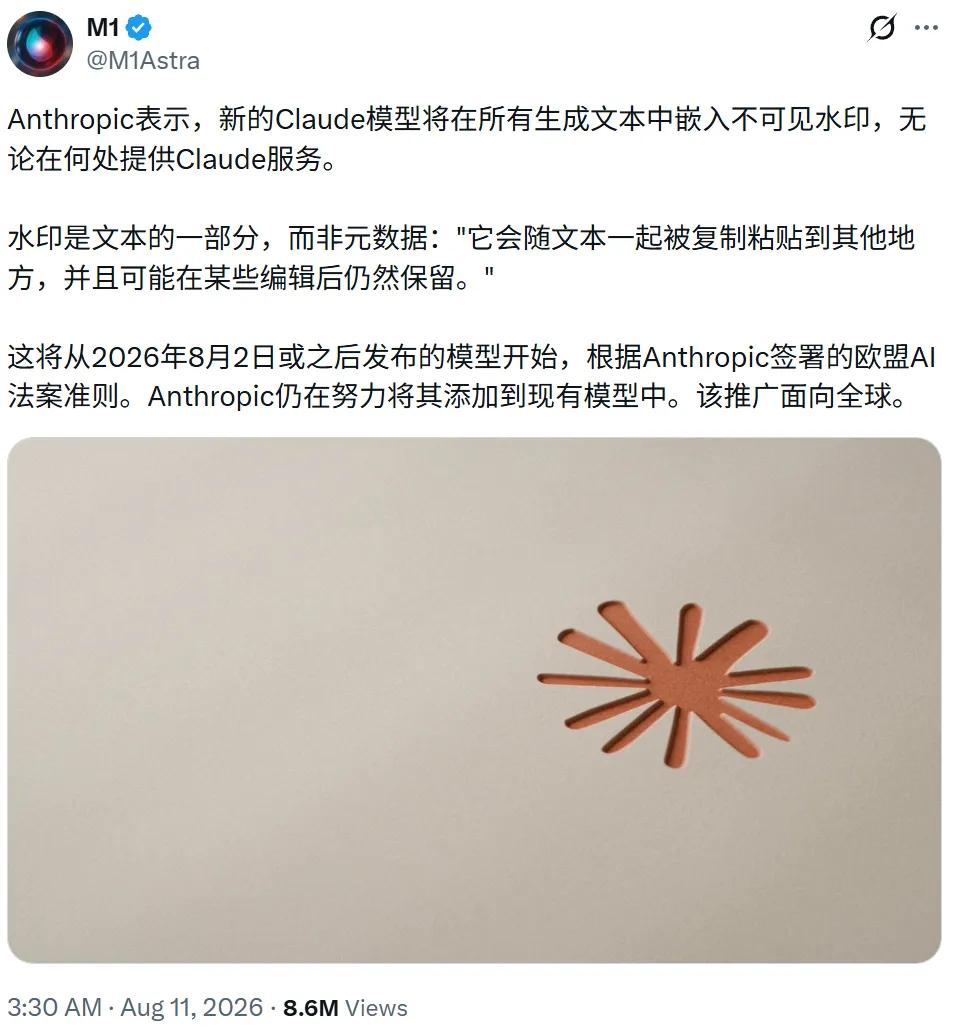
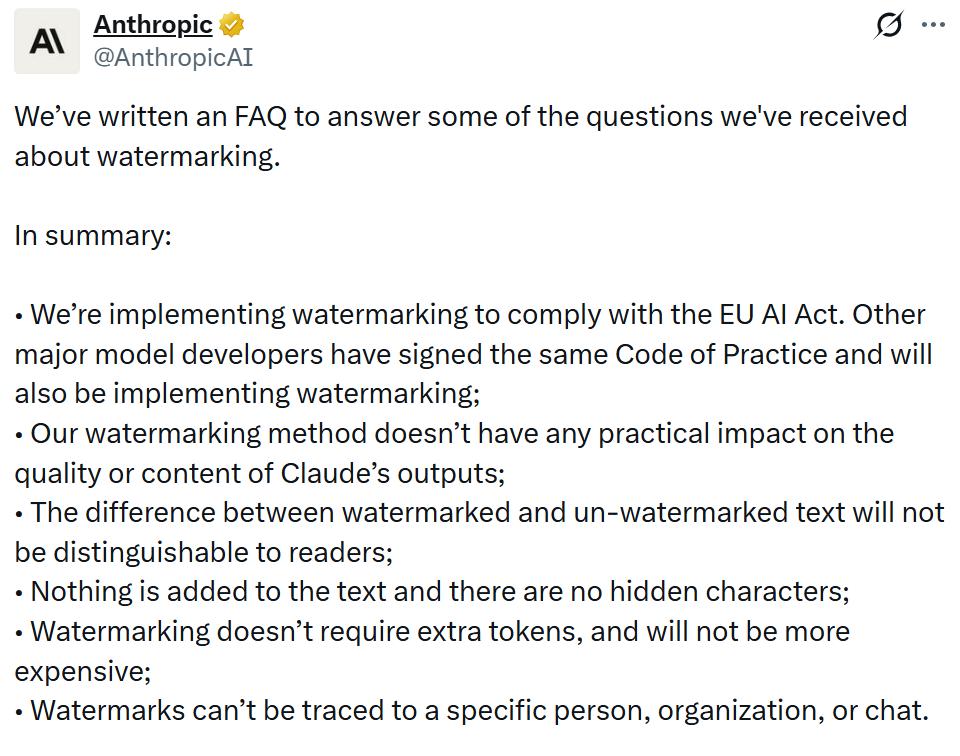
Just today, Anthropic released an FAQ in response to the recent external questions about Claude's text watermark mechanism.
Simply put, Anthropic stated that the introduction of watermarks is mainly to comply with the relevant requirements of the EU AI Act. Other major model developers that have signed the same "Code of Conduct" will also implement similar mechanisms in the future.
According to Anthropic, this set of watermarks will not have a practical impact on the quality and content of Claude's output, and ordinary readers cannot tell whether a piece of text has a watermark. The watermark will not be implemented by adding extra text or hidden characters, nor will it consume extra Tokens, so it will not increase usage costs.
In addition, Anthropic emphasized that such watermarks cannot be traced back to specific individuals, organizations or a specific chat record.
Article link: https://www.anthropic.com/news/claude-text-watermark
The trillion-dollar valuation also begins to be "discounted"
It is at this very moment that Anthropic is sprinting towards the capital market.
The Wall Street Journal reported that the company is intensively meeting with potential investors to stabilize confidence for a potentially record-breaking IPO. The key points that investors are asking about include: whether low-cost Chinese models will break through its commercial moat, whether the friction with the Trump administration will affect orders, and whether the crazy expansion of data centers can finally get sufficient returns.
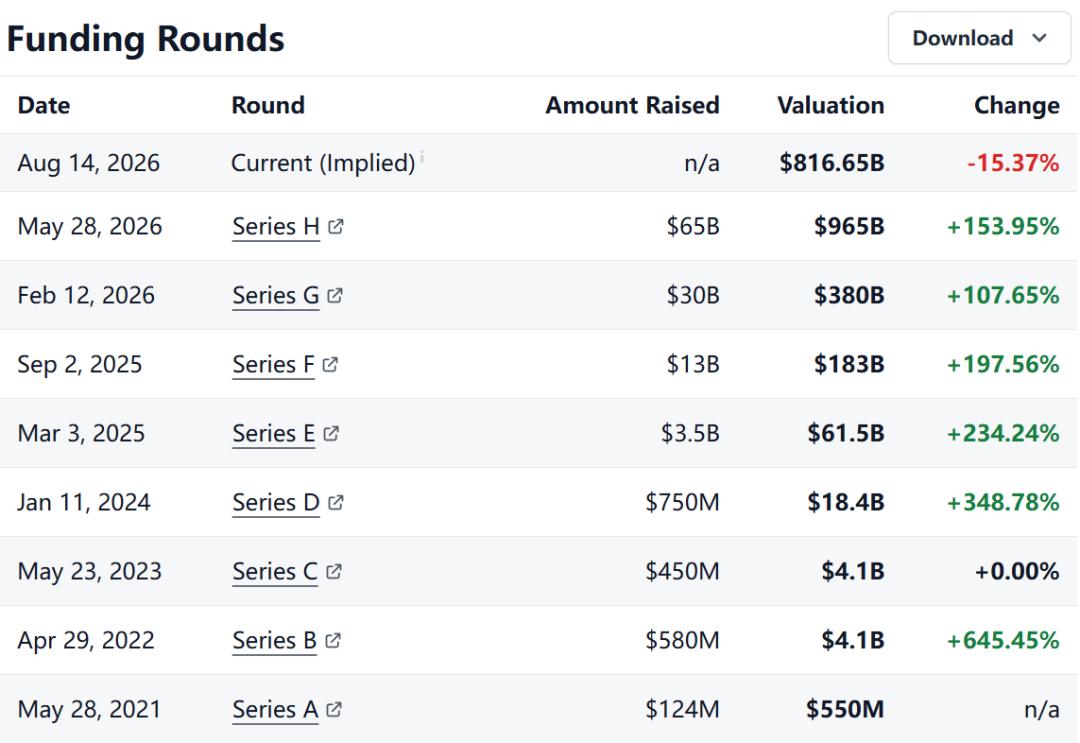
On May 28, Anthropic completed a $65 billion financing, with a post-investment valuation reaching $965 billion, and claimed that its annualized revenue has exceeded $47 billion. After that, its valuation even exceeded one trillion US dollars, approaching 1.4 trillion at the peak.
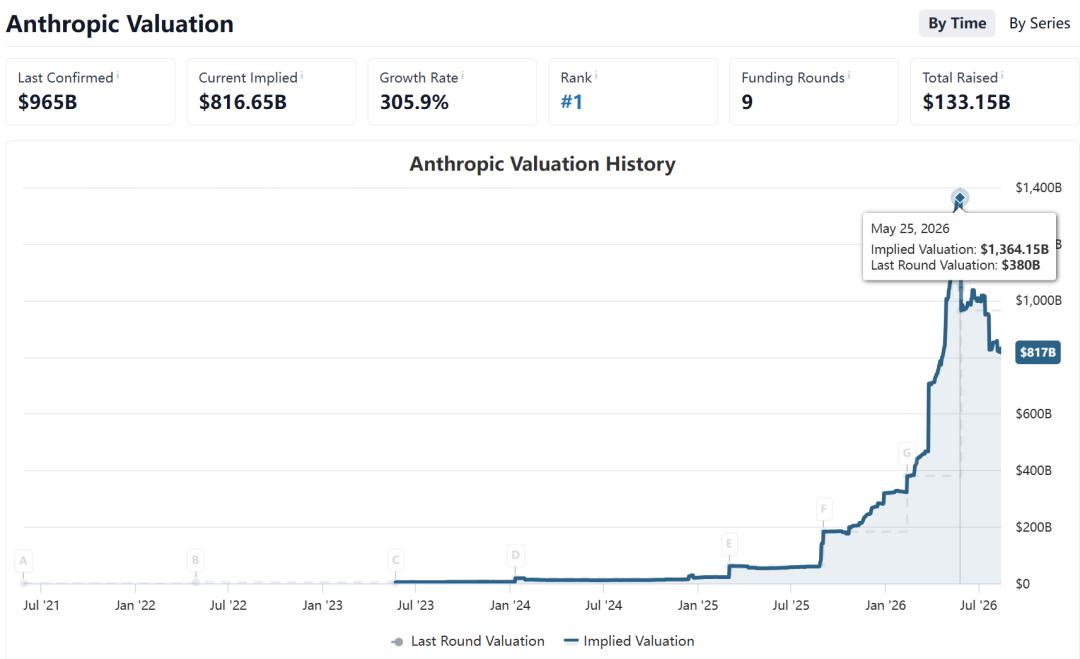
But as of today, the implied valuation calculated by Stock Analysis based on the secondary market price of Hiive is about 816.65 billion US dollars, 15.37% lower than the official financing valuation. It should be noted that official financing and the secondary market with limited liquidity are not calculated on the same basis. This gap cannot be simply interpreted as the company's value has "evaporated", but it is enough to show that market enthusiasm has declined to some extent.
However, it is too early to judge that Anthropic has begun to lose its attractiveness because of this.
The other side of the coin: Anthropic is still "growing"
When external investors are dissatisfied, internal conflicts continue, morale is low, and people are trapped in the "choice" between leaving and staying, top talents still keep actively joining this ship.
Recently, Google researcher Justin Gilmer was exposed to have left Google Brain and joined Anthropic.
