Over the past six months, an average of one unicorn has emerged every day.
On average, one unicorn enterprise is born across the globe every single day.
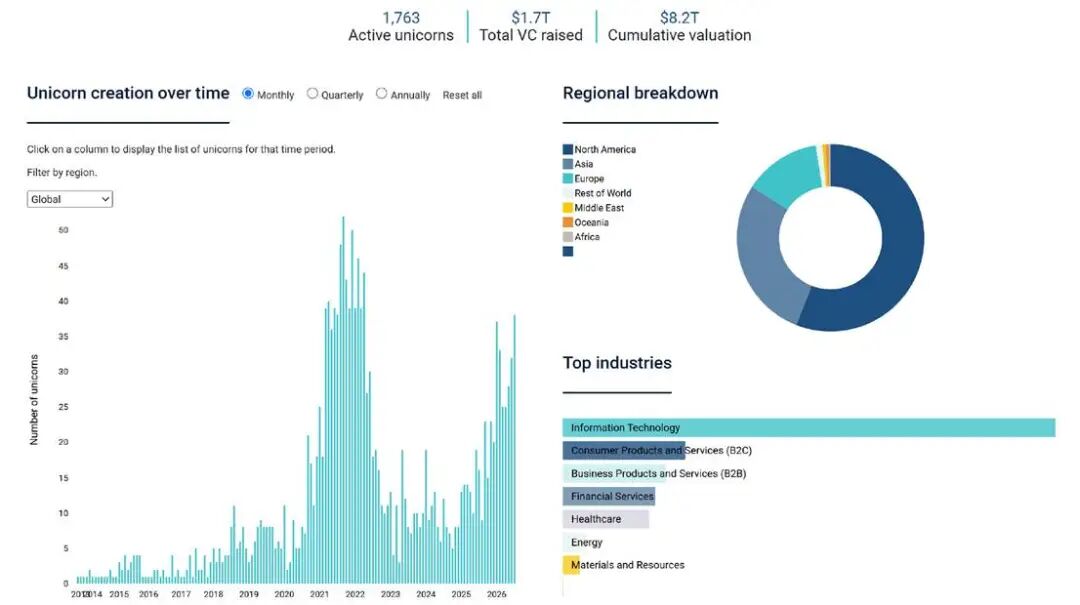
Latest data from PitchBook Global Unicorn Tracker shows that 38 companies crossed the $1 billion valuation threshold and were promoted to "unicorn enterprises" collectively in July this year.
Looking at the figures of the first seven months of 2026 as a whole, the trend of this curve becomes clearer: 37 in January, 33 in February, 25 in March, 25 in April, 28 in May, 32 in June, and 38 in July. After sliding all the way from the high point at the start of the year to the low of 25 for two consecutive months in March and April, the number rebounded for three straight months starting from May. The figure in July not only surpassed the low point in March and April, but also exceeded the starting value of January, hitting a new high since 2026.
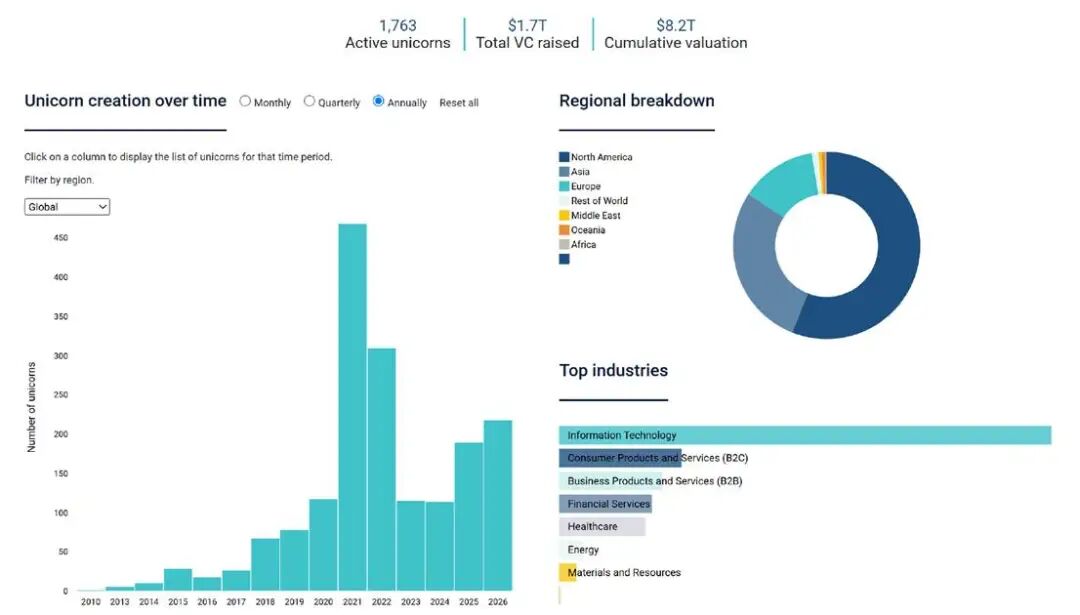
Back in 2021, 468 unicorns were born across the globe in total that year, hitting the highest record in history, but the situation took a sharp downturn soon after. The number halved to 309 in 2022, halved again to 115 in 2023, and remained almost flat at 114 in 2024. The word "unicorn" once literally became the rare creature as its literal meaning suggests.
The turning point came in 2025, when the global number of new unicorns rebounded to 189 for the whole year. After entering 2026, this curve suddenly rose steeply, with 218 new unicorns generated in the first seven months alone, exceeding the total number of the whole year 2025 ahead of schedule.
Behind this roller-coaster curve lies a complete macro cycle from the zero-interest rate boom to the interest rate hike winter, and then to the AI narrative rekindling capital enthusiasm. However, the PitchBook report reminds people of the other side under the prosperous picture: data shows that more than half of the existing unicorns have not raised a new round of funds for more than two years, and are in a de facto dormant state.
"Unicorns" are no longer rare
Connecting the annual figures from 2020 to 2026, a "roller-coaster curve" comes into view.
In 2020, 117 new unicorns were added globally. Driven by the dual impetus of extremely loose liquidity and the SPAC boom, the number soared to 468 in 2021, four times that of 2020, and it is also the only year on this curve that has ever exceeded 400 so far.
In the second half of 2022, the world entered an interest rate hike cycle, and the financing environment took a sharp downturn. The annual figure halved to 309; the decline did not stop in 2023, and the number further halved to 115; in 2024, the figure remained almost flat at the low level with only 114 new unicorns, which was the lowest point in the past seven years.
These three years are exactly the period when the global venture capital circle repeatedly discussed the "capital winter in the primary market" — narrowing exit channels, valuation inversion, difficulties in fundraising for institutions... All these discussions can find corresponding annotations on this curve.
2025 was the turning point. The number of unicorns rebounded to 189 for the whole year, a 66% increase compared with 2024, but there is still a considerable gap from the historical peak in 2021. What is really surprising is 2026. In the seven months from January to July alone, the number of new unicorns worldwide has reached 218, which not only far exceeds the level of the first half of 2025, but also surpasses the total number of the whole year 2025 four months in advance.
If broken down according to the data from PitchBook's monthly tracker, the growth of these seven months is not even: 37 in January, 33 in February, and the number fell to the annual low of 25 for two consecutive months in March and April, then rose to 28 in May, 32 in June, and 38 in July, forming a V-shaped rebound that first fell and then rose, and the figure of 38 in July was the new monthly high since 2026.
Looking at the industry distribution of the new unicorns specifically, the information technology sector is far ahead, with a proportion much higher than other categories, followed by consumer-facing products and services (B2C), enterprise-facing products and services (B2B), financial services, healthcare, energy, materials and resources in sequence.
However, another set of figures from the *PitchBook Global Unicorn Tracker Report for Q1 2026* released in May this year better explains what the driving force behind this round of recovery is. The report shows that AI-related companies already account for 47.6% of the total $8.6 trillion valuation of the global unicorn universe, while this proportion was less than 10% ten years ago.
To understand which specific companies this 47.6% valuation share of AI falls on, a monthly review by the industry media Tech Funding News provides a very specific sample. In a June report titled "Where Exactly Did AI Funding Go This Month", the media selected 15 of the most representative companies, covering robotics, defense technology, AI infrastructure, enterprise software, healthcare and other tracks, 2 of which are headquartered in China, namely X Square Robot and LibLib, accounting for more than 13%.
Among them, X Square Robot based in Shenzhen was founded by Qian Wang in 2023. It builds an end-to-end embodied intelligence system around its self-developed WALL series foundation models, and cooperates with the QUANXTA data pipeline to solve the core bottleneck of physical AI: the collection, cleaning and labeling of robot training data. At present, the company has completed four consecutive rounds of financing with a total amount of $588 million, and its valuation has climbed to about $2.9 billion. Its investor lineup includes Alibaba, ByteDance, Meituan and HSG.
LibLib, the AI image creation community based in Beijing, represents another path. This platform under its parent company EVOKEN has more than 30 million cumulative users and is one of the top AI creator communities in China. This $300 million B+ round of financing in June was jointly led by Granite Asia from Singapore, Tencent and Shunwei Capital, while early shareholders including HSG, Gaorong Capital and Ant Group also made additional investments simultaneously. The participation of Tencent and Shunwei means that large technology companies are taking the segmented application field of AI-native content creation as a track worthy of independent investment, rather than just a functional extension of large model capabilities.
Half driven by robotics and AI
67 new Chinese unicorns emerged in half a year
The other half of the recovery story lies in the update rhythm of the domestic list.
According to statistics from the enterprise database IT Juzi, 67 new unicorns were added in China in the first half of 2026, hitting a new semi-annual historical high in nearly five years, second only to the historical peak of 76 in the second half of 2021. On average, a new unicorn was born in less than three days.
In terms of the industry distribution of new unicorns, robotics contributed 19, artificial intelligence 17, and advanced manufacturing 12, accounting for 71.6% in total. This outbreak is not a general financing cycle covering multiple tracks as the last round, but a specific technology wave around large models, generative AI, AI infrastructure, humanoid robots, embodied intelligence and other directions. The city distribution is also highly concentrated: 19 in Beijing, 18 in Shanghai, 9 in Shenzhen, 5 in Hangzhou, 4 in Suzhou, 3 in Hefei, 2 in Guangzhou. The four core cities account for 76.1% in total, higher than 58.2% in 2023.
The valuation is also converging to the top. The total valuation of the 67 new unicorns is $182.9 billion, with an average of $2.73 billion and a median of $1.409 billion. DeepSeek ranks first in terms of valuation.
By the end of June, the number of listed unicorns in China has reached 517, with a total valuation of about $2.39 trillion. The valuation structure presents a pyramid distribution: 57.3% are concentrated in the $1 billion to $2 billion range, only 62 unicorns have a valuation of more than $5 billion, and there are only 5 super unicorns with a valuation of more than $50 billion, namely ByteDance, Ant Group, SHEIN, DeepSeek and Xiaohongshu. The top 5 companies contribute about 36% of the total valuation.
The embodied intelligence track is particularly crowded. The total amount of full financing in this domestic track in the first half of 2026 reached 93.5 billion yuan, a 5-fold increase compared with the same period in 2025. There were 322 financing events, a year-on-year increase of 137. In June alone, 36 financing events took place, including 10 large transactions exceeding 1 billion yuan, involving companies such as Qianxun Intelligence, Xingchen Intelligence, Superb Vision, and Zhisquare. Zhisquare received a single round of financing of nearly 5 billion yuan, which was the largest single financing in the first half of the year. By the end of June, 18 domestic embodied intelligence enterprises have a valuation of more than 10 billion yuan, and X Square Robot, Galaxy General, Independent Variable, Zhisquare and other enterprises have even crossed the valuation threshold of 20 billion yuan.
The next step for new unicorns has been placed on the agenda of capitalization. Recently, market sources said that EVOKEN, which owns a number of AI application products including LiblibAI, LibTV and StarFlow, has officially started the preparation for Hong Kong IPO, and the new round of financing with a valuation of $30 billion is about to be completed. Less than two months have passed since the B+ round of financing with a valuation of $20 billion in June this year, which is already the second huge financing obtained by EVOKEN within 8 months.
The IPO queue in the embodied intelligence track is longer. According to incomplete statistics, more than 20 embodied intelligence companies have clarified their listing plans in 2026, and many other companies choose to submit their listing applications secretly to reduce external interference.
The latest development is that "the first A-share humanoid robot stock" is about to be launched. Recently, Unitree Technology completed the IPO subscription on the Sci-Tech Innovation Board, with the issuance price set at 150.80 yuan per share, and the expected fundraising is about 60.99 billion yuan. The post-issuance valuation exceeds 60 billion yuan. After it, Lexing Robotics and Deep Robotics followed to enter the listing counseling and filing process; Agibot, Galaxy General, Fourier Intelligence, Q-robot, X Square Robot, Songyan Power have completed share reform one after another... The list goes on and on.
The valuations generated in the primary market are queuing up for re-pricing in the secondary market.
Half of the unicorns have not raised funds for two years
There is no doubt that AI is still the absolute protagonist in this round of recovery.
The report shows that AI and machine learning related companies currently account for 37% of the total number of global unicorns, reaching 622, accounting for 47.6% of the total unicorn valuation, equivalent to about $4.1 trillion; while the three companies OpenAI, Anthropic and ByteDance control 42% of the value of this $4.1 trillion. The birth speed of new unicorns is also accelerating significantly. 95 companies crossed the $1 billion valuation threshold in the first quarter alone, 60 of which are AI-related companies, almost twice the number of AI unicorns for the whole year 2025.
By region, the United States leads the world with 910 unicorns, and China ranks second with 354; by track, SaaS ranks first with 914 companies and a total valuation of $5.6 trillion, followed by AI/machine learning, with 761 companies totaling $4.9 trillion.
However, PitchBook did not avoid the other side under the prosperous surface. Among more than 1,000 unicorn enterprises worldwide, about half of them have not raised a new round of funds for more than two years and are in a de facto dormant state. The report specially points out that the valuations of many companies still remain at the level set before the 2022 correction. Once re-priced, they are likely to face the risk of a sharp drop. The 631 unicorns born in the 2021 financing peak have basically not experienced re-pricing so far. If these companies exit the market intensively at the current valuation level, there is a big question mark whether their long-term returns can be realized.
In other words, the other side of recovery is that a large number of unicorns are sliding to the edge of dormancy or even death.
The judgment given in the PitchBook report is that the re-pricing cycle is only delayed, not canceled. As the fund maturity dates gradually approach from 2028 to 2031, those dormant companies that have not raised financing for more than two years will eventually have to face one of the three paths: discounted financing, acquisition or liquidation.
However, in this ongoing knockout round, there are also enterprises that continue to cross the critical stage from technological breakthrough to commercial realization, and complete the transition from innovative enterprises to industry unicorns.
At the "2026 China Science and Technology Investment Summer Summit — Innovation Industry Summit" co-hosted by Rongzhong Finance and Qinchuangyuan Science and Technology Innovation Investment Group, Ji Ming Mao, partner and vice president of the unicorn enterprise Superb Vision, split the answer into three layers when discussing the growth code of unicorn enterprises. The first layer is to set goals. He emphasized that the direction should not follow the trend blindly, but match the inherent genes of the team. Superb Vision chose the world model track because its founding team has a background in intelligent driving and has been engaged in computer vision for a long time. Choosing the world model is a judgment based on its own capabilities and accumulation, not rushing to whichever track is popular. The second layer is to choose paths. With the goal set, it is necessary to figure out which scenarios the technology can be implemented in, and whether these scenarios can really bring revenue. Only by considering technology, scenarios and business as a whole can we find the correct development path. The third layer is execution, which refers to the overall management capability, leadership and organizational collaboration capability.
Goals, paths and execution may be exactly the answer for unicorn enterprises to cross the cycle. Dormancy and renewal alternate every day between the increase and decrease of enterprise numbers in the database.
This article is from WeChat Official Account "Rongzhong Finance" (ID: thecapital), written by Xiaoting Feng, authorized to release by 36Kr.