Behind the explosive popularity of the "Intent Economy": Young people want to be completely hands-off during their travels.
Have you ever been in a situation where you start feeling exhausted even before your trip officially begins?
You open Xiaohongshu to search for your destination, scrolling until your fingers get sore. After swiping through dozens of posts, you find the content is increasingly identical: the same shooting spot, the exact same line of "absolutely stunning for photos", and the identical "three-day, two-night special forces travel guide".
To compare prices, you have to jump back and forth between 5 or 6 different apps. You've saved tons of guides, but all that content scattered across images, videos and long articles can't be directly put to use, Eventually, you still have to open the notes app and type every detail manually: where to stay on Day 1, how to get there on Day 2, what time the ticket is for, and how long the transfer takes.
Your phone is stuffed with all kinds of apps, but the most annoying tasks still have to be done by yourself, which is basically like working for them at your own expense. The term "intention economy" has made a comeback precisely because it accurately taps into people's dissatisfaction with the service premium of traditional platforms.
"In plain terms, the 'intention economy' means: users only need to make clear what they want, and all the remaining troublesome stuff will be handled by machines. For young people who are already drained by "travel-related internal friction", this statement almost carries a sense of liberation — for the first time, the person running errands for you doesn't have to be yourself.
The question is, can this promise be delivered?
Have you ever tried dumping all these trivial chores on AI to help plan your trip? It does save you a lot of time scrolling on your phone, and the generated plans are fast and look great. But a closer look reveals plenty of problems: the recommended hotel doesn't exist, the given flight schedule doesn't match the actual operation, and there are even cases where it swears a certain museum "is closed on Mondays so you need to avoid it", but it actually stays open on public holidays.
Making travel guides was originally meant to save you trouble, but it ends up being more tiring than going to work. Sometimes even if all the information online is true, putting them all together doesn't necessarily work. For example, someone might tell you to rush to the Forbidden City within two hours after landing at Beijing Daxing International Airport, completely ignoring that the distance from the cabin to the ride-hailing waiting area takes no less than 40 minutes to walk. The information gap and experience gap are the two hardest pitfalls to fill in travel planning, Once you miscalculate, you may at worst fail to catch the opening time or miss the last bus, and at worst have to overturn and rearrange the entire day's itinerary.
So, can AI really arrange a whole trip properly?
Recently, Fliggy launched its brand-new travel AI product Fliggy Helper, positioned under the slogan "Depart with just one sentence". Unlike ordinary AIs that only chat and answer questions, it tries to take over all the planning, searching, booking and a whole series of trivial tasks during travel, leading users from "telling it what I want" all the way to "getting things actually done".
There is a common saying in the industry: most products that claim to "generate XX with one sentence" are just money-grabbing gimmicks.
To verify whether it can really rescue us from "travel-related internal friction", Houlang Research Institute conducted an in-depth experience of Fliggy Helper's performance in several of the most headache-inducing scenarios. Next, we will show you whether this AI Agent that "has grown hands" can really make people rest assured and act as a total hands-off manager.
Can other people's travel guides be directly turned into my own itinerary?
I picked a hit post on Xiaohongshu: "Xi'an Citywalk, from Xiangzi Temple to Hanguang Gate". Without switching to any other page, I pasted the link into the Fliggy Helper intelligent panel that stays at the bottom of the app, and waited for a response.
It responded very quickly. A few seconds later, a complete 3-day 2-night travel itinerary was generated. The departure place was automatically identified as my current city, Beijing, and the departure date was reasonably arranged, giving a suggestion of "depart on Friday night and return on Sunday night" that fits the weekend travel habits of office workers.
Fliggy Helper also added a note: "Compared with the original post you provided, this guide supplements the elevator guide for climbing the city wall from Hanguang Gate, the daily route connection, and recommendations for highly-rated local barbecue and creative cuisines nearby."
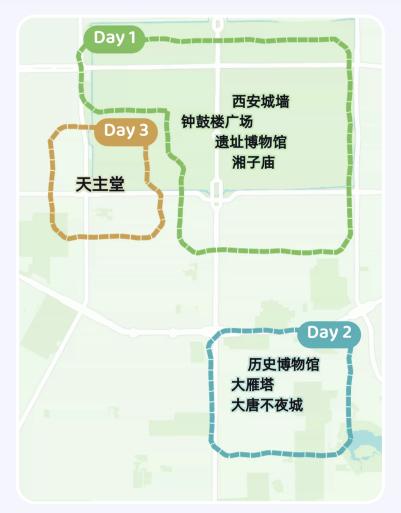
The three-day route is laid out on the map and distinguished by colors: Day 1 for the City Wall area, Day 2 for the Giant Wild Goose Pagoda area, Day 3 for the Church area. The general direction basically conforms to the original post, but the details are revised: it reminds you to book tickets for Shaanxi History Museum in advance since tickets are in great shortage, and suggests you go up the city wall after 5 p.m. in August as the ultraviolet radiation in Xi'an is very strong.
The guide is a minimalist version, and you can ask it to upgrade it to a full travel route book whenever you need to use it.
This point is very different from the general-purpose AI that most people are using now. In terms of expression, general-purpose AI undoubtedly performs better, with incisive reasoning process and beautifully written generated plans, while Fliggy Helper seems slightly inferior in comparison; but in terms of executability, Fliggy Helper has huge advantages, it performs better in the rationality of time-space and road network, and the pertinence of travel suggestions, especially its detailed version of the route book.
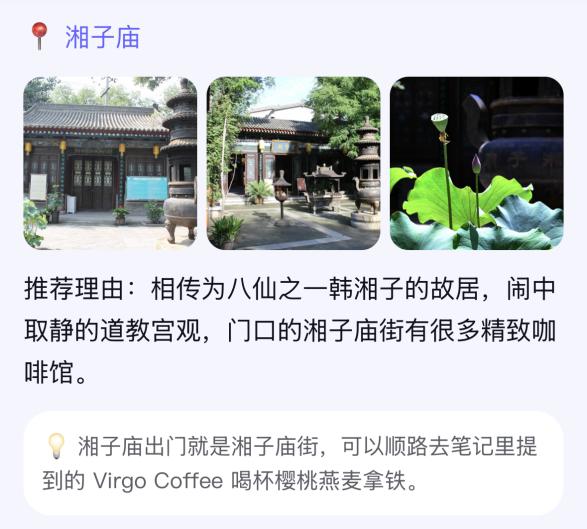
Open the route book for a closer look, it re-deconstructs the information scattered in the images, texts and videos of the original guide, and aligns all of them to Fliggy's supply chain. The route on Day 1 is Xiangzi Temple — Shuyuanmen — Beilin Museum — Xi'an City Wall — Bell and Drum Tower Square, which retains the essence of Citywalk in the original post, but each scenic spot is attached with recommended reasons and specific suggestions.
For example, after visiting Xiangzi Temple, you can drop by Virgo Coffee for a cherry oat latte; after visiting the Beilin Museum, it is recommended to take a taxi or ride a bike to Hanguang Gate, where there is an elevator in the Hanguang Gate Site Museum that leads directly to the top of the city wall. These details are not mentioned in the original post, but for people who do not like climbing stairs, the experience difference of being able to find the elevator entrance at Hanguang Gate is huge.
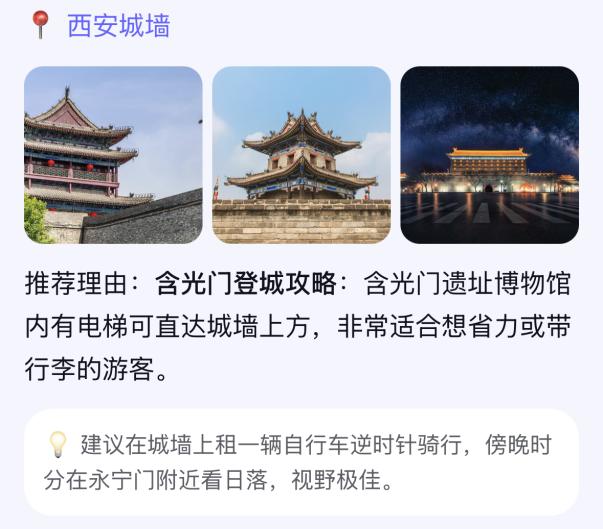
The suggestions given by Fliggy Helper provide specific bookable products: The newly opened hotel near the South Gate is within walking distance to Xiangzi Temple, which is very convenient; the dinner recommendation is Zui Chang'an at Yongning Gate, which has an excellent rating of 4.6, and it is marked with "must-order the 2-jin super lion's head"; tickets for Xi'an City Wall start from 53 yuan. China Eastern Airlines flight MU2120 takes off from Daxing at 20:30, priced at 620 yuan, and can be booked directly — yes, "direct booking" means if you say "help me place the order" at this moment, it will obediently generate the order page, let you confirm the cost details, and then execute the order placing action. For money-related matters, AI is still very cautious at this stage. But in terms of capability alone, it has indeed been able to complete the payment in the original interface without any page jump or extra clicks.
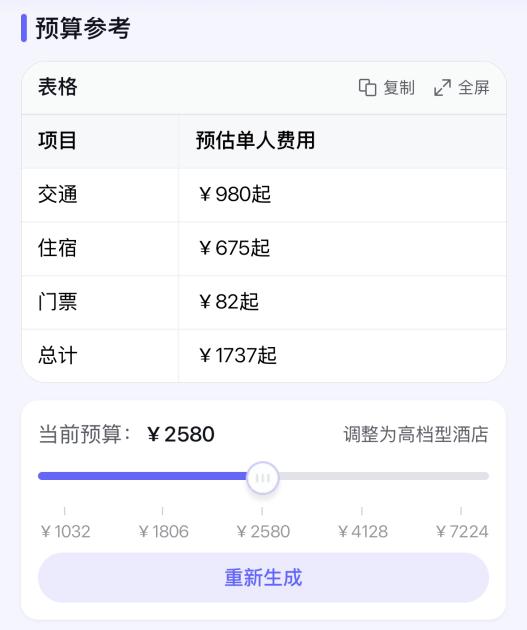
These are all things that social media influencer guides or general-purpose AI usually won't bother to handle for you. Scroll down and there is also a budget reference table, which calculates transportation, accommodation and tickets separately, with a total starting price of 1737 yuan. You can even drag the slider to adjust the budget from 1032 yuan all the way to 7224 yuan, to get plans of different grades.
If you often work as a team building organizer, you can also share this route book in the form of a long image to WeChat groups, collect team opinions like "want to see the Terracotta Army" and "want more authentic local food", then take a screenshot and send it back to the dialog box. It will automatically recognize and refer to these feedbacks, then generate a new version of the plan that takes everyone's needs into consideration.
Fliggy Helper does not just rewrite the guide in a different format. It fills in all the information you used to have to check one by one yourself, including "how to get there, whether it can be booked, and how much it costs". The budget part even provides a draggable visual range, which is completely impossible for ordinary travel guide posts to achieve.
However, we also found in the actual test that if the original guide contains some extremely niche, unpopular landmarks that are not standardized and included in the public database or Fliggy platform (such as a small popular street stall on a street corner), the AI still needs manual secondary confirmation when matching the exact corresponding product. But even so, it has compressed the "guide making" time that used to take two or three hours at every turn to only a few minutes for confirming the final plan. Maybe the time will be even shorter in the future, but how to balance the short processing time and reliable experience may be a new lesson that Fliggy's product managers will face then.
From an influencer travel guide to a bookable itinerary sheet, Fliggy Helper basically has the ability to fill all the gaps that you used to fill manually.
Can you get things done just by chatting casually?
Another scenario that really makes me feel the interaction mode has changed is as follows.
After the Xi'an itinerary is generated, I want to adjust the hotel. The originally recommended hotel is perfect in all aspects, but it is not pet-friendly, so I can't bring my dog to stay together. The filtering logic of traditional apps is: click into the hotel channel — select check-in date — tick "pets allowed" — then filter "scenic room", and finally let the system list the specific hotel list sorted by distance.
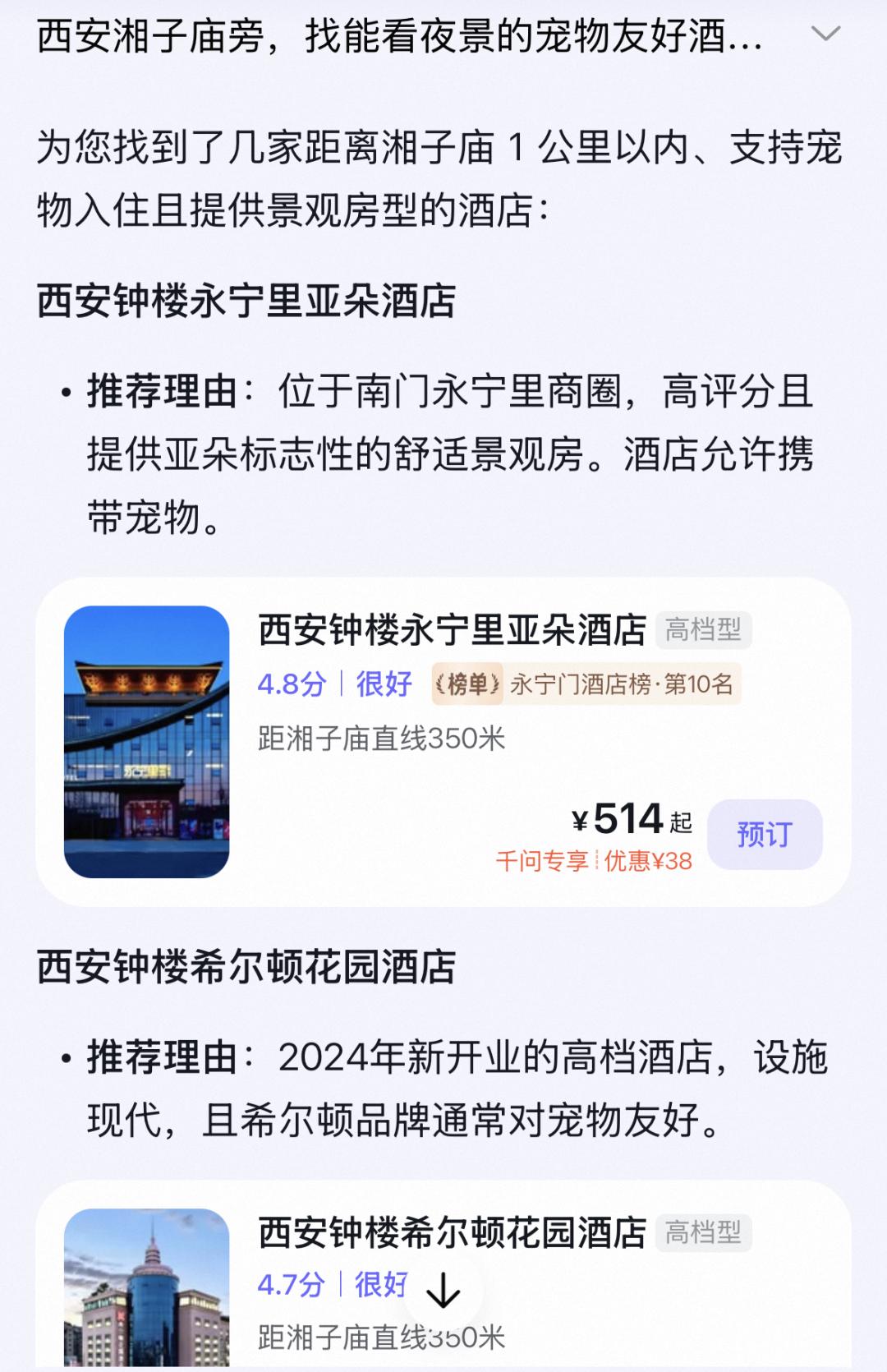
The operation path is very long, and emotional demands like "can see the night view" basically do not exist in the filter bar. But in the dialog box of Fliggy Helper, I can directly tell it by voice: "Find a hotel within 1000 meters from Xiangzi Temple, with rooms that can see the night view and are pet-friendly."
It understood this requirement and gave several hotels that meet the conditions. Atour Hotel Xi'an Bell Tower Yongning Gate is 350 meters straight-line distance from Xiangzi Temple, marked with "pets allowed" and "provides Atour's iconic comfortable scenic room", you can click to book and pay. The other one is the Hilton Garden Inn newly opened in 2024, with modern facilities, and the brand is usually pet-friendly.
In the past, when we used apps, we were learning its language: for example, where the "pet-friendly" filter option is hidden, and how to find the "scenic room" tag. Now it is the app that is learning our language, just like chatting, it translates it into a combination of conditions it can understand, then matches and executes the task.
In general, AI Agent has changed the interaction mode between apps and people.
In fact, this is the LUI (Language User Interface) that has been discussed in the past two years. To put it plainly, you no longer need to click menus and check options layer by layer. You can directly speak out your demands, and the AI will understand and execute them. The corresponding one is the familiar GUI (Graphical User Interface), which refers to graphical operations like clicking buttons and sliding lists. Some travel products on the market that claim to be "AI" usually add a dialog box to the original app. This logic is "AI in X", where AI is more like an additional functional module hung on the original system.
But Fliggy's idea is more like "X in AI", the entire product can be driven by the language logic of AI.
However, judging from the current design, Fliggy is not too radical, the GUI mode is still retained. After all, for standard product screening with given conditions, the old way works better. But when necessary, users can let the AI Agent operate the GUI for them in the LUI interface.
As a commercial company, retaining some products from the "old school" era is not a strange thing. On the other hand, making changes forcibly in scenarios where users are already used to the original operation just for the sake of being AI-powered will slip to another extreme.
Starting from the real needs and real efficiency of users, rather than starting from whether the product looks cool or has grand narratives, this is the impression that Fliggy Helper leaves on people in terms of product proposition at present.
Of course, this interaction mode is not completely without flaws after actual testing. After all, demands like "can see the night view" are inherently more difficult to be standardized and verified than "within 1000 meters". Fliggy Helper can match according to the existing information of the hotel's scenic rooms, location and other data, but for which exact room you will stay in and what kind of night view you can see outside the window, it is still best to confirm before placing the order.
However, accurately translating a sentence of "human language" with multiple limiting conditions into several specific bookable hotels, this operation of "using voice instead of manual work" has already made people feel the refreshing experience brought by the qualitative change of interaction mode.
Can the most annoying trivial matters during the trip be handled properly?
If planning routes and searching for hotels are still considered "pre-trip preparations", then when you actually start the trip, those unavoidable trivial chores are the culprits that drain young people's energy for traveling.
This is also the part where Fliggy Helper really surprises me, it starts to deal with those trivial matters that I clearly know how to handle but am too lazy to handle personally.
For example, hotel room upgrade. If you are a member of a big brand hotel, you can actually call the front desk before check-in to ask if there is a chance for a free room type upgrade.