Baidu, which made its layout in the AI office sector three years in advance, has taken the lead to break through the pack.
On August 14, Baidu Wenku and Baidu Netdisk announced at AI Day that their general intelligent agent GenFlow has officially launched its official localized name — Kuku AI.
What deserves more attention is that along with the new name, a set of latest user data was also released. The monthly active users (MAU) of Kuku AI (GenFlow) has long exceeded 100 million, among which the MAU of Kuku AI Office has surpassed 25 million. Noticing users' high-frequency interaction in AI office scenarios, the Wenku and Netdisk teams quickly formed a 30-person team covering product, R&D, strategy and other divisions one month ago, and launched the independent client of "Kuku AI" in only over 20 days. The *Office Agent Workflow Evaluation Report* recently released by the National Industrial Information Security Development Research Center shows that Baidu Wenku ranks first in the score, leading the industry for consecutive periods and occupying the first echelon alone.
This achievement comes at a time when competition is heating up rapidly — BAT meets head-to-head on the same track once again.
Tencent has brought WorkBuddy to the forefront, increasing investment in AI office around WeChat, WeCom and its collaboration ecosystem; Alibaba has integrated products including QoderWork, Wukong and MuleRun into Qianwen Office; Baidu has also launched a matrix of products in a coordinated manner, among which Kuku AI continuously iterates and upgrades its product capabilities based on the data accumulated by Wenku and Netdisk.
However, from the perspective of the competition pattern of traditional office software, Baidu is not the first company that comes to mind. Tencent owns a huge communication and collaboration relationship chain, while Alibaba has DingTalk and a long-accumulated enterprise customer system behind it.
So why did Baidu achieve such results? The answer may lie in a changing competition logic that is taking place in the AI office sector.
When AI goes beyond generating a PPT or summarizing a document, and further starts to read user materials, call different tools and perform complex tasks continuously, what determines the upper limit of product capabilities is no longer just a single model or a certain function. Users' real work data, the Agent's task execution, and the new data continuously generated after execution, have begun to form a continuously circulating system.
Baidu's leadership provides a new perspective for understanding AI office competition: what truly determines the long-term gap may not be a single point capability, but whether a continuously operating loop can be formed. Wenku, Netdisk and Kuku AI are forming different links of this cycle.
Wang Ying, Vice President of Baidu Group and President of the Personal Super Intelligent Business Group, said in today's speech: "The upgraded Kuku AI can not only meet daily needs, but also support efficient office collaboration; it can handle personal office scenarios, and also support in-depth organizational collaboration, truly becoming a super intelligence that everyone and every organization can use. Let everyone, no matter when and where, can rest assured that Kuku will take care of the work."
01
Why did Baidu take the lead first?
It is not surprising that AI office has become a battlefield where major tech giants are collectively increasing investment.
It is almost one of the applications where large models can most easily build a commercial closed loop. One end connects a huge number of knowledge workers, and the other end covers a large number of high-frequency work tasks such as documents, spreadsheets, PPTs, meetings, research, and programming. Once AI can stably complete part of these tasks, the efficiency improvement can be directly perceived; at the same time, knowledge workers themselves are a group of users with stronger willingness and ability to pay for productivity tools. The clearer the efficiency value created by AI, the shorter the commercialization path will be.
More importantly, knowledge work is also one of the production processes with the highest concentration of high-value human knowledge, where the knowledge, judgment and experience of professionals are accumulated. The content and feedback generated by these real work can not only become an important context for Agents to perform tasks, but also become high-quality signals for post-model training and Agent optimization on the premise of obtaining authorization and meeting privacy requirements.
The AI office competition is not only for a high-value commercial entrance, but also for a data link that is closest to high-quality knowledge, real tasks and user feedback. Therefore, the office sector is bound to become one of the most heavily invested directions for major tech giants.
Baidu is one of the earliest internet giants that captured this value.
In 2023, Baidu began to reconstruct Wenku with large models. A document platform that has been running for more than ten years has transformed from a content retrieval and download tool to a "one-stop AI content acquisition and creation platform". Capabilities such as intelligent PPT, intelligent document, and mind map were added successively, allowing AI to directly participate in users' content production.
In retrospect, the significance of this step is far more than adding AI to the original functions, but starting to redefine the product logic of Wenku.
For office products, generation is only one part of the whole work process. Users may search for information from dozens of materials, reorganize content from different sources into reports, and then make the reports into PPTs; after completion, they also need to modify data, adjust formats, add pictures, finally save and share, and continue to call these contents in the next work.
A real AI office product needs to gradually take over this entire link, instead of only being responsible for one generation action.
This is also the reason why Baidu has continuously connected Wenku and Netdisk later. Wenku has a large amount of professional content, while Netdisk carries users' long-accumulated private files and team materials. When content acquisition, personal storage and AI creation are integrated into the same system, the objects that AI can process begin to expand from a single instruction to users' real work materials.
By April 2025, these capabilities were further integrated into a new product form.
Baidu Wenku and Netdisk jointly launched GenFlow, which is today's Kuku AI. Users only need to put forward their tasks, and the intelligent agent can independently plan steps, call different models and tools, and finally deliver multiple results such as copies, PPTs, pictures and charts.
With a more complete product carrier and data foundation, the iteration speed of Kuku AI has accelerated significantly.
From version 1.0 in April 2025, to version 2.0 in August of the same year, version 3.0 in November, and then to version 4.0 in April 2026, Kuku AI completed four rounds of major version iterations within one year. Version 4.0 further integrates Word, PPT and Excel Agents into unified scheduling, and strengthens capabilities such as cross-device execution, file management and team collaboration. Public data shows that by the end of April this year, its monthly active users have exceeded 100 million.
Baidu has actually completed the superposition of three layers of capabilities: content can be understood by AI, files can be called by AI, and tools can be executed by Agents.
This also explains why when AI office enters the Agent competition stage, Baidu can achieve scale growth relatively faster.
However, in the environment of rapid iteration of AI products, the time advantage brought by early entry is not stable. What truly determines whether this leading position can be maintained is whether these capabilities can continue to accumulate in the process of use.
02
The real moat of AI office lies in the loop
The earlier layout has given Baidu a leading position. But this is not enough to explain why Kuku AI can continue to stay ahead.
AI products iterate extremely fast. After a function is verified, competitors can follow up in weeks or even days; the models themselves are also increasingly easy to access and replace. What is truly difficult to replicate is the accumulation formed by the product in continuous use.
This is especially obvious in the AI office field.
Office software processes a very special type of data. The daily output of knowledge workers exists in the form of files, which are continuous records of work: the operating data of the previous quarter will become the basis for the analysis of the next quarter, an industry research report will be repeatedly cited in new reports, and a project may go through dozens of rounds of revisions from the initial plan to the final review.
These continuously accumulated and interrelated work records eventually form an increasingly important asset in the AI era — Context.
Therefore, the value of AI office products to users largely depends on how much context it can obtain and whether it can understand the relationship between these contexts.
This is exactly the long-accumulated asset of Baidu Wenku and Netdisk.
At present, Baidu Wenku has accumulated more than 1.8 billion professional documents; Baidu Netdisk has more than 1 billion users, and the total storage space used by users exceeds 100 billion GB. The former provides a large amount of public knowledge and professional content, while the latter stores users' long-accumulated personal files and work materials.
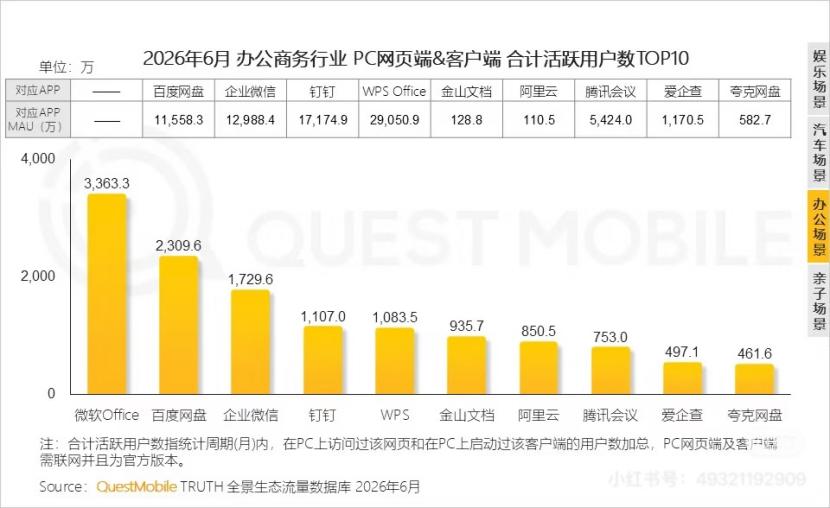
In the recent QM report, the number of monthly active users of Baidu Netdisk ranks firmly first in China, far exceeding dedicated office tools such as DingTalk and WPS, which fully proves that it has upgraded from a personal storage tool to the infrastructure of office scenarios.
The superposition of the two types of data allows Kuku AI to obtain far richer context than a single prompt when facing a certain task.
For example, when a user asks AI to "help me make a new energy industry analysis", what truly determines the quality of the result is whether it can find the industry reports the user saved before, read historical data and spreadsheets, combine new public materials to form judgments, and finally organize this information into a result that can be directly used.
This is also an easily underestimated change after Agents enter the office scenario: the basic unit of competition has begun to become complete work tasks. A task often goes through multiple links such as material acquisition, information understanding, task disassembly, tool call, content generation, inspection and modification.
Once AI begins to participate in the complete task, a more important cycle will be formed accordingly — data — execution — result — new data.
The user's existing documents and knowledge provide the context required for the Agent's first execution; the Agent calls these data and tools to complete the task, and generates new work results such as reports, spreadsheets and PPTs; the user further modifies, confirms and uses these results, which will generate new files and feedback, and continue to become the context for subsequent work.
What is more noteworthy about this cycle is that it has the possibility of self-reinforcement.
The more real work users hand over to AI, the richer the context the system can access; the more complete the context, the more likely the Agent is to deliver results that better meet user needs; the more reliable the results, the more willing users are to let AI participate in the next work.
This is also the reason why storage is revalued in the Agent era.
Cloud disk once solved the problem of "where to store files". When Agents can directly read, understand and call files, storage has become the context entrance for AI to perform tasks. Those long-accumulated work materials have also changed from static files to production materials that can be continuously called by AI.
For latecomers, PPT generation functions can be quickly caught up with, and stronger models can also be accessed, but the files, knowledge and work history accumulated by users for several or even more than ten years are difficult to re-establish in a short time.
This may be the part behind Kuku AI's current leadership that is more difficult to replicate.
03
From general office to the deep water zone of professional work
User scale can prove whether an AI office product is feasible, but it cannot determine how far it can go in the end.
The more critical question is how important the work that users are willing to hand over to AI is?
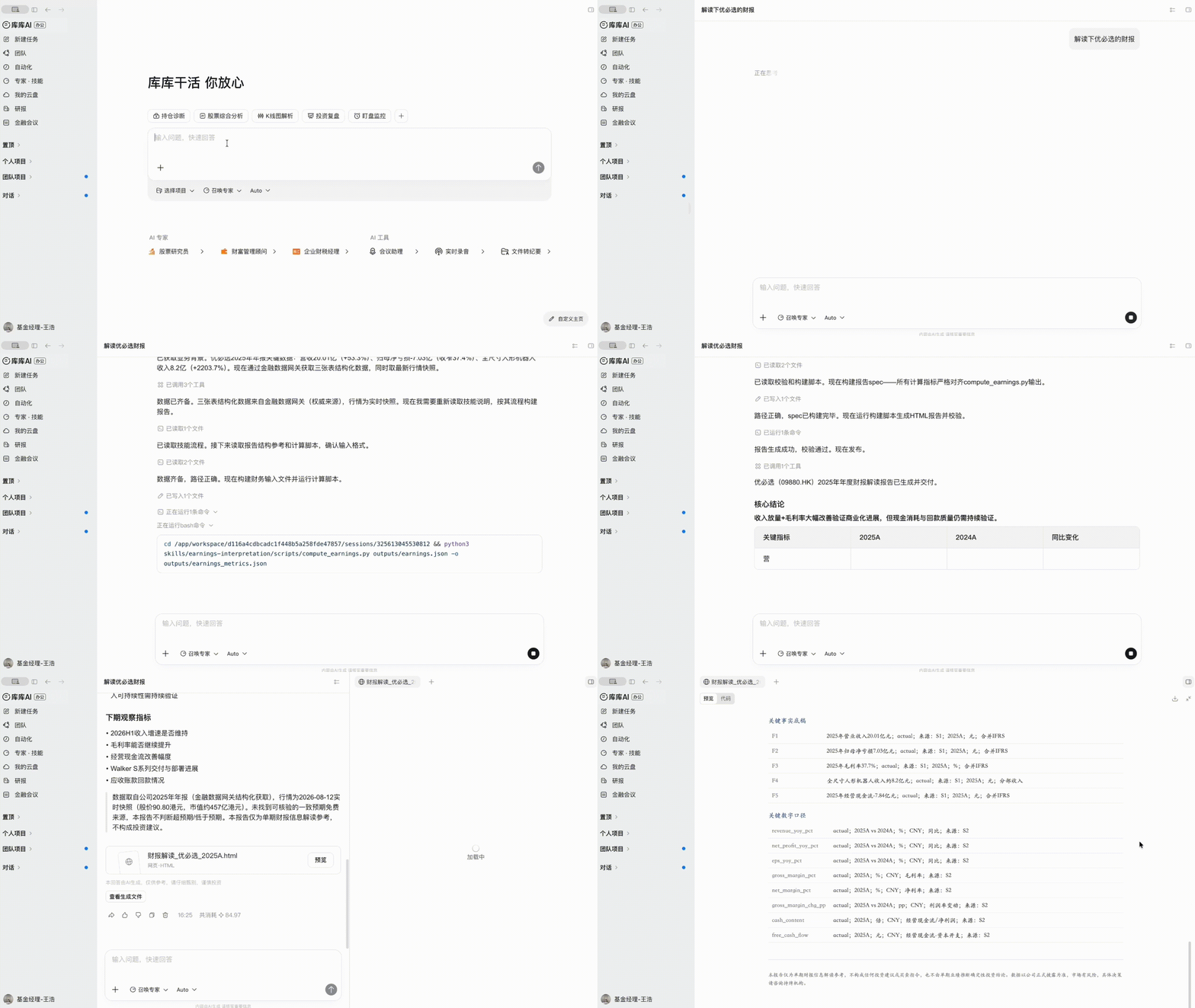
This is also another signal released by Baidu at this AI Day. In addition to officially launching the localized name "Kuku AI" for GenFlow, Baidu Wenku and Netdisk also launched the Kuku AI Office mode, targeting professional vertical scenarios such as finance, office and education, and entering the financial sector in the first phase.
The financial sector is a very representative choice.
For financial practitioners, a seemingly simple company research may contain dozens of financial reports, announcements, research papers and meeting minutes, which requires further data processing, financial analysis, valuation calculation, and then organize the conclusions into reports, spreadsheets and PPTs. The task chain is long enough, and the requirements for professionalism, accuracy and final deliverables are high enough.
In such scenarios, generation capabilities are far from enough. What is needed is to complete information analysis, task planning, tool call, data processing and content generation at the same time, maintain stability in a long execution chain, and finally deliver a result that can be truly put into work.
Yang Xi, Head of B-end Product and R&D of Baidu Personal Super Intelligent Business Group, also mentioned in the sharing that for enterprise Agents, the foundation of professional capabilities is first professional data. What enterprises want is not an AI that only knows general Q&A, but an Agent that can understand the industry, understand the enterprise, and understand the business scene. To achieve this, three types of data need to be connected.
The first type is public domain professional content. It provides the breadth of external information, including a large amount of professional content and real-time updated information sources across the network, so that Agents can understand the market environment, industry changes and public knowledge.
The second type is enterprise private domain knowledge. It comes from the enterprise's own files, meeting information, project materials, business data and organizational experience. This part of data determines whether the Agent can truly understand the situation of the enterprise itself and complete tasks based on the internal context of the enterprise. We have connected the enterprise cloud disk, which can make the use of the enterprise's private domain knowledge more convenient.
The third type is industry-specific resources. It provides professional depth, including industry data, practical templates, academic resources, certified PGC and professional institution content. These resources enable Agents to have a more reliable judgment basis and execution basis in specific industry scenarios.
Around this goal, Kuku AI Office mode has added a series of capabilities for professional tasks.
At the execution level, users can control the computer to complete tasks through mobile phones, and support parallel execution on multiple devices; in terms of professional capabilities, the system has a built-in expert and Skill ecosystem, which can call Office tools such as Word, PPT and Excel; the final delivery form is not limited to traditional office files, and can further generate videos, podcasts, mini programs and Apps.
These capabilities all point to a core direction of AI office: let Agents independently undertake more complex and professional work.
But when truly entering enterprises, professional capabilities are only the first threshold.
Individuals can hand over a task to the Agent completely, but work in enterprises is rarely completed independently by one person. A research report may need to be modified jointly by analysts, industry experts and investment managers, and a project will also circulate repeatedly between different departments. Agents not only need to complete tasks, but also need to understand the information shared by the team, take over the work of the previous link, and finally precipitate the results back to the organization.
The Kuku AI Enterprise Version launched together this time further complements this layer of capabilities.
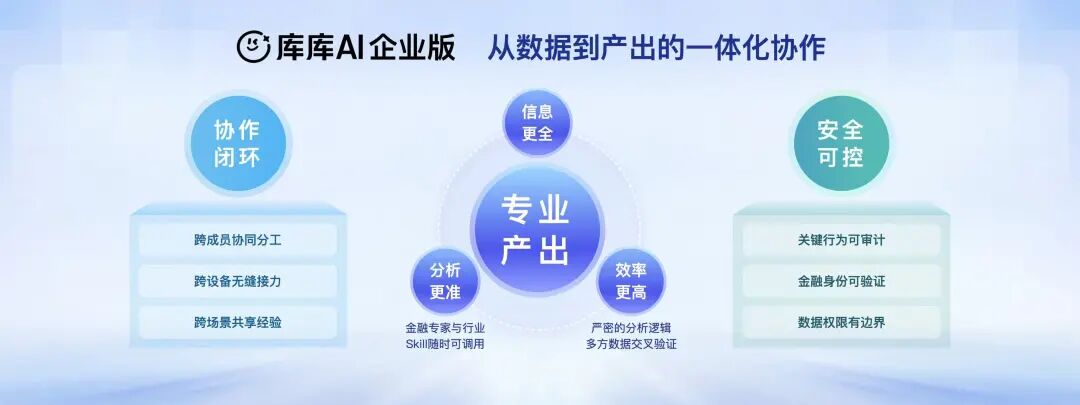
In terms of professional capabilities, it connects public domain professional content, internal enterprise knowledge and industry-specific resources into the same working environment, and further encapsulates industry experience into capabilities that Agents can call through the Skills ecosystem co-built with more than