Pop Mart's "Japanese mentor" has made an enormous fortune in China
Author | Xie Yunzi
Editor | Zhang Fan
On August 12, Sanrio, the parent company of Hello Kitty, experienced a "bloodbath" on the Tokyo Stock Exchange.
On the day the financial report was released, Sanrio's stock price fell by 18% during intraday trading, marking its largest single-day drop in nearly a decade. Analysts at Nikko Securities gave a straightforward evaluation: "The current financial report shows mediocre performance with no highlights exceeding expectations."
This is somewhat counterintuitive. Judging from the financial report, in the first quarter of fiscal year 2027 ending in June this year, Sanrio's performance was not bad: revenue reached 52.035 billion yen, a year-on-year increase of 20.7%. In terms of net profit, the company recorded 15.516 billion yen, a year-on-year increase of 9.3%.
The problem lies in the fact that operating profit fell short of expectations.
In the first quarter, Sanrio's operating profit was 22.44 billion yen, a year-on-year increase of 11.1%; the market had previously expected operating profit of 23.4 billion yen, nearly 1 billion yen less than the actual figure. More critically, in the past few quarters, Sanrio almost "raised its guidance" every time after releasing financial reports, but this time it "kept the guidance unchanged".
This is equivalent to sending a signal to the market that Sanrio's growth slowdown may have arrived.
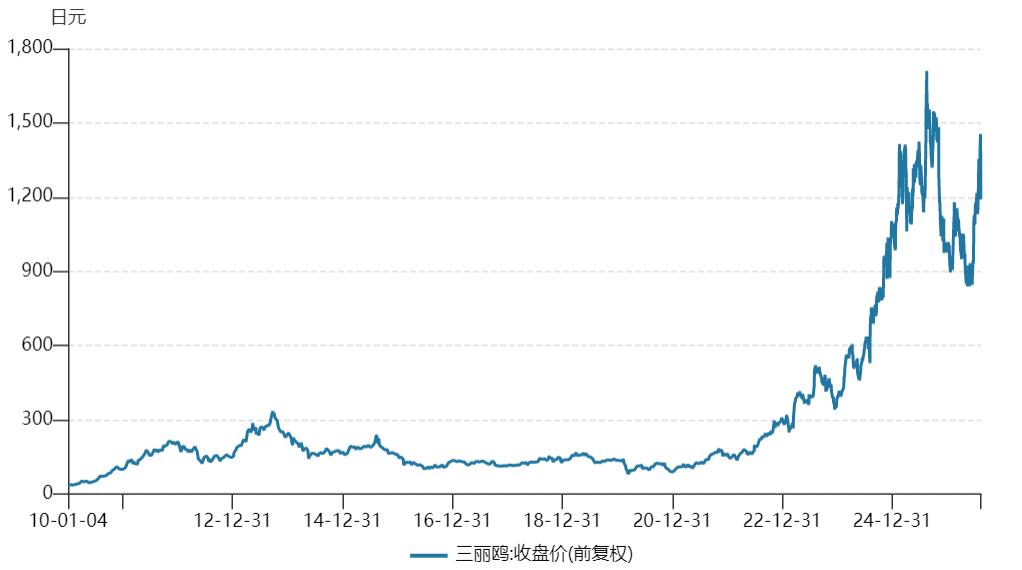
Screenshot from Wind, produced by 36Kr
A white cat and Alifish
In 1974, Hello Kitty was born. This cartoon image with no mouth, no fixed expression and a permanent 5-head body proportion has become one of the most profitable IPs in the world in the following 50 years. Its parent company Sanrio has also gradually developed from a gift shop into an IP giant.
But the subsequent journey was not all smooth sailing. Starting from fiscal year 2015, Sanrio fell into a seven-year performance slump, with both revenue and profit declining, and the drawbacks of over-reliance on Hello Kitty became prominent.
The turning point came in 2020. In that year, Tomokuni Tsuji, grandson of founder Shintaro Tsuji, took over as president and promoted reforms based on the principle of "profit priority". The main measures include: closing loss-making stores, cutting a large number of redundant SKUs, shifting the strategic focus from a single IP to multi-character operation, transforming from self-operated retail to high-margin licensing, and expanding from the Japanese local market to overseas markets.
In this process, China has become the biggest variable for Sanrio's global revival. The factor that drives this variable is the systematic reconstruction of licensing operations by Alifish.
In July 2022, Alifish, the IP transaction and innovation platform under Alibaba, signed an agreement with Sanrio, obtaining the exclusive agency rights for 26 characters including Hello Kitty, My Melody and Kuromi in mainland China for a period of five years, with the cooperation taking effect on January 1, 2023.
For Alifish, Sanrio is an important engine for explosive performance growth.
The financial report of Damai Entertainment (formerly Alibaba Pictures) shows that in the fiscal year ending March 31, 2026, the revenue of IP derivative business with Alifish as the core reached 2.17 billion yuan, a year-on-year increase of 60%, making it the company's second largest source of revenue. Alifish ranked sixth in the world with total sales of 4.1 billion US dollars in the *2025 Global Top Licensing Agents Report*.
At the same time for Sanrio, Alifish has solved the two major pain points of "channels" and "localized operation" in the Chinese market.
According to the officially disclosed data, in 2024 alone, more than 200 brands reached licensing cooperation with Sanrio, and a total of more than 30,000 SKUs were launched in the market.
The expansion of offline channels is equally aggressive. By the end of December 2025, Sanrio has opened a total of 59 stores in China, 31 more than the previous fiscal year. This means that Sanrio is no longer just an IP licensor that collects royalty fees in the Chinese market, but has personally stepped in to sell goods.
The financial report data can more intuitively reflect the effect of Sanrio's reforms.
In fiscal year 2026 ending in March this year, Sanrio's revenue reached 194 billion yen, a year-on-year increase of 33.9%; operating profit reached 79.3 billion yen, a year-on-year increase of 48.4%.
Among them, sales in the Chinese market soared to 31.44 billion yen, a year-on-year surge of 83.2%. Kuromi surpassed Hello Kitty to become the "sales champion" in China, and characters such as Cinnamoroll, My Melody and Hangyodon all ranked in the top ten of the transaction list.
From the group's perspective, the revenue share of Hello Kitty in this fiscal year has dropped from 60.6% in 2016 to 37.3%. This shows that Sanrio has got rid of the dilemma of relying on a single IP.
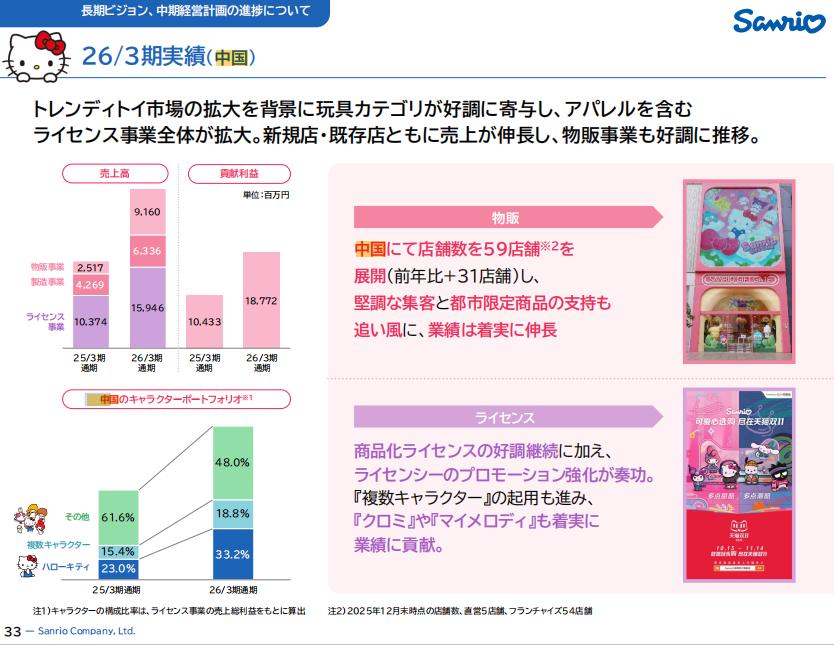
Image excerpted from Sanrio's *Financial Results Explanation Document*
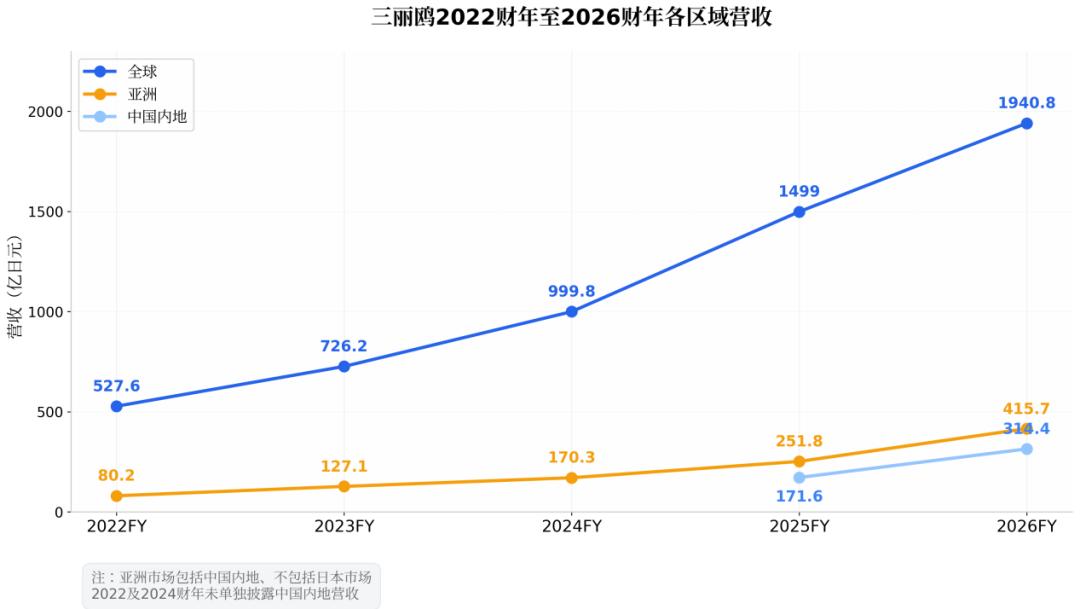
Produced by 36Kr based on Wind and financial reports
Becoming the "control group" with Pop Mart
But Sanrio still disclosed risks in its financial report.
"As the core of the company's growth strategy, the company plans to focus on expanding its business in the two major markets of China and North America, and there is no guarantee that this strategy will be successful." In North America, the company is still digesting the impact of taxes, and although sales show signs of recovery, they are far from explosive growth; in China, when the market base reaches a certain level, the high growth rate of 83.2% is unsustainable.
In fact, during the years of Sanrio's vigorous development, rising star Pop Mart has also grown rapidly, especially since 2024, LABUBU has become a phenomenal IP.
And these two companies are often compared together.
From the perspective of business model, both Sanrio and Pop Mart adopt narrative-free character IPs.
Hello Kitty has no mouth, and LABUBU never speaks. Users can freely project their own emotions onto the characters. This "blank space" in the storyline gives the IP intergenerational vitality.
An analyst once published an article on Eastmoney.com summarizing Pop Mart as "Sanrio's IP logic + Funko's trendy toy mechanism + Miniso's retail efficiency". From this perspective, Sanrio can be regarded as Pop Mart's "Japanese teacher".
However, the shortcomings of lacking story support are also obvious: the depth of emotional connection between IP and users is limited, and without continuous output of plot, users' attention is easily distracted.
At this stage, both companies are trying to supplement their content narrative capabilities through games and feature films; at the same time, they are deploying offline theme parks to increase interaction and emotional connection with users.
Of course, such acquired efforts are quite difficult.
The difference between the two business models is that Pop Mart adopts "asset-heavy direct operation". By the end of 2025, the number of Pop Mart's global stores reached 630, and it controls the pricing power through its own retail network. On the other hand, although Sanrio is also vigorously expanding directly-operated stores in China, it still follows the logic of "asset-light licensing".
Precisely because of the different business entry points, Sanrio and Pop Mart are never purely competitive, but important cooperative partners.
In March this year, Pop Mart officially launched the "THE MONSTERS × Sanrio Family Series" vinyl plush pendant blind boxes. Only one minute after the release, the official channels of Pop Mart were sold out, and more than 30,000 pieces were sold instantly online.
Sanrio's classic IP allows LABUBU to reach a wider consumer group, and Pop Mart's trendy toy mechanism also injects new vitality into Sanrio.
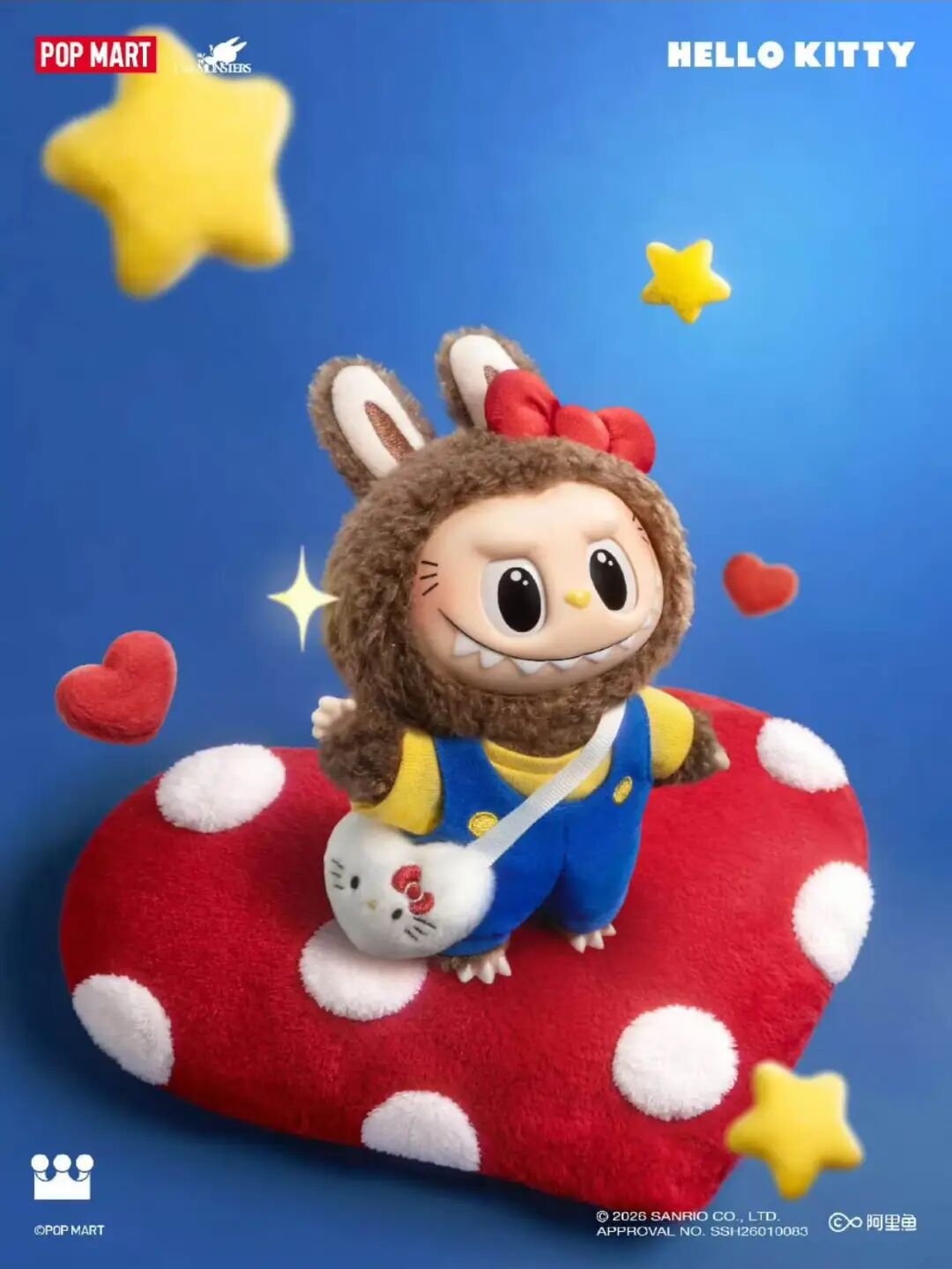
THE MONSTERS × Sanrio Family Series
It is a clear fact that in the capital market, both companies are actively or passively deflating bubbles. The valuation logic that used to rely on scale and high growth is being reshaped, and the market pays more attention to the meticulous operation of IP operations and actual conversion efficiency.
When Sanrio's years-long growth myth hits the inflection point of slowing growth, the stock price drop on August 12 may only be the beginning. After going through the cycle with the "cuteness" business, Sanrio needs to continue to prove to the market that it is not just selling plush toys and "licensed stickers", but a comprehensive IP group that spans content, commodities, experiences and digital entertainment.
To a certain extent, Pop Mart is no exception.
*Disclaimer:
The content of this article only represents the author's opinion.
The market is risky, and investment needs to be cautious. Under no circumstances shall the information or opinions expressed in this article constitute investment advice to anyone. Before deciding to invest, investors must consult professionals and make prudent decisions if necessary. We have no intention of providing underwriting services or any services that require specific qualifications or licenses for all trading parties.

Follow for more information
This article is from WeChat official account "36Kr Finance", authors: Xie Yunzi, Zhang Fan, published by 36Kr with authorization.