Capital is pouring into the AIGC content track, but funds are no longer exclusively chasing large models.
If we only look at financing amounts, the AIGC content industry in 2026 seems to have returned to its hottest era.
In July, Kuaishou's Keling AI completed nearly $3 billion in financing; Shengshu Technology secured $500 million in new financing; Aishi Technology completed its overall Series C financing totaling RMB 2.98 billion; Zhixiang Future completed RMB 1.5 billion in Series C financing. Looking further back, Yanyu Technology completed nearly $300 million in Series B+ financing within half a year, Jingying Technology successively obtained Series A and Series A+ financing, and multiple financings worth tens of millions of dollars have also emerged in the fields of AI manhua drama, AI animation, AI games and AI interactive narrative.

However, different from 2023 when capital bet on the "general large model story", this round of capital begins to flow down the industrial chain: from video generation models to creation tools, content production platforms, and then to content companies that can truly acquire users, revenue and IP assets.
Behind the financing boom, what capital is really looking for is no longer just "stronger models", but three more practical questions: Can AI produce content stably? Will anyone watch the content produced? Can traffic, subscriptions and IP revenue cover the continuously rising computing power costs?
AI Video Becomes the New Infrastructure of the Content Industry
The most prominent feature of the current AIGC content sector is that funds are concentrated in leading companies of video generation and world models.
According to Xinhua News Agency, in the past three months, the total new financing disclosed by Keling AI, Shengshu Technology, Aishi Technology and Yanyu Technology has approached RMB 300 billion. Keling AI completed nearly $3 billion in financing, and its post-investment valuation is expected to reach $180 billion; Shengshu Technology completed $500 million in financing in July; Aishi Technology completed its overall Series C financing totaling RMB 2.98 billion; Yanyu Technology completed nearly $300 million in Series B+ financing with a post-investment valuation of more than $2 billion.


Another multimodal model company, Zhixiang Future, also completed RMB 1.5 billion in Series C financing in July, with total financing exceeding RMB 2.1 billion in the past three months. Its investors not only include state-owned institutions such as the Sichuan Revitalization Science and Technology Innovation Fund under the National Social Security Fund and ICBC Capital, but also content industry capitals such as Shangying New Vision Fund and Huace Film & TV.
These financings seem to belong to the "large model competition", but in fact they are highly related to AI short dramas, manhua dramas, animations and games.

Live-action short dramas solve the problem of shooting efficiency, while AI manhua dramas and AI animations solve the problem of generating the entire visual world. Character consistency, complex movements, continuous shots, camera movement, audio and video synchronization, as long as one link is unstable, it is difficult to achieve large-scale production. Therefore, short drama companies can rely on mature photographic equipment and production teams, while AI content companies must rely on continuously iterating video models.
This is also why capital is willing to give billions of RMB to leading video model companies, but rarely directly give hundreds of millions of RMB to an ordinary AI manhua drama studio: the underlying model can serve multiple industries such as advertising, animation, short drama, film and television, e-commerce and games, with a larger revenue boundary; a single production company is easily affected by platform policies, hit content rate and production capacity fluctuations.
PixVerse from Aishi Technology and the domestic product "Paiwo AI" are competing for the mass video generation market; Shengshu Technology's Vidu goes deep into short drama, manhua drama and professional film and television institutions; Zhixiang Future deploys long-form video creation agents; Yanyu Technology covers image, design and video creation through LiblibAI, Xingliu and LibTV. The boundaries between models, tools, communities and content are disappearing rapidly.

It is particularly noteworthy that Yanyu Technology's annual recurring revenue as of May 2026 has exceeded $300 million. Two months after its LibTV was launched, its monthly revenue reached 13 times that of the first month. This shows that capital is beginning to see a new possibility: video models do not necessarily have to rely only on API charges, but can also directly generate revenue through creation tools, membership subscriptions, community ecology and enterprise services.
AI video is evolving from a technical capability to the means of production of the entire digital content industry.
From Models to Content Factories, Capital Starts to Look for Companies That "Can Produce, Distribute and Make Profits"
If billions of RMB in financing are concentrated in the underlying models, then tens of millions of RMB in financing are flowing to the industrial production links of AI short dramas, AI manhua dramas and AI animations.
In 2025, Lingjing AI completed three rounds of financing within one year. Its latest round is an angel+ round of tens of millions of RMB, led by Sinoventure Capital. The funds are mainly used to expand the mass production capacity of AI animation, build a creator ecosystem and explore overseas markets. The company has established two production lines of original animation and live-action short drama stylization, connecting novel adaptation, script storyboard, static image generation and dynamic rendering.

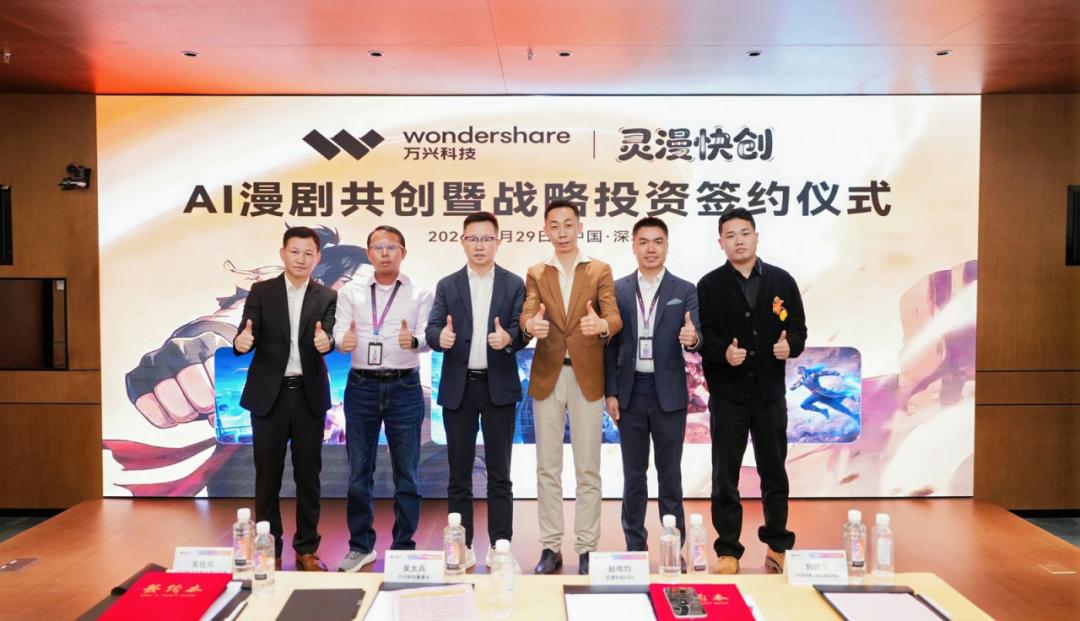
In January 2026, Lingman Kuaichuang received a ten-million-level strategic investment from Wondershare; in March, Pole Interactive, which participated in the production of the AI animation short drama Next Monday, completed tens of millions of RMB in angel round financing; in June, AI short drama platform Jingying Technology announced the completion of tens of millions of dollars in Series A and Series A+ financing, with investors including Ant Group, Wang Huiwen Family Office Lollapalooza Capital, etc.

Jingying Technology represents a path that deserves more attention. It not only provides tools for creators, but also tries to connect creation, evaluation, feedback and distribution into an Agent system. Creators can first produce a few minutes of content, verify the subject matter through real user data, and then decide whether to continue production. In fact, this transforms the traditional film and television industry's model of "investing a lot of funds first and then waiting for market feedback" into a rapid testing mechanism similar to Internet products.

Mootion takes another path. In July 2025, the company completed tens of millions of RMB in strategic financing, with cumulative financing approaching 100 million RMB. Its video generation agent serves both ordinary creators and professional animation film production. The core value of such companies, as reported by ChinaVenture, is not to have an exclusive model, but to organize scripts, characters, storyboards, videos, dubbing and editing into a controllable workflow.

The capital investment logic has thus shown obvious stratification.
The first layer is model companies, which compete for generation quality, inference cost and world model capability; the second layer is creation platforms, which compete for workflow, user scale and subscription revenue; the third layer is content companies, which compete for IP, screenwriting capability, distribution capability and hit rate.
The most easily misunderstood part of AI manhua dramas is that "reduced production cost" is often equated with "easier to make money". In fact, AI makes supply grow faster than demand. A large number of teams use the same model, similar web novel IPs and similar prompts, leading to rapid homogenization of art style, subject matter and rhythm. The more popular the model capability becomes, the harder it is to simply master tools as a barrier.
This explains a seemingly contradictory phenomenon: on the one hand, the domestic AI manhua drama market expanded rapidly in 2025; on the other hand, a large number of production teams are still losing money. Capital is willing to invest in platforms that can connect production, data and distribution, but is not willing to pay high valuations for a production team that relies on a single hit work.
A truly valuable content company does not just reduce the cost per minute from thousands of RMB to hundreds of RMB, but can continuously identify which subjects are worth doing and which content can stand out among a large number of projects, and further develop successful works into animations, games, interactive film and television games and overseas products.
AI Games and Interactive Film & Television Games Are Still in Early Stage, Next Round of Financing Will Bet on "Content Assets"
Compared with the financing frenzy of AI video models, capital's attitude towards AI games and AI interactive film & television games is significantly more cautious.
In July 2025, interactive film and television company Huying Technology completed Series B financing with undisclosed amount. The company previously produced Break Through the No.13 School, and also has interactive dramas, interactive short dramas and interactive content production tools.
In 2026, Funloom AI, the parent company of AI game creation platform Kuluan Zhimeng, completed tens of millions of RMB in Pre-A round financing, and previously received ten-million-level angel round financing. Its product tries to allow users to generate maps, NPCs, tasks and plots through natural language and graphical interface.

AI game companion company Xinying Suixing has completed four rounds of financing totaling tens of millions of dollars. Its product "Doudou Game Partner" can recognize game screens, conduct voice interaction with players, and provide strategies and emotional feedback, with more than 8 million registered users. This kind of product does not directly generate a new game, but first enters the existing game scenario, and builds AI interaction relationships based on mature user demands.
These cases reveal the current reality of AI games: AI is already very suitable for generating art materials, codes, NPC dialogues and marketing content, but it has not yet stably solved the problem of "why the game is fun".
According to the 21st Century Business Herald, from 2022 to 2025, there are 42 domestic companies that have obtained more than two rounds of financing and have business tags containing "AI + Games", but less than 10 teams actually take AI as the core gameplay.

The branches of traditional interactive film and television games are pre-designed by screenwriters, while AI interactive film and television games hope to generate plots in real time according to players' inputs. The problem with the former is that it ends once the content is consumed, while the problem with the latter is that the plot is easy to get out of control, the characters may "lose memory", and the story lacks proper narrative rhythm. AI can create unlimited content, but it does not naturally equal unlimited fun.
Therefore, the next round of capital competition will not just be "who can generate more content", but who can own three types of scarce assets.
The first type is proprietary data. Including which plot users exit at, for which character users pay, and what shots can increase the completion rate. These data can reversely train the creation Agent, forming a feedback loop that is difficult for general models to replicate.
The second type is sustainably developable IP. AI reduces the visualization cost, so that a