Yuanqing Lin, Aibee: "Build solid strongholds and fight steady, unglamorous battles", on the path to physical-world AGI
What makes an excellent enterprise? What traits define successful entrepreneurs? What are the common pitfalls to avoid along their journey of striving, and what is the most transformative change they need to make?
Pioneer·Insight We put forward these questions to outstanding alumni of leading Chinese tech ventures, investors, and industry veterans, hoping to share their perspectives with you.
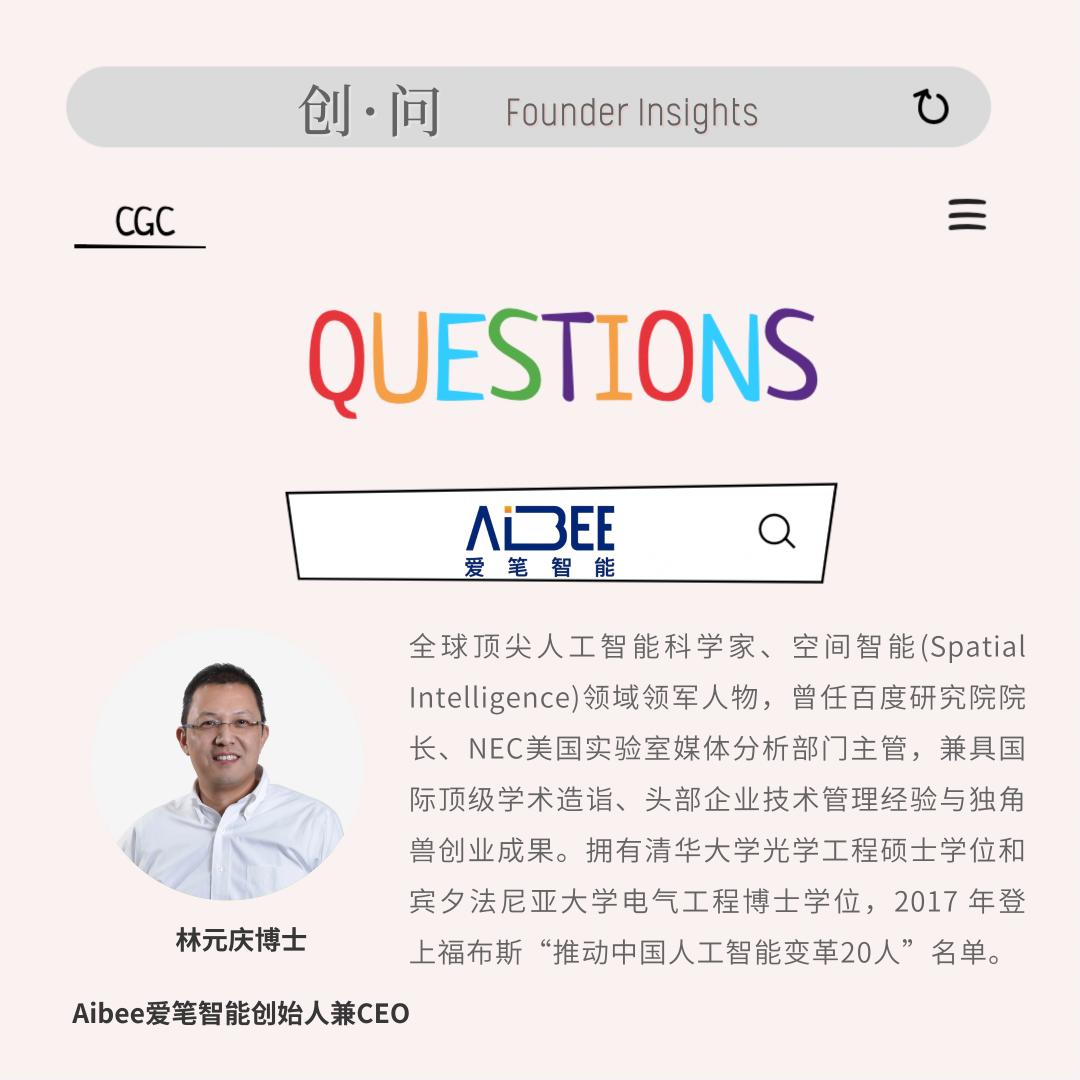
The guest of this issue is Dr. LIN Yuanqing, Founder and CEO of Aibee. Aibee focuses on the digitization and intellectualization of offline physical spaces, integrating multi-modal AI technologies including computer vision, natural language understanding, big data analytics, and robotics, to help offline spaces achieve comprehensive digital transformation and move toward intelligent operation, management, and user engagement.
China Growth Capital invested in Aibee at its angel round.
For AI, just like for humans, there are no shortcuts to understanding the complex world.
Humans piece together the full picture of the world through real-life interactions and accumulated experience; AI, by contrast, has knowledge of everything in the universe but cannot grasp the spatiotemporal operation of the physical world.
The entrepreneurial path chosen by Dr. LIN Yuanqing, Founder and CEO of Aibee, is another journey with no shortcuts. As a former scientist at NEC Labs Silicon Valley, Director of Baidu Research Institute, and a star entrepreneur, LIN Yuanqing could have led AI into more popular tracks, but he deliberately chose to empower traditional offline physical industries with AI.
Over the past nine years, LIN Yuanqing has been dedicating to enabling AI to perceive and understand the real world. It was not until spatial intelligence and world models became new industry consensus that the outside world re-recognized Aibee: the scenarios and data accumulated in the physical world are becoming a critical foundation for future AI to understand the real world.
In LIN Yuanqing's view, AI cannot always be a "master sitting in a glass room" forever. It needs to enter the real world to maximize its value. To this end, LIN Yuanqing has drawn a map that AI can understand and navigate, and on this map, he has found his own "gold mine".
The full text is shared as follows:
Q: China Growth Capital
A: Dr. LIN Yuanqing, Founder and CEO of Aibee
Sitting on the "Gold Mine"
China Growth Capital: In the past few years, everyone's focus has been on large language models. This year, world models and Physical AI have suddenly become new consensus, regarded as the next wave of AI technology. How did you manage to stand here before the trend came?
LIN Yuanqing: When large language models were booming in the past two years, we never thought of jumping on that bandwagon, because we knew for sure that the development would eventually flow in this direction.
Ultimately, the development context of AI covers exactly these five AI application fields: Natural Language Processing (NLP), speech recognition, computer vision, robotics, and big data analytics.
The evolution of technology has different paces, and the industry also develops in a spiral upward trend.
When Aibee was founded in 2017, we were already working on "digitization and intellectualization of offline spaces". The name was too long at that time, but it is essentially the same concept as today's "spatial intelligence", namely 3D understanding of physical spaces.
There are always new concepts in the industry, but what we do remains unchanged: to bring AI into offline physical spaces.
China Growth Capital: What kind of gap does AI need to cross to move from the virtual world to the real world?
LIN Yuanqing: Robots need to have a pair of "eyes" like human beings: they can identify what objects are around, where they are, how they move, and have the perception and understanding of both space and time.
In the past few years, we have completed a large number of 3D reconstructions in offline scenarios. Whether it is customers, stores, and commodities in shopping malls, or pedestrians and vehicles at road intersections, all can be marked with accurate 3D coordinates.
These data can not only help merchants improve operational efficiency and thus boost performance, but also reduce urban traffic congestion, and finally realize the AI-empowered operation of the real physical world.
China Growth Capital: Why have these capabilities suddenly become important today?
LIN Yuanqing: In the past language stage, AI could be trained based on public data. But AI for the physical world requires a large number of real scenarios, and scenarios mean data.
Now we process more than 1 million hours of video data every day. What does this concept mean? The total new daily upload volume of Douyin, Kuaishou, and Tencent Video, the three major domestic platforms, is only 270,000 hours, while that of YouTube is 720,000 hours. Moreover, all these structured data of Aibee come from fixed real scenarios, which are scarce resources for training physical world AI in the future.
Therefore, we have always firmly believed that Aibee is actually sitting on a "gold mine" — it has massive amounts of offline scenarios and physical space data.
From Experience to Data
China Growth Capital: In 2017, you started your business with the genes of AI and the Internet. Why did you choose to do offline business at the very beginning?
LIN Yuanqing: Some scientists like to raise new questions, while others focus on solving problems. Whether technology can be implemented has always been my area of interest.
At that time, I served as the director of Baidu Research Institute, and I saw that AI's empowerment for the Internet had penetrated into all aspects of Internet business, but when I looked at the offline world, AI was barely present.
Before starting my business, I visited nearly 40 companies in nine traditional industries, and realized that the development of AI technology must never be separated from applications and real traditional industries.
We named the company Aibee, which stands for AI To B, just to let AI walk out of the laboratory and the Internet, and be useful in all walks of life in the real world.
China Growth Capital: Aibee initially chose to start from shopping malls. What transformations have you made with AI?
LIN Yuanqing: Aibee has a "five-piece suite" in shopping mall scenarios: AI precision passenger flow, AI parking, AI navigation (AR/VR navigation), AI large screen, and ToC AI agent.
After the rise of large models this year, we have developed big data analytics agents: such as operation agent, investment promotion agent, and marketing agent.
AI technology of computer vision is responsible for collecting comprehensive data of the physical world, while AI technology of large language models is responsible for analyzing these data and generating business suggestions. All these technologies are independently developed by Aibee (except that the basic LLM large model uses an open-source large model). In a large physical space such as a shopping mall, we provide a one-stop AI overall solution.
In terms of business empowerment for shopping malls, Aibee's AI solutions have covered the entire process of daily shopping mall operations, including investment promotion, operation and marketing, which not only empowers the shopping mall itself, but also empowers brand merchants, as well as the interaction between C-end customers and shopping malls. From the perspective of AI technology application, we have in-depth applied computer vision (CV), speech recognition (ASR), large language model (LLM), big data analysis, and robotics — these "core AI technologies" have achieved "all in place" and give full play to their respective roles in the shopping mall scenario.
I have never seen any AI startup that can achieve such comprehensive AI orchestration capabilities, allowing AI to travel freely between the digital world and the physical world.
China Growth Capital: In the past, merchants often made major decisions such as product selection and staff replacement based on experience rather than data. How did you break this point?
LIN Yuanqing: The core is that we gradually began to communicate with customers in their own language, and our technology can bring tangible business empowerment.
Take AI precision passenger flow as an example. Our passenger flow data analysis is like taking an X-ray, which can identify the weak operational links of various brand stores in a shopping mall.
For example, Aibee once spent more than three months helping a jewelry store improve its performance. How many people pass by the store entrance? How many of them will be attracted to enter the store? How many people can stay for more than 8 minutes to achieve long stay? Among those long-staying customers, how many will place an order?
Data often reveals problems. Therefore, through younger product design and improved staff reception capabilities, the performance of this jewelry store increased by 146%, and the commission rent paid to the shopping mall nearly tripled.
It sounds very complicated, but what we use is nothing more than the mature funnel analysis that has been widely used in the Internet industry: UV, PV, and conversion rate. This is what Internet product managers do every day, but no one has done it in offline shopping malls, because there was no such per-ID data offline before, but Aibee's AI precision passenger flow makes up for this point, completely enabling such funnel analysis.
China Growth Capital: In the past two years, everyone has been bearish on shopping malls and commercial real estate. Why can you still maintain growth?
LIN Yuanqing: In fact, the business of many shopping malls is still booming, which is very counter-intuitive, right? Some leading shopping malls can still achieve annual sales of 10 billion yuan, and their annual sales are still growing.
What we see instead are positive changes: First, commercial real estate used to charge fixed rents, but after the epidemic, it has changed to guaranteed rent plus commission. The higher the merchant's performance, the more commission the shopping mall gets, so they naturally have the motivation and willingness to improve their operation level.
Second, the industry is concentrating on leading players. For example, China Resources has started to do asset-light operations. In the next five years, it plans to open more than 100 new shopping malls, most of which will be renovated and attract merchants in the form of asset-light operations. When the management radius expands, AI technology is the weapon that allows the management team to expand without proportional growth.
Third, with the disappearance of hot money, decision-making will return to the essence: whether your product can ultimately create value for the industry.
Shopping malls will not disappear. When the industry is at a low ebb, everyone will be more motivated to improve efficiency, and technology empowerment will be particularly meaningful.
Aibee is the Only One in the World That Can Achieve This
China Growth Capital: Many people are using AI to transform traditional industries. Why did you successfully walk through this path?
LIN Yuanqing: A very fundamental point is that I am a particularly utilitarian person, as many partners often evaluate me. After the grand strategy is thoroughly thought through, I have always adhered to the style of "building solid fortresses and fighting steady battles".
In terms of specific implementation paths, we have made sufficient abstraction of underlying technologies, and thus achieved extreme productization.
For example, in shopping malls, through robot 3D scanning and modeling, AI can "see" how people and objects in the space move through cameras.
The same is true for airport aprons. When will the plane stop? In which direction will it stop? Which vehicle on the ground will pick up the passengers? All these can be transformed into the understanding of 3D space.
When the middle layer of spatial intelligence is well built, no matter what applications are on top, we can grasp the whole chain of information by building 3D models. Whether it is objects or people, AI can understand their status and interactions.
When complex technologies are transformed into sufficiently standard products, they can be migrated across industries and brands.
For example, the four scenarios we cover: shopping malls, brand chain stores, airports and hubs, and dual-intelligent cities, all share the same set of underlying technologies. Solutions that can be implemented in China Resources shopping malls can also be replicated in Xiaomi brand stores, and the same applies to airports.
China Growth Capital: To make AI truly "see" offline spaces, what is the hardest thing to achieve?
LIN Yuanqing: Autonomous driving only needs to focus on the relatively standardized scenario of roads, which has already required massive capital investment. After more than ten years of development, technologies such as L5 and fully autonomous driving have not been well realized yet.
Scenarios such as shopping malls and airports are far more complex. How to achieve a more comprehensive 3D understanding of these spaces is actually very difficult.
For example, airports have people, vehicles, luggage, aircraft, etc., which usually means that hundreds of thousands of objects are distributed in a space of hundreds of thousands of square meters. A system is needed to well understand the spatial position and other information of all objects in real time. This requires a super-large-scale and super-strong AI analysis capability. For autonomous driving, usually only up to 20 to 30 objects around need to be understood.
Therefore, it is particularly difficult to uniformly command such a large-scale spatial intelligence system in time and space to achieve accurate 3D understanding of each object.
It is no exaggeration to say that Aibee is the only company in the world that can achieve these technologies at present.
In addition, the cost issue is equally critical. If the cost is too high, the technology will be difficult to commercialize.
China Growth Capital: Can technological barriers form a moat?
LIN Yuanqing: Aibee's set of spatial intelligence technologies has very high barriers. In addition to the barriers of the algorithm itself, there is also the engineering of algorithms. Can high precision be achieved robustly? Can the cost be reduced? And can the technology be truly implemented in the end?
For example, the 3D modeling of a 100,000-square-meter shopping mall usually costs about 3 million to 5 million yuan, while we can achieve it at less than 100,000 yuan.
This is not the most exaggerated. We once did 3D scanning of all roads in Haidian District, Beijing. Many companies quoted as high as 200 million to 300 million yuan. Guess how much we spent to complete it?
8 million yuan.
China Growth Capital: How can you control the cost to such a low level?
LIN Yuanqing: We optimize costs by continuously improving AI technologies. The biggest optimization often does not come from a single module, but from treating these AI systems as a whole, which requires a thorough mastery of various AI technologies.
Not only 3D modeling, but our optimization of 3D perception technology is more extreme.
For example, when Aibee built the 3D perception system for its first shopping mall in Beijing in 2018, 150 GPUs servers with 8 graphics cards were needed. Because the amount of video data was too large, it took 10 days to calculate only one day's data.
Eight or nine months later, we reduced the number of GPUs to 12, and one day's data can be calculated within one day, which improved the computing efficiency by nearly 100 times. After that, we put more than 90% of the computing into the camera and use AI chips for computing, which directly reduced the number of GPU servers to 1.
Today, we don't even need that one, all relevant calculations can be done on the camera side. The price of one GPU was 150,000 yuan at the earliest, and the cost of 150 units would be more than 20 million yuan, plus 10 days of calculation. But now we have achieved the cost of ten thousand yuan level and can finish the calculation in 0.5 days