CoreWeave, Nebius: With soaring computing power prices and deep-pocketed backers stepping in, how long can Nvidia's "favored protégés" stay at the top of their game?
Behind the recent sharp rally of new cloud platforms such as Nebius and Coreweave, combined with performance reports and earnings calls, the current AI cloud computing demand in the industry is clearly in a state of severe supply shortage amid strong demand.
Taking Nebius as an example, for medium and long-term contracts spanning 1 to 3 years, the computing power price is USD 20-25 billion per GW. However, to secure more favorable pricing, the company deliberately retains some retail capacity and adopts an auction mechanism where customers bid, with the highest bidder winning the resources. The pricing can reach up to USD 50 billion per GW.
It is common practice for cloud vendors to bid for enterprise projects in the past. Such reverse operation, not to mention the 2X gap between long-term agreement prices and retail prices, the auction method itself fully demonstrates that the entire AI cloud computing market is currently a strong seller's market.
I. How Long Will the Severe Supply-Demand Mismatch of AI Computing Power Last?
Under such circumstances, the core logic for both new cloud vendors and established cloud giants is that any cloud vendor that holds operational production capacity this year deserves positive valuation premiums.
Moreover, this is why SpaceX uses its revenue of less than USD 50 billion in 2026 to support approximately USD 200 billion in capital expenditure (calculated backward based on the company's target increment of computing power production capacity). The same goes for Meta: after building its own computing power to meet internal demand, it continues to make large-scale investments even when its self-developed AI models are not competitive enough, and shifts to the cloud computing rental business.
After all, when extrapolating computing power prices linearly based on this year's pricing, the pricing of USD 25-50 billion per GW means cloud vendors can recoup their costs within 1 to 2 years. The subsequent rental income plus the residual value of decommissioned equipment are all extra profits.
The essence behind this supply-demand mismatch is that model training relies on software engineering capabilities and can advance non-linearly, while AI computing power production capacity is subject to physical world constraints in terms of construction, production and manufacturing.
A major iteration of models every 6 months can directly drive the Token demand up 10X, but the whole cycle from construction to production in the physical world is a linear 1.5 to 2 years. The rapid advancement of the virtual world and the hard constraints of the physical world inevitably lead to a significant supply-demand mismatch.
Therefore, the analyst from Dolphin Research does not dare to linearly extrapolate next year's pricing using the 2026 computing power pricing. According to the current capital expenditure progress of major vendors, for example, both Meta and SpaceX have set a 2027 target of 6-8 GW of operational capacity. According to Dolphin Research's estimates, the computing power production capacity will enter a phased concentrated launch period in 2027.
Therefore, from a risk control perspective, Dolphin Research suggests focusing on major vendors that started Capex construction earlier and have larger scale, such as Amazon and Microsoft. They are the companies that can generate substantial real revenue during the period of certain supply-demand mismatch.
II. NVIDIA Steps in as the "Backer"
The sharp rally of new cloud platforms this round is not only the market's reward for new cloud vendors in a seller's market, but also backed by NVIDIA's USD 500 billion financing platform.
Cloud giants initially support their huge capital expenditure with their operating cash flow. After the operating cash flow is exhausted, they use the cash reserves on their balance sheets, and turn to financing when the reserves are not sufficient.
The priority order of financing options is on-balance sheet debt issuance first, then off-balance sheet debt issuance, then convertible bonds, and finally equity financing. The stronger the equity attribute of the financing instrument, the higher the financing cost will be. However, as a business with high capital barriers, the capital cost for large vendors is significantly lower than that of new cloud vendors.
For new cloud vendors such as Coreweave, the interest rate on debt issuance can be as high as 8-9% (vs around 5% for large vendors), and they need to mortgage the cash flow from their purchased GPU equipment or customer contracts. Or similar to Nebius, they directly issue convertible bonds plus additional share offerings, leading to significantly higher financing costs.
However, the problem is that new cloud vendors only have annual revenue of tens of billions of dollars, but their annual capital expenditure reaches hundreds of billions of dollars. Neither asset-backed bond financing is sufficient, nor the equity dilution from large-scale share issuance is economically viable due to the excessively high actual cost.
At this moment, NVIDIA, the strong backer of new cloud vendors, takes another major step: it leads a group of six financial institutions including Apollo, BlackRock, Blackstone, Brookfield, Goldman Sachs and KKR to sign a memorandum of understanding, planning to establish a USD 500 billion financing pool through an independent platform to help new cloud vendors break through financing bottlenecks.
Specific details have not been fully disclosed yet, but after sorting out a series of clues, Dolphin Research believes that the operation logic is very similar to Meta's off-balance sheet financing, while key terms such as the residual value guarantee or project guarantee ratio provided by NVIDIA, as well as the specific interest payment schedule, need to wait for NVIDIA's earnings report to see if more details will be released.
The figure below is the chart made by Dolphin Research when analyzing Meta's off-balance sheet financing. Roughly estimated by Dolphin Research, if we replace the minority capital contributors of the joint venture with NVIDIA and the new cloud vendors, and replace the residual value guarantee responsible party from Meta to NVIDIA, the structure will be almost the same.
The core of this arrangement is residual value guarantee: only with NVIDIA's involvement and endorsement can capital institutions such as BlackRock and Blackstone that only pursue determined priority returns be willing to enter the market.
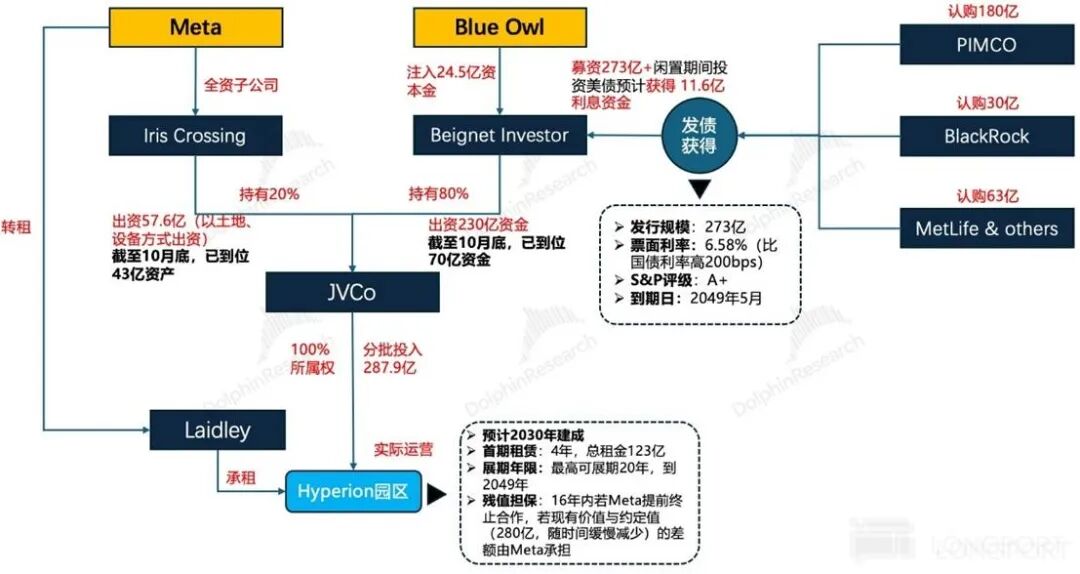
For these capital providers, there are only two sources for the recovery of principal and interest in effect: a. Stable rental income after the AI factory is put into lease; b. If the tenant defaults and the rental income disappears, the plant and equipment will be sold for cash, of which the depreciation of the plant and other facilities is relatively small, and the part with large value fluctuation is mainly IT equipment.
The first scenario is completely risk-free. For the second scenario, for capital institutions like BlackRock, the sum of a and b must first ensure the preservation of principal, and ideally also provide a certain guaranteed return.
Since new cloud vendors do not have the capability to develop self-designed ASICs, almost all the computing power they use is NVIDIA GPUs plus network equipment. The core variable of equipment realizable value is GPU. NVIDIA provides residual value guarantee for this part, ensuring that enough money can be recovered from equipment sales to preserve principal, which is the key to the success of this USD 500 billion financing initiative.
From NVIDIA's perspective, originally a GPU with a cost of USD 25 can be sold for USD 100, generating pure income. Under this new sales model, when recording income and profits, there is an additional off-balance sheet contingent liability.
Against the backdrop that the moat of NVIDIA's GPUs may weaken in the inference era, the extra cost NVIDIA pays for the determined USD 100 income is to ensure that when large cloud vendors generally develop self-designed ASICs, NVIDIA can support new cloud vendors from the financing dimension, maintain the market share of NVIDIA GPUs, and narrow the cost gap between growing new cloud vendors and established cloud giants.
In this case, NVIDIA must first ensure that the guaranteed amount does not exceed the USD 75 gross profit from this unit of income. The fact that NVIDIA dares to provide such a guarantee itself shows that NVIDIA believes it can extend the service life of older generations of GPUs through CUDA system upgrades, software performance improvements and other hardware iteration measures. Therefore, even if a single data center operates poorly, there is still room to sell it to other market players.
Under this arrangement, NVIDIA is essentially mobilizing social capital to provide financing for NVIDIA's GPU computing power factories, expanding the territory of new cloud vendors to compete with self-developed ASICs.
Depending on the payment terms of data center leases, if new cloud vendors can obtain this financing, it will be a long-awaited relief. Most new cloud vendors have a large backlog of orders but cannot produce enough capacity to fulfill them, and their on-balance sheet leverage is already too high. This round of financing properly moves the leverage off the balance sheet, reduces the pressure on the balance sheet and equity dilution, which is undoubtedly positive news.
In the competition between new and established cloud vendors, the cost gap between ASICs and GPUs still exists, and the advantages of established cloud vendors such as cross-border multi-cloud deployment remain. But at least in the financing dimension, the USD 500 billion financing platform means the financing cost gap between the two camps is narrowed. The financial pressure on new cloud vendors is reduced, allowing them to focus more on project delivery and execution.
This article is from the WeChat Official Account "Dolphin Research" (ID: haituntouyan), written by Dolphin Analyst, and authorized for release by 36Kr.