With untold wealth right in front of them, has Applied Materials (AMAT) actually chickened out?
Applied Materials (AMAT.O) released its financial results for the third quarter of fiscal 2026 (ended July 2026) after U.S. market hours on the early morning of August 14, 2026 Beijing time. The key points are as follows:
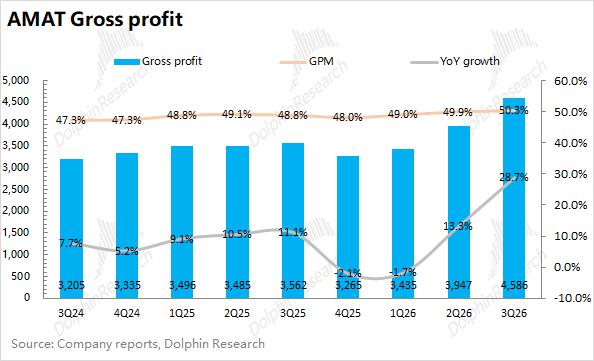
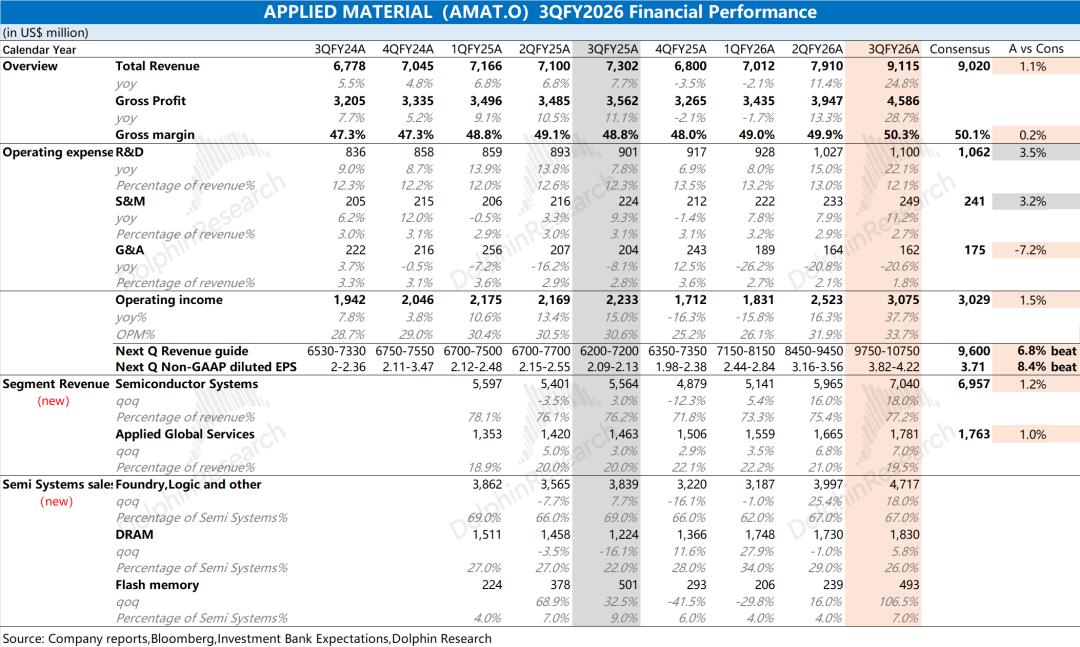
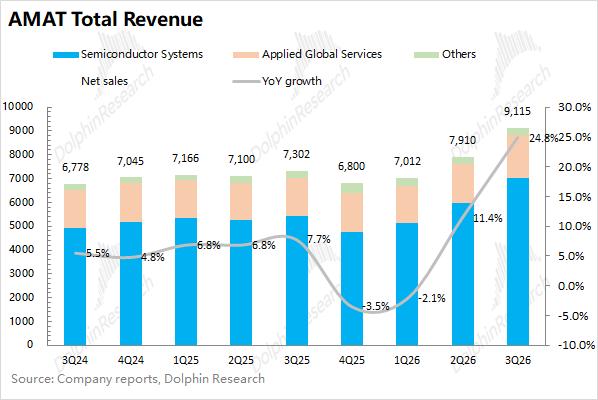
1. Core Data: Applied Materials (AMAT) posted revenue of $9.12 billion this quarter, up 25% year on year, slightly beating market expectations of $9.02 billion. The growth was mainly driven by the expansion of AI computing power infrastructure, which boosted demand for advanced logic, DRAM, and advanced packaging equipment.
The company's gross margin stood at 50.3% this quarter, up 0.4 percentage points quarter on quarter, meeting market expectations of 50.1%. Against the backdrop of expanding downstream capital expenditure, the company's gross margin showed an upward trend. As for the relatively slow growth rate, the company explained that it had increased cost investment in the semiconductor equipment and services sector.
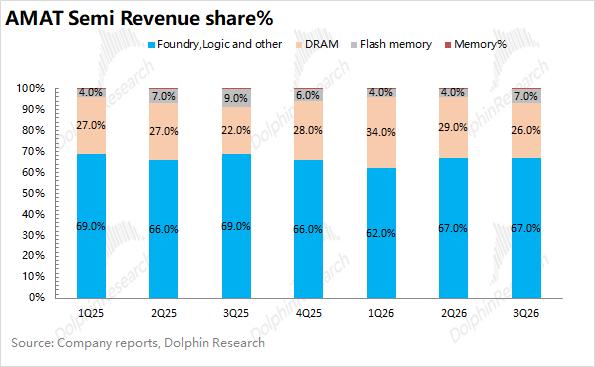
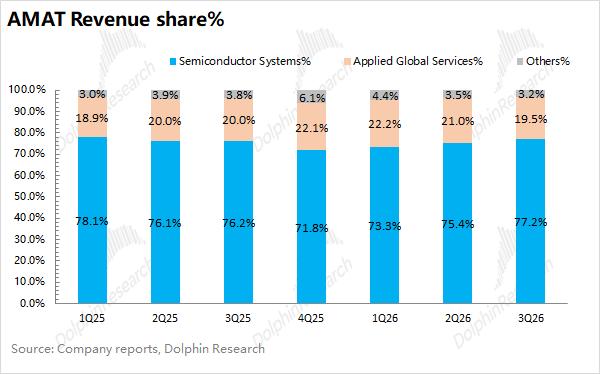
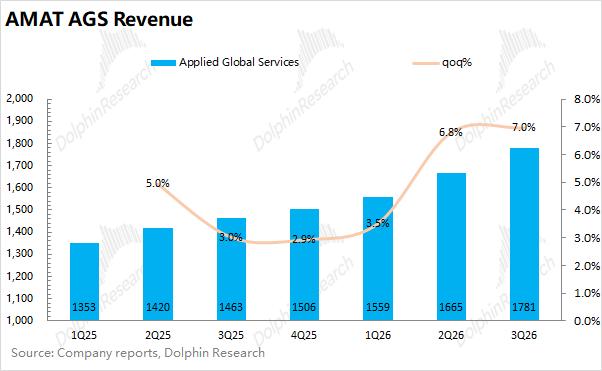
2. Specific Business Performance: Applied Materials' business is mainly divided into two parts: semiconductor equipment business and service revenue. The semiconductor equipment business is the company's largest source of revenue, accounting for more than 70%.
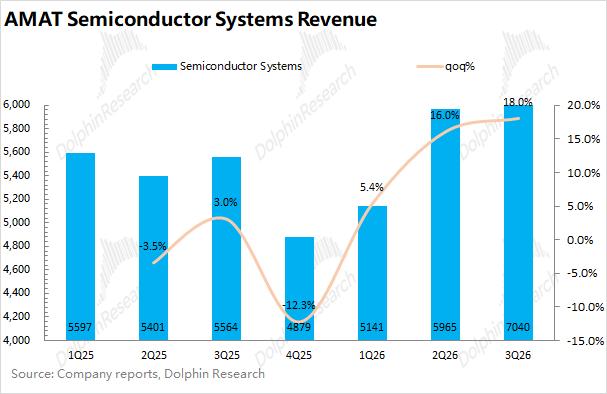
In the semiconductor equipment business: ① Revenue from the logic segment reached $4.72 billion this quarter, up 18% quarter on quarter, mainly driven by rising demand for advanced manufacturing processes; ② Revenue from the DRAM segment reached $1.83 billion this quarter, up 6% quarter on quarter, affected by the mismatch between customers' capacity expansion pace and delivery cycles (limited clean room space).
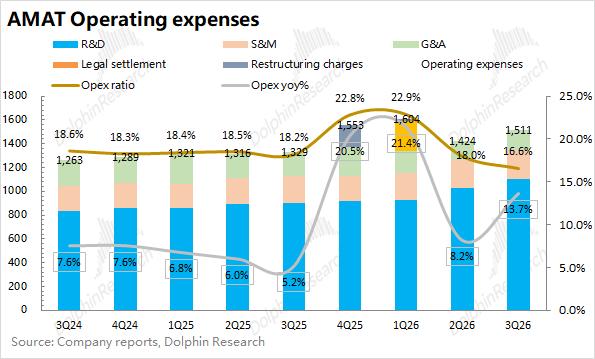
3. Operating Expenses: The company's operating expenses rose to around $1.51 billion, up 14% year on year. In terms of core operating expenses, R&D expenses increased to $1.1 billion this quarter, while administrative expenses and sales expenses remained stable.
The company announced at the end of October 2025 that it would lay off 4% of its staff. With the improvement of performance, the company has significantly recruited more semiconductor engineers and service personnel, and the number of employees increased by 7% quarter on quarter this quarter.
4. Next Quarter Guidance: Applied Materials expects revenue of $9.75-10.75 billion for the fourth quarter of fiscal 2026, better than market expectations of $9.6 billion. The midpoint of the range represents a 12.5% quarter-on-quarter increase; the company expects non-GAAP earnings per share for the next quarter to be $3.82-4.22, also better than market expectations of $3.71.
Haitun's Overall View: Strong Performance Failed to Prop Up a Conservative Guidance
Applied Materials' financial results are solid, with both revenue and gross margin meeting market expectations. The company's growth mainly comes from the expansion of AI infrastructure, which drives increased demand for advanced logic, DRAM, and advanced packaging equipment.
The company's guidance for the next quarter is also better than market expectations, however, the company's share price plunged sharply after market hours, which was mainly affected by the management's remarks. The company previously gave guidance that "the semiconductor equipment business is expected to grow by more than 30% in the 2026 calendar year", but it did not explicitly raise this target after releasing this earnings report.
The management mentioned that demand continued to strengthen this quarter, and the business growth rate will exceed the "over 30%" emphasized in the previous quarter. The company also stressed that it expects its market share to increase within the year, but it did not give a quantitative figure, not even "40%", which reflects the company's lack of confidence in its order backlog.
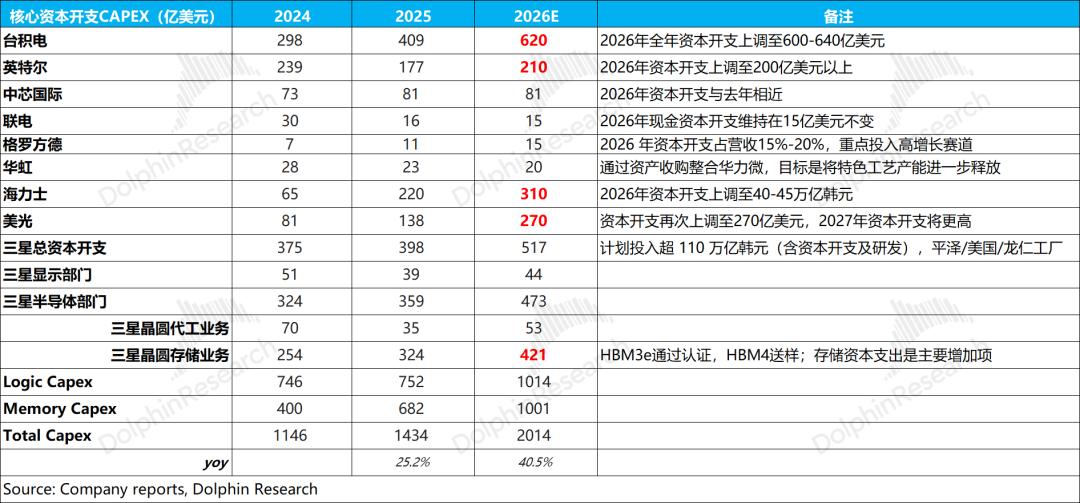
Combined with the capital expenditure plans of core large manufacturers (over 40% growth for the full year), Applied Materials' guidance is clearly on the weak side. Especially after many large manufacturers recently raised their full-year capital expenditure targets again, the market expected the company to make a significant upward revision.
On the other hand, since Applied Materials' fiscal year is 2 months offset from the calendar year, even if the 2026 calendar year growth rate is set at 40%, it means a sharp slowdown in the sequential growth of the semiconductor equipment business (18% this quarter -> 12% next quarter -> 6% the quarter after that). It is worth noting that Q1FY27 (ended January 2027) has 14 weeks, which means that the "+6%" figure is close to zero quarter-on-quarter growth when adjusted to the same 13-week base, which obviously does not satisfy the market.
Apart from this quarter's performance, the market is also paying attention to changes in the following aspects:
a) Capital expenditure of wafer fabs: Driven by AI demand, many core wafer fabs have raised their capital expenditure outlook again, which is the main driving force for the semiconductor equipment industry and the company's share price to move upward.
Specifically: ① TSMC raised its 2026 capital expenditure guidance to $60-64 billion, with the annual increment reaching about $20 billion; ② Micron raised its 2026 capital expenditure to $27 billion again; ③ Samsung and SK Hynix have also explicitly increased their capital expenditure.
Combined with the capital expenditure outlook of various parties, the capital expenditure growth rate of global core wafer fabs in 2026 will rise to around 40%, with the main increment coming from TSMC's advanced process and memory manufacturers' capacity expansion. However, the company did not explicitly raise the "full-year growth of more than 30%" target for its semiconductor equipment business after the earnings report, which is hardly satisfactory to the market.
b) Memory demand and order visibility:
Combined with the capital expenditure outlook of large wafer manufacturers, memory manufacturers have relatively stronger demand for expanding capital expenditure. Since the manufacturing of DRAM and HBM relies more on processes such as deposition, CMP and advanced packaging, Applied Materials will also benefit from this round of memory manufacturers' capital expenditure drive.
Because Applied Materials' revenue focus is on the logic sector, the memory segment only accounts for 20-30% of total revenue, and the pull from memory to the company is not as strong as that of Lam Research (memory revenue accounts for nearly half of its total). It is worth noting that Applied Materials has the widest coverage across all links in the DRAM/HBM field (covering deposition/CMP/metrology/packaging), which will also bring more stable performance to the company.
The management maintained during the earnings call that "the largest customer provides an 8-quarter rolling forecast", and the only additional incremental information is that "some customer conversations have been extended to 2030". The latter is still in the negotiation stage, and the relatively certain forecast still remains within the 8-quarter time horizon.
In fact, Applied Materials, ASML and Lam Research are all upstream equipment players in the semiconductor industry, forming a basket of stocks concept, all affected by the semiconductor cycle and wafer fab capital expenditure. Applied Materials' current valuation multiples are also close to its peers ASML and Lam Research.
For investment in semiconductor equipment companies, the focus is mainly on the certainty of semiconductor capacity expansion and high growth in the next 2-3 years. As long as the prosperity of AI Capex/semiconductor cycle remains, subsequent upward revisions of capital expenditure are expected to drive the performance and valuation of upstream semiconductor equipment related companies to rise.
Previously, semiconductor demand was mainly concentrated in advanced processes and memory sectors. Judging from SMIC's gross margin yesterday, the mature process has also entered an upward cycle, especially price hikes are widely seen in the 8-inch wafer field. Driven by AI demand, "supply shortage" has spilled over to more semiconductor segments. If subsequent companies begin to increase investment in traditional semiconductor fields, it is expected to further boost the demand for semiconductor equipment and other related sectors.
Overall, driven by the continuous increase of AI Capex and the recovery of traditional semiconductors, the trend of this round of semiconductor cycle has not changed. Large manufacturers are expected to continue to increase capital expenditure in the follow-up, which is the basis for the company and the semiconductor equipment industry to accelerate growth.
As for the management's failure to explicitly raise the full-year outlook for the semiconductor equipment business (still above 30%) this time, it will affect market confidence in the short term. As long as the upward trend of the semiconductor cycle remains unchanged, the short-term pullback will not be too deep. The subsequent increase in downstream customers' capacity expansion demand and investment will still drive the company's performance and valuation to rise.
The following is the detailed data of Haitun Research on Applied Materials' earnings report:
This article is from the WeChat official account "Haitun Research" (ID: haituntouyan), Author: Haitunjun, published with authorization from 36Kr.