After Unitree, who will be the "second Unitree"?
On August 10, Unitree Robotics launched the online subscription for its STAR Market IPO. The issue price was 150.8 yuan per share, with an implied issued market value of approximately 60.993 billion yuan.
The final winning rate for online distribution was only 0.0181%, which means that out of every 10,000 subscription numbers, fewer than 2 could win the allotment. It took only 73 days from IPO acceptance to approval, marking the fastest record in the history of the STAR Market.
This Hangzhou-based robotics company has anchored a 61 billion yuan valuation benchmark in the embodied intelligence track.
The next question is who will become the second player of this level. The market has set its sights on two companies: Agibot and Deep Robotics.
One has just overtaken Unitree in total shipment volume, while the other is holding a firm position in the quadruped robot track.
But comparing the two companies, the interesting part does not lie in which side has better-looking data, but that they are adopting completely different approaches to answer the same question:
After a company with a market value of 60 billion yuan has defined the track valuation standard, what makes you valuable enough to support your own market value?
1
The First to Go Public Sets the Rules
Agibot Robotics was founded in February 2023, and it has been only three and a half years up to now.
Deng Taihua, legal representative and chairman, is a former vice president of Huawei and the core operator of the Kunpeng and Ascend ecosystem. Peng Zhihui, the co-founder, is better known by his online name "Zhihuijun", a Bilibili UP host with millions of followers and the well-known "Huawei Genius Youngster". Its shareholder list includes a group of star institutions such as Tencent, BYD and GL Ventures.
The most eye-catching advantage of this company is its astonishing growth rate.
Its revenue was about 300,000 yuan in 2023, around 60 million yuan in 2024, and exceeded 1.05 billion yuan in 2025, realizing a 3500-fold increase in three years. In the first quarter of 2026, its single-quarter revenue has surpassed 1 billion yuan, and its full-year revenue target is 4 billion yuan.
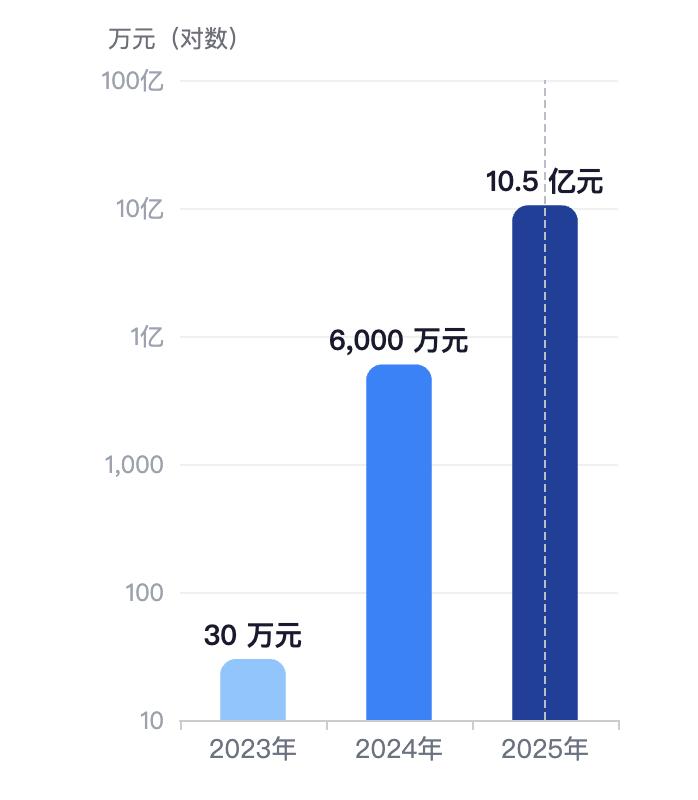
Deng Taihua once put forward the internal "358 Grand Blueprint": 10 billion yuan revenue in 3 years, 100 billion yuan in 5 years, and strive for a total revenue of over 1 trillion yuan in 8 years.
Its mass production speed is equally amazing. In January 2025, its monthly output exceeded 1000 units, and the total number of units rolled off the production line reached 5000 in December; in March 2026, the 10000th unit was produced; on June 28, the cumulative number of offline units reached 15000.
In terms of shipment volume, Agibot shipped about 8400 units in the first half of 2026, with a year-on-year increase of 562%. Its global market share rose from 25% to 44%, surpassing Unitree's 5900 units and 31% market share for the first time and ranking first in the world.
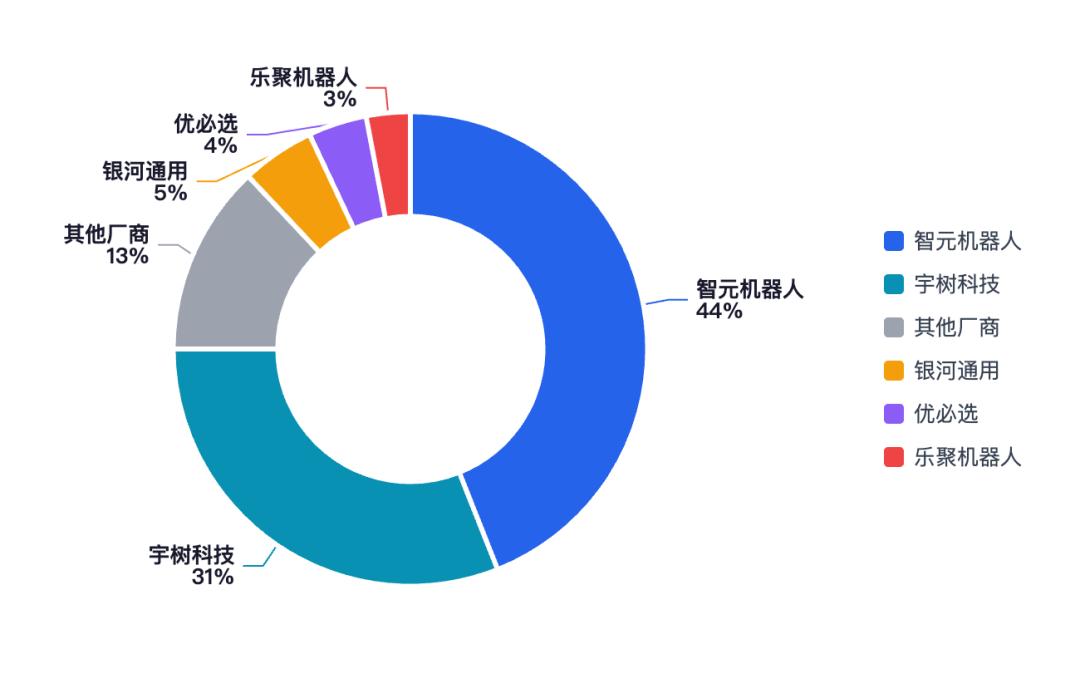
The two companies together occupy about 75% of the global market share. The shipment scale of American manufacturers such as Tesla and Figure AI still lags far behind: in 2025, the shipment volume of Optimus was only at the 1000-unit level, and the total annual shipment of Figure 02 was less than 500 units.
On the technical side, Agibot released the GO-1 large model last March, introduced the ViLLA architecture, and added an implicit planner between the "perception" and "execution" links, allowing robots to simulate actions in their "brain" before outputting actual movements, solving the common industry problem that VLM large models can understand tasks but cannot perform them well.
In April this year, GO-2 was officially launched, introducing the action chain of thought and asynchronous dual-system, supporting collaborative training for thousands of robots. In terms of technical route, Agibot bets that the intelligent brain determines everything: the robot body can be produced through cooperation with other partners, and application scenarios can be jointly built, but the core intelligent brain must be fully mastered by itself.
But none of these points are the most thought-provoking part. The really interesting thing is Agibot's IPO rhythm.
In July 2025, Agibot obtained 63.62% controlling stake of the STAR Market listed company Sino Composite through the mode of agreement transfer plus tender offer, with a transaction amount of about 2.1 billion yuan. The market value of Sino Composite soared from more than 3 billion yuan to a maximum of 89.1 billion yuan.
The market immediately boiled over, with widespread speculation that Agibot was planning a backdoor listing. Finally, Agibot issued a clarification statement, saying that it had no backdoor listing plan within 36 months.
Then in July this year, Agibot officially launched the Hong Kong stock listing process. The target valuation given by cornerstone investors is HK$40 billion to HK$50 billion (about 34.6 billion to 43.3 billion yuan), which is basically in line with Unitree's 42 billion yuan valuation. The company once hoped to push the valuation to about HK$80 billion, and there are rumors that it is advancing the listing process at a valuation of 20 billion US dollars.
A company that has been established for only three and a half years and has not yet achieved profit is heading for a valuation of more than 40 billion yuan.
Here comes the question: does Agibot lack money? Peng Zhihui, CTO of the company, said plainly in an interview in April: "Agibot's commercialization pace is very fast, and we already have the ability of self-sustaining cash flow."
It does not lack money, so why is it in a hurry to go public? The answer may be that what it is buying is not capital, but time.
All actions of Agibot in the past three years have only one main line: to ensure that it still has enough chips in hand before each round of industry reshuffle comes.
Deng Taihua revealed that about 3/4 of Agibot's R&D manpower and more than 3/4 of its R&D expenses are concentrated on the "cerebrum and cerebellum AI" technology, while the robot body manufacturing part adopts a large number of OEM modes. Because the correctness of the technical route will not be known until five years later, but being eliminated from the game only needs one round of industry reshuffle.
Unitree has already gone public, and the 61 billion yuan valuation anchor has been firmly set. The one who goes public first sets the rules, and the ones who go public later have to bear the corresponding pressure.
Agibot chose the Hong Kong stock market, which is much faster than the STAR Market. The 18C channel of Hong Kong stock allows specialized and sophisticated technology companies with no revenue and no profit to list, and the company can be listed as early as August.
This is not a problem of whether it lacks money, but a problem of fearing that it will be too late. In Peng Zhihui's words: "Embodied intelligence has reached a critical point. In the next 12 to 18 months, the player who can first realize the real commercial landing of products will get the admission ticket for the next round of competition."
2
Use the Money Earned from Quadruped Robots to Bet on the Future of Humanoid Robots
Deep Robotics has taken a completely different path.
Founded in 2017, it was spun off from the Robotics Laboratory of Zhejiang University. Its founder Zhu Qiuguo is an associate professor of Zhejiang University. Different from Agibot's high-profile and aggressive expansion strategy, Deep Robotics' playbook is very pragmatic: it first focuses on quadruped robots, then gradually expands to the humanoid robot track.
The cost of being pragmatic is slower development, but the advantage is higher stability.
Financial data shows that its revenue was 50.11 million yuan in 2023, 103 million yuan in 2024, and 337 million yuan in 2025. In 2025, it achieved profitability for the first time, with a net profit of 28.684 million yuan. Its gross profit margin rose from 33.48% to 52.82%.
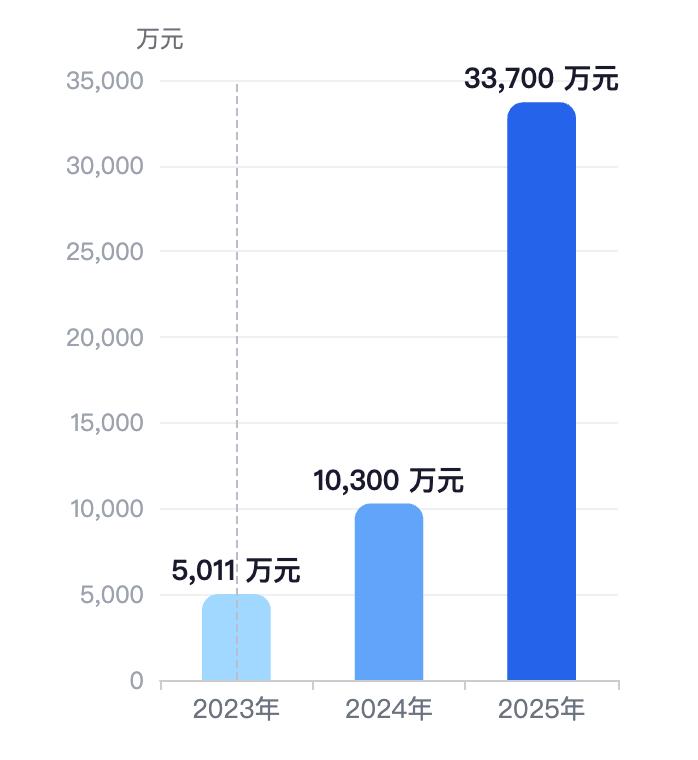
In the footed robot industry where most players are generally loss-making, this report card is very impressive.
According to the statistics from Sullivan, in 2025, Deep Robotics ranked first in the world in terms of industry application revenue of quadruped robots, and ranked second in total revenue of the track, second only to Unitree.
Its products are sold to 45 countries, and are running in more than 100 substations under State Grid and China Southern Power Grid. In the power inspection scenario, Deep Robotics' market share exceeds 85%, which is a niche market almost monopolized by it.
But the problem is also obvious: Deep Robotics' revenue is almost entirely supported by B-end quadruped robot dogs.
In 2025, quadruped and wheel-footed robots together contributed more than 95% of the total revenue, of which industry-level products accounted for nearly 86%. The industry version of Jueying X is priced at 287,500 yuan per unit, with a gross profit margin of 54.35%. 681 units of this product were sold throughout the year, contributing 58.11% of the company's total revenue. Although the unit price of consumer-grade products is as low as 16,000 yuan and the sales volume has exceeded 1000 units, their gross profit margin is only about 17%, bringing very limited profit.
This is a good business, but its ceiling is clearly visible. The annual compound growth rate of the global quadruped robot market is only about 17%. In other words, Deep Robotics has pushed the quadruped robot business to the extreme, but the quadruped robot track itself is not a huge market.
The more embarrassing part is the report card of its humanoid robot business.
In 2024 and 2025, Deep Robotics sold 3 units and 1 unit of its DR series humanoid robots respectively, with a total of 4 units in two years. The revenue of humanoid robots was 823,000 yuan, accounting for only 0.24% of the total revenue.
Deep Robotics stated in its reply letter that the low shipment volume of humanoid robots is caused by "resource allocation tilt under active strategic choice, high access threshold for target industry application scenarios, and long verification cycle". It is expected that the production capacity will climb to the level of 100 units in 2026.
Then there is a huge contrast.
On May 18 this year, Deep Robotics' STAR Market IPO application was accepted. On August 7, it disclosed the reply to the first round of inquiry. It plans to raise 2.502 billion yuan, of which nearly 70% (about 1.723 billion yuan) will be invested in embodied algorithm and model R&D, as well as robot body R&D.
The single "embodied algorithm and model R&D project" alone needs an investment of 1.169 billion yuan, while the company's total R&D investment during the reporting period was only 155 million yuan.
Using the money earned from robot dogs to bet on the future of humanoid robots is the prescription Deep Robotics has made for itself. But the dose of this prescription is too strong: the fundraising scale is more than 7 times the company's 2025 revenue and more than 10 times its net assets. If the IPO is successful, Deep Robotics' asset scale will expand tenfold overnight.
In the regulatory inquiry letter, the name "Unitree Robotics" appeared more than 200 times. The market is measuring Deep Robotics with the standard of Unitree, while Deep Robotics' humanoid business is still in the stage of gradually realizing small-batch mass production, and it is expected that the production capacity will climb to the level of 100 units in 2026.
The more interesting part lies in its valuation.
Deep Robotics supports a valuation of about 13.9 billion yuan with a revenue of 337 million yuan, with a price-to-sales ratio of about 41 times. Unitree's revenue in 2025 was 1.708 billion yuan, and its IPO valuation was about 42 billion yuan, with a price-to-sales ratio of about 25 times.
After calculation, Deep Robotics' valuation multiple is about 60% higher than that of Unitree. An investor commented: "There is a considerable forward premium in its valuation, and this premium needs to be cashed out through the future growth story of humanoid robots."
And that story has not even finished its prologue yet. During the book-building phase, the quotations given by some institutions correspond to a P/E ratio of more than 70 times in 2025. For a company whose main revenue source is industrial-grade quadruped robot dogs, this pricing is almost entirely bet on its humanoid robot business that has not yet proved its market value.
3
The 61 Billion Yuan Valuation Anchor and Two Different Answers
Putting the two companies together for comparison, the gap between them is obvious at a glance.
Agibot's 2025 revenue was 1.05 billion yuan, while Deep Robotics' was 337 million yuan. Agibot shipped 8400 units in the first half of the year, while Deep Robotics sold a total of 2908 units of quadruped and wheel-footed robots throughout the year. Agibot's humanoid robots have achieved large-scale mass production, while Deep Robotics only sold 4 humanoid robots in two years. Agibot's R&D expense ratio is about 70%, while Deep Robotics' is about 19.5%.
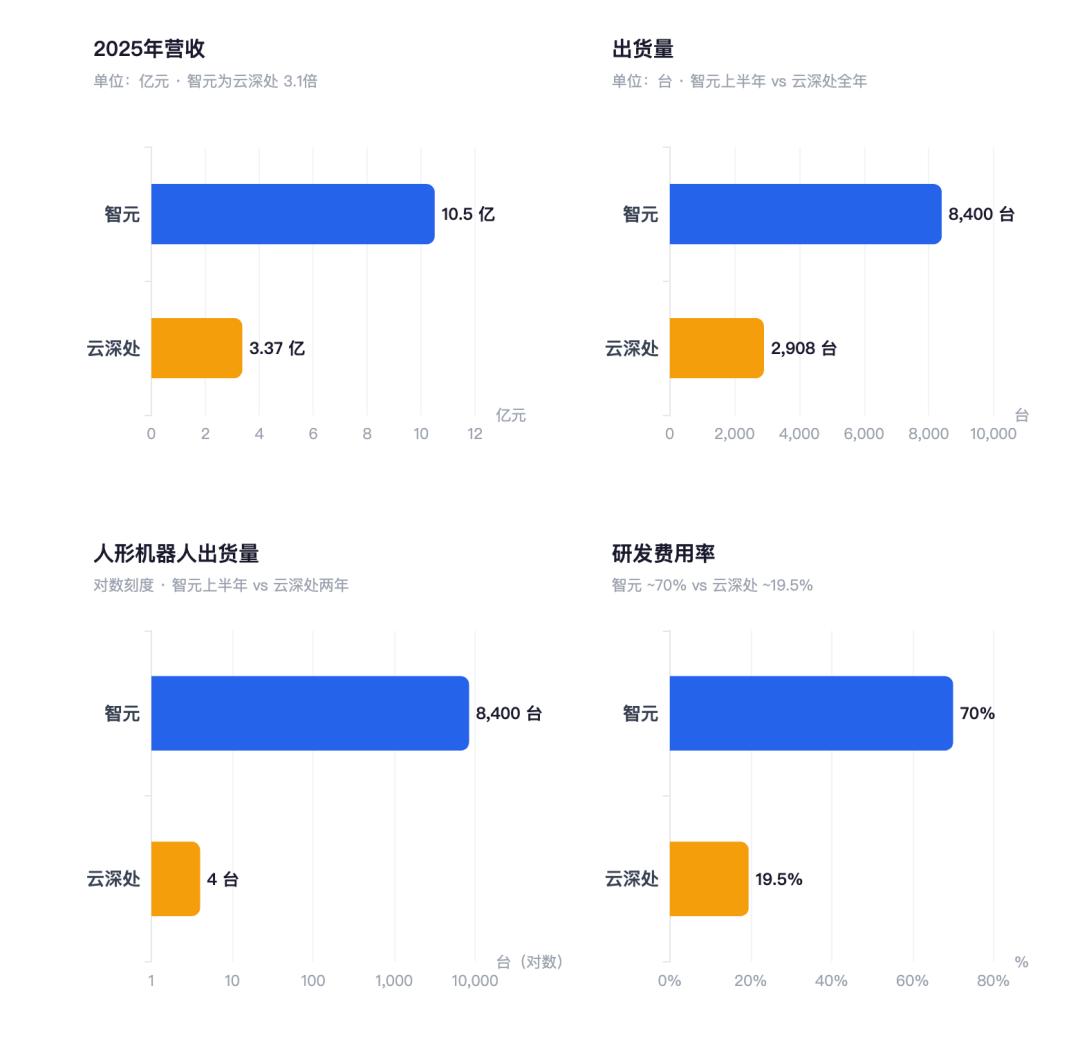
But what is really thought-provoking is not these numbers, but two completely different strategic choices.
Agibot's choice is: speed.
In three and a half years, it grew from zero to 1 billion yuan in revenue, and from zero to the world's largest shipment volume.
Even if it does not make profit, it must first expand the scale and occupy the game table. Going public is not for financing. The CTO personally said that the company does not lack money. The real purpose is to get the pricing right before the industry reshuffle.
The Hong Kong stock market is faster than the STAR Market, so it chooses the Hong Kong stock market. Its valuation is benchmarked against Unitree, so it directly benchmarks Unitree. Even if it has not yet made a profit, even if