One financial report, two Tencents
In the Q2 earnings report, there are two versions of Tencent.
One version includes Hy, Yuanbao, CodeBuddy, WorkBuddy and Xiaowei, posting non-IFRS operating profit of 75.6 billion yuan, up 9% year on year; the other excludes these new AI products, recording operating profit of 86.1 billion yuan, up 19% year on year.
The gap between the two figures stands at 10.5 billion yuan. This difference, which has taken relevant revenue into account, represents the net impact of this set of products on current-period operating profit. It is neither equal to Tencent's total AI investment, nor the loss of these products. Tencent has started disclosing this statistical caliber since last quarter.
On the other side is the capital that has been spent. Capital expenditure in Q2 hit 52.8 billion yuan, up 176% year on year, with the total for the first half of the year reaching 84.7 billion yuan; free cash flow turned negative by 13.8 billion yuan, and would be positive at 37.6 billion yuan if the prepayment for computing power procurement is excluded. The 51.4 billion yuan gap between the two calibers indicates that the prepayment for computing power procurement is the main reason for the negative free cash flow in this quarter.
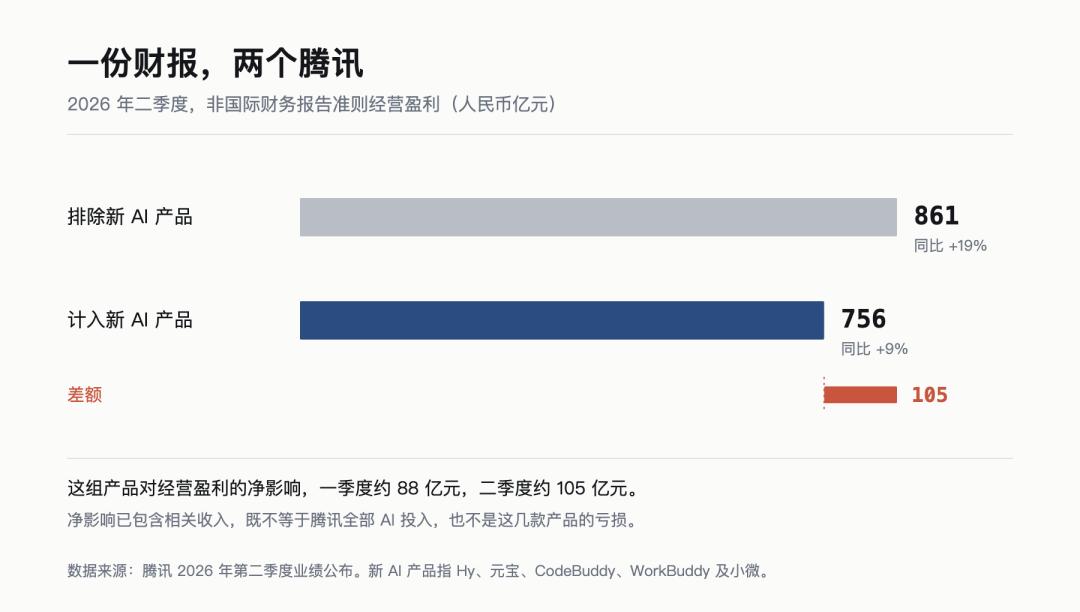
The 52.8 billion yuan capital expenditure and the 10.5 billion yuan profit gap do not fall under the same statistical caliber. The former mainly forms assets, while the latter is the net impact of several new AI products on current-period operating profit. The capital expenditure is also used for model training, cloud services and other products at the same time, and cannot be fully attributed to WorkBuddy.
Tencent's official statement is that the substantial increase in computing power procurement will help the company convert the usage of applications and models into revenue.
The earnings report and the earnings call on the same night explained more clearly than usual where the money was spent and where the returns are expected to come from.
1
From Computing Power to Billing
A batch of purchased computing power can be used in three scenarios: training self-developed models, supporting the inference of self-owned products, or leasing to external parties.
Tencent's priority order is training first, inference second, and only the surplus capacity will be leased out — the option that can realize direct monetization is placed at the end.
When explaining this priority order at the earnings call, Martin Lau first acknowledged another possible arrangement. He said that some of the computing power orders Tencent locked in several months ago, if resold today, can be priced at more than 30% higher than the original purchase price; leasing computing power through the cloud business can also recover depreciation costs relatively quickly. Tencent did not take this path as the top priority, but prioritized the computing power for training the Hunyuan model first, and then supporting the inference of products such as WorkBuddy.
Tencent bets its long-term returns on models and applications, while leasing and reselling serve as a fallback plan retained under the current market conditions.
The cost of these choices has begun to be reflected in the financial statements. The gross margin in this quarter rose to 58% from 57% in the same period last year. Tencent explained that the rapid growth of high gross margin revenue offset the rising depreciation and operating costs brought by the expansion of AI infrastructure. In the same period, the depreciation of properties, equipment and fixtures increased from 6.08 billion yuan to 9.55 billion yuan, and the operating cost of technical infrastructure rose from 7.5 billion yuan to 15.2 billion yuan, both figures are counted under the company-wide caliber.
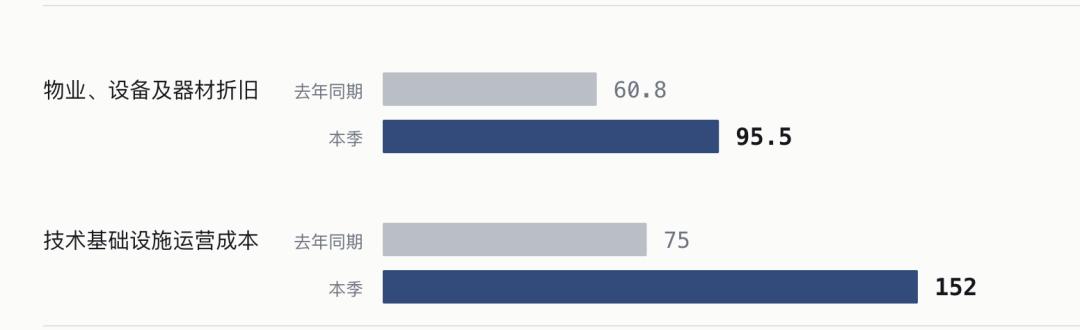
New AI products are still in the stage of large-scale investment, and high gross margin businesses are currently sufficient to absorb the rising infrastructure costs.
After the usage direction of computing power is determined, the next step is to see how the returns flow back to the accounts. For the WorkBuddy path, the answer is the cloud business.
In this quarter, revenue from fintech and corporate services reached 60.3 billion yuan, up 9% year on year, and the growth of corporate services came from the cloud segment. Tencent further disclosed at the earnings call that the revenue growth rate of the cloud business accelerated from nearly 20% in Q1 to just over 20% in Q2, while the supply of computing power remains tight.
Tencent attributes this part of the growth to the rising demand for model inference, agent operation and AI-native applications, and stated that products such as WorkBuddy and CodeBuddy have already contributed incremental revenue.
The respective revenue of these products is not shown separately in the earnings report. Tencent does not split them out individually, and the earnings call supplemented a time difference note: the subscription payment collection of WorkBuddy is growing. Since users mainly pay by subscription, these payments will not be fully recognized as revenue at the time of receipt, but will be recognized gradually during the subscription period. The subscription funds received today will continue to be reflected as cloud business revenue in subsequent quarters.
To collect this revenue, Tencent first has to solve a problem unique to the Chinese market.
In the United States, the habit of purchasing office software on a per-seat basis has lasted for decades. After AI capabilities are developed, they can be directly added to existing seats. Copilot charges an additional $30 per person per month, on the premise that users already have a Microsoft 365 subscription. It is attached to a billing system that has been generating revenue for years, and there is no need to start from scratch to educate enterprises to accept the per-seat payment model.
China does not have such a mature billing system. Free instant messaging, free documents and free meetings have cultivated the habits of a whole generation of enterprise users, and a universal and stable per-seat payment market similar to that in the United States has never taken shape here.
Tencent needs to create a set of pricing methods on its own.
Tencent's approach is to combine subscription and usage: enterprises subscribe on a per-seat basis, each seat comes with a fixed amount of points per month, and additional points need to be purchased after the quota is used up. The seat fee brings relatively stable basic revenue, while the points mechanism allows enterprises with higher usage to pay more. The price is also on the rise.
In the first half of this year, the SaaS enterprise version of WorkBuddy was raised from 78 yuan to 198 yuan, and the dedicated cloud version was raised from 158 yuan to 316 yuan. Tencent stated in its earnings press release that user growth and retention remain strong after the price increase, and users are still willing to pay for subscriptions and top up for Tokens.
The office scenario itself also provides favorable conditions. When a user submits a demand, the product returns a document, a spreadsheet, or a set of analysis results, and the user can confirm whether to accept it immediately. Office tasks still do not have a signal that can automatically judge right or wrong like unit testing, but in terms of business, its acceptance standard is clearer than most AI scenarios, which provides a solid basis for revenue collection.
Demand is indeed growing. Liu Yi mentioned a figure: after WorkBuddy was launched, the per capita Token consumption increased by more than 10 times within three months. This is a signal of growing usage demand, which does not mean that paid revenue grows synchronously. At the earnings call, Tencent further stated that WorkBuddy's paid users have generated positive gross margin, and its gross margin level is comparable to the overall gross margin of Tencent Cloud.
2
WorkBuddy in the Middle of the Financial Statements
The earnings report does not list the revenue and cost of WorkBuddy separately.
The revenue it generates is included in the cloud business, its own revenue, costs and expenses are counted under the new AI product caliber, and the computing power it consumes comes from Tencent's company-wide infrastructure investment. The 10.5 billion yuan figure is the combined net impact of it and the other four products. The earnings report confirms that WorkBuddy has already brought revenue, but does not provide a separate income statement for it.
WorkBuddy was only launched in March this year. At the current stage, what is most worth paying attention to is not the profit scale, but the fact that this previously hard-to-implement billing model has been successfully launched: enterprises have started to pay for agents by seat and usage; after the price increase, users are still growing, and the retention rate remains good. What WorkBuddy has first verified is that a new paid market is taking shape, and this set of charging mechanisms has been functioning smoothly.
WorkBuddy collects payment on its own, and also integrates model capabilities into daily work, and finally records this part of revenue into the cloud business. What it best illustrates is how this investment goes through the model, task execution and charging process, and finally turns into cloud revenue.
The most widely concerned path in the industry is to train models with computing power, and then sell the model itself as a product, with model capabilities as the moat. Tencent is also advancing along this path: Hunyuan continues to catch up with the cutting-edge level, Yuanbao participates in application competition, and Xiaowei has just started the gray-scale testing.

But it does not put all its chips on the model itself. Another part of the investment is focused on specific work scenarios: enabling the model to write documents and complete analysis, so that enterprises will pay for these results.
WorkBuddy is not tied to a single model. Tencent has its own Hunyuan model, and also adds external models to the optional list. Users can select models by themselves in the settings, and different models consume different amounts of points. Hunyuan is not the only option, but is listed alongside external models for users to choose from.
Tencent is also continuously improving its competitive advantage. According to Tencent's internal testing caliber, after the new version of Hunyuan is jointly optimized with WorkBuddy, the task resolution rate rose from 72% to 90%; among users who choose models independently, 60% have selected Hunyuan. The open model list allows the product to strike a balance between cost and capability, and this 60% share is obtained under the coexistence of multiple models.
Models can be procured, switched and scheduled, but the underlying documents, identity systems, organizational relationships and payment networks are very difficult to rebuild in a short period of time. In this quarter, WeChat Pay launched the "AI Exclusive Card" tailored for agents, which first accessed WorkBuddy, so that recommendation, order placement and payment can be completed in the same closed loop — a payment capability built more than a decade ago has become a module that agents can directly call.
T.S. Eliot wrote in *Tradition and the Individual Talent* that the best part of a poet is often the part where the inheritance from predecessors continues most strongly in him.
Liu Yi, Vice President of Tencent Cloud and head of WorkBuddy, once said that there is "no particularly strong moat" at the agent product level. The functions at the product layer can be imitated, while what is hard to replicate is the underlying interfaces, relationships, and the groups of people who have already been working on the platform.
Currently, WorkBuddy mainly handles cross-industry general office work: documents, spreadsheets, meeting minutes and analysis. The next growth space is to extend this mechanism to professional tasks such as contract review, production scheduling and financial analysis. At that stage, what Tencent needs to supplement is not only model capabilities, but also the knowledge of processes, rules and delivery standards in various industries.
The more types of work scenarios WorkBuddy can cover, the larger the scale this billing system can achieve, and the current positive gross margin will continue to grow accordingly.

Back to the two sets of figures.
Calculated based on the gap between the two disclosure calibers, the net impact of new AI products on operating profit rose from about 8.8 billion yuan in Q1 to about 10.5 billion yuan in Q2. Tencent stated at the earnings call that the structural changes between the two quarters are significant — as the growth of WorkBuddy exceeded expectations, Tencent raised its investment priority among this set of products in Q2, and lowered the priority of some other products at the same time. The gap between the two calibers is widening, and Tencent is also reallocating resources based on usage and payment signals.
WorkBuddy has already generated revenue, its subscription payment collection is growing, and paid users have achieved positive gross margin. It has verified the feasibility of a closed loop: Tencent purchases computing power, uses it to train models and complete work tasks, and obtains revenue from enterprise subscriptions and cloud services.
We can hardly expect a product that has been launched for less than half a year to immediately become a core business as important as WeChat. However, when the AI application layer is facing profit difficulties and most market participants are claiming that "coding is the only solution", WorkBuddy has explored a new path and verified that this path is feasible.
From the perspective of the earnings report, this is just a small path, but the promising prospects ahead are already faintly visible.
This article is from the WeChat official account "Sa Jia Junze", author: Sa Jia Junze, published with authorization from 36Kr.