900 million cups, Luckin Coffee has turned another new business into a massive runaway hit.
On August 3, a giant poster featuring Wang Yibo holding Luckin coffee liquid was simultaneously displayed in Chongqing Light of Asia and New York Times Square across the Eastern and Western Hemispheres, with the number "900 million cups" on the screen standing out strikingly.
This is a marketing campaign launched by Luckin Instant Coffee to mark its sales milestone. As of July 1, 2026, the cumulative sales volume of Luckin coffee liquid has reached 900 million cups.
Coincidentally, Luckin once used the "900 million cups" figure to tell another story back in 2022, when it sold 900 million cups of freshly brewed coffee that year.
More than three years have passed, and Luckin has expanded its store network to 36,000 outlets. However, behind the rapid scale expansion, the same-store sales of its self-operated stores have recorded negative growth for three consecutive quarters. As the marginal contribution of store expansion to growth diminishes, Luckin's second "900 million cups" of sales comes from store shelves rather than its physical outlets.
In July 2024, Luckin launched its pre-packaged coffee brand "Luckin Instant Coffee", whose product line covers coffee liquid, bottled ready-to-drink coffee, instant coffee, coffee beans, drip coffee and more — in short, "all forms of coffee" except for freshly brewed drinks made in its physical stores.
This is a strategic layout for occupying a favorable position in the industry, which also reflects Luckin's strategic shift to actively seek new growth outside its physical stores after the dividend of store expansion peaks.
Launch of bottled "Coconut Latte" sells over 1 million bottles in 24 hours
In recent months, many consumers have accidentally found that Luckin's signature Coconut Latte now has a "bottled version" when visiting convenience stores.
On April 28, Luckin Instant Coffee officially launched its bottled ready-to-drink coffee, with three initial flavors available: Coconut Latte, Classic Americano, and Pomelo C Americano. These classic bestsellers that have recorded cumulative sales of over 1.2 billion cups in Luckin's stores are "completely preserved" and packed into 300ml bottles for shelves, priced at 6 to 7 yuan per bottle.
The new product detonated the market on the day of its launch. Official data shows that within 24 hours after the sale of Luckin bottled coffee, the sales volume on online channels exceeded 1 million bottles, and the total sales revenue of all categories exceeded 18 million yuan, which is an impressive start for a new entrant in this track.
Looking at Luckin's pricing strategy, the unit price of 6 to 7 yuan is right in the middle of the 4 to 12 yuan price range of ready-to-drink coffee, higher than Nongfu Spring's BING coffee and Dongpeng Daka, while lower than Starbucks and COSTA. Luckin still adopts the cost-effective play, but not the "absolute low price" strategy.
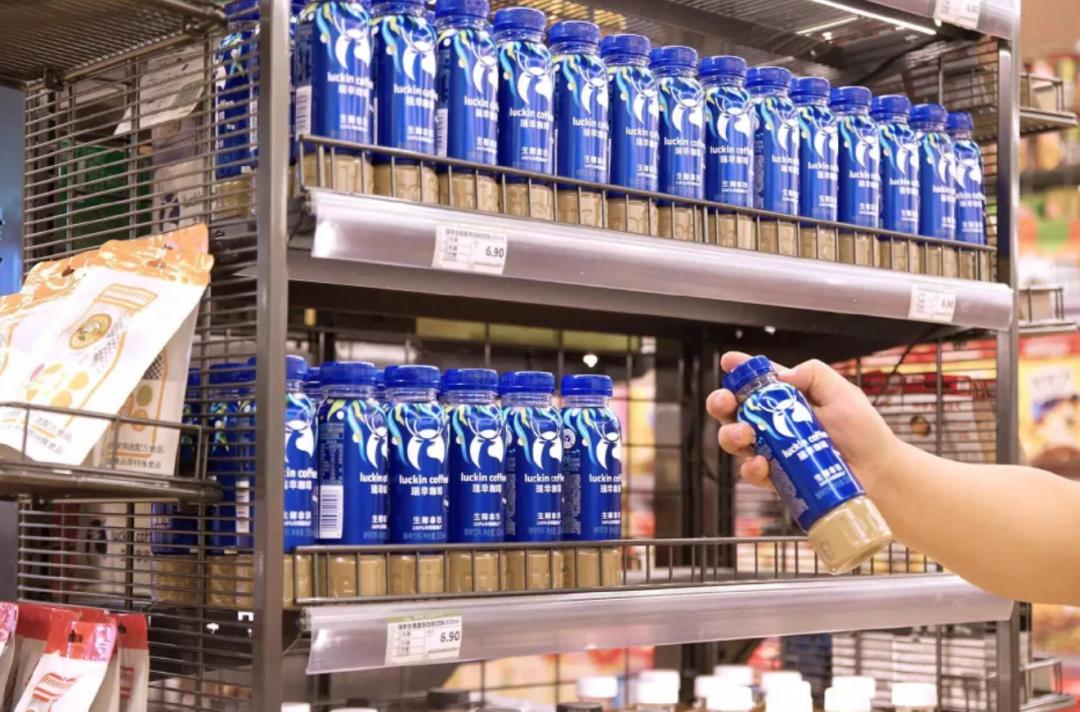
Luckin bottled coffee
In terms of channels, Luckin adopts an omni-channel strategy that covers all possible partners. In addition to e-commerce platforms, its product distribution network covers offline scenarios such as chain convenience stores, regional supermarkets, and vending machines. According to distributors, Luckin does not restrict the sales scope, so convenience stores, bulk snack stores and family-owned stores can all be covered, and distributors are allowed to act as agents for other brands.
The purchase price for a case of 15 bottles of Luckin coffee ranges from 63 yuan to 65 yuan, and the retail price in stores is basically 70 yuan to 75 yuan, with a gross profit of 5 to 12 yuan. Luckin tries to quickly drive distributors to distribute its products through flexible gross profit margins, and obtain channel discourse power by scale.
In terms of supply chain, Luckin's bottled coffee is currently produced by Huizhou Tungtex Enterprise Co., Ltd., which is affiliated to the Uni-President Group, whose long-term client list includes leading brands such as Red Bull, Wong Lo Kat and Nongfu Spring.
As a new entrant in the beverage market, Luckin adopts the reliable "hit product translation" strategy to reduce the cost of consumer taste cultivation. However, when the product is converted from a paper cup to a bottle, consumers' taste buds are the most honest tester.
On social media platforms such as Xiaohongshu, the first batch of early adopters have given different reviews: supporters praise its high portability and overall similar flavor to the store version; but some consumers feedback that the bottled Coconut Latte has a relatively weak coffee taste, lacking aroma and layered flavor, while the Classic Americano is "so bitter that it makes people doubt life".
Generating 2.3 billion yuan in annual revenue, Luckin devotes itself to developing its "side business"
If we extend the timeline, Luckin's layout "outside physical stores" is far from a whim.
In 2022, Luckin's pre-packaged product revenue reached 690 million yuan; in 2023, it increased to 1.24 billion yuan, with a growth rate of nearly 80%; in 2024, it hit 1.69 billion yuan; in 2025, it further climbed to 2.32 billion yuan, accounting for 4.7% of the total revenue of that year.
Over the past four years, the scale of this business has been rising steadily. Although its proportion in the company's total business volume has been hovering around 5%, its absolute volume can no longer be ignored, and its product coverage is complete, covering almost all forms of coffee that consumers can access.
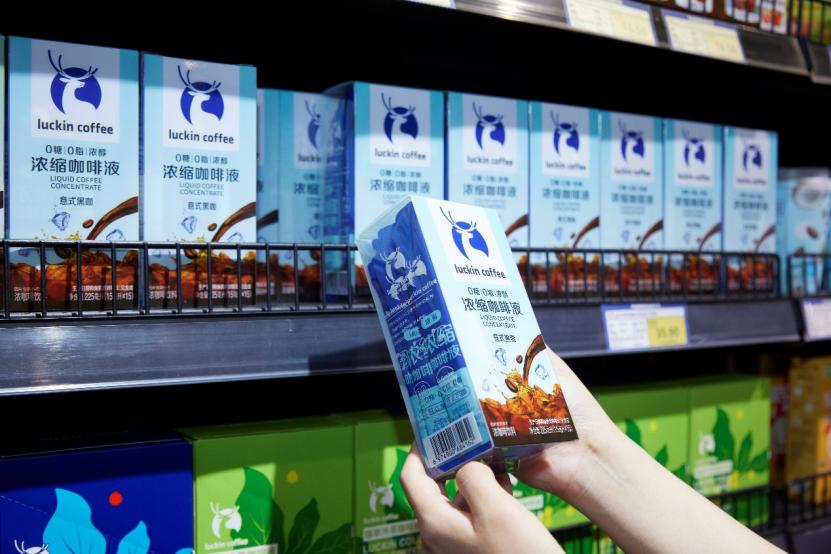
Why is Luckin so eager to open up a new battlefield outside its physical stores? The answer can be found in its financial reports.
In the second quarter of 2026, the same-store sales of Luckin's self-operated stores decreased by 5.3% year on year, marking the third consecutive quarter of negative growth. After the total number of global stores exceeded 36,000, the average daily revenue per store dropped by 9.5%, and the number of monthly customers covered per store decreased by 11.6%. The "dilution effect" of the store densification strategy on the output of each single store is accelerating to appear.
At the same time, the coffee track is no longer a one-man show of Luckin. Cotti Coffee, Lucky Coffee under Mixue Ice City, and Nowwa Coffee have all joined the 10,000-store camp. In addition, a large number of cross-border players have entered the market, making the competition in the cost-effective coffee track unprecedentedly fierce.
More importantly, this round of food delivery wars that started in 2025 has promoted the growth of orders in the freshly made coffee industry, but it has impacted the profit margins of a large number of brands.
In the fourth quarter of 2025, Luckin's revenue increased by 32.9% year on year to 12.777 billion yuan, but its net profit dropped by 39% year on year to 518 million yuan, with the surge of delivery costs by 94.5% being the core factor. In the food delivery war, the marginal return of growth driven solely by physical stores and food delivery subsidies is dropping sharply.
Under the pressure of growth, Luckin chooses to expand in multiple directions: it sells light milk tea, opens 100-square-meter "store-in-store" outlets, launches pour-over coffee products and more. But these attempts are essentially "seeking growth within the physical store system", while the layout of instant coffee is a leap out of the store boundary.
Previously, Luckin's pre-packaged retail products have completed the market verification from zero to 2.32 billion yuan. The 900 million cups of coffee liquid have proved the explosive power of this category, and freeze-dried coffee powder and coffee beans continue to contribute steady revenue.
The launch of bottled coffee is a further advancement on this verified path: it extends the competition dimension from the store competition of freshly made coffee to the shelf competition of fast-moving consumer beverages.
In the era of 9.9-yuan food delivery coffee, is portable coffee still a profitable business?
Luckin calls the business forms outside freshly brewed coffee in stores "portable coffee", but in fact, there are two sets of commercial logics operating in this field.
Products such as coffee liquid, freeze-dried coffee powder and drip coffee belong to the category of instant coffee, which consumers brew by themselves after purchase, suitable for convenient scenarios in offices, homes and business trips; while bottled ready-to-drink coffee belongs to RTD coffee, which can be drunk directly after opening the lid, suitable for scenarios such as picking up a bottle in a convenience store on the way to work, or buying a bottle at a gas station to refresh oneself. Although both belong to retail products "outside physical stores", their consumption scenarios and channel logics are not exactly the same.
When we look at the entire coffee industry, a profound restructuring is taking place. In 2025, the scale of China's coffee industry reached 354.9 billion yuan, with a year-on-year growth of 13.3%, and the annual per capita coffee consumption rose to 28.57 cups. But the industry is undergoing drastic differentiation.
Several consecutive transactions in 2026 have attracted widespread attention: in April, Starbucks completed its joint venture transaction with Boyu Capital, selling 60% stake in its China retail business for 4 billion US dollars; almost at the same time, Nestle agreed to sell Blue Bottle Coffee to CITIC Capital, which is the controlling shareholder of Luckin, for less than 400 million US dollars; The Coca-Cola Company shelved the plan to sell COSTA as bidders' offers failed to meet the expected 2 billion pounds.
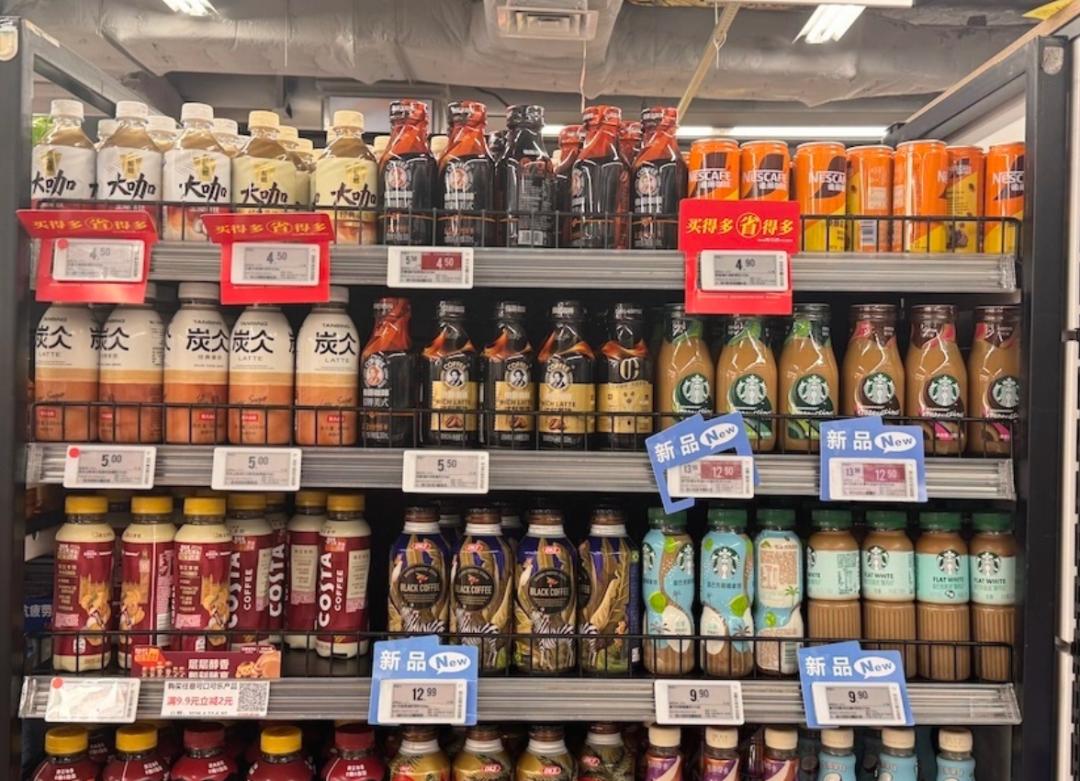
Source: Jiemian News
Behind these major transactions is the same signal: China's coffee industry has passed the first stage of rapid expansion and entered the period of capital integration.
But while the giants are busy with capital restructuring, why do major brands still stick to their retail business?
The answer may lie in the fact that the domestic coffee market is still expanding, and as drinking habits deepen, scenarios and consumer groups are bound to become more segmented. The same consumer may brew a pack of freeze-dried instant coffee to work overtime at night, pick up a bottle of RTD coffee in a convenience store on the way to work, buy a 9.9-yuan freshly brewed coffee after lunch, and check in at a popular coffee shop on weekends. All these consumption behaviors can happen to the same person.
Ready-to-drink coffee and instant coffee, with their high portability and cost-effective advantages, are still markets that cannot be underestimated, and are tracks that can continuously contribute stable cash flow.
Data from MassWin, an offline fast-moving consumer goods monitoring company, shows that the top five brands of ready-to-drink coffee in China in 2025 are Nestle, Starbucks, Dongpeng Daka, COSTA and Robust, with the CR5 market share as high as 87.2%. Among them, Starbucks' ready-to-drink business has maintained double-digit growth for six consecutive years, and its offline distribution network covers more than 1,400 county-level markets across the country; although Nestle's market share and sales volume have both declined, it still ranks first in the ready-to-drink coffee track with a share of nearly 40% relying on its channel network cultivated for many years.
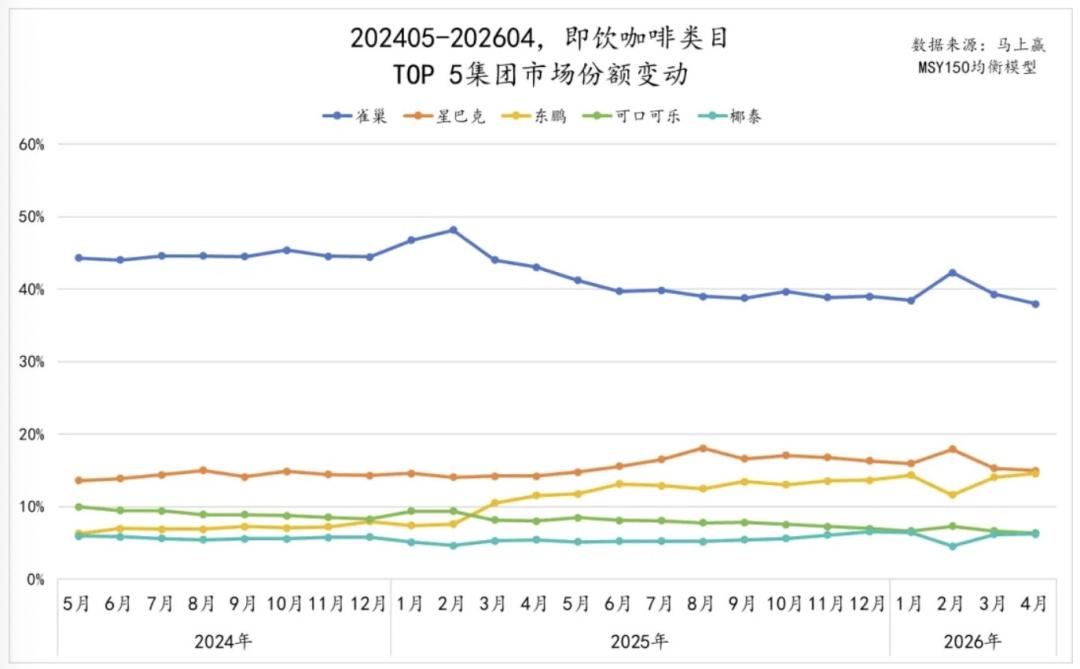
Just this year, an unexpected cross-border dark horse has emerged in the ready-to-drink track.
In May 2026, data from MassWin shows that Dongpeng Beverage's "Dongpeng Daka" accounted for 14.69% of the sales share in the ready-to-drink coffee category, surpassing Starbucks (14.39%) by a narrow margin and rising to the second place in the industry for the first time.
In the past year, the year-on-year sales growth rate of Dongpeng Daka exceeded 50%. It has no cafes, no fancy brand stories, and no subsidy wars. Dongpeng relies on 4.5 million active terminals to place its 4.5-yuan/330ml coffee in gas stations, service areas, office building convenience stores and county-level small shops. A long-haul driver said: "For me, Dongpeng Daka is not coffee, it is Red Bull with a different flavor."
However, the challenges on this stock track cannot be ignored. The primary challenge comes from the dimensionality reduction strike of freshly made coffee. When 9.9-yuan freshly brewed coffee is widely available, the cost-effective logic of ready-to-drink and instant coffee is being disintegrated. A consumer said bluntly: "A bottle costs more than 6 yuan, it is better to add 3 yuan to buy a freshly made cup."
The second challenge is the white-hot channel competition. The number of ready-to-drink coffee brands continues to increase, and the top five brands have occupied more than 80% of the market share. As a latecomer, Luckin has a weak channel foundation, which is an unavoidable obstacle.
The last challenge is the homogenization dilemma. When the product form, taste and flavor of major brands are getting more and more similar, price seems to become the only competition method again.
Looking at 2026, the ready-to-drink coffee track is rebounding from negative growth for more than two consecutive years to a positive growth of about 7%, but its annual compound growth rate has dropped to single digits.
With 2.32 billion yuan in pre-packaged revenue, Luckin has occupied a considerable share in the two sub-tracks of instant coffee and ready-to-drink coffee, but it has to face a cruel fact: ahead of the bottled ready-to-drink track is a market with slow growth and surrounded by industry giants.
900 million cups is a milestone achievement, but it cannot cover up a structural problem: can the achievements Luckin made in the instant coffee track be replicated in the completely different battlefield of bottled ready-to-drink coffee?
When the entire industry transitions from rapid expansion to capital integration, and from high-speed growth to stock game, what Luckin has to face on the shelves is far more than just Nestle and Starbucks.