Google has rolled out a series of new Gemini Flash updates in quick succession: its programming performance has been boosted, the price has been slashed by half, and the release date of the flagship model remains undetermined.
Google is once again accelerating the iteration of its Gemini models.
On Thursday, August 13 US Eastern Time, Google announced the launch of Gemini 3.7 Flash, which is focused on programming, Agents and complex workflows. According to Google, this is its "smartest work-oriented model" to date, with further improvements over the previous generation in code debugging, production-grade code generation and multi-step task execution.
This is already the fourth Flash series model Google has rolled out intensively in recent times. One day before Google's parent company Alphabet released its financial report on July 22, Google launched three versions at once: Gemini 3.6 Flash, Gemini 3.5 Flash-Lite and Gemini 3.5 Flash Cyber, all targeting AI agents and developer workflows. Less than a month later, the Gemini Flash series has ushered in a new update again.
Google also takes pricing as a key selling point this time: before the end of this year, the guide price of Gemini 3.7 Flash is $0.75 per million input Tokens and $3.75 per million output Tokens, which is half of the original price of Gemini 3.6 Flash.
However, on the other side of the rapid iteration of the Flash series, the flagship model Gemini 3.5 Pro that has drawn more market attention still does not have a clear launch date. The delayed launch of this model has raised investors' doubts about Google's development roadmap, especially in fields such as AI programming. Media pointed out that all kinds of uncertainties about the release time of the next flagship model have made the outside world more skeptical about whether Google can outperform its competitors and successfully convert its huge AI investments into market-leading tools and services.
01
From "writing code" to "delivering applications", the new model enhances complex task execution capabilities
Google clearly positions the core upgrade of Gemini 3.7 Flash on programming and complex workflows this time.
Google stated that the new model has significantly improved over the previous generation in debugging, problem-solving and generating code that can be directly put into production. It can complete application development with fewer prompts, and optimize developers' experience in continuous multi-step tasks.
In terms of positioning, 3.7 Flash does not simply pursue faster response speed, but moves closer to a work-oriented model that is "capable of completing tasks".
The test data released by Google shows that in the FrontierCode 1.1 Main test, Gemini 3.7 Flash scored 43.6%, higher than the 34.4% of 3.6 Flash; in the DeepSWE v1.1 test, the score increased from 49.0% to 65.3%. In WebDev Arena, the new model achieved an Elo score of 1588, which is also higher than the 1538 of 3.6 Flash.
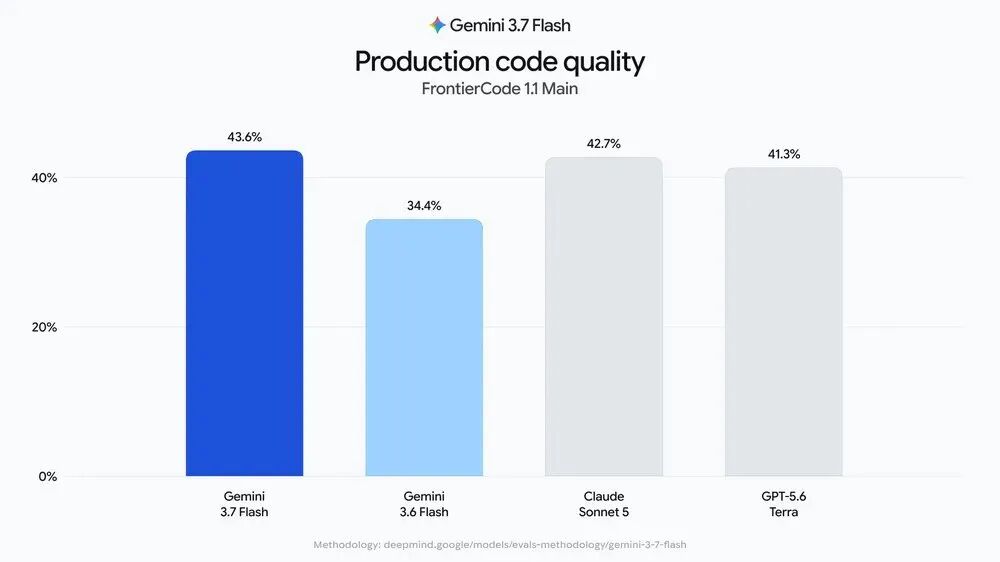
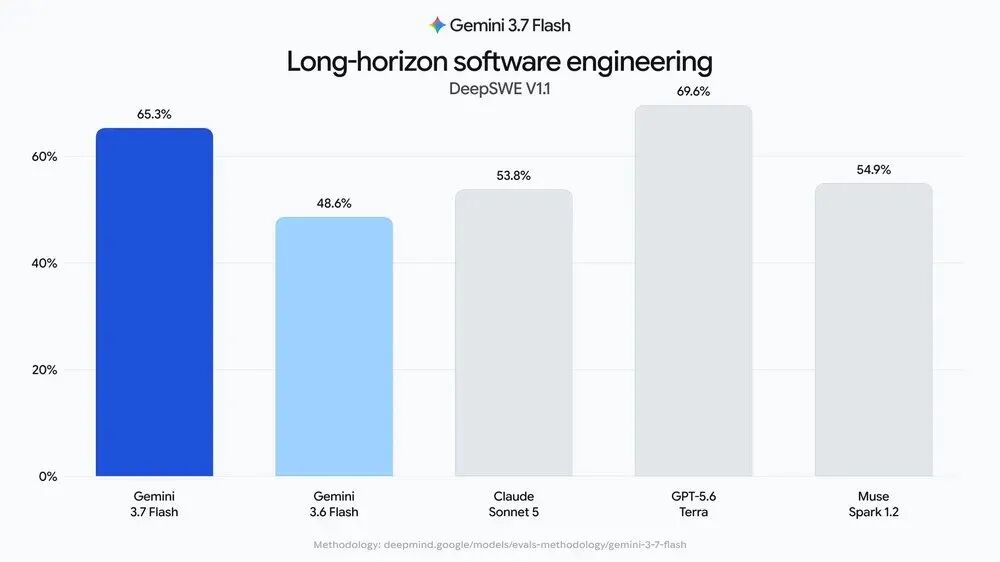
This type of capability is particularly important for AI programming. What developers really need is not for the model to simply generate several snippets of code, but to enable the model to understand existing code, locate bugs, call tools, complete modifications, and finally deliver a runnable application.
Google said that 3.7 Flash can carry out more in-depth "thinking" in multi-step planning and tool calling, and better adjust strategies when encountering obstacles during execution, thus reducing repeated user prompts and manual intervention.
02
Capture the agent market at low cost, the Token price is reduced to half of the previous generation
In addition to performance improvements, pricing is another "trump card" of Gemini 3.7 Flash this time.
The guide price given by Google is $0.75 per million input Tokens and $3.75 per million output Tokens, valid until December 31, 2026. Starting from January 1, 2027, the price will return to $1.50 per million input Tokens and $7.50 per million output Tokens.
In other words, before the end of this year, the cost for developers to call 3.7 Flash is only half of the original price of the previous 3.6 Flash.
This strategy is in the same line as Google's recent idea of intensively launching Flash models: by improving model capabilities, reducing latency and lowering Token costs, Flash can become the base model for large-scale deployment of AI agents.
In fact, the three Flash models launched by Google at one go on July 21 have already reflected this direction. Gemini 3.6 Flash is positioned by Google as a "work-oriented" model for coding, knowledge work and multimodal tasks; 3.5 Flash-Lite emphasizes low latency and high throughput, which is suitable for a large number of invocation scenarios such as agent search and document processing; 3.5 Flash Cyber is targeted at cybersecurity tasks and integrated with the CodeMender code security agent.
Now, 3.7 Flash continues to advance along the line of "high performance + high efficiency + low cost". Google obviously hopes to compete for more developers and enterprise users in the process of rapid commercialization of AI agents.
03
Flash is iterating at an accelerated pace, Google's AI flagship is still pending
But for investors, the rapid iteration of the Flash series cannot completely cover up the problem that the launch of the flagship model has not been determined for a long time.
When launching 3.6 Flash, 3.5 Flash-Lite and 3.5 Flash Cyber on July 21, Google stated that Gemini 3.5 Pro is being tested with partners and plans to open it to a wider range of users as soon as possible "when it is ready". At the same time, Google also announced that it has launched the most ambitious round of pre-training for Gemini 4 to date.
However, as of the launch of Gemini 3.7 Flash on August 13, Google still has not given a clear public launch time for Gemini 3.5 Pro.
This has created a rather obvious contrast in Google's AI product line: the Flash series is being updated at a high frequency, but the Pro model that truly undertakes the flagship competition task still has no clear schedule.
Some comments pointed out that the delay of 3.5 Pro has made investors pay attention to Google's AI product roadmap, especially in fields with rapidly rising commercial value such as AI programming. As OpenAI and Anthropic continue to advance their top-tier models, when Google's next flagship model will be launched has become an important observation indicator for the market to measure its AI competitiveness.
Some media also pointed out that Google previously stated in July that 3.5 Pro was being tested with partners and would be launched soon, but no specific release date was provided when 3.7 Flash was released this time.
In other words, Google is currently strengthening its competitiveness in the "AI application implementation end" through the rapid iteration of the Flash series, but in the field of top-tier models that determine the upper limit of AI capabilities, the market is still waiting for an answer.
04
Google bets on faster iteration, Gemini 4 has also been put into training
Google's move is not an isolated event, but part of its strategy to accelerate the iteration of AI models.
Sundar Pichai, CEO of Alphabet and Google, previously stated at the July earnings call that the company hopes to launch models at a faster pace and has invested a large amount of computing resources to train the next-generation Gemini 4.
Before Alphabet released its financial report on July 22, Google had already intensively updated the Flash product line: 3.6 Flash, 3.5 Flash-Lite and 3.5 Flash Cyber were released on July 21; 3.7 Flash was launched on August 13.
Judging from the product rhythm, Google is obviously shortening the iteration cycle of the Flash series. Its purpose is not only to catch up with the model release speed of competitors, but also to seize the infrastructure entry for developers and enterprise applications when AI agents begin to move from "chatting" to actual task execution.
Google has further enhanced the security capabilities of 3.7 Flash this time, including protection against malicious hacker attacks and abuse of dangerous chemical, biological, radiological and nuclear materials, while avoiding affecting normal development and research purposes as much as possible.
At present, Gemini 3.7 Flash is available through Google Antigravity and the Gemini API, and can be used in Google AI Studio and Android Studio. Gemini Spark, Google's AI productivity agent, will also use 3.7 Flash starting from August 13.
Therefore, the significance of Gemini 3.7 Flash may not only lie in "just another new model" — Google is competing for the AI application implementation market with faster Flash iteration, stronger programming and agent capabilities, and lower Token prices; but at the same time, when Gemini 3.5 Pro will actually be launched is still a key puzzle piece that has not been filled in Google's AI competitiveness landscape.
This article is from the WeChat official account "Wall Street CN Max", written by Li Dan, and is released with authorization from 36Kr.