Moore Threads: The moment when domestic GPUs are closest to "crossing the snow-capped mountain"
On August 9, 2026, only 8 months after the Sci-Tech Innovation Board listing bell rang, Moore Threads announced in a public notice its plan to list in Hong Kong.
A+H, the first domestic GPU stock, is about to add another market to its growth story.
At this point, its market value is about 269 billion RMB. Calculated based on its 15.06 billion RMB revenue in 2025, the static price-to-sales ratio is close to 180 times. This figure is somewhat exaggerated: NVIDIA's peak PS ratio in 2024, the most turbulent year of the AI wave, was only around 35 times.
The market is voting for a "not yet stably profitable" story with a 180x PS ratio.
On the other side of this vote lie three sets of figures in its financial reports: 2025 attributable net profit of -10.01 billion RMB, non-recurring profit and loss deducted net profit of -10.88 billion RMB, and operating cash flow of -14.87 billion RMB.
Why is a company with a 65% gross margin not making money?
In a sense, this is not only a financial issue, but also an industrial issue about how domestic computing power can achieve the "from 0 to 1" breakthrough.
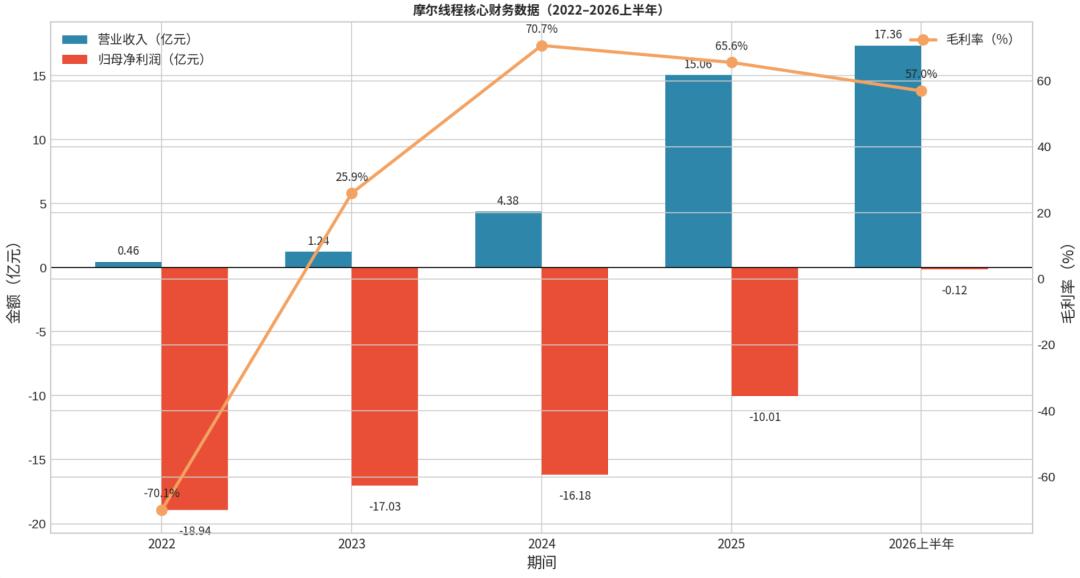
Fig. Moore Threads Core Financial Data (2022–2026 H1)
01
The moment closest to "crossing the snow mountain"
Let's turn the clock back to 2022 first.
In that year, Moore Threads recorded an annual revenue of 46 million RMB, with a gross margin of -70.08%. This means that for every chip it sold, it lost 70% more than the production cost.
That was the darkest hour for domestic GPU companies: no ecosystem, no customers, no scale, only R&D investment of more than one billion RMB per year burning through cash.
Then the story began to reverse:
Over four years, revenue grew 32 times, and gross margin rose from -70% to 65.5%. In the first half of 2026, its half-year revenue reached 17.36 billion RMB, exceeding the full-year revenue of 2025. In the first quarter of 2026, the attributable net profit was 29 million RMB — the first single-quarter profit since the company was founded.
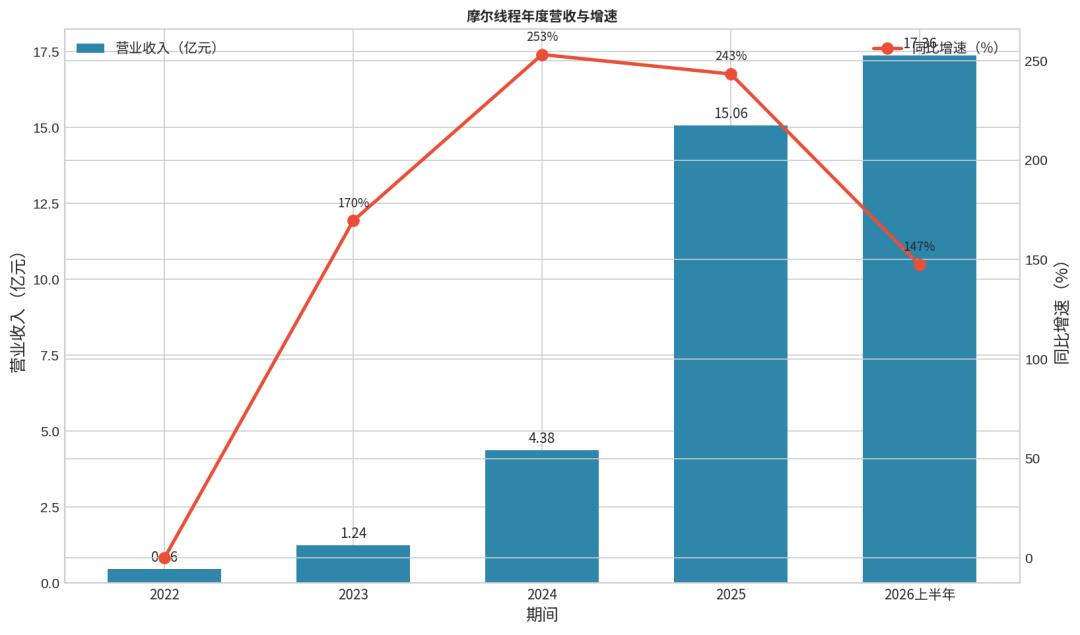
Fig. Moore Threads Annual Revenue and Growth Rate
This is the closest moment domestic GPUs have ever been to "crossing the snow mountain".
But bring the magnifying glass a little closer. Of the 29 million RMB profit in Q1 2026, the non-recurring profit and loss deducted net profit was -54 million RMB. Where does the gap come from? Government subsidies, fair value changes, asset disposals — those "non-recurring" windfalls.
29 million RMB is a milestone, -54 million RMB is the truth.
Whether a company is truly profitable does not depend on the attributable net profit of a single quarter, but on whether it can continuously earn money back from the market with its own products, its own ecosystem, and its own pricing power.
Obviously, Moore Threads has not yet reached that point.
This is not a criticism. For a company that is fighting on three fronts of capacity ramp-up, ecosystem construction and market expansion, non-recurring loss after deduction is normal, even "reasonable". The real question is:
When the market prices it at 180x PS, is it betting on "being profitable" or "monopoly-level profitability"?
02
Moore Threads' hidden cards
The hidden card in Moore Threads' hand is called "full-featured GPU".
Domestic GPU players have their own unique strengths: Cambricon focuses on AI inference, Biren and MetaX specialize in computing cards, and Jiajingwei is partial to graphics rendering. But Moore Threads is the only one that can cover graphics, AI, and video codec all in one.
This identity naturally gives it a "village's last hope" narrative: government and state-owned enterprise information technology needs graphics, intelligent computing centers need computing power, video processing needs encoding, and one card can handle all scenarios.
What truly has strategic depth is its MUSA ecosystem, a software stack that is almost 1:1 compatible with CUDA APIs.
This is the smartest "open conspiracy" of domestic GPUs: NVIDIA spent 20 years building the CUDA ecosystem, and millions of developers around the world are deeply bound to it. Moore Threads is not trying to overthrow this fortress, but building a door next to the fortress: developers only need to modify a few lines of code written in CUDA to run it on MUSA.
800,000 registered developers have unknowingly completed the first migration of the ecosystem.
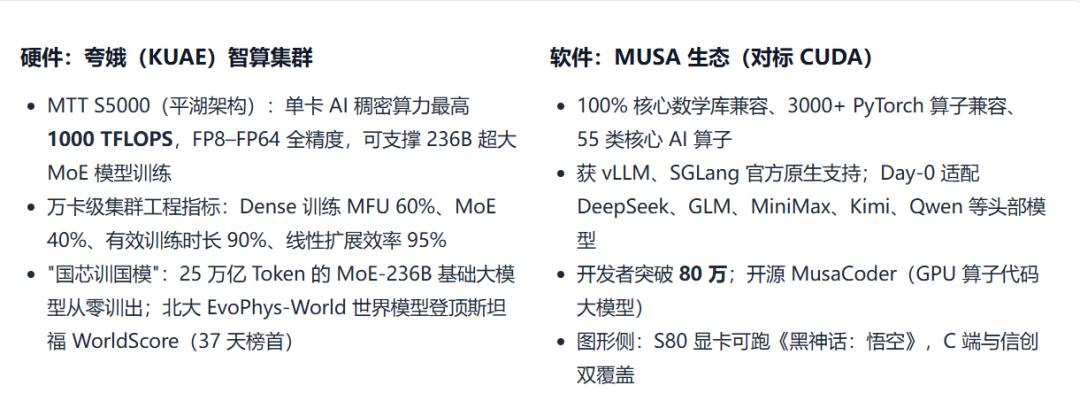
Fig. Moore Threads Products and Technologies: Ku'e Cluster and MUSA Ecosystem
The story sounds great. But a narrow path lies ahead:
First, compatibility means "following", not "surpassing". Where CUDA iterates to, MUSA has to catch up. It can catch up with the version number and performance, but it cannot catch up with the middleware, libraries and toolchains that NVIDIA has accumulated over 20 years, which is the moat fed by the entire generation of software engineers' careers.
Second, the flip side of full functionality is "wanting everything". The three lines of graphics, AI and video are burning money at the same time, and the R&D expense ratio remains high for years. In 2025, R&D investment accounted for more than 80% of revenue. For a company with an annual revenue of just over 1.5 billion RMB, this is a gambling-level investment intensity. If it wins, it becomes a platform company; if it loses, it ends up as "doing everything, mastering nothing".
Full functionality is a great card, but the person who plays it is destined to run the fastest on the longest track.
03
The metaphor of 180x price-to-sales ratio
Let's face the most exciting question directly: Is a market value of 270.6 billion RMB expensive or not?
From a static perspective, it is ridiculously expensive. 180x PS (price-to-sales ratio) and about 270x static PB (price-to-book ratio) make any traditional valuation framework meaningless.
From a dynamic perspective, this is an arithmetic problem of "long-term expected value". What the market is actually pricing is this chain of assumptions:
In 2028, the size of China's AI computing power chip market will exceed 1 trillion RMB → domestic GPUs will capture more than 40% of the market share → Moore Threads, as the only "full-featured" player, will take 5% of that share → corresponding to about 40-50 billion RMB in revenue → valued at 15-20x PS for mature semiconductor companies → the current 270.6 billion RMB is just a "discounted future".
This problem cannot be falsified, only verified. And the price of verification is time.
In sharp contrast to Innolight, the optical module leader, which is a "winner with realized performance" with 46% gross margin and a net cash to net profit ratio of about 1.0, every cent of its profit can be traced in cash flow. But Moore Threads is a "story-telling growth stock" with a seemingly more impressive 65% gross margin, but its operating cash flow has been negative consecutively, with a net outflow of 1.487 billion RMB in Q1 2026.
The high gross margin is because it has not yet grown up; the negative cash flow is because it is spending profits to buy the future.
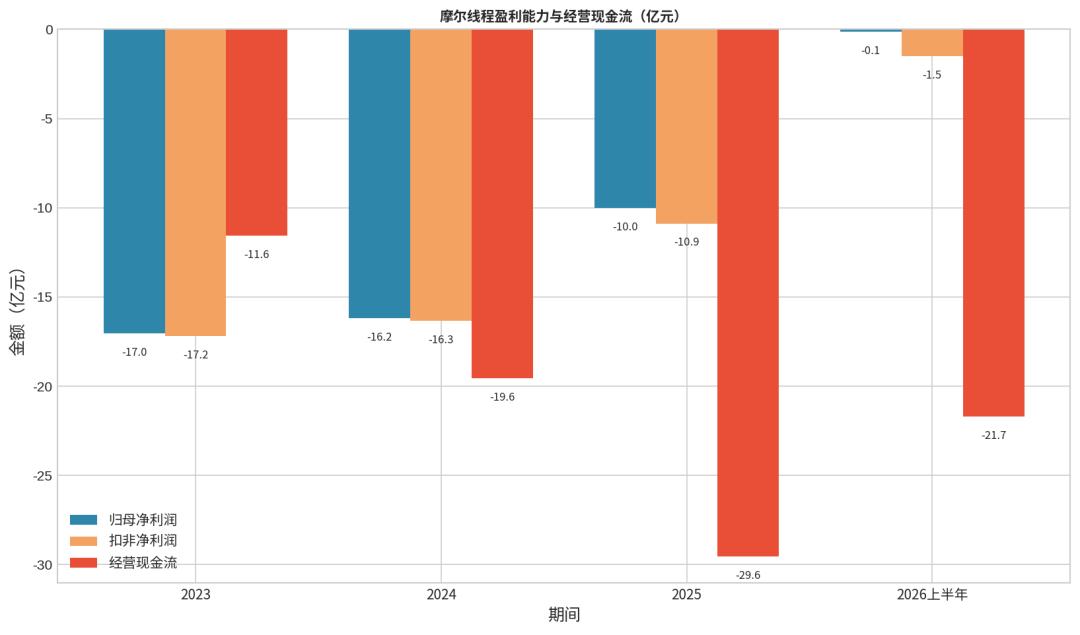
Fig. Moore Threads Cash Flow Status
The capital market loves and fears this kind of company most. What it loves is the flexibility of "from 0 to 1", and what it fears is the collapse of "from 1 to 0". The 180x PS is naturally not the valuation for the present, but the valuation for "still alive and the best performer 5 years later".
04
The cruellest puzzle piece of domestic computing power
To understand Moore Threads' situation, we must first see the chessboard it is on.
In China's AI chip market in 2025, NVIDIA still accounts for about 55%, and domestic chips account for 41% in total. But please note that of this 41%, Huawei Ascend takes most of the share. The remaining small part is divided by Moore Threads, Cambricon, Haiguang, Biren, MetaX and other players.
The combined share of the "four domestic emerging GPU players" is less than 8%.
In other words, the real competitive landscape Moore Threads faces is: it has to withstand NVIDIA's dimensionality reduction strike from above, and avoid Huawei Ascend's crushing encirclement from below.
In 2026, the market generally expects Ascend to take more than 60% of the local market share. Once this figure is realized, the bulk of the "domestic substitution" narrative dividend will almost all flow to Huawei.
Deeper down, there is another constraint underestimated by the capital market: the production capacity is not in its own hands.
Moore Threads relies on SMIC for chip manufacturing, and SMIC's advanced process capacity (N+2) is estimated to have been locked about 43% by Huawei. When Ascend's orders are scheduled to 2027 and the wafer fab is at full capacity, how many wafers Moore Threads can get directly determines its revenue ceiling — it is not that demand is insufficient, but that supply is locked.
This is the cruellest puzzle of domestic computing power: technical routes can overtake on curves, ecosystems can migrate gradually, but wafer production capacity is a physical fact that cannot be changed by any narrative.
Why are the four emerging players "small"? Because under the triple squeeze of production capacity, ecosystem and customers, surviving itself is already a victory.
05
Three shackles: share unlock, inventory and cash
If we draw a timeline for Moore Threads in the second half of 2026, there are three pointers counting down synchronously:
Shackle 1: December 7, the 39.55% share unlock peak. The first batch of restricted shares will be unlocked, including early shareholders such as HSG and Tencent. Nearly 40% of the chips will flow to the market within the year, and the supply-demand relationship will be drastically rewritten. Unlocking is not a negative factor in itself, but it tests how firm the takeover logic is: if the 180x PS story is solid enough, selling pressure is just a handover of shares; if the story cracks, this will be the starting point of a collapse.
Shackle 2: 2.195 billion RMB of inventory, 658 days of turnover days. There are 2.195 billion RMB of inventory on the balance sheet, with inventory turnover days as high as 658 days, which means it takes nearly two years to sell all the stock. This is not only a helpless move of "locking production capacity, stocking up to grab wafers", but also a time bomb of inventory depreciation risk. Chips are one of the fastest depreciating commodities. An unsold GPU erodes the gross margin every extra day it sits in storage.
Shackle 3: -1.487 billion RMB of operating cash flow, and 19x surge in capital expenditure. In the first quarter of 2026, the net outflow of operating cash flow was 1.487 billion RMB, while the capital expenditure in the same period surged 19x year-on-year. Expanding production, building lines, purchasing capacity, every action is burning money. The cash and short-term investments on the account are still 7.687 billion RMB, which seems to be sufficient ammunition, but at the current cash burning rate, the window left for "story verification" is not unlimited.
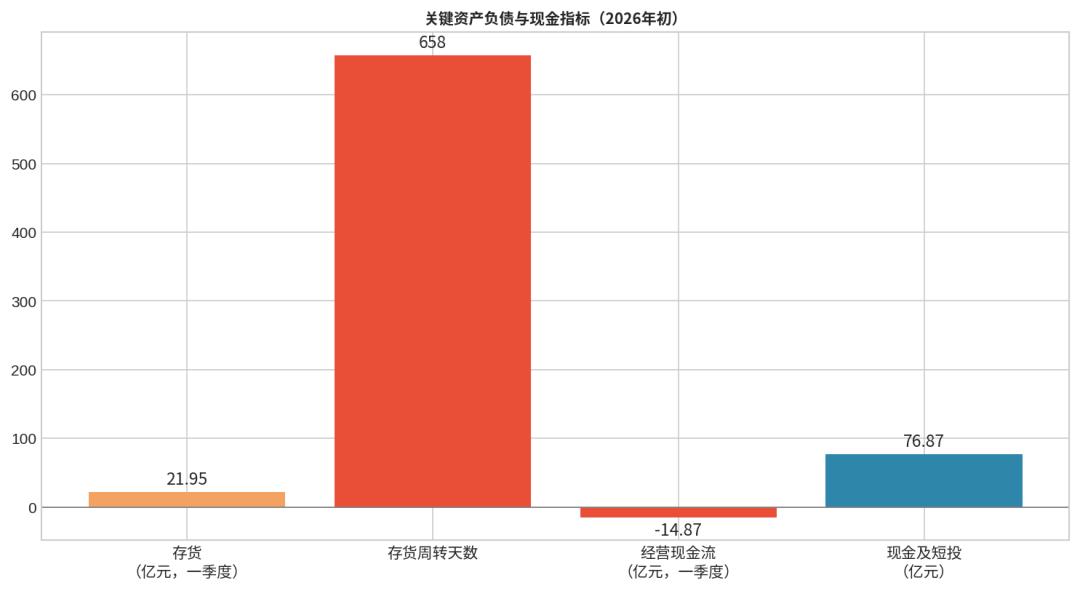
Fig. Moore Threads Inventory and Cash Indicators
The three pointers point to the same question: In the second half of 2026, when the share unlock selling pressure, inventory depreciation and cash flow pressure are superimposed, can Moore Threads deliver a "second profitable quarter" to prove itself?
The continuity of profitability is the only reliable bridge between its present and future.
06
Conclusion
Looking back at 2022 when the gross margin was -70%, and now the 65.5% gross margin and 270 billion RMB market value, Moore Threads has completed the most difficult leap for domestic GPUs, from "can it survive" to "deserves it to win".
The fate of this company never depends on whether it can beat NVIDIA, which is a matter of 20 years. It depends on whether it can build its own scale and ecological moat before Huawei Ascend completes its ecosystem closed loop, before the wafer production capacity is fully locked, and before the countdown composed of the share unlock peak and cash flow pressure ends.
In the story of domestic computing power, the most dangerous thing is never the competitors, but time.
The 65% gross margin is earned by itself, but the "no profit" status is the debt it owes. The market has given it five years with 180x PS. Five years later, when the tide recedes, people will only ask one question:
Is it just