AI-generated short dramas are rampant: 220,000 new titles were launched in half a year, and 90% of them are operating at a loss.
The transformation of the short drama industry driven by AI is like a nuclear explosion — the energy released is staggering, yet it does not necessarily lead to prosperity.
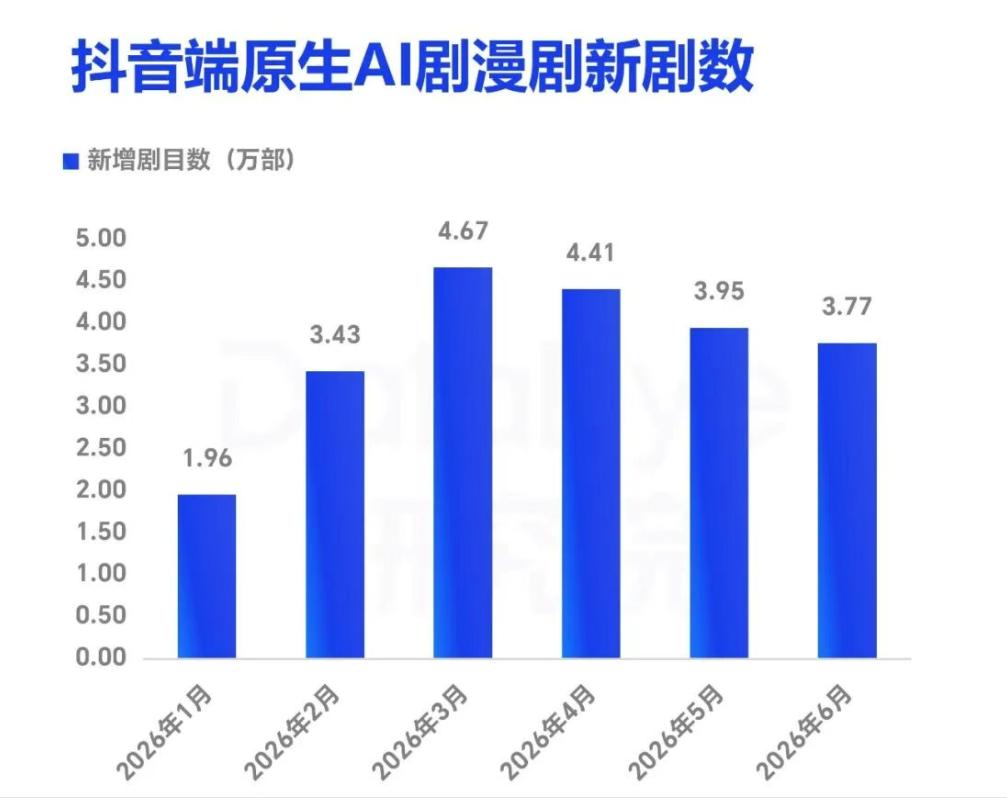
At present, a new AI-generated short drama is launched on Douyin every 36 seconds on average. In just one year, the number of new releases per month has skyrocketed from 655 to over 74,000, a hundredfold increase.
Contrary to this trend, the revenue curve has been declining all the way: the revenue per 10,000 views has dropped from 30-100 yuan last year to 5-10 yuan this year, with the maximum decline exceeding 90%.
Technological progress is supposed to create value, so why has it dragged the entire track into more cutthroat involution instead? Where on earth does the money from AI short dramas end up going?
01 "Explosion of Production Capacity, Collapse of Revenue"
AI has played an extremely catalytic role in the production of short dramas.
A traditional live-action short drama requires dozens of people including the film crew, actors, costume and prop staff, site managers, and post-production teams to work together for several weeks, with costs generally starting at 400,000 to 500,000 yuan, and high-quality productions often costing millions. AI short dramas have restructured this entire chain: the script's first draft is generated by models, roles and scenes are reused from digital assets, visuals are generated in batches by video models, and dubbing is completed with one click.
According to industry statistics, the production cost of a high-quality AI short drama is about 800-1500 yuan per minute, and the total cost of a 100-minute work is around 100,000 yuan, which is only 1/5 to 1/7 of that of a live-action short drama. The production cycle has also been shortened from 25-40 days to 7-15 days, and in extreme cases, a single person can complete the entire work at home.
The story of Liu Ziyu, a young man from Yunnan, is the most vivid poster of this revolution. He spent 10 days and about 3,000 yuan in computing power costs to produce the AI short film "Zombie Scavenger" entirely by himself at home, which went viral at home and abroad overnight, and even attracted Hollywood producers to search for him across the entire internet. This narrative of "earning millions of returns with just a few thousand yuan" has attracted all kinds of players like a magnet.
Once the floodgate is opened, the flood surges in.
Data from the China Net Audio-Visual Association shows that a total of 367,000 micro short dramas were launched on various platforms in the first half of the year, of which AI-generated content accounted for more than 74%. DataEye's *2026 H1 AI Drama & Comic Drama Data Report* further calculated that Douyin alone had more than 221,900 natively launched AI short dramas — if each work is 100 minutes long, it would take a person 42 years to watch all of them without sleep, while the total number of live-action micro short dramas launched nationwide in 2025 was only 33,000.
*Source: DataEye
The explosion of supply has directly diluted the already limited attention span. The number of unique viewers of short dramas has reached 851 million, which means two out of every three internet users have watched short dramas, but the total time users spend on such content is rigid. When the supply increases a hundredfold within a year, the traffic allocated to each individual work can only be diluted exponentially.
Among the 221,900 AI short dramas on Douyin in the first half of this year, only 1,055 had views exceeding 100 million, with a hit rate as low as 0.47%; 12,000 had views exceeding 10 million, accounting for 5.8%.
Measured by the break-even line of 50 million views, less than 1.3% of the works can recoup their costs — roughly only 1 out of every 77 new dramas can barely break even. The situation is even more severe for AI comic dramas, where the hit rate is less than 0.1%, roughly equal to the probability of winning a 1-in-1000 lottery.
What is more fatal than the falling hit rate is the collapse of the value per unit of traffic.
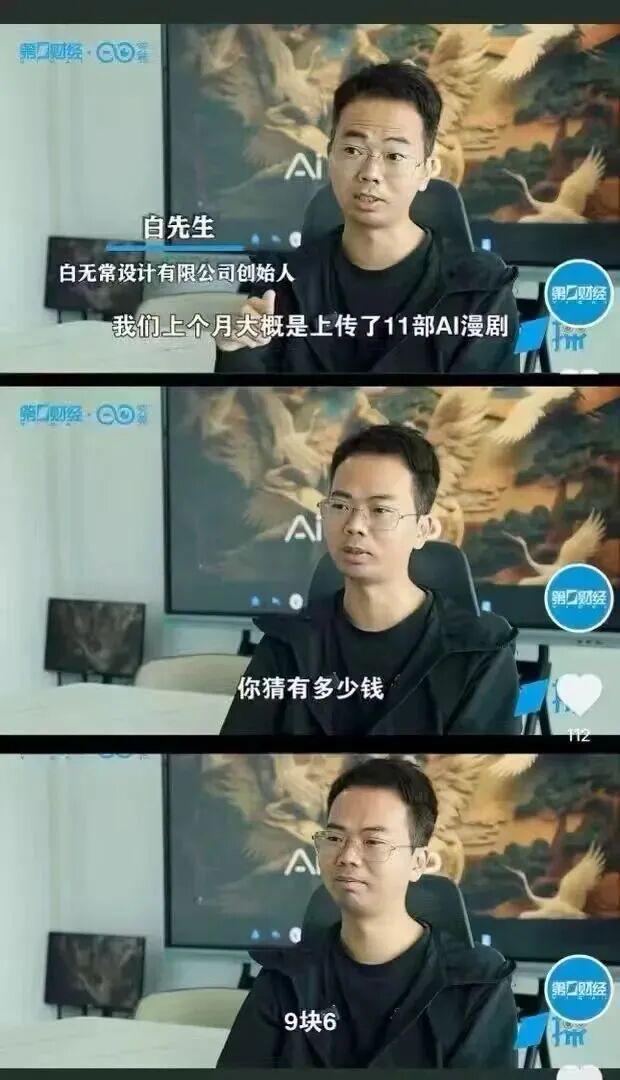
According to reports from multiple media outlets, the revenue per 10,000 views of AI short dramas has dropped from 30-100 yuan at the peak last year to 5-10 yuan this year. A practitioner revealed in an interview with Yicai that after uploading 11 AI comic dramas with 16 episodes each, the total revenue was only 9.6 yuan. The life cycle of themes is also shrinking sharply — a popular track that enters the market one week late may have already been saturated by the market.
*Source: Yicai
The rift between production capacity and revenue reveals a cruel truth: AI has not created new demand, it has only flooded the original market with an extremely low entry barrier.
02 "Whose Pockets Are The Profits Flowing Into?"
A thought-provoking question arises: AI has cut production costs by a large margin, so where did the saved money go?
Let's first look at the accounts on the production side. The expenses for a high-quality AI short drama worth 100,000 yuan are mainly divided into three parts.
The script accounts for the smallest proportion, about 10% which is around 10,000 yuan, and the production company can even select scripts for free from the platform's backend.
Labor costs still take up a significant share, mainly referring to the salaries of chief screenwriters, directors, asset managers, prompt engineers, and editors. AI has not eliminated human labor, it has only replaced traditional roles such as actors and on-site managers with new positions like prompt engineers and digital asset specialists.
The most flexible and easily out-of-control part is the "computing power" used for image generation.
Computing power is mainly consumed in repeated "card drawing" processes. The 720p video of the mainstream tool Seedance 2.0 is priced at 1 yuan per second. Theoretically, if a 100-minute work only undergoes one generation process, the computing power cost is only 6,000 yuan. But under the requirements of high-quality production, mature teams will generate each shot 3 to 5 times, pushing the computing power cost up to 18,000 to 30,000 yuan.
After the release of Seedance 2.5, the 720p generation price rose to about 2.1 yuan per second, doubling the previous cost. To make matters worse, the price of computing power itself is still rising, making the "card drawing" bills for creators increasingly heavy.
Even so, the production cost of 100,000 yuan is still much lower than that of live-action short dramas. But production cost is only the admission ticket, and what really determines the survival of the work is the traffic investment.
Industry data shows that traffic placement for AI quasi-live-action short dramas accounts for about 70% of the total cost across the entire chain. Lin Qiwen, Vice President of DataEye Drama Check, once publicly stated, "The production cost of AI short dramas has dropped by about 90%, but the traffic cost has risen by more than 100% year on year, while the revenue side has declined by more than 50%."
This is the real dilemma of the industry: the production side has reduced costs thanks to AI, but the traffic purchase cost is rising rigidly, and the revenue side is still declining, forming an increasingly tightening scissors gap. AI short drama companies are essentially working for traffic platforms — their income comes from platform revenue sharing, and most of the income is returned to the platform in the form of traffic investment.
In this game, the only parties that are guaranteed to make steady profits are the platforms and AI tool manufacturers. The platforms collect traffic investment fees on one hand and take a share of content revenue on the other; tool manufacturers charge computing power fees by the second, and the more the production capacity expands, the more lucrative the computing power bills become. The complaint from some netizens that "the computing power bill is higher than the rent" is not an exaggeration.
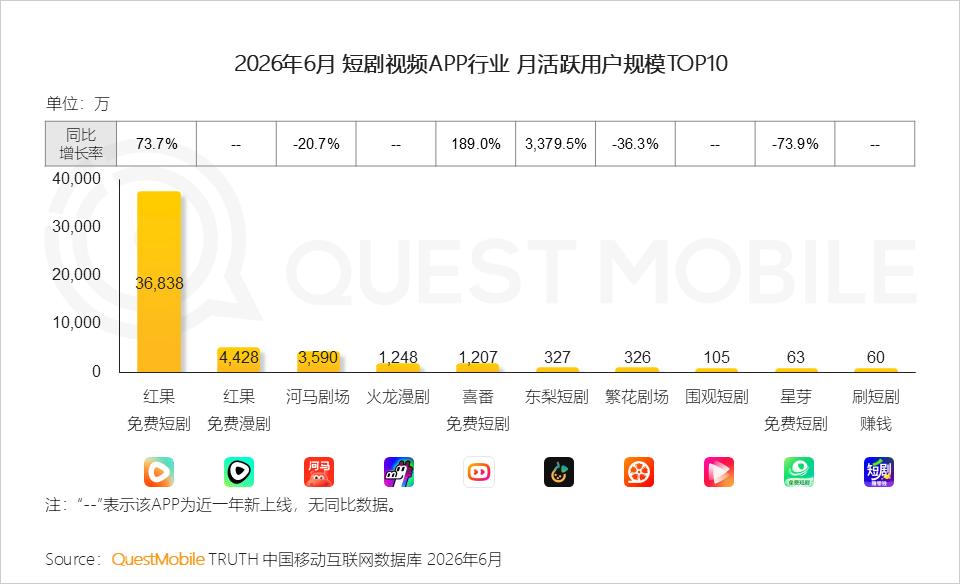
Take Hongguo Free Short Drama as an example. This App, launched less than three years ago, had over 100 million daily active users in January 2026, becoming ByteDance's fifth independent App with over 100 million daily active users. Data from QuestMobile shows that by June this year, its monthly active users reached 368 million, a year-on-year increase of 73.7%, firmly ranking first in the industry with an absolute advantage.
*Source: QuestMobile
In the AI video tool sector, ByteDance's Seedance 2.0 and 2.5 have a much higher usage rate among creators than Kuaishou's Keling. Although manufacturers including Alibaba's Tongyi, MiniMax, and Tencent have recently stepped up their efforts in video large models, there is a huge gap in performance, and they lack the closed-loop industrial scenarios.
From the perspective of the industrial chain, ByteDance has formed a complete closed loop: upstream, it has Tomatofiction to provide massive IP reserves, and the Seedance series of AI video models to collect computing power fees; in the middle, it has two major content distribution platforms, Hongguo and Douyin; downstream, it has a mature advertising system to absorb traffic investment budgets.
Creators are responsible for producing content and taking the risk of low hit rates, while the platforms profit from computing power fees, advertising fees, and capture user traffic with a free model at the same time, forming a veritable "triple-win" closed loop.
Creators bet on the probability of producing a hit at the gaming table, while the platforms steadily collect rake fees beside the table — this is the most real business logic of the AI short drama track.
03 "Return of Live-action Works and Value Restoration"
When the bubble grows to a certain size, the industry reshuffle comes faster than expected.
In the second quarter of 2026, the trend quietly changed. According to data from the China Net Audio-Visual Association, a total of 239,000 micro short dramas were launched in Q2, of which 153,000 were AI-generated short dramas, accounting for 64%; the number of live-action short dramas increased from 6,000 in the first quarter to 86,000.
Behind the data is the collective reflection of the entire industry. The assembly-line mass production approach has been proven unviable by the market. Those speculators who thought "AI generation equals easy money" are exiting the market, and the core of industry competition has shifted from "competing for production capacity" to "competing for content and IP capabilities".
Platforms are also taking the initiative to correct their direction. In April 2026, Hongguo launched the "Short Drama Creator Center", opening access to screenwriters, directors, and copyright holders. Le Li, Chief Editor of Hongguo Short Drama, has repeatedly emphasized publicly that AI has lowered the creation threshold and expanded the boundary of themes, but the platform will continue to increase its investment in live-action short dramas "as always". On July 24, the China Net Audio-Visual Association and Hongguo Short Drama jointly launched the "Chuangxiang Plan" to provide financial support and full-link services for selected projects.
A more significant signal comes from the regulatory authorities. On July 27, the National Radio and Television Administration reviewed and passed the *Measures for the Administration of the Development of Micro Short Dramas*, which will come into effect on September 1, 2026. This is the first departmental regulation in China specifically targeting the micro short drama industry, which clearly requires that micro short dramas generated using artificial intelligence technology must add clear reminder labels in a prominent position in each episode.
The access rule of "filing first, launching later", together with the "Sword Net 2026" special campaign that targets copyright chaos, jointly marks the end of the extensive growth model — good money starts to drive out bad money.
The value of live-action short dramas is being rediscovered. A striking comparison is that in the first quarter of this year, AI micro short dramas, accounting for over 95% of the total production, only generated about 4% of the total views across the network. Users have voted with their clicks, and homogeneous AI content cannot support real emotional resonance.
In the first half of 2026, a small number of high-quality AI works such as *The Laid-off Girl* proved that technology can empower creation — but the premise is that creators are willing to polish AI works as carefully as they polish live-action dramas. The director of the drama revealed that in order to pursue the visual quality, the team sometimes spent 20 to 30 rounds of generation. The 73-minute content with 11 episodes took 30 days to produce, and the cost per episode exceeded 10,000 yuan, which finally made the AI character in the work gain hundreds of thousands of fans.

*Source: Fangtaozi Screenshot
As Chen Ruiqing, Chairman of Dianzhong Technology, said: "The cheaper things are, the more expensive they turn out to be. Everyone can make short dramas, but the entry threshold is getting higher and higher. The capabilities of IP operation, script creation and aesthetic judgment are the core competitiveness."
04 "Final Notes"
AI short dramas have gone through the development that takes other industries ten years in just one year.
From the get-rich-quick myth of "50,000 yuan cost for 10 million yuan return" at the beginning of the year, to the current situation where 90% of the works lose money and the revenue per 10,000 views cannot even buy a cup of milk tea, the expansion and cooling of this track have come extremely rapidly.
The industry ultimately has to answer a fundamental question: are we creating content, or are we producing digital garbage?
This article is from the WeChat official account "Qingcheng Finance", Author: Qing Feng, Editor: Liu Zi, published by 36Kr with authorization.