With a 12% "entry fee" for AI, do insiders in the alcohol and travel industries consider Doubao to be surprisingly cheap?
Hotel business has been tough in recent years.
"The day construction started, seven groups of urban management officers showed up and stopped us from working," a single-property e-sports hotel operator in a third-tier city told Pangjing as he calculated the returns he had earned since opening his hotel in June this year. "We only have 50 rooms, which is a small scale, and the rent for our location is very high. In these past few months when business was good, our occupancy rate was around 99.5%. Even under the most optimistic scenario, it will take us three years to recoup our investment, which is already considered a 'huge success'."
"When we first opened, we spent 50,000 to 60,000 yuan on various informal approvals and paid visits to relevant parties one by one. Starting from this year, we have to cover corporate income tax, value-added tax, dividend tax, and the five social insurances and housing fund for our employees... The platform's account managers check every day whether our pricing is aligned with the platform's, we are heavily affected, and whether we can make money is entirely up to luck."
Now, Doubao has also "struck a blow" to the industry.
Recently, a piece of news about Doubao charging commission pushed the hotel industry and the commercialization of AI to the forefront of public debate. Public information shows that hotel orders completed via Doubao's entry that redirect to Douyin Local Life will be subject to an independent rate: a 11.4% software service fee plus a 0.6% payment processing fee, with a combined rate of about 12%. For a moment, discussions about "Doubao charging for hotel recommendations" have been filled with widespread panic.
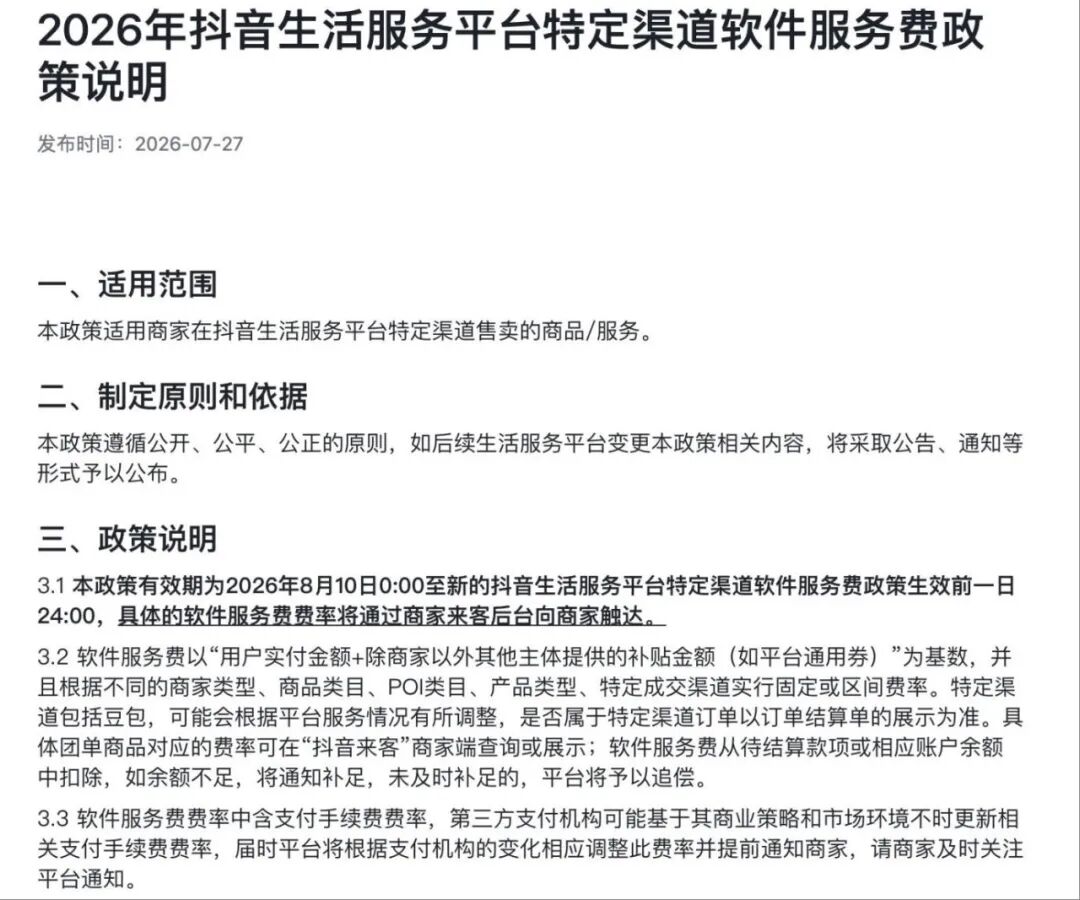
Caption: Screenshot of Douyin Local Life backend Source: Internet
The night the news broke, Liu Xing, Head of PR for Doubao, responded quickly: The statement that "Doubao will charge fees for hotel recommendations" is inaccurate. Doubao's local life service business does not have paid promotion options at present, and Doubao does not charge advertising fees for hotel recommendations. Merchants cannot influence recommendations or ranking through payment, and only need to pay channel service fees after an order is completed.
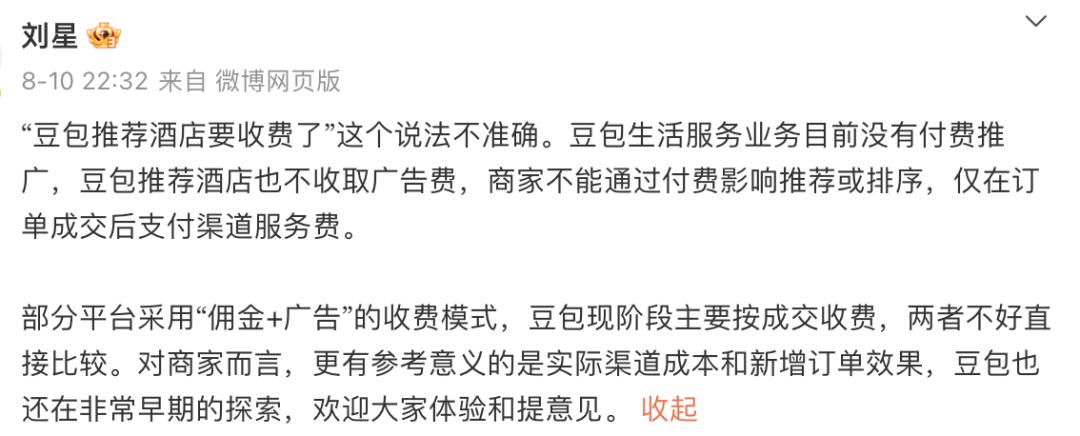
Caption: Liu Xing, Head of PR for Doubao, responded on Weibo Source: Weibo
Is this 12% rate really expensive? Why can hotels hardly reject Doubao? Is the traffic coming from Doubao new incremental visitors, or a re-attribution of existing traffic? When AI starts to generate revenue from transactions, how should consumers judge the answers it gives? Doubao's commission collection has fired the "first shot" in the commercialization of AI search, and this discussion about the "bargaining power" of new channels has just begun.
With these questions, Pangjing talked with a number of industry practitioners.
The 12% "admission fee", a masked ball where you can't see the "arriving guests" clearly
For the hotel industry, a 12% commission cut is "very cost-effective".
Many hotel owners told Pangjing that compared with some leading travel platforms, the combined commission of around 12% for Doubao and Douyin is not the highest, and this platform-related investment is already included in their budgets.
Guo Weiwen, senior cultural tourism brand consultant and partner of Weekend Hotels, judged based on his years of industry experience that this commission rate is roughly between that of Ctrip and Meituan, and does not differ much from various platforms. "As long as it is lower than Ctrip's rate, there will be hotels willing to accept it."
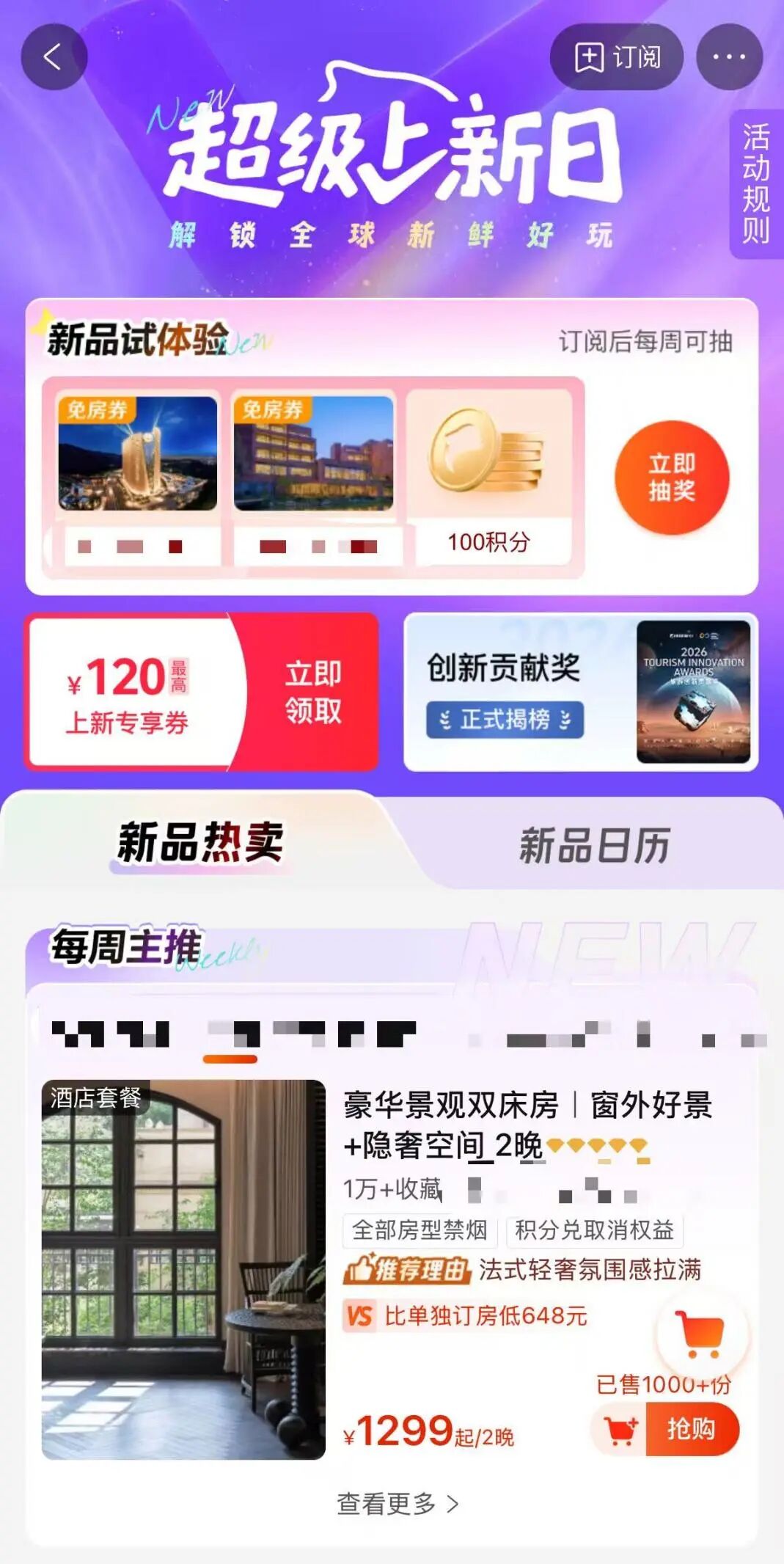
Caption: Ctrip Campaign Source: Ctrip
Then, what dimensions of platform commissions should the 12% figure be specifically compared with?
Guo Weiwen said: "OTA commissions are usually deducted before settlement, and hotel owners only see the amount that arrives in their accounts. Economically, this is the channel cost for hotels; in terms of settlement, it is deducted before hotels receive the money returned by the platform. The platform may also have additional advertising, promotion and traffic products, so the combined rate of Doubao cannot be simply compared horizontally with the basic commissions of other platforms. What hotels actually compare is the net received amount, order volume, customer source quality and the degree of new increment, and these data can only be obtained after using the service for a period of time.
For a long time, platforms and hotels are interdependent while also in constant tugs of war. Guo Weiwen mentioned that consumers trust OTAs not only because they have more hotels, complete data and numerous reviews, but also because they can get pre-sales consultation and after-sales coordination, which are services that merchants themselves cannot provide.
Hotels need platforms to aggregate users for search, price comparison and transactions; platforms also need hotels to continuously provide available inventory and fulfill orders. The reason why Ctrip has long occupied an important position in off-site hotel booking with the highest commission rate is that it delivers good order volume and payment performance, and has long served as a "yardstick" for hotels to measure the value of other channels.
Hotels have long been accustomed to paying commissions to platforms, but why is it the hotel industry that is the first to stir up controversy when the rate rises by about 4 percentage points? Judging from the Douyin Local Life backend screenshots shared by merchants, this adjustment is not only targeted at hotels. The Doubao channel rate for multiple categories has increased to varying degrees, but the most intense reactions come from hotel and travel merchants.

Caption: Doubao Fires the Shot Source: Internet
A hotel owner told Pangjing that over 90% of his orders come from platforms. "Non-chain hotels like ours are highly dependent on OTAs. Large hotel chains can retain orders through their brand and membership systems, but even if individual hotels have distinctive products and run Douyin promotions, it is difficult for them to independently achieve stable customer acquisition. In the early stage, we will definitely spend as much money as possible on platform traffic investment." He believes that this 4% commission increase is only an "admission fee", and there will definitely be additional charging items such as advertising fees and algorithm recommendation fees in the future.
To find the root cause, an insider from a leading travel platform analyzed to Pangjing: "At present, the hotel and travel industry has the highest dependence on platforms. Every empty room a merchant has every day is a hard loss. Merchants should sell the rooms themselves, but they cannot sell them all, so they can only rely on the traffic from platforms." As a result, many hotels know clearly that "they cannot rely too much on external channels, otherwise they will be backfired one day", but they do not have the ability to easily leave these platforms.
The long-term strong dependence on OTAs collides with the FOMO brought by the arrival of new technologies and new channels such as AI, which makes the hotel and travel industry that is already struggling in stock competition fall into deeper industry anxiety: When AI stands in front of OTAs, do hotels have another traffic entrance that they have to operate?
Consumer habits and traffic entrances have always been the key areas that all parties compete for.
Guo Weiwen analyzed to Pangjing: "For hotels, Doubao is equivalent to a new additional channel that can reach incremental groups who do not usually use Douyin. From the perspective of the whole industry, the final place where orders are completed is still Douyin, and behind this is the new change of distribution rules. Once users develop the habit of making consumption decisions through AI applications, the starting point of traffic will shift to the AI end, rather than the traditional ordering platforms.
Doubao with 382 million users, how does it open the "wallets" of merchants?
After discussing why the hotel and travel industry has ushered in such fierce discussion and reform, another question worth asking is why Doubao stands at the forefront and fires the first shot of AI commission collection.
Although there are many playful remarks of "silly Doubao" on social media, nowadays, everyone is already inseparable from Doubao.
According to data from QuestMobile, in June 2026, the number of active users of Doubao reached 382 million, ranking first among all AI-native apps counted by the institution.
Doubao can take the lead in generating revenue from AI traffic, and three conditions are indispensable: strong large model capabilities, the highest monthly active users among app entrances, and ready-made transaction infrastructure. As a product under ByteDance, Doubao is naturally located upstream of Douyin's transaction link, with unique advantages in undertaking traffic. AI understands demands and distributes traffic, Douyin, as an e-commerce platform, undertakes content, products and transactions, and Douyin Local Life handles stores, inventory, verification and settlement, forming a closed loop of the whole link.
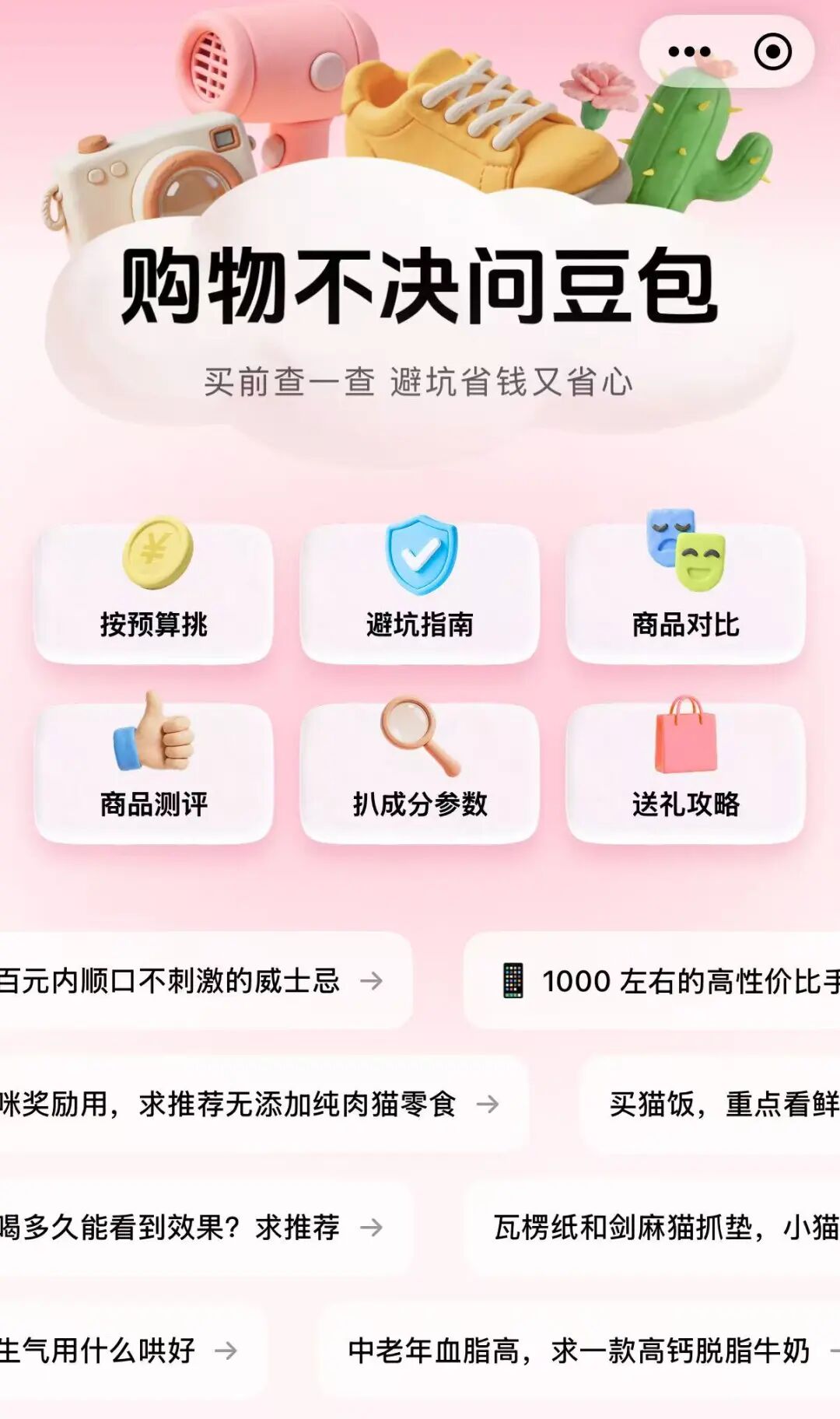
Caption: Ask Doubao when you are hesitant about shopping Source: Doubao
Quantitative change leads to qualitative change. With demands, supply and market all gathered at the same time, Doubao's identity has begun to change.
The most obvious change is that it has transformed from an AI tool to a channel.
Many hotel owners interviewed told Pangjing reporters that after hearing the news, they and their peers are all "going long" on the Douyin platform: hotels that do not have stores on Douyin are opening stores there, those that already have stores are working hard to improve their hotel's product shelves and text descriptions, deal with negative reviews, and strive to make users place more orders on Douyin and leave positive reviews. All these actions are to make their stores gain more weight that is favored by AI.
A detail worth noting is that Doubao will increase the weight of negative reviews from Douyin orders, and rarely extract reviews from platforms such as Meituan and Ctrip.
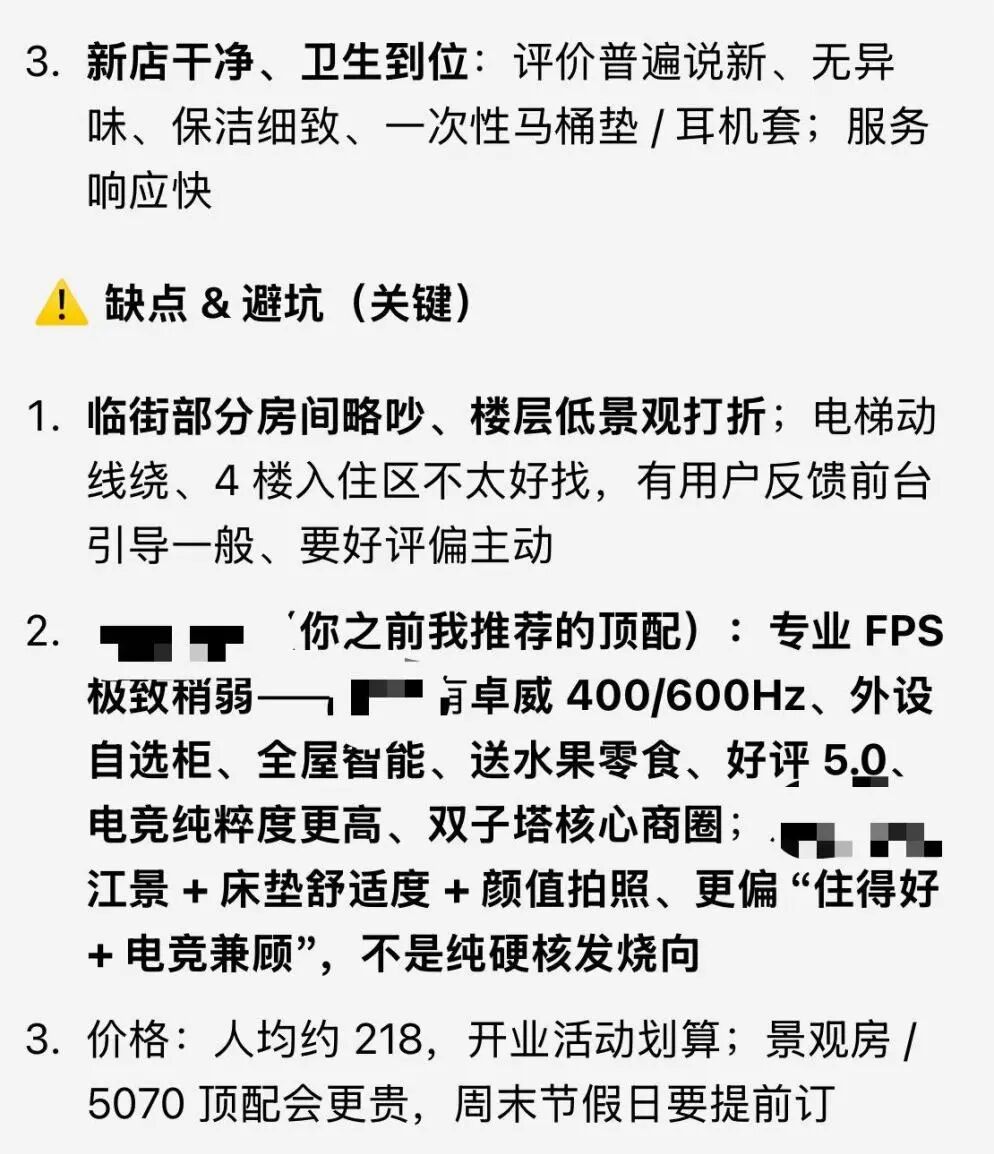
Caption: Negative reviews captured by Doubao Source: Doubao
Guo Weiwen summed up this change as a new test facing merchants: "First of all, hotel merchants need to adapt to the AI era and make their content more AI-friendly; secondly, from the perspective of business operation, they need to observe which group of guests from different channels bring higher actual returns."
In his view, hotel content with clearer structure and more consistent text, image and video information may be more friendly to AI. But after a hotel is mentioned by Doubao, whether users will click to redirect and then complete the order is still another matter.
Whether the 12% rate is worth it has no answer for now.
There are also other concerns: does Doubao bring a group of new customers from AI apps, or does it just change the entrance of orders that would have happened on Douyin, Ctrip and Meituan? Merchants reorganize their content to be accurately identified by AI, whether the operating cost of channel adaptation can be covered by the corresponding revenue?
At least for now, hotels still have some choices. Guo Weiwen told Pangjing that merchants can decide whether to open the products and inventory in Douyin Local Life: "If the Douyin channel charges too high fees, or the hotel's reservations are already full, they can also close the inventory access."
In his view, "being recommended and being charged are two different things".
Thus, a more sensitive issue has emerged. Doubao has clearly stated at present that merchants cannot influence recommendations or ranking through payment. Guo Weiwen believes that it is not unexpected for platforms to generate revenue through traffic, but there must be a clear boundary between recommendation and commercial interests: "The two links should be strictly isolated when making recommendations, otherwise the recommendation mechanism and the public's trust will be lost."
Conclusion
At present, Douyin Local Life Open Platform has covered multiple industries including catering, leisure and entertainment, beauty services, hotels, scenic spots, travel agencies and transportation. Hotels are just the sample with the most intense debate at present, and other local life service categories whose transactions are completed via Doubao are also facing a channel rate that is about 4 percentage points higher than that on the main Douyin app.
Although this 4 percentage point increase is a direct cut into merchants' real profits, during visits, all the hotel owners, insiders and stakeholders told Pangjing: "This is inevitable." "The platform also needs to make profits." "We have long expected that AI will shift from burning money to generating revenue, we are just waiting for a proper form." Among the 5 ordinary users randomly interviewed by Pangjing, 3 said they would not use AI to make shopping decisions, 1 would use Doubao to compare reviews on different brands and platforms, and 1 is very resistant to this practice.
Nowadays, Doubao has launched monthly payment service and collects commission for redirected orders; Qianwen has been connected to Taobao and Fliggy; Meituan's "Xiaomei" allows users to order food with one sentence; many apps including JD and Ctrip have launched in-app AI functions. The AI applications of China's leading internet companies are all moving from the chat box to the checkout counter.
At the moment, the ball has just started.
This article is from WeChat Official Account "Pangjing Headlines", author: Wu Jialin, editor: Fan Yi, published with authorization from 36Kr.