Google has begun to dismantle DeepMind, with several of its teams reassigned under the jurisdiction of its headquarters.
A week after DeepMind's leadership reshuffle, the upheaval is still ongoing —
Google has begun to split it apart and integrate part of it into its own system.
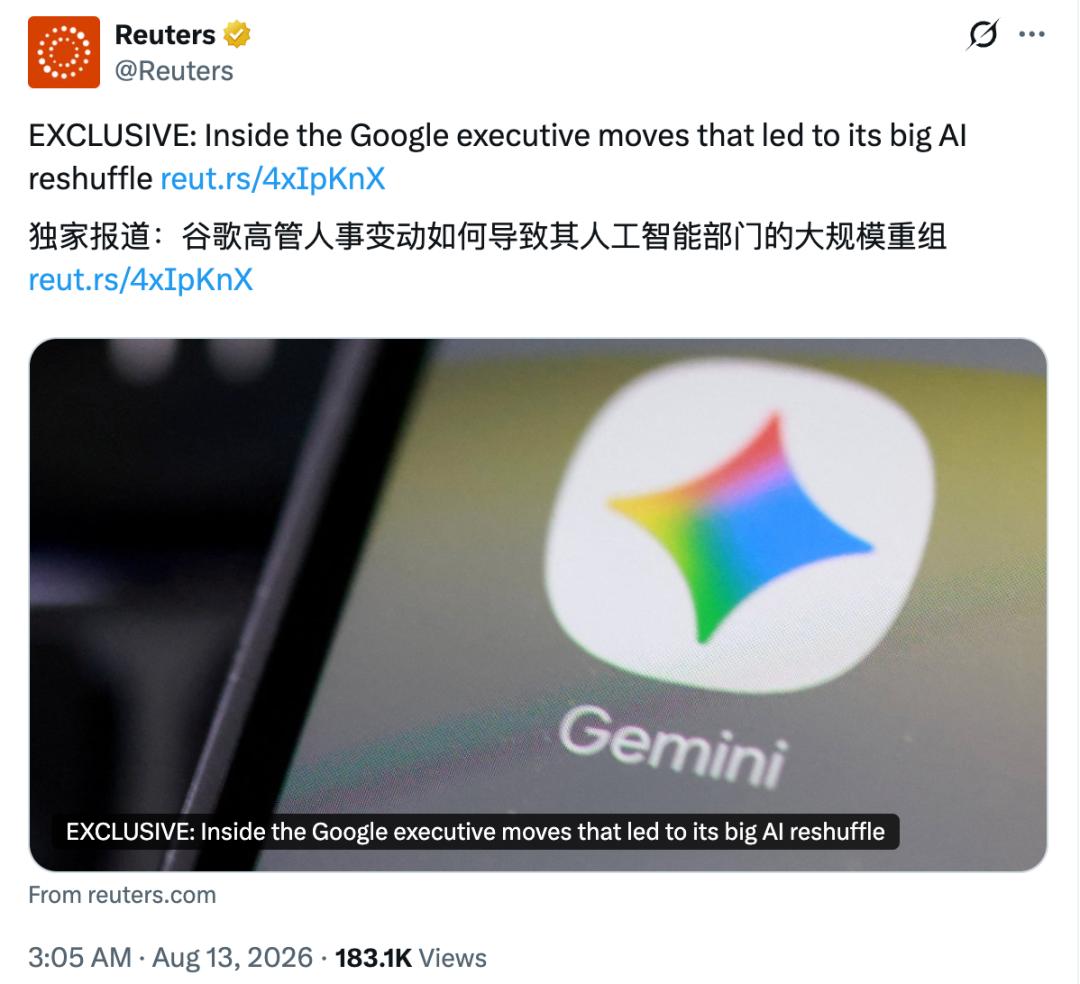
According to the latest Reuters report, at the Google DeepMind all-hands meeting held on August 6, the management announced:
Several non-technical teams will be moved out of DeepMind and transferred to Google's corporate reporting hierarchy.
At the meeting, Demis Hassabis and his successor Koray Kavukcuoglu were still reassuring employees that the daily work of the lab would not change.
Most employees did not know that major adjustments were coming to DeepMind until the leadership change was announced publicly. Now, they are faced with a series of unanswered questions:
Which teams exactly will be relocated? Who will decide the fate of the remaining projects? How much resources can those researches that do not directly serve Gemini obtain?
Google has not given a positive answer to any of these questions so far.
Meanwhile, another key figure has returned to the power center of Google AI.
Google co-founder, Sergey Brin.

He does not hold a formal management position, but has re-engaged in the model training and resource allocation of Gemini.
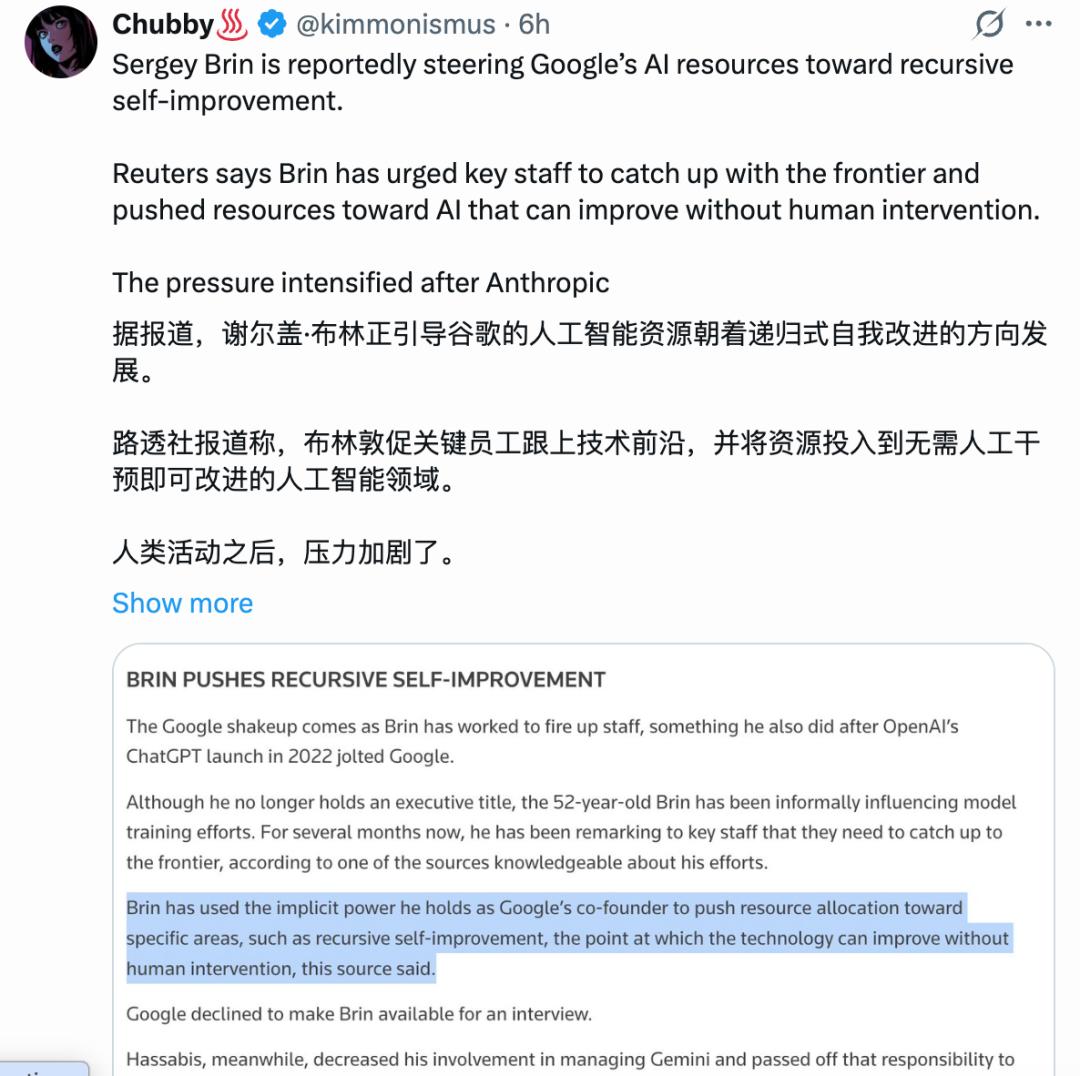
Over the past few months, Brin has been constantly urging core AI employees to catch up with the cutting-edge of models, and pushing resources to focus on directions such as "recursive self-improvement".
Google Starts Splitting DeepMind
Some teams of DeepMind are being directly transferred back to Google.
According to Reuters, at the all-hands meeting on August 6, the management announced that several non-technical teams will be moved out of DeepMind and report directly to Google instead.
Reuters did not disclose which specific teams are involved. Google also refused to respond to relevant questions.
What can be confirmed at present is that the research teams remain in DeepMind. The teams split out are the support teams beyond research.
Google has not publicly explained the reason for this adjustment. But in the context of the entire reorganization, the goal points to one thing:
Reduce the intermediate links between DeepMind and Google's product divisions, so that Gemini can be integrated into Search, Cloud and other products faster.
Since being acquired by Google in 2014, DeepMind has retained a considerable degree of autonomy — independent culture, independent teams, and independent research agendas.
Judging from the current signals, DeepMind may continue to retain its brand and research teams, but its organizational form is increasingly approaching "the in-house model R&D department of Google", rather than a semi-independent lab.
The balance of power is also tilting.
Reuters pointed out that Koray Kavukcuoglu is gradually becoming the core figure shaping the development direction of Gemini.

In 2025, he took over the supervision of model development, with the task of integrating Gemini into all the company's products. Four anonymous sources said that in the following months, some leaders of DeepMind found their influence declining.
A Google spokesperson confirmed last week that Koray now has the final say on major decisions of DeepMind.
More notably, according to people familiar with the matter, it has always been Koray, not Demis Hassabis who serves as the main liaison between DeepMind and Google Cloud, the company's main AI revenue source.
Brin Returns to the Power Center of Google AI
The 52-year-old Google co-founder, Sergey Brin, can no longer stay on the sidelines.
In April this year, after Anthropic demonstrated the Claude Mythos model, Brin attended an internal meeting for hundreds of employees.
At the meeting, he asked Google DeepMind to speed up and go all in on Gemini.
Over the past few months, he has been constantly emphasizing to Google's core AI employees that the company must catch up with the cutting-edge of models again.
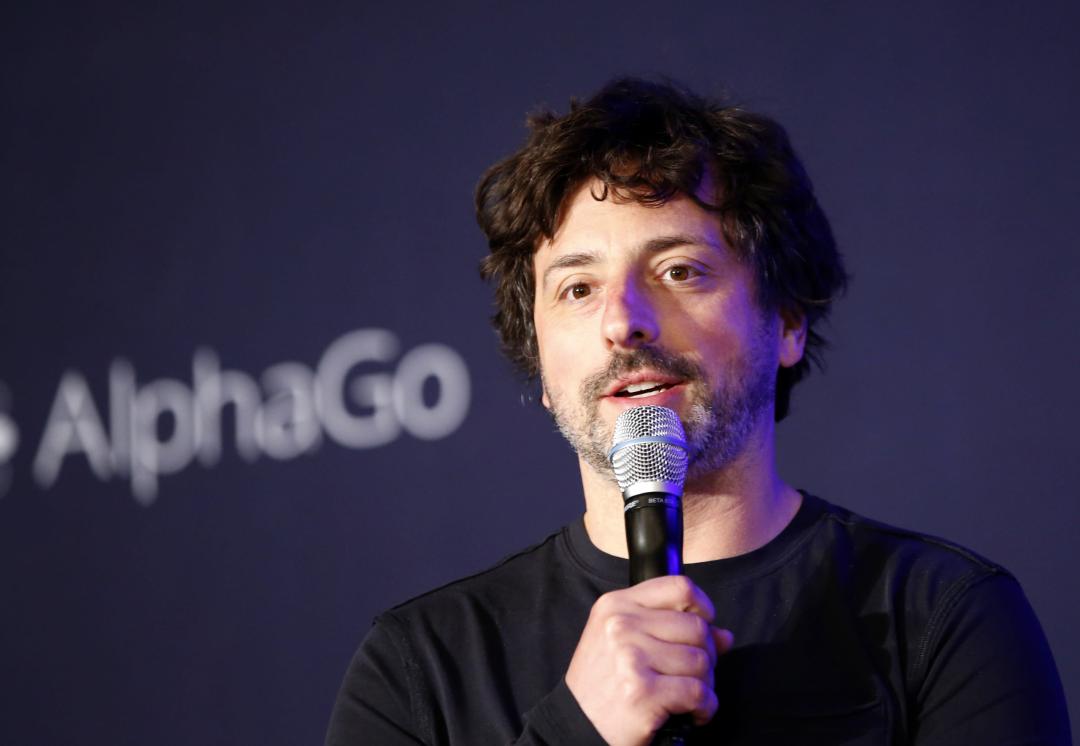
Moreover, Brin's involvement has gone far beyond the scope of moral encouragement.
Although he does not have an official executive title, he can still use his influence as Google co-founder to push resources to tilt towards specific technical directions.
One of the directions is "recursive self-improvement", which refers to the highly popular "AI self-evolution" at present.
Simply put, it means allowing AI to participate more in its own research and improvement process, and gradually reducing the reliance of model iteration on human researchers.
Once this path is proven feasible, the speed of AI R&D may no longer be only determined by the size of the research team, and the model may in turn help develop the next generation of models.
Obviously, how could Brin miss such a hot direction?
It has to be said that whenever Google faces a crisis, this big figure will make a "sudden appearance".
The last time he returned to Google was after the release of ChatGPT.
At the end of 2022, OpenAI released ChatGPT, setting off a fierce AI competition. Brin, who had stepped down from daily management for many years, re-entered the company, participated in Gemini development, and pushed employees to speed up to catch up.
Now Brin is stepping in again, which only shows that he is extremely dissatisfied with Google's current speed!
(Let alone Brin, I am not satisfied either)
In the new power structure, Koray also gets full backing from Brin.
Outside the formal organizational structure, Brin decides what Google should bet on and where resources flow; within the structure, Koray is responsible for implementing these decisions.
One in the open and one in the shadow form the new power axis of Google AI.
One More Thing
The official version of DeepSeek-V4-Pro and Grok 4.6 were both released last night, which is more than enough to make the AI circle celebrate.
In contrast, Gemini is still facing continuous outages...
According to Reuters, as of August this year, the new version of Gemini has been delayed for two months compared to the original plan. Internal tests show that it still lags behind competitors in capabilities such as coding.
There are also reports that Google has canceled the release of Gemini 3.5 Pro.
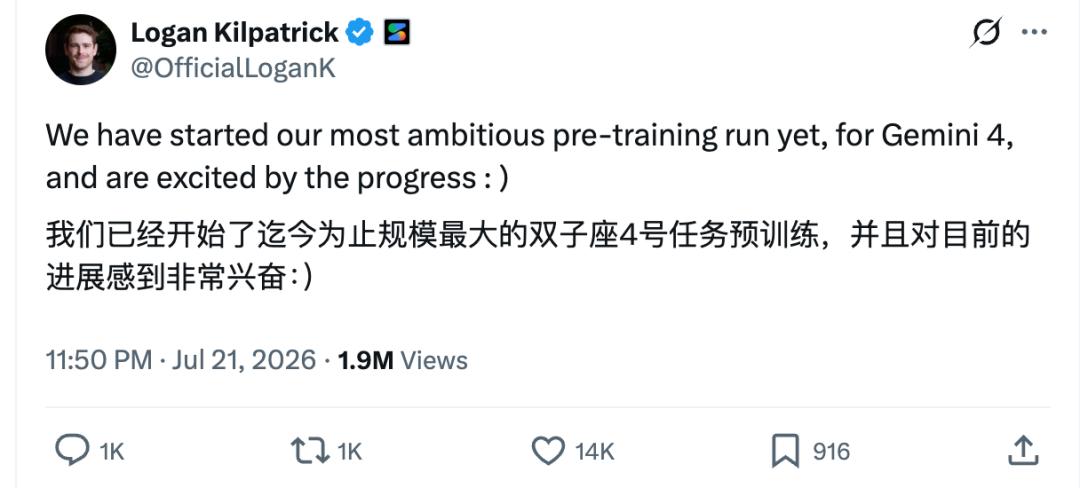
Previously, Logan, the former Head of Product at DeepMind, also stated that they had already started pre-training for Gemini 4, and it was not ruled out that Gemini 4 might be released directly?
There are said to be three reasons why Gemini falls behind:
1. Limited TPU computing power.
Google has to train Gemini on the one hand, use TPUs to support consumer products such as Search on the other hand, and also provide computing power to Cloud customers.
Multiple business lines are competing for the same batch of scarce resources, and the computing power allocated to model training is not always sufficient.
There was even a conflict between DeepMind and Google Cloud over TPU allocation. Senior Cloud leaders expect that the promotion of Koray will ease this tension.
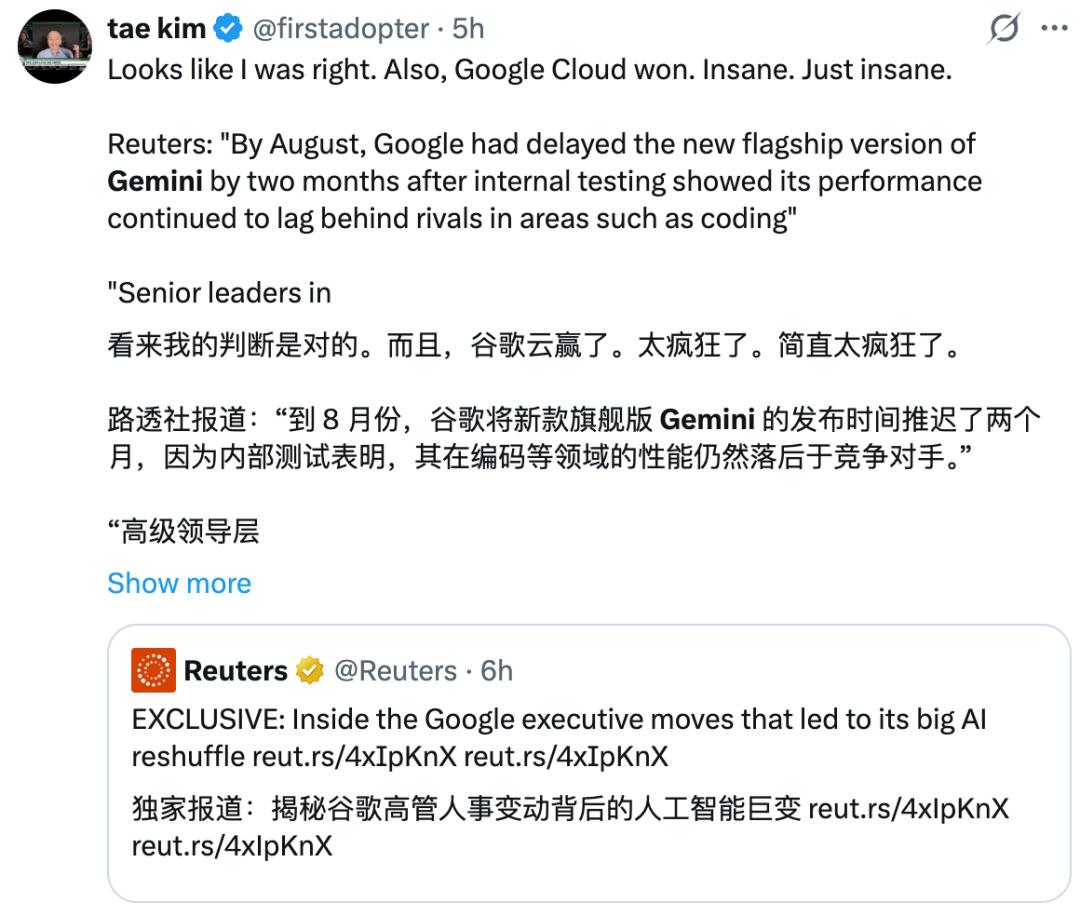
2. Infighting among multiple Gemini project leads.
Reuters reported that Gemini has multiple project leads, and there are divergences among different leads.
Limited resources were pulled between different directions, and capabilities such as coding, which later became the focus of competition, did not receive sufficient investment in time.
3. Google's bureaucracy leads to a slower release rhythm than its agile competitors.
Several people familiar with the matter believe that Google's bureaucratic system has slowed down model releases. From the completion of training to the official launch, a version needs to go through a more complex decision-making chain than OpenAI and Anthropic.
The monthly competition in the industry has already started, while Google's internal teams may still be coordinating leads, computing power and product departments.
It can be seen that Google's organizational problems outweigh its technical problems at present.
If they still want Gemini to catch up, they really need to carry out drastic reforms...

References:
[1]https://www.reuters.com/world/inside-google-executive-moves-that-led-its-big-ai-reshuffle-2026-08-12/
This article is from the WeChat official account "QbitAI", written by Yu Ting, authorized for release by 36Kr.