Changxin has claimed the top spot in terms of market capitalization, while Tencent has seized the "granary" of AI computing power.
On August 13, the share price of Tencent Holdings fell 4.46% in a single day to HK$441 per share, and its total market value dropped to HK$4.01 trillion (equivalent to about RMB 3.44 trillion). On the same day, the share price of leading memory manufacturer Changxin Technology closed at 52.88 yuan per share, with a total market value of 3.54 trillion yuan.
This means that Changxin Technology, which was listed only 17 days ago, has surpassed the "stock king" Tencent and officially taken the top spot in terms of market capitalization among A-share and Hong Kong stock markets.
Behind the change of the "stock king" throne, Tencent has just released its performance report for the second quarter of 2026.
In the second quarter of this year, Tencent recorded revenue of RMB 2,047.85 billion, up 11% year on year; Non-IFRS operating profit reached RMB 756.36 billion, up 9% year on year. However, if the investment in new AI products is excluded, the company's Non-IFRS operating profit will reach RMB 861 billion.
For a long time, Tencent has been considered to have slightly "fallen behind" in the AI business. Faced with external doubts, Tencent chose to spend real money to speed up its pace of catching up.
According to the financial report, in the second quarter of this year, the company's capital expenditure in a single quarter was as high as RMB 528 billion, a sharp increase of 176.25% year on year and 65.28% quarter on quarter; affected by this, the company's free cash flow in the second quarter dropped to -RMB 138 billion, which is also the first time Tencent has recorded a negative free cash flow in the second quarter since it disclosed this data in 2014. If the prepayment for computing power procurement is excluded, the company's free cash flow will be RMB 376 billion.
In this round of AI boom, the computing power infrastructure track has seen a sharp rise in popularity. As a leading domestic memory chip manufacturer, Changxin Technology completed its listing at the top of the cycle and became a highly sought-after computing power target in the market. In contrast, Tencent, which has invested a large amount of capital in purchasing computing power facilities, has caused a divergence in market attitudes.
After the release of the Q2 report, Citi raised Tencent's target price to HK$765 in its research report, on the grounds that Tencent's artificial intelligence plan has shown obvious results while its core business remains resilient. Morgan Stanley, on the other hand, believes that Tencent's solid core fundamentals have been offset by upfront investments in artificial intelligence, so it cut the company's target price by more than 15% to HK$550.
What kind of future will Tencent's AI path lead to?
The "New Tencent" Empowered by AI
"Entering the third quarter, we are building a brand new, AI-empowered Tencent at three levels: intelligence, applications and infrastructure," said Ma Huateng, Chairman and CEO of Tencent's Board of Directors.
At present, Tencent has planned a complete AI business chain from the foundational large model to AI applications. The company's new AI products mainly include the Hunyuan large model, Yuanbao, AI programming tool CodeBuddy, AI office tool WorkBuddy, and the WeChat-based AI agent Xiaowei, etc.
Among them, the Hunyuan large model is the key focus of Tencent's capital expenditure in this round. James Mitchell, Tencent's Chief Strategy Officer, said that the company will allocate the vast majority of its newly added computing power to self-developed large models, striving to reach the top level in the industry.
For a long time, Tencent's foundational large model Hunyuan Hy has not been well-known among numerous large models, until Yao Shunyu joined last September, the R&D of the Hunyuan large model began to enter the fast track.
In July this year, the official version of Hy3 was released, and Tencent began to stand out in the field of foundational large models. The financial report shows that the performance of the official Hy3 version is significantly better than most models of the same size. According to the Token consumption of OpenRouter, the AI model aggregation platform, Hy3 has consistently ranked among the top three in the world since its launch.
While developing self-developed large models, Tencent is also actively promoting the development of AI application products, and WorkBuddy is one of the products that the company focuses on developing. At the beginning of the Q2 earnings call, Ma Huateng mentioned that "in terms of monthly interaction volume, WorkBuddy has ranked first among China's AI productivity services."
Among a large number of products, the core reason why the AI office tool WorkBuddy can get Tencent's attention may be that it has taken the lead in realizing the commercial landing path.
Mitchell said that the core strategic purpose of Tencent's heavy investment in WorkBuddy is to promote the popularization of this strategically significant core application, while continuously collecting scenario feedback to reversely optimize the large model and the entire Tencent ecosystem. In addition, this product can generate immediate cash revenue.
The rapid development of large models and AI applications indirectly confirms the rationality of Tencent's current large-scale increase in AI investment. However, the market also pays attention to two core issues: will Tencent continue to invest a lot of resources in AI in the future? Can the AI business bring sufficient returns to the company?
In response, Tencent President Martin Lau also emphasized that the capital expenditure invested in AI-native businesses is mainly a one-time concentrated investment in this year and next year, and there is no need to assume that Tencent will maintain the same large-scale investment every year.
Martin Lau also said that we always believe that AI is a long-term track, and we will continue to make long-term layouts. With the expansion of scale, commercial returns will be gradually realized, and profitability will be achieved eventually. More importantly, we have a fallback plan: even if we stop developing self-developed applications and simply lease out the computing power, the related business itself can be profitable, so we dare to invest in it for the long term.
The "Old Tencent" Supported by Traditional Businesses
Apart from the brand-new AI business, Tencent's existing businesses such as games, advertising, fintech and enterprise services are the company's mature main businesses. Compared with the AI business that requires large amounts of capital "blood transfusion", these mature businesses still perform steadily and have the ability of self-sustaining profitability.
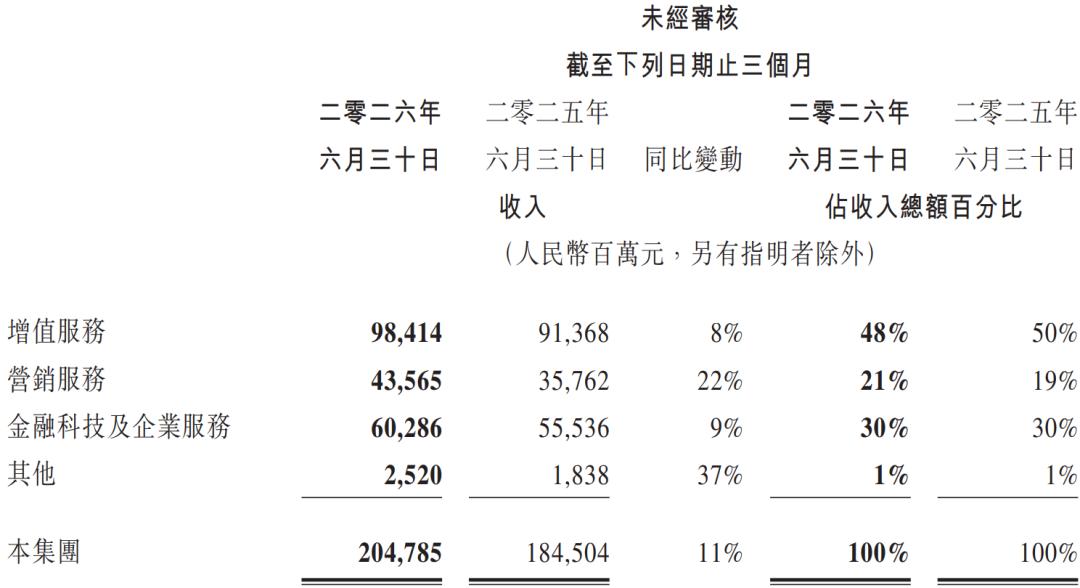
The game business is Tencent's main source of revenue. In the second quarter of this year, the company's value-added services revenue reached RMB 984.14 billion, up 8% year on year.
Among them, the revenue from the domestic game market was RMB 473 billion, and the revenue growth mainly came from the contribution of games such as *Honor of Kings* and *Rock Kingdom: World*; the revenue from the international game market was RMB 186 billion, a quarter-on-quarter decline, mainly affected by the revenue drop of the Finnish game company Supercell. In addition, the growth of in-app item sales for mobile games drove the company's social network revenue to RMB 325 billion.
On the whole, in the first half of this year, none of the major domestic game manufacturers other than Tencent launched heavy new products. Therefore, *Rock Kingdom: World* has become one of the biggest dark horses in the domestic game industry this year. The financial report shows that this product ranks first in both the average daily active accounts and revenue among all new mobile games released in China this year.
Marketing service revenue is the fastest-growing part of Tencent's three main business segments, with revenue in the second quarter rising 22% year on year to RMB 435.65 billion. In the second quarter, Tencent optimized links including advertising recommendation models, intelligent delivery product matrix, and closed-loop marketing within the WeChat ecosystem, which led to an increase in marketing investment in most major industries.
It is worth noting that the video account business, which Tencent has focused on developing in recent years, has also achieved rapid development. In the second quarter of this year, the total user usage time of video accounts increased by more than 20% year on year. This is attributed to the increasingly rich content for young users, the upgrade of interactive functions and the new content mixing system.
At present, Tencent presents a business pattern of steady growth in traditional businesses and large-scale investment in new AI businesses. It is precisely because traditional businesses can provide stable cash flow that the company can be generous in investing in the development of new businesses. At the moment when the AI wave is surging, it is not easy for Tencent, which was once "slow to respond", to catch up to the forefront of the trend, and the current investment will add impetus to its progress.
This article is from the WeChat public account "Morgan Stanley Finance" (ID: damofinance), author: Damo Finance, authorized for release by 36Kr.