Selling Seedance 2.5 at a heavily subsidized 90% off loss-making clearance price, will Libtv and its peers have to work for ByteDance for the rest of their lives?
Manga drama practitioner Zhang Lei plans to register as a Meituan rider to deliver food.
The reason is simple: the cost of computing power is too high, and producing manga dramas is no longer profitable. "Last month, the profit was only 4 yuan, the computing power cost was nearly 200,000 yuan, and the total income was only 270,000 yuan," he stated.
After ByteDance's Seedance 2.5 was released, many users complained that its price was too high. As ByteDance's most powerful video generation model, the official pricing of Seedance 2.5 is 42 yuan per million tokens with video input, 70 yuan per million tokens without video input, 1.5 to 2.1 yuan per second under 720P resolution, and a 30-second video costs at least 45 yuan, which is a 50% price increase compared to version 2.0.
Finding the most cost-effective channel to call Seedance 2.5 has become the most troublesome problem for current users.
The four leading video Agent platforms represented by Libtv, OiiOii, Tapnow and Flova have come to offer timely help. The lowest price for Seedance 2.5 on these platforms can be as low as 0.23 yuan per second, nearly 90% cheaper than the official price.
Coincidentally, except for Tapnow, the other three platforms are all founded by former executives or employees of ByteDance's Jianying team. The most well-known founders are Chen Mian of LibTV and Guo Lie of Flova. Chen Mian was previously the head of Jianying's commercialization department, while Guo Lie was the early core operator and founder of Jianying.
Even after leaving ByteDance, they still maintain great affection for their former employer. Without training self-developed models or reserving their own computing power, they have become the largest "distributors" of ByteDance Volcano Engine. They access the Seedance model as soon as it is launched, purchase computing power from Volcano Engine at the official original price, but offer large subsidies independently, and sell the services to users at a price lower than the official platform. They compete on the scale of subsidies and the fluency of product design, earning meager hard money that may even be less than food delivery riders.
However, a confusing problem for all parties is that the fiercer subsidies the video Agent platforms provide, the more users they attract, and the more computing power quota they need to purchase from Volcano Engine. In other words, every subsidy they offer creates revenue for ByteDance. Do these former ByteDance executives really intend to work for ByteDance for their entire career?
01
ByteDance's cash outposts sell services at a loss
The top priority for all video Agent platforms at present is to access the new Seedance model as fast as possible.
Seedance 2.5 was announced to open for public beta at 2 p.m. on August 7. Almost at the same time, Libtv and Tapnow both announced that their products had already accessed Seedance 2.5. OiiOii did not want to fall behind either, but it was 18 minutes slower than the two platforms.
Their prices are far lower than the official 1.5-2.1 yuan per second (720P). Creators can call Seedance 2.5 through LibTV at only 0.4 yuan per second under 720P; through OiiOii, the price is only 0.27 yuan per second after the "buy one get one free" top-up offer; TapNow offers a limited-time 45% discount, with the price as low as 0.24 yuan per second.
FlovaAI was the slowest, nearly 5 hours later than the others, but it offers the lowest price. With the "buy one get one free" offer using membership points and a limited-time 53% discount for 10 days, the final price can be as low as 0.23 yuan per second.
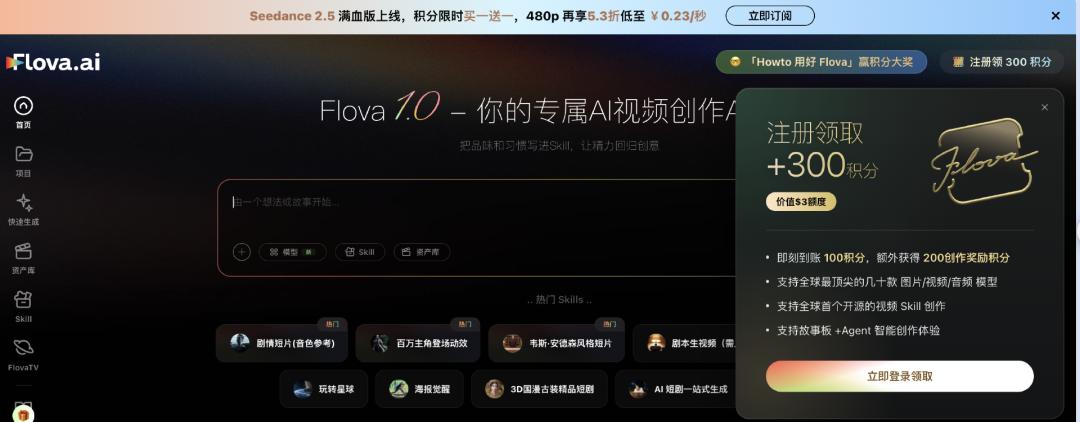
Caption: Screenshot of Flova.ai official website
A short drama practitioner told Tech Planet that when he generates images and videos now, he prioritizes the price, and uses the platform with the lowest cost. They also pay attention to the generation speed: for example, some users need to queue for more than 10 hours when calling Seedance 2.0 on the official Jimeng platform. Even though the official platform provides the full-capacity model with better video quality, the long waiting time greatly reduces their creation efficiency.
Therefore, even if there may be problems of diluted model performance when accessing through third-party platforms, users can still accept it. Some users told Tech Planet that in actual tests, Libtv has the problem of diluted model output, but as long as one out of ten generated videos is of full quality, the platform will continue to provide subsidies.
Compared with large technology companies, these video Agent applications do not have enough capital to independently develop large models, so they compete on the discourse power of product definition and pricing.
A short drama practitioner said that Volcano Engine treats all distributors equally, and there is no extra discount for bulk purchases. Even for customers who purchase the 50 million yuan annual package of Seedance, the lowest price during the Seedance 2.0 period was no less than 0.9 yuan per second, but LibTV can offer the service at 0.3 yuan per second.
In other words, the video Agent platforms access the Seedance model at the first time, provide large subsidies independently, and sell the services to users at a price lower than the official platform, which is essentially helping ByteDance sell its computing power services.
The founding teams of these three video Agent platforms all have connections with ByteDance. Libtv's parent company Yanyu Technology was founded by Chen Mian, ByteDance's youngest 4-1 level executive and the head of global commercialization of Jianying and CapCut, and Libtv is the largest video Agent application in China. Another product of Yanyu Technology, Lovart, was once praised by Elon Musk.
The founder of OiiOii, Nao Nao, was previously the head of the special effects business of ByteDance's Jianying and Douyin/TikTok. During the internal test period, 100,000 users queued up to grab only 100 access quotas, and the invitation code was extremely hard to get.
Guo Lie, the founder of Flova, is a core veteran of the Jianying team. He has developed a number of the most successful C-end tool products in China's mobile Internet era: Menglian and FaceU. In 2018, the Menglian team was acquired by ByteDance for about 300 million US dollars. The Menglian team later became the core force of ByteDance's imaging middle platform. After that, Guo Lie was in charge of ByteDance's imaging business, and participated in the incubation of a series of products including Jianying, CapCut, Xingtu and Qingyan Camera.
They seem to work harder than ByteDance's official team. All of them have placed prominent promotions of "dual models of Seedance 2.5 & MiniMax H3" on the most visible positions of their official websites, creating an atmosphere as lively as the 618 or Double 11 e-commerce shopping festivals. Libtv even displays a countdown timer accurate to the second in the upper left corner of its official website, giving users the illusion that it is foolish not to take advantage of the cheap offers.

Caption: Screenshot of Libtv official website
02
The more generous the tens of billions of subsidies are, the more anxious video Agent platforms become
Two months ago, Libtv's parent company Yanyu Technology completed a B+ round of financing of nearly 300 million US dollars, with a post-investment valuation exceeding 2 billion US dollars, setting a new record for the highest single-round financing of AI application layer projects in China. One month later, Flova announced that it had obtained 80 million US dollars of financing, but the news was far less sensational than Yanyu Technology's financing.
Yanyu Technology's financing was extremely rare at that time, because the AI application track seemed to have cooled down, and the saying that "Token kills AI applications" began to spread widely.
According to data from IT Juzi, in 2025, 930 AI application companies across China obtained a total of 107.07 billion yuan of financing, with an average of 2.6 companies getting financing per day, and an average of 12 million yuan of capital entering the market per hour.
In the first half of 2026, China's domestic AI equity financing reached 307.682 billion yuan, exceeding the total amount of the whole year of 2025. However, computing power chips took 72.568 billion yuan, the large model layer took 93 billion yuan, and only 6.8 billion yuan was left for the AIGC application layer for all head projects combined. DeepSeek alone raised 45.9 billion yuan in its A round of financing, which is nearly 7 times the total financing of the entire AIGC application layer in the first half of the year.
In the view of Zhang Lei, the short drama practitioner, Libtv's financing is entirely used for subsidies, to boost its ARR (Annual Recurring Revenue). This logic is easy to understand: the more financing a company gets, the more confidence it has to provide subsidies, the more users it can attract, and "once the subsidy stops, all user loyalty disappears".
Chen Mian himself also admitted that there is almost no threshold in the video application industry. In an interview with *Latepost*, he said, "In this era, products developed by different teams are almost the same. The optimal solution for PMF (Product-Market Fit, which means the product precisely meets a real and strong market demand) in a specific vertical track, especially the optimal solution for interactive interfaces, is extremely convergent. All mobile phones look similar now, and the mainstream interaction of short videos is swiping up and down."
When the product form, interface and model are all convergent, the only remaining competitive dimension is price. Libtv has long recognized this logic. During the Seedance 2.0 period, it was one of the first batch of third-party applications to access the model, except for the official Jimeng and Xiaoyun platforms, about a week earlier than OiiOii, Tapnow and Flova.
It was the first to launch the price war, launching a 39% discount membership plan. After purchasing the membership, the cost of Seedance 2.0 was only 0.35 yuan per second, while the official price was about 1 yuan per second. Through subsidies, LibTV accumulated hundreds of thousands of paying users in just May, the group's overall revenue increased by more than 3000% year-on-year, its ARR has reached 300 million US dollars, and it is currently preparing for an IPO. Similarweb estimates that its monthly visits are about 2.2 million.
Now OiiOii, Tapnow and Flova, which lag behind in market share, have all launched cheaper Seedance 2.5 services than Libtv, trying to regain market recognition through larger subsidies. An employee of an AI video generation platform told Tech Planet that his platform achieved profit last year, but was forced to join the subsidy war this year.
In order to attract enough users, boost ARR and support the financing narrative with performance data, Libtv does not hesitate to operate at a loss. *Silicon Star Pro* once calculated an account: the average monthly price of LibTV's standard continuous annual membership is 47.4 yuan, and the official website estimates that users can generate 56 seconds of 720P Seedance 2.0 video, which is equivalent to a membership income of about 0.85 yuan per second. Assuming that users use all their quota to call Seedance 2.0 without video input, and according to Volcano Engine's official price of about 0.99 yuan per second, the marginal gross profit margin is about -17% even if only the model calling cost is calculated.
But Chen Mian once said that he does not sell APIs at a negative gross profit, "We do not pursue negative gross profit, but I also do not think the application layer should have a very high gross profit in the early stage, especially within one year after the product is released." After the launch of Seedance 2.5, Libtv has obviously raised its price, but it is still lower than the official price.
If the subsidies are suspended, user growth will stagnate, and ARR will stop increasing, making it more difficult for video Agent platforms to get new financing. If they keep offering endless subsidies without getting recognition from investors, the only outcome is to close down.
03
Minimax open-sourced its model, why not develop self-owned models now?
The open source of MiniMax's multimodal model H3 brings a glimmer of hope to video Agent platforms.
Although it is not as good as Seedance 2.5, the overall performance of H3 is close to the level of Seedance 2.0, and it performs particularly well in TVC advertisements, e-commerce video advertisements and post-editing scenarios.
Open source means that the model can not only be deployed on personal computers, but also allow video Agent platforms to fine-tune their own models on this basis, so as to get rid of the tough situation of making money only as ByteDance's distributors. An employee of an AI video generation platform told Tech Planet that his company has discussed internally that they will carry out fine-tuning training in the long term.
"Open source allows us to import some skills and data materials, which can save a lot of money. The benefit of fine-tuning our own model is that the content censorship will not be so strict, and we can define the openness of content by ourselves," a short drama practitioner said.
LibTV is the most likely platform to achieve this goal. The LibTV platform itself has integrated the LoRA training framework, which is positioned to support users to "train exclusive video style models", and this is the core technical means for LibTV to achieve the goal of "post-training fine-tuning" based on H3.
But if they really want to train their own models, the biggest challenge is computing power. "What they need is not scattered individual GPUs, but a large-scale GPU cluster that can support the entire training process, which requires a huge amount of capital," a ByteDance employee said.
Some changes have already taken place. At the end of July, Higgsfield, the overseas video Agent platform with the highest annualized revenue, sent updated terms of service to its users. The most critical change in this revision is that model training is enabled by default, which means that as long as users use Higgsfield's services, the content they upload will be used by default to train and improve the model.
Many people predict that it is inevitable for video Agent platforms to fine-tune their own models in the future.
After all, the fierce subsidy wars in the food delivery and ride-hailing industries finally gave birth to Meituan and Didi. But after burning hundreds of millions of dollars, the video Agent platforms find that they are only helping ByteDance build a larger model ecosystem. They are not doing real entrepreneurship, but a new form of "outsourcing service for ByteDance".
The worse outcome is that Guo Lie sold Menglian to ByteDance for 300 million US dollars and can retire easily, but this batch of new entrepreneurs may not have a second chance to be acquired by large companies. The only way to get rid of the identity of outsourcing service provider is to become strong enough on their own.
(Note: Zhang Lei in this article is a pseudonym.)
This article is from WeChat official account "Tech Planet" (ID: tech618), written by Wang Lin,