Alo's China debut was a runaway success: its transaction volume exceeded 10 million yuan within the first minute, scalpers are hyping up its limited-edition canvas bags and reselling them at huge premiums, and unofficially produced "self-created counterfeit variants" have already emerged in Yiwu.
After gaining popularity on Xiaohongshu for several years, Alo has finally officially launched its sales in Chinese Mainland.
In the early morning of August 12, Alo's official Tmall flagship store officially opened for sale. A reporter from Time Weekly learned from Tmall that after the pre-payment of the final balance started at 00:30, the transaction volume of Alo's official Tmall flagship store exceeded 10 million yuan in just 1 minute, breaking the transaction record for new brand stores in Tmall's sports and outdoor industry.
A TENNIS CLUB knitted cardigan labeled "Zhao Lusi's same style" is priced at 1,380 yuan, and was shown as sold out at 9 a.m. on August 12. As of noon that day, the number of followers of this store has exceeded 110,000.
What sparked discussions on social platforms earlier than the clothes was a canvas bag given away by Alo.
A reporter from Time Weekly learned that from August 12 to 19, consumers who register as members at Alo's official Tmall flagship store and complete their first order with a total actual payment of over 1,000 yuan can receive an Alo tie-dye tote bag, which is officially marked with a reference value of 450 yuan and is limited to 5,000 pieces.
After the activity went online, the second-hand market quickly "launched new products". The reporter of Time Weekly noticed that many scalpers are reselling Alo canvas bags. On Xianyu, some sellers are selling the tote bag separately at a price of 400 yuan, and some consumers have even posted specifically to buy it.
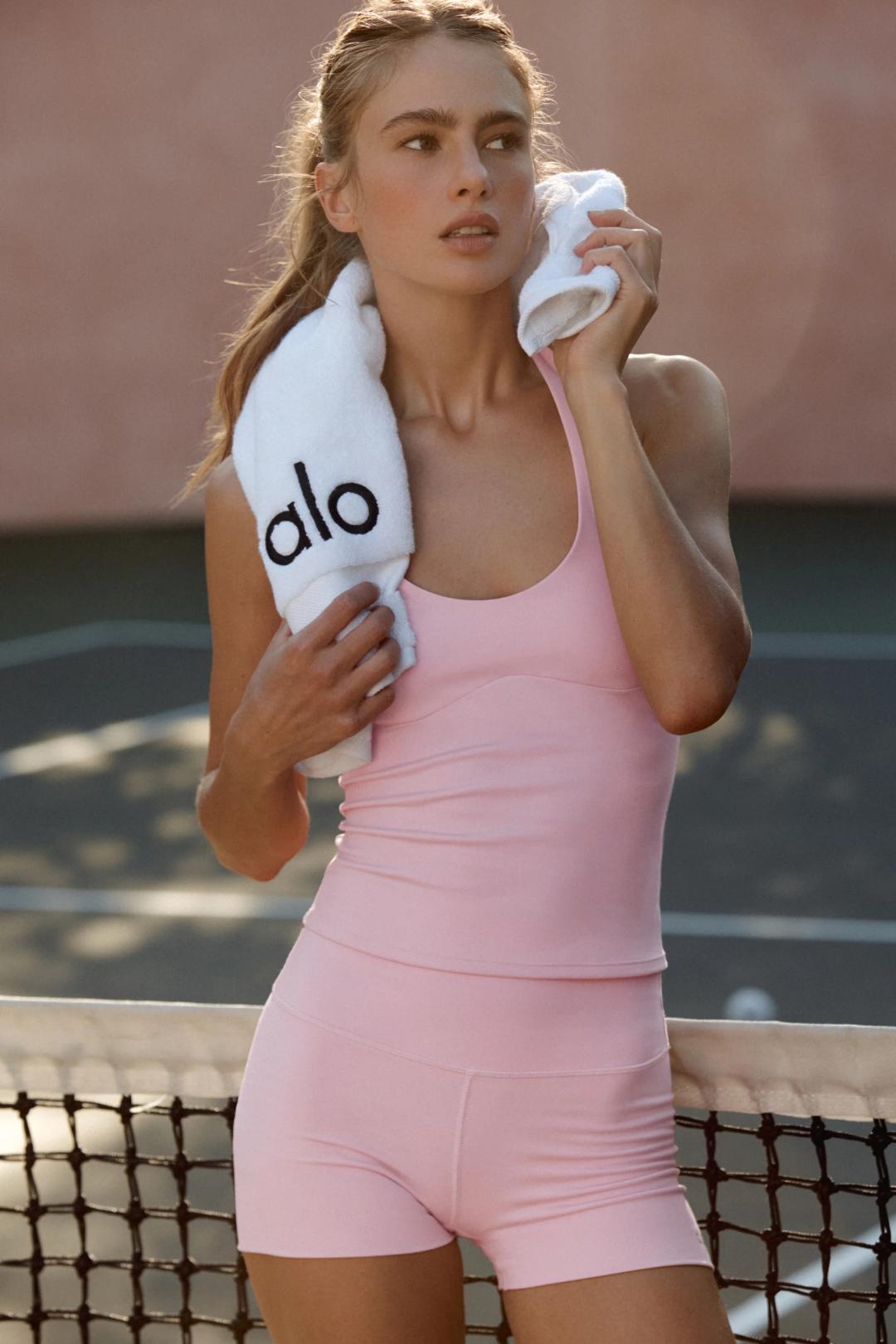
Photo source: Alo official website
In fact, before there were official stores, Alo had already attracted a large number of consumers in China, which also gave rise to a mature market for purchasing agents, reselling and counterfeit products. In August this year, the views of the Alo topic on Xiaohongshu have reached 240 million, with celebrity private outfits, blogger outfits and overseas shopping guides continuing to gain popularity.
Nowadays, with the official opening of the Tmall flagship store, this American sports brand that "has already made a booming business before its physical store arrives" is starting to pull the consumer demand that was previously scattered on social platforms, purchasing agents and gray channels back to the official system.
01
First Show Lands on Tmall
Alo, founded in Los Angeles in 2007, started out with yoga wear, and later continuously strengthened its "Studio-to-Street" sports lifestyle label. Frequent wearing by celebrities such as Hailey Bieber and Kendall Jenner made it break away from the category of a simple yoga wear brand very early and enter the field of fashion outfits.
This celebrity and social media-driven communication method also brought Alo into the sight of Chinese consumers in advance.
Before Alo officially announced its entry into China, a large number of products sold in the name of "Alo" already existed on domestic e-commerce platforms. At present, a pair of Alo yoga pants priced at about 1,000 yuan on its official overseas website is sold for less than 500 yuan in some stores, and some e-commerce brands even have products priced at dozens of yuan.
The fact that the brand is extremely popular but cannot be purchased directly has left a lot of "room" for counterfeit and "copycat" businesses. The reporter of Time Weekly retrieved and found that there have been more than 1,000 trademark applications similar to Alo in China, and Yiwu has even launched "self-created styles" that the brand has never launched.
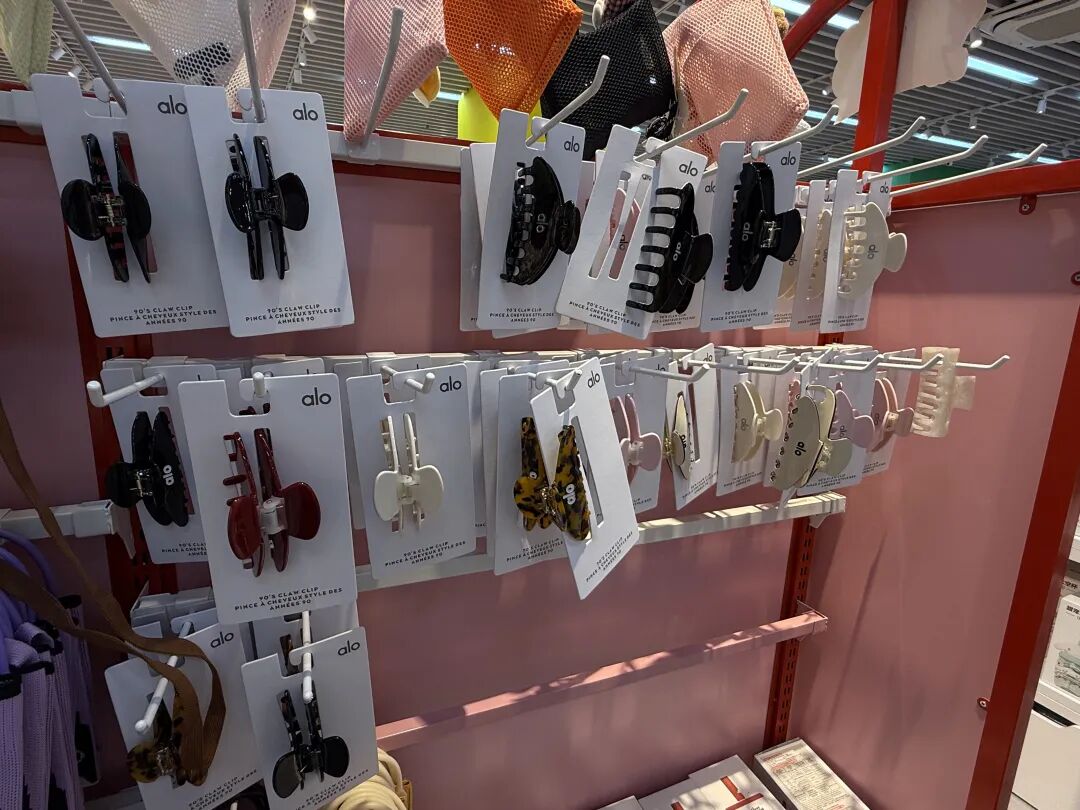
"Yiwu version of Alo" photographed by Time Weekly reporter
In this context, Alo's opening of a store on Tmall this time needs to solve far more problems than just adding an additional sales channel. In the past few years, consumers who wanted to buy Alo products in China had to either shop overseas, find purchasing agents, or choose among third-party stores where it was hard to tell whether the products were genuine or fake. The long-term absence of official channels has made the authenticity of products, after-sales services, and even consumers' perception of the brand's normal price range fragmented.
After opening the Tmall flagship store, Alo's prices have been pulled back to the official system. Taking the SUNSET DE trainers as an example, the price at Alo's official Tmall flagship store is 1,750 yuan. The previous price comparison by the reporter of Time Weekly found that the same product, when shipped directly from the official US website to China with relevant taxes and fees included, costs about 1,786 yuan, and there is basically no price difference between the two. The price of SUIT UP wide-leg pants on Tmall is 1,150 yuan, and the price on the US official website is 148 US dollars. After considering direct mail fees and taxes, the actual payment price is also close.
The main reason why consumers were willing to take the uncertainty of purchasing agents before is the price and product differences between overseas and mainland channels. When official stores can launch new products simultaneously and the price is close to that of the official overseas website, purchasing agents have lost at least part of their price advantage.
At the same time, Alo is also actively cutting off the old paths. The reporter of Time Weekly found that its official overseas website can no longer place orders directly to Chinese Mainland, and Alo customer service said that Chinese consumers can purchase through official Chinese channels in the future.
Starting from August, Alo has truly taken back its Chinese business that was previously scattered in cross-border e-commerce, purchasing agents and third-party platforms into its own hands.
02
One-Year "Warm-up"
Alo's first official business in China landed on Tmall, but according to the understanding of the reporter from Time Weekly, as early as a year ago, the brand was preparing to enter the Chinese Mainland market.
The first step was to set up the corporate entity. In August 2025, Alo Hong Kong Limited established Alo Commercial (Shanghai) Co., Ltd. in Shanghai with a registered capital of 12 million US dollars. On April 28, 2026, the Hong Kong parent company of Alo Commercial (Shanghai) Co., Ltd. established Alo E-commerce (Shanghai) Co., Ltd. with a registered capital of 2 million US dollars.
Between the two entities, Alo's offline layout has also surfaced.
In February this year, Alo confirmed that it would take over the original Fortnum & Mason store at K11 MUSEA in Tsim Sha Tsui, Hong Kong, China. K11 MUSEA, where Alo is located, gathers a large number of luxury brands such as Louis Vuitton and Gucci. Alo chose a large two-story store facing the sea as an important store in the Greater China region, which also continues its recent trend of continuously moving closer to the high-end lifestyle.
However, as of early August, the Hong Kong store has not yet officially opened, and the brand has not announced the exact opening date. Previously, the market has successively spread news about the location of mainland stores such as Jing'an Kerry Center in Shanghai and Taikoo Li Sanlitun in Beijing, but none of them have officially opened yet.
Before the offline stores are launched, Alo has first built the entrance for consumers. On June 17, the official WeChat account "ALO" published its first article "Hello, China", officially announcing its entry into the Chinese market.
Subsequently, Alo's community activities started first. At the end of July, Alo's official mini-program began to open reservations for activities such as yoga, pilates, running, and mindful walking, with the number of participants controlled at 10 to 40 per session. Starting from August 1, Alo launched an 8-week urban community experience program in Shanghai, with content further expanded to running groups, urban walking, outdoor yoga, core bed pilates, cycling and health sharing salons.
In fact, the community is a very familiar strategy for Alo. In the US market, yoga, fitness courses and the establishment of communities around a healthy lifestyle are inherently part of its brand operation. In China, it put this step before the physical stores: before consumers walk into Alo's stores, the brand has already started to find its first batch of users through WeChat, mini-programs and offline activities.
It was not until August that Alo's transaction link was truly completed.
On August 10, Alo's official Tmall flagship store launched pre-sales, and officially opened for sale on August 12. More than 300 products were launched in the store for the first time, covering categories such as yoga, training, sports leisure, footwear and accessories.
"Connecting the timeline, Alo's pace of entering China is quite clear: first set up the operating entities, confirm the offline stores, then open official accounts, launch communities, and finally use Tmall to support transactions." A practitioner who has long paid attention to the footwear and apparel industry told the reporter of Time Weekly that for overseas sports brands, physical stores are no longer necessarily the first step. E-commerce can first test which products are truly sought after by consumers, community activities can help identify who the core users are, and pop-up stores can test offline passenger flow and brand acceptance. When these answers gradually become clear, deciding where and how large a long-term store will open is much less costly than laying out a store network from the very beginning.
03
Competing against Lululemon?
There is a very direct background for Alo to choose to officially enter the Chinese market at this time: sports shoes and apparel is still one of the few large consumer categories that maintain growth.
Data from iiMedia Research shows that the market size of China's sports shoes and apparel reached 598.9 billion yuan in 2025, and is expected to increase to 896.3 billion yuan in 2030. According to this data, the average annual compound growth rate in the next five years is about 8.4%.
However, while the market pie is getting bigger, Alo is also facing great competitive pressure in China.
It is widely believed that Alo's most direct "rival" is Lululemon. Earnest Analytics, based on US consumer transaction data, found that in the 12 months ending April 22, 2024, 63% of Alo consumers had purchased Lululemon products at the same time.
But at this stage, there are still obvious differences between Alo and Lululemon. Lululemon has long emphasized fabrics, sports functions and community operations, and has continuously expanded to professional scenarios such as running, training, tennis and golf; Alo is obviously closer to fashion.
In the past two years, Alo has even moved further towards luxury fashion. It has launched handbags priced at over 1,000 US dollars and introduced management talents with luxury brand backgrounds; its Hong Kong flagship store has directly settled in K11 MUSEA, becoming a "neighbor" with a number of luxury brands.
This is also the differentiation that Alo may find in the Chinese market. It is not just selling what to wear for yoga practice, but trying to make sportswear a part of daily outfits.
In recent years, yoga pants, running shoes, windbreakers, tennis skirts, and golf apparel have continuously entered commuting, social and travel scenarios from sports scenarios, so sports brands have begun to compete with traditional clothing brands and even light luxury brands for the same group of consumers.
In the price range of 1,000-yuan yoga pants, Alo has no shortage of competitors. It has to face Lululemon, which already has more than 100 stores, as well as brands such as MAIA ACTIVE and Particle Fever that compete for young female consumers. Local brands are often easier to make quick adjustments in terms of version, size and adaptability to Asian women's figures.
For Alo, opening a Tmall store is just reconnecting the transaction entrance. The next more difficult problem is whether consumers are willing to buy the products after watching celebrity outfits and browsing Xiaohongshu notes; and why they will continue to stay after buying the first product.
This article is from the WeChat official account "Time Weekly" (ID: timeweekly), written by Liu Ting, Zhang Xiaorui, edited by Yang Chunxia, and published with authorization from 36Kr.