Panoramic cameras account for 3% of the market share in the summer season, and there is still a considerable distance for them to reach the main track of the imaging industry.
Against the current summer boom, action cameras are gaining huge momentum. From July to mid-August, the summer travel peak has pushed the handheld smart imaging track from the market cultivation phase to the peak growth phase.
The entire handheld imaging track has also seen an upward trend this year. According to IDC data, global shipments of handheld smart cameras reached 4.14 million units in the first quarter of 2026, a year-on-year increase of 33%.
IDC forecasts that the entire market will exceed 40 million units by 2030, with a five-year compound annual growth rate of nearly 18%. Against the backdrop of the overall sluggish consumer electronics market, this growth rate is bucking the trend, and the track has bright prospects.
But behind the boom, one issue is worth exploring in depth: Where exactly are consumers spending their money?
Data from Luo Tu Technology's summer travel season shows that in the 2026 summer online market for handheld imaging devices, the share of various product forms is 61% for handheld gimbal cameras (Pocket), 27% for traditional action cameras (Action), 9% for wearable devices, and 3% for panoramic cameras.
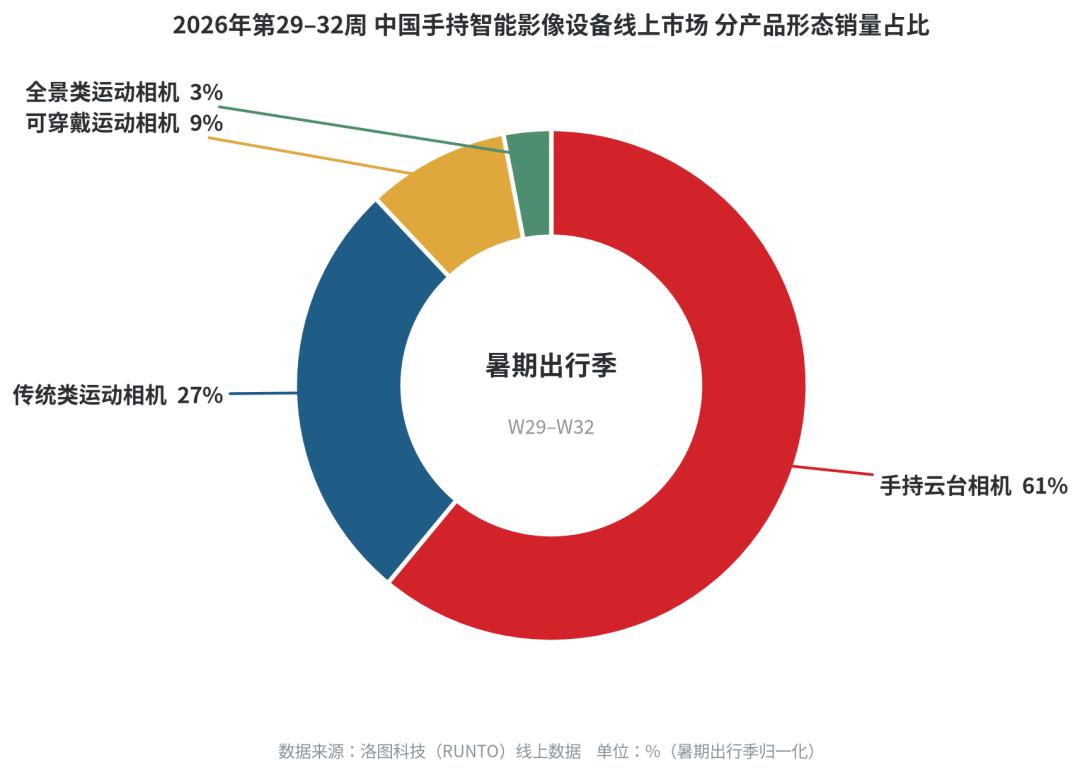
In other words, handheld gimbal cameras and action cameras are still the main driving force of the track, and more consumers are choosing to spend real money to support these two mainstream products instead of panoramic cameras.
01
88% vs 3%, high growth does not drive low market share
In terms of track popularity, panoramic cameras are not low in attention. Whether leading brands intensively release new products in August, or summer travel drives the boom of imaging consumption, panoramic cameras are in the limelight.

But this does not mean that panoramic cameras have entered the mainstream imaging track. Looking back at the long-term tracking data of Luo Tu Technology, the share of panoramic cameras in the entire handheld imaging track has long been below 5%. Even in the summer peak season with strong demand, its online sales share is still only 3%.
This forms a special phenomenon: high sales growth rate, low market share.
The underlying logic is that when the growth rate of a category continues to be higher than the overall market, but its share hardly rises or even decreases, it indicates that the product performance is recognized by the market, the absolute scale of the category is growing, and the size of the vertical user group is expanding.
But at the same time, its market share has not increased, indicating that the industry's increment is mainly contributed by other products. The growth of action cameras and gimbal cameras acts on a much larger base, contributing a far larger increment.
The conclusion points to a judgment: Panoramic imaging is not penetrating the mainstream market, it is only filling its own vertical niche pool.
In the past few years, panoramic camera manufacturers have competed to the extreme, from high frame rate to anti-shake algorithm, the track has always maintained rapid development with high R&D investment, high marketing exposure and fast iteration speed, but it cannot break through the market share bottleneck in peak seasons.
This has nothing to do with whether the product is optimized to the extreme, but the size of the potential user group limits the expansion of this segmented category. The growth rate can only reflect whether the vertical niche pool has been fully tapped, while the share can reflect how large the pool itself is.
In terms of brand pattern, during this summer window, DJI leads the entire online market with a share of 80.5%. Its main products are also gimbal cameras and action cameras, and brand concentration and category concentration are developing in tandem.
The question is, how are panoramic cameras locked in the vertical niche market?
02
The core base of the handheld imaging sector lies in daily demands
The real ceiling of handheld imaging is not entirely determined by technology, but by the frequency of scenario occurrence. This is why Pocket and Action can become mainstream products.
The features of the Pocket handheld gimbal are that you can take it out of your pocket, turn on the device in one second with the rotatable screen, seamlessly switch between horizontal and vertical shooting, there is no complex operation logic, you don't need to worry about hand shake, it can guarantee the lower limit of image quality, encapsulate professional capabilities in extremely simple operations, and the shooting threshold for users is close to zero.
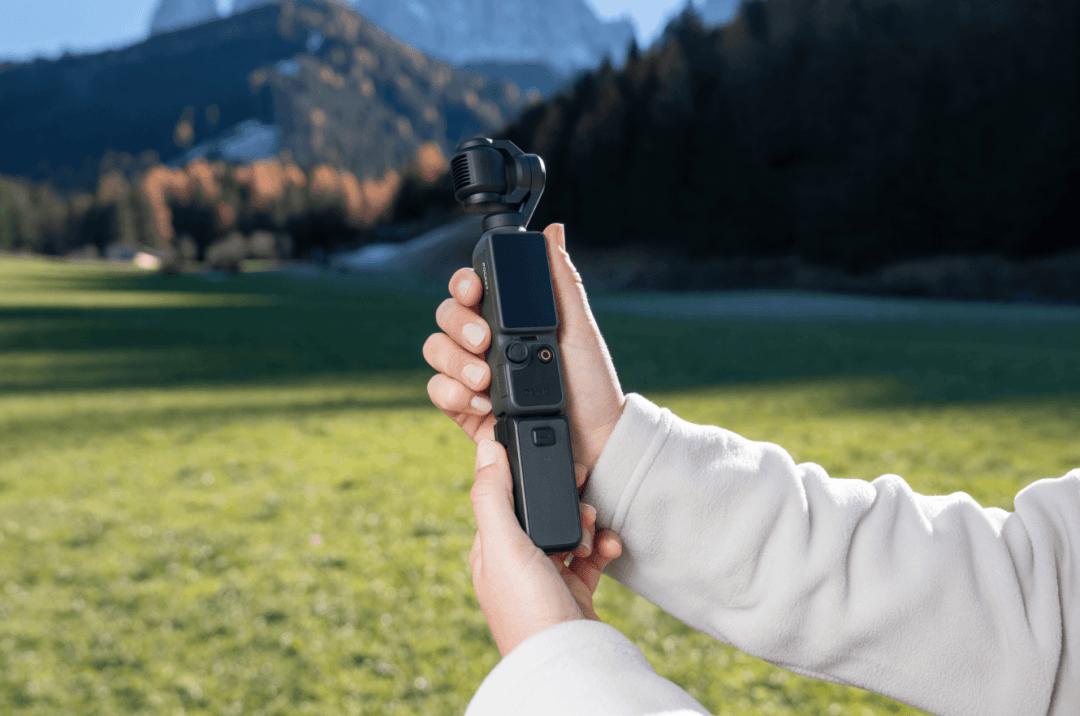
The scenarios it covers share a series of common features: clear shooting subjects, fixed viewing angles, and users pursue stable and good-looking imaging results.
For example, shooting a set of outfits when shopping, recording street views during travel, shooting a stage clip at a concert, taking photos of cats or children at home on weekends. Users don't need to deliberately create a special scenario, they can take it out and shoot immediately.
Action is similar, its core competitiveness is waterproof, drop-proof, dust-proof, low-temperature resistant, it can be fixed in position to shoot first-person perspective without intervention during the whole process, pushing the usage cost in special scenarios to the extreme.
Action solves another high-frequency scenario, that is, stably completing first-person recording in complex sports scenarios.
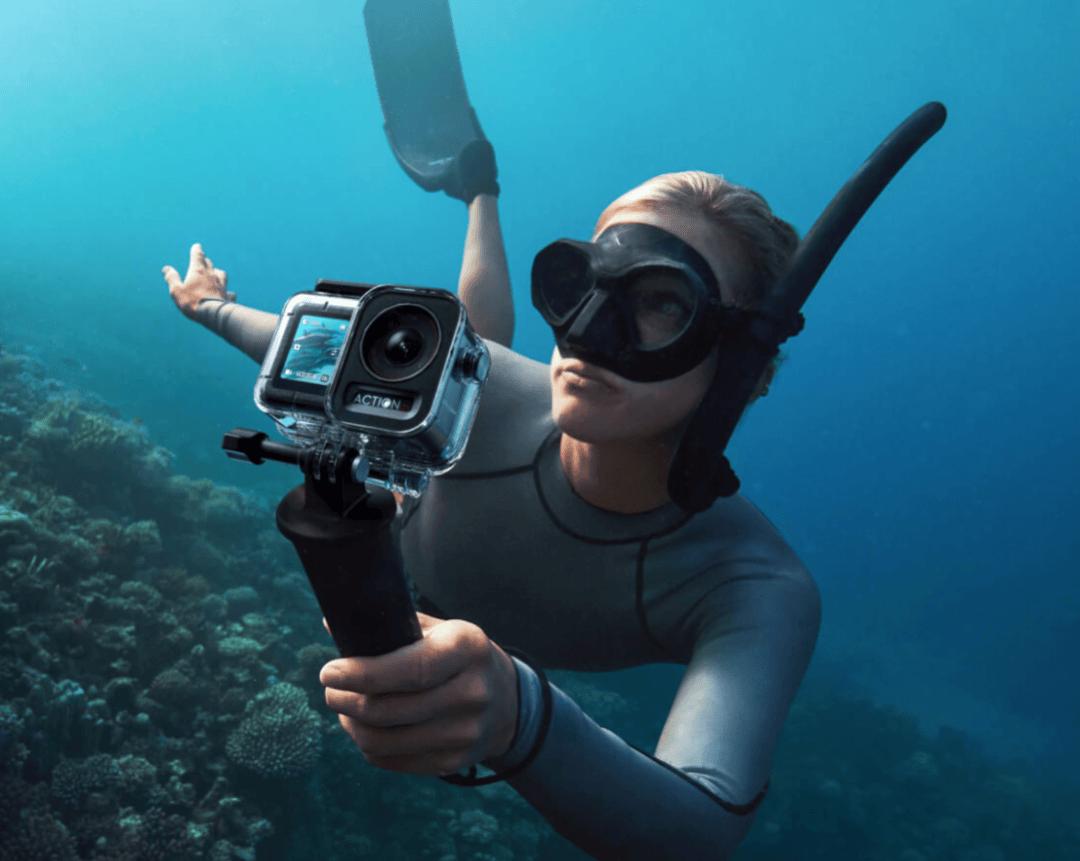
Such as skiing, surfing, skydiving, cycling and other sports. The features of these scenarios are that creative composition is not needed, but the equipment must be simple and durable enough, not only can withstand bumps, waterproof and drop-proof, but also can start recording with one press, and the output footage is usable directly after shooting, and can be stably output when tied to a helmet or handlebar.
Although the two have different usage scenarios, they have one thing in common: users know very well when they need to use them.
This is also the most important difference between mainstream products and vertical niche categories. Mainstream products do not necessarily have the most dazzling functions, but they often have more high-frequency, repeatable, and self-explanatory usage scenarios.
03
The threshold of panoramic cameras appears after pressing the shutter
The core scenarios of panoramic cameras lie in first-person perspective recording of extreme sports and creative special-effect short videos, emphasizing framing after shooting, 360-degree dead-angle-free collection, and invisible selfie stick effect, to achieve immersive perspectives that conventional devices cannot achieve.

But for most consumers, such scenarios are not common in daily life. Extreme sports itself have strict requirements for participants, and creative videos are even less suitable for ordinary users' daily creation.
This limits the improvement of penetration rate of panoramic cameras. Although from the perspective of engineering complexity, panoramic imaging is the highest among the three categories, it does not mean that consumers will pay for it.
Most ordinary users do not need to record a complete spherical picture most of the time, they only need to shoot the scenery in front of them well.
This is why various creative gameplay pictures often arouse heated discussions among users on social media, but cannot convert these people into actual buyers.
The focus of panoramic cameras is to raise the upper limit of inspiration and give works more possibilities. The highest-frequency scenarios of ordinary consumers do not require 360° collection + post-framing, most people only need to take out the device to shoot, get good-looking direct output footage, and share it on Moments.
There is another obstacle preventing consumers from choosing panoramic cameras: the real threshold of panoramic cameras will only appear after the user presses the stop recording button.
The first cost is time.
The product logic of Pocket and Action is shooting for direct final output. The footage obtained by shooting is a finished product that can be shared immediately. Panoramic cameras subvert this logic: shoot everything first, then import the footage, select the angle, select the key frame, adjust the perspective and motion track, and finally export the flat picture and edit it for release.
The advantage of panoramic cameras that no composition is needed during shooting does not mean that users do not need to make decisions, but delays the composition work to the post-production stage.
This means a longer creation path. For professional creators, it represents greater freedom, but for people who want to get the finished product immediately, the delayed output of footage is itself dissolving the impulse to share.
The second cost is storage and computing power.
The standard configuration of dual sensors and the product feature of recording spherical space determine that whether it is the amount of data collected by hardware or the pixel redundancy required to output the finished product, panoramic cameras are much higher than ordinary single-lens cameras.

In order to freely rotate the perspective in post-production and retain clear local pictures, the native shooting resolution of panoramic cameras often reaches 7 or 8K. To export the final small part of flat video, users have to accept video sizes of several Gs.
This not only requires higher-spec memory cards, but also means that the mobile phones and computers responsible for editing must reserve more space for computing.
An ordinary mobile phone can smoothly edit 4K flat video shot by Pocket, but it may obviously lag when facing panoramic footage of the same duration. Users do not get stuck on the panoramic camera, but get stuck in the editing software. This is exactly the last mile that determines whether the footage can become a finished product.
The third cost is the structural trade-off of image quality.
At the same price, same sensor and similar total pixel level, ordinary single-lens cameras concentrate the main pixels on one perspective, while panoramic cameras need to cover the entire sphere with the picture.
When shooting the same single-angle picture, panoramic cameras need to cover a larger collection range, which also means that limited pixels and optical capabilities have to be spread over a larger field of view. When users output the picture, the effective resolution is naturally lower than that of flat devices of the same level.
In this regard, manufacturers can optimize the stitching algorithm and multi-frame synthesis, but the physical upper limit cannot be bypassed. For consumers, what they perceive is that for products at the same price, the image quality of panoramic cameras is inferior to that of single-lens cameras.
The last cost is decision-making cost.
This is the charm and pain point of panoramic cameras: no composition is needed during shooting, 360-degree dead-angle-free collection. But the price is that you have to redo the composition during editing, the total amount of decision-making has not decreased, it is only delayed.
Even the potential workload may be greater.
Faced with a piece of footage that contains infinite editing possibilities, every frame requires user decision-making. For users who are used to shooting and sharing immediately, this is equivalent to forcibly splitting shooting and sharing, with a must-do manual process in between.
The combination of these four costs explains the puzzle of panoramic cameras' high popularity, low repurchase rate, and slow word-of-mouth spread. For most young users, they don't need to shoot more footage, but need to complete shooting more easily.
The most likely destination of panoramic cameras is not to become the next main track of handheld imaging, but to become a capability embedded in mainstream track products.
When technologies such as panoramic stitching algorithm, AI framing, and invisible selfie stick are sufficiently mature, miniaturized and low-cost, panoramic cameras may be integrated into the next generation of mainstream products.
In this industrial evolution, panoramic cameras will play the role of a small vertical niche, not a mass entrance. It has its own exclusive value, such as first-person perspective for extreme sports, creative multi-angle narrative, and virtual reality content collection, but for mass consumption, the role of daily devices has been taken over by Pocket and Action.
This article is from the WeChat official account "Shixiang", author: Jing Xing, editor: Yang Zhou, published with authorization from 36Kr.