Coca-Cola and Asahi Group have both adopted new sugar replacement solutions, achieving explosive sales of 14.4 million bottles in three months. What is the origin of this green cola?
A bottle of sugar-free cola without disruptive new raw materials has become a smash hit in Japan. What's the secret behind its success?
On August 4, Green Cola, a Greek cola brand introduced by Asahi, was officially launched for full nationwide sale in Japan.
Only 3 months after its launch, its total sales have exceeded 14.4 million bottles. The shelf posters are prominently marked with: NO guilt, NO sugar, NO calories.
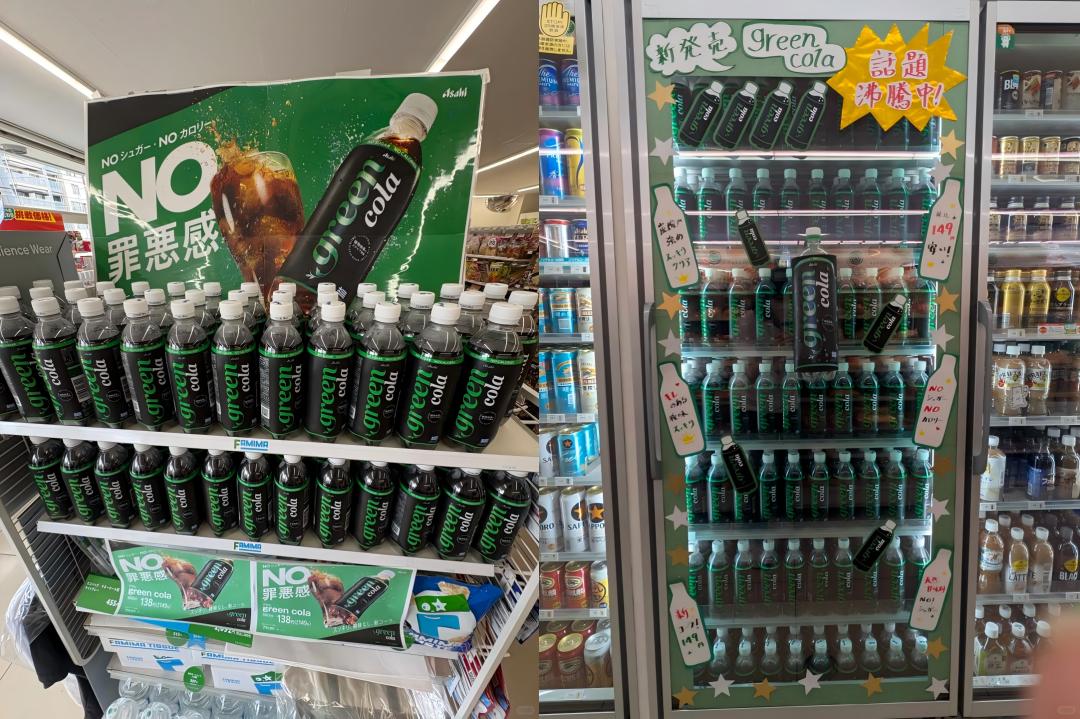
Image source: Xiaohongshu @Yutar, inFamilyMart
While the sugar-free cola market has long been a red ocean, why can a seemingly "repackaged but unchanged" product take Japan by storm so quickly?
Many people assume the secret to its viral success lies in steviol glycosides, but the truth is far from that simple.
1
Sugar-free is no novelty. With a new "sugar substitute", how can Asahi "storm" the cola market?
"Revitalize the cola market." This is the goal stated by the head of Asahi's soft drink marketing team when talking about Green Cola.
It sounds audacious, but this ambition is not unfounded.
In the past few years, driven by rising health awareness, sugary carbonated drinks in Japan have been under sustained pressure, while sugar-free carbonated drinks are growing rapidly. Even so, cola remains the largest carbonated drink category in Japan, accounting for nearly 40% of the market share.
This is exactly why Asahi is unwilling to give up on the cola market.
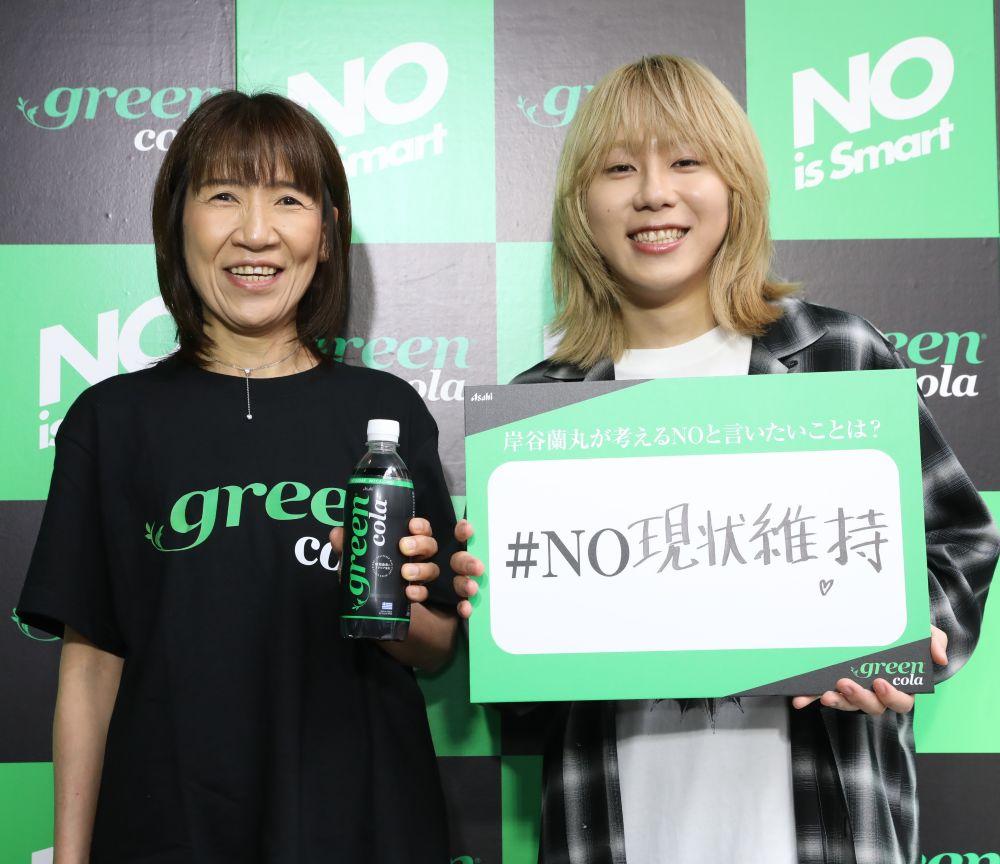
Image source: shokuhin
The problem is that the consumer base of cola keeps shrinking. Although sugar-free cola is still growing, products on the market have long lacked innovation, become highly homogenized, and the market pattern has gradually solidified.
This is exactly the opportunity Asahi spotted.
It did not want to simply launch another ordinary "sugar-free cola", but hoped to bring new value to this category through a new product.
By coincidence, Asahi came across Green Cola at an exhibition two and a half years ago.
Green Cola is a Greek brand launched in 2012, which has now entered more than 50 countries and regions around the world.
In its home market Greece, Green Cola has taken the second spot in the cola category, second only to Coca-Cola; in the United States, it has entered more than 1,300 stores across 17 states by 2022, covering mainstream supermarkets such as Whole Foods and H-E-B, becoming the "third choice" on cola shelves.
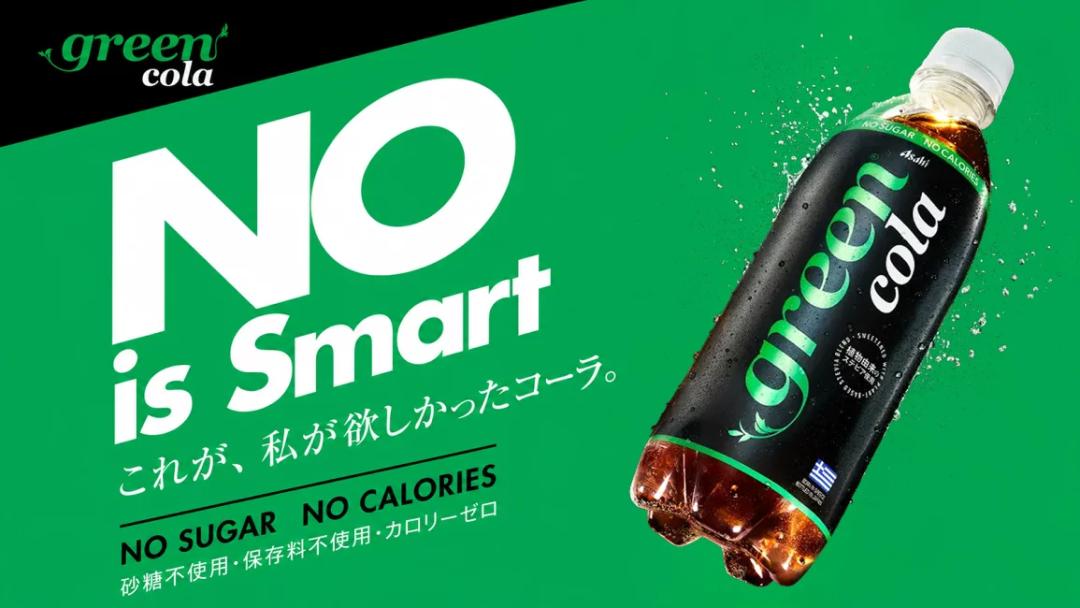
Image source: Rakuten Supermarket
From the perspective of product positioning, Green Cola is no different from traditional zero-sugar colas: they are both carbonated drinks, and both highlight zero sugar and zero calories.
But the essential difference between the two lies in the source of sweeteners.
The sweetness of common sugar-free colas on the market mainly comes from artificially synthesized sweeteners such as aspartame and acesulfame potassium; the sweetness of Green Cola comes from two ingredients: sucralose and steviol glycosides.
Sucralose is a common artificial sweetener, and although steviol glycosides are plant-derived, they have been widely used for a long time and are nothing new.
Yet it is exactly the addition of steviol glycosides that gives Green Cola an extra layer of value beyond "sugar-free": its formula has a more natural source.
This is exactly the opportunity Asahi saw in Green Cola. Before that, no brand in Japan's sugar-free cola market had ever used the selling point of "plant-derived sweeteners".
This value anchor completely different from existing products led Asahi to judge that it might become a trump card to revitalize Japan's cola market.
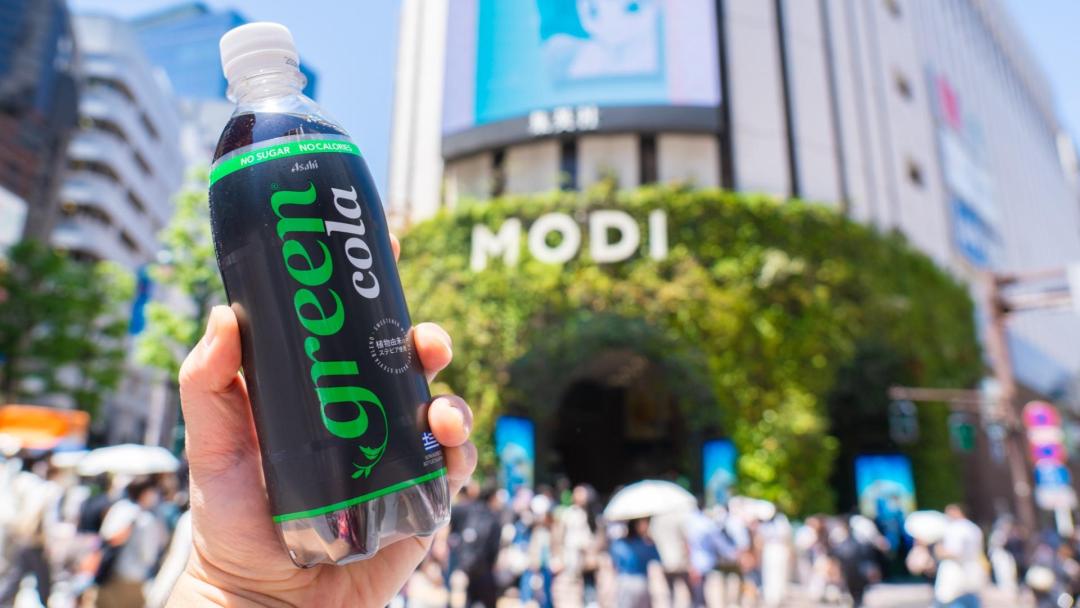
Image source: Yahoo
But after the product was introduced, new problems emerged: Why would Japanese consumers choose it?
If Asahi only told consumers "this is a zero-sugar, zero-calorie, no-burden cola", it would hardly be a sufficient reason for consumers to pick it.
So Asahi started to rethink: What value can Green Cola actually deliver?
According to Asahi's observation, young Japanese consumers show a preference swinging between two extremes of "guilt" in food and beverage consumption:
On one side is the "immoral consumption" that pursues extreme indulgence and guilt, on the other side is the "smart consumption" that hopes to minimize the daily "health debt".
The high-sugar heavy carbonated drink "Guilty Carbonated NOPE" launched by Suntory this year is a representative of the former, which shipped 20 million bottles just 7 days after launch and quickly became a phenomenal hit product.
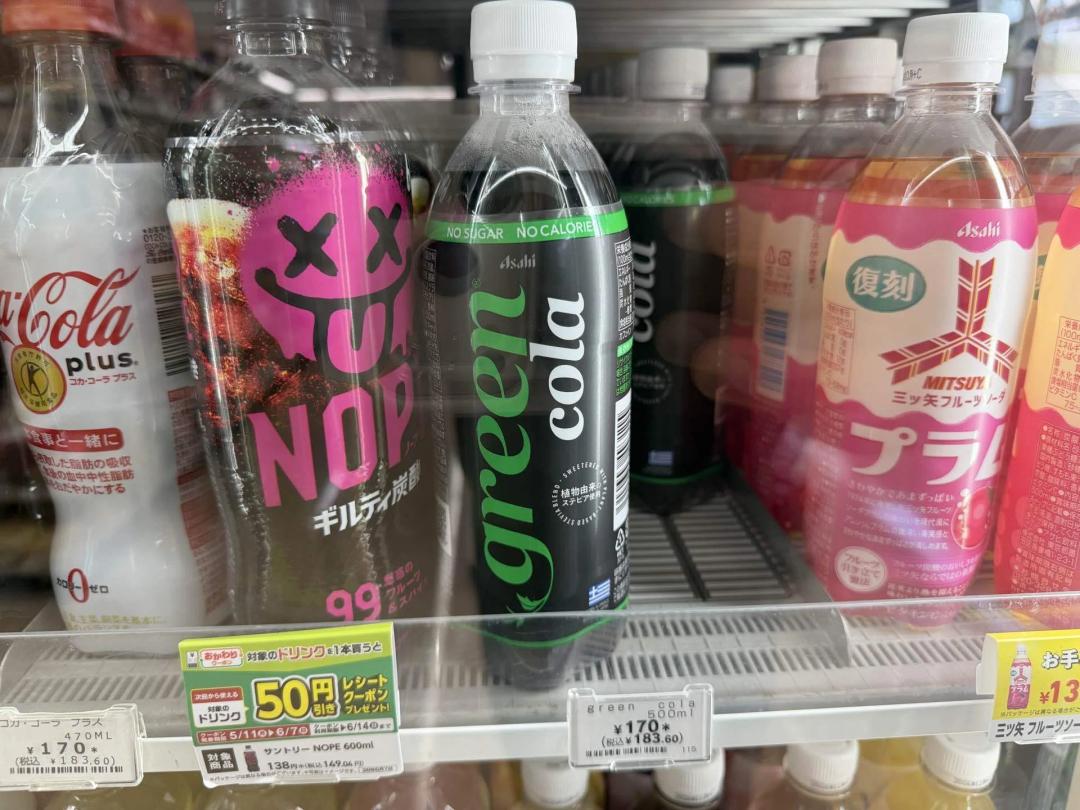
Image source: note
Asahi turned its attention to the latter — "smart consumption".
In many global markets, Green Cola emphasizes functional values — "NO sugar", "NO calories", "NO preservatives". But after market research in Japan, Asahi found that Japanese consumers have a different understanding of the word "NO".
While these expressions are meant to tell consumers "less burden", they easily give people the feeling that "you are asking me to restrain myself again", which instead creates psychological burden.
So Asahi adjusted its strategy, changing the slogan to "NO is Smart" — it no longer interprets "NO" as "rejection", but redefines it as an active choice: It's not that I can't have it, but that I actively discard what I don't need.
This transforms the logic from "health restraint" to "smart choice".
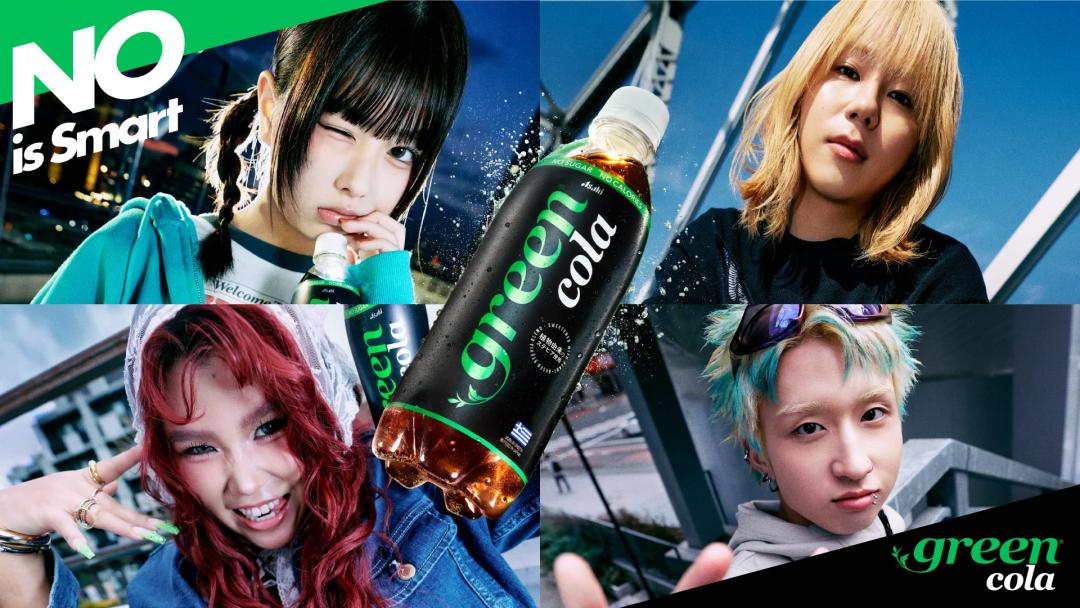
Image source: prtimes
The story of Green Cola seems to start from an inconspicuous "sugar substitute", but what really allowed Asahi to break into the mature cola market is that it caught the structural opportunity of sweetener upgrading for sugar-free cola.
This is exactly the confidence for Asahi to keep talking about "revitalizing the cola market".
2
Giants are collectively shifting to "plant-derived sweetness". What will the next round of competition for sugar-free cola focus on?
Green Cola has become a huge hit in Japan. But will this kind of "plant-sweet" sugar-free cola have a market in China?
In the past two years, Chinese consumers have kept paying attention to the "sweeteners" in cola, with controversies mainly concentrated on two levels:
The first is health concerns. After aspartame was classified as a "possible carcinogen" in Group 2B by WHO, although subsequent studies confirmed it is safe within the specified range, consumers' "vigilance" against artificial sweeteners has already formed.
The second is complaints about taste. Many consumers report that sugar-free cola has a "fake sweet" feeling, and even has an odd taste that is hard to swallow.
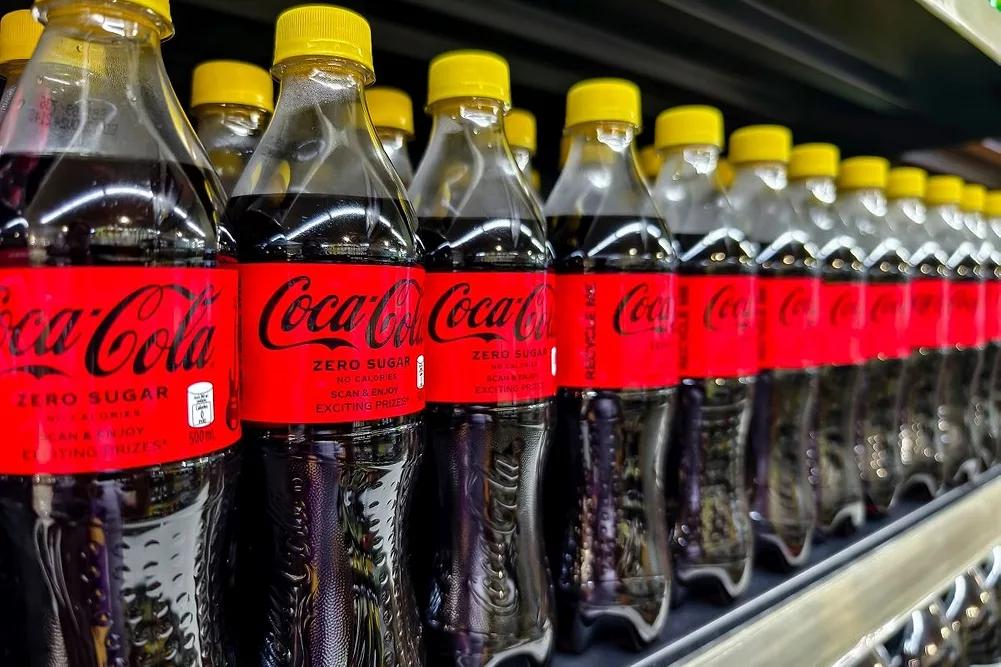
Image source: foodbusinessnews
However, despite all the complaints, the sugar-free cola market is still growing.
The situation of China's cola market is similar to that of Japan. In the first half of 2026, the growth of carbonated drinks almost all came from the sugar-free category, while the offline sales of classic sugary colas, Sprite and other products decreased by more than 12% year-on-year in the second quarter[2].
Take Coca-Cola as an example, in 2026, its sugar-free series has accounted for 58.7% of its carbonated beverage revenue, and the Zero series has become the top revenue pillar of the brand[3].
This shows that consumers' demand for sugar-free cola is real, but existing products have not yet provided a satisfactory solution in terms of taste and health.
This is exactly where the opportunity for "plant-sweet" sugar-free cola lies.
This year, Sam's Club launched a custom Coca-Cola product called "Sugar-Free Plant-Sweet Cola", which no longer uses traditional artificial sweeteners, but adopts a plant compound formula of "steviol glycosides + mogrosides".
Compared with the past practice of simply emphasizing "zero sugar and zero calories", this product adds a new core selling point — plant-derived, and Coca-Cola has directly put this selling point in the product name.
Although netizens have mixed opinions on its taste, most people recognize its positioning of "relatively healthier".
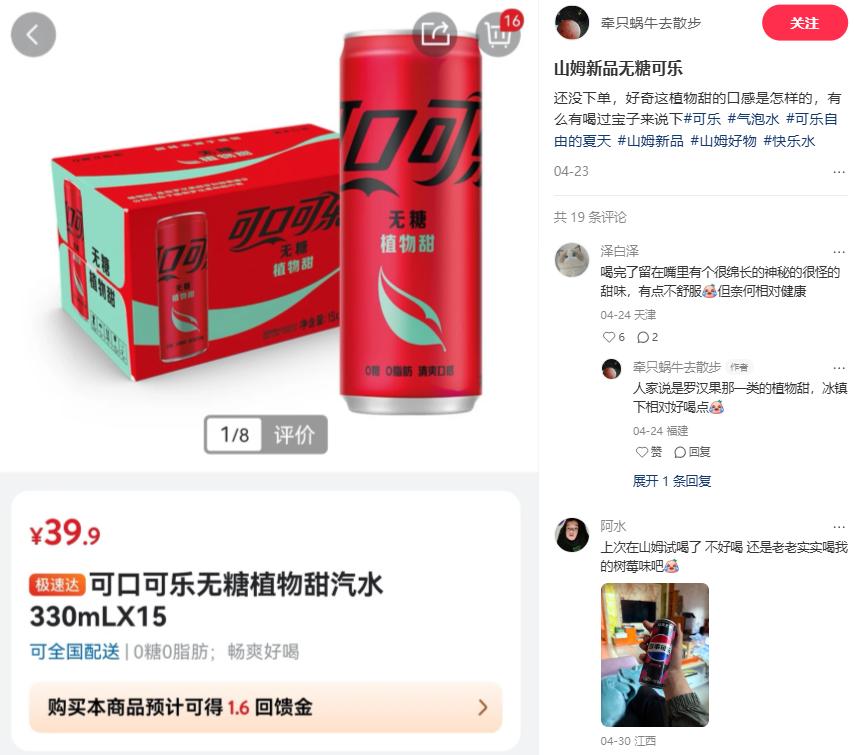
Image source: Xiaohongshu @Walking with a Snail
Whether it is Asahi's Green Cola or Coca-Cola's sugar-free plant-sweet soda, the two are moving in the same direction: emphasizing "plant-derived natural sweeteners".
This means that a new competitive variable is emerging in the sugar-free cola market — sweetener upgrading. So how exactly should this upgrading be carried out?
Looking back at the iteration path of sugar-free colas on the market over the past ten years, its evolution has always been accompanied by the progress of steviol glycoside solutions.
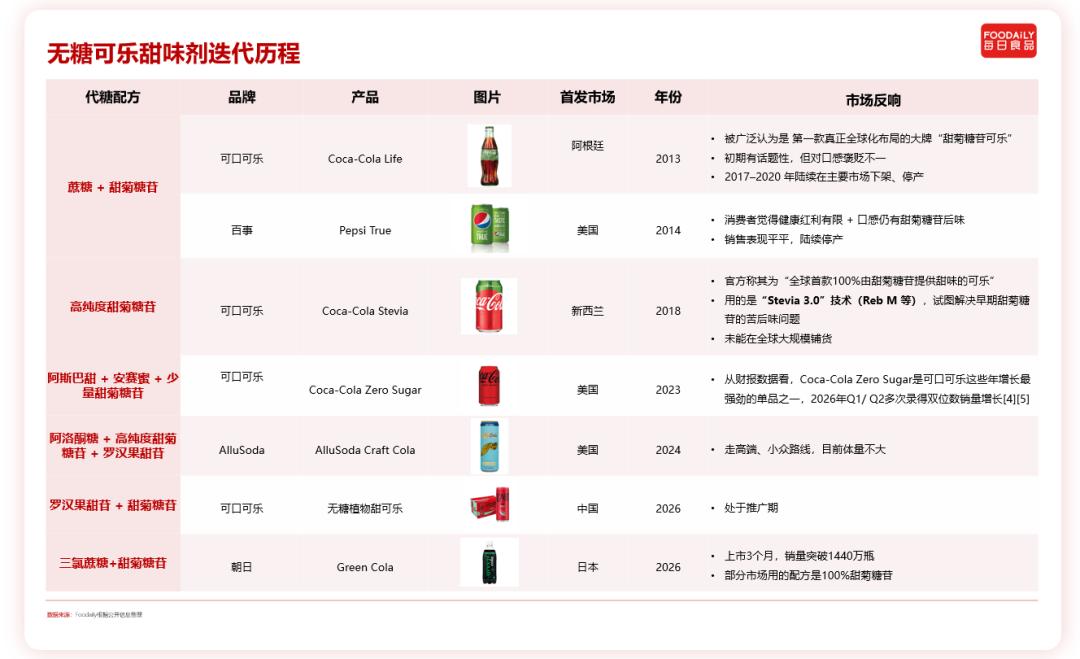
Data source: Foodaily sorted from public information
In the early days, the practice of reducing sugar in cola was to partially replace sucrose with steviol glycosides, represented by products such as Coca-Cola Life and Pepsi True.
At that time, the Reb-A type steviol glycoside with high commercialization level had high purity, but its after-bitterness and metallic aftertaste were still obvious, so it could not completely replace sucrose, and could only make "reduced-sugar cola".
To solve this pain point, Coca-Cola jointly developed the Reb-M type steviol glycoside with PureCircle (now part of Ingredion). Compared with Reb-A, its sweetness curve is closer to sucrose, and the after-bitterness and metallic feeling are significantly reduced.
But for consumers who are used to traditional cola, there are still differences in flavor, and some consumers can still perceive herbal or odd tastes; coupled with cost factors, the full-steviol glycoside formula has not finally become the global main SKU.
This also pushes the industry to further move from "single sweetener substitution" to "multiple sweetener compounding", and two main routes have been formed at present:
One route is to add a small amount of natural sweeteners such as steviol glycosides on the basis of original artificial sugar substitutes. On the one hand, it improves the aftertaste, on the other hand, it can attach the communication label of "plant-derived" to the product;
The other route is to completely abandon artificial sugar substitutes, and adopt the compound of single or multiple natural sweeteners. The goal is to make the taste as close to sucrose as possible, while obtaining the image of "clean label". But this route is still in the stage of trade-off and test in terms of taste acceptance and cost.
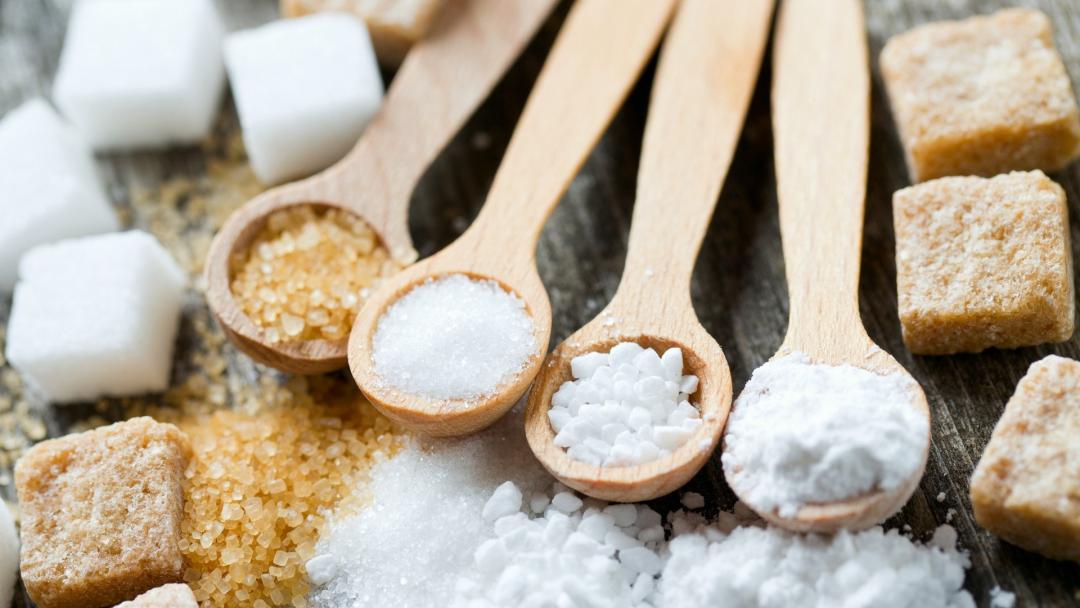
Image source: hk01