As local state-owned enterprises acquire land, massive entrusted construction opportunities are emerging for all major urban agglomerations.
At present, China's real estate agency construction industry is in a critical period of transformation from high-speed growth to high-quality development. Although the growth rate of the industry scale has slowed down, it remains at a high level. The competition pattern is accelerating reshuffling, and the large-scale entry of central SOEs and local SOEs is reshaping the industry ecosystem. These changes at the industry level are profoundly affecting the market pattern and development logic of commercial agency construction.
From the market fundamentals of major urban agglomerations, the leading position of local SOEs in the land market has laid a solid customer foundation for commercial agency construction. The proportion of land acquired by local SOEs in the Yangtze River Delta, Guangdong-Hong Kong-Macao Greater Bay Area, and Chengdu-Chongqing urban agglomerations all exceeds 50%. The contradiction between the high proportion of land acquired by local SOEs, high unstarted rate and insufficient professional development capability constitutes the biggest structural opportunity in the commercial agency construction industry.
Summary of the Current Status of Real Estate Agency Construction
(I) Scale Analysis: The growth rate slows down, but the total scale remains at a high level
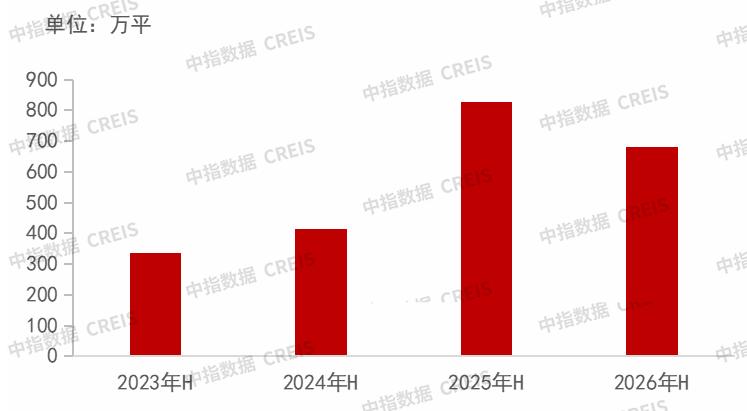
After experiencing rapid growth from 2021 to 2023, China's real estate agency construction industry has entered a "precipitation period" with slowing growth since 2024, but the total scale remains at a high level. According to data from the China Index Academy, the newly signed planned construction area of agency construction enterprises in 2025 was 171.53 million square meters, a year-on-year increase of 4.3% compared with 2024. Since 2023, although the growth rate of the newly signed planned construction area of agency construction enterprises has fluctuated slightly, the scale has always remained stable at a high level. According to the "2026 H1 Ranking of China's Real Estate Agency Construction Enterprises", the threshold for the top 5 in the cumulative scale of real estate agency construction enterprises is 6.8 million square meters, down 17.7% compared with the first half of 2025, but still maintaining a relatively high scale in the past four years.
Figure: Threshold for the top 5 in cumulative scale of agency construction enterprises in H1 2023-2026
(II) Competition Pattern: Stable market share of leading enterprises, intensified reshuffling of enterprises, and the entry of central and local SOEs changes the pattern
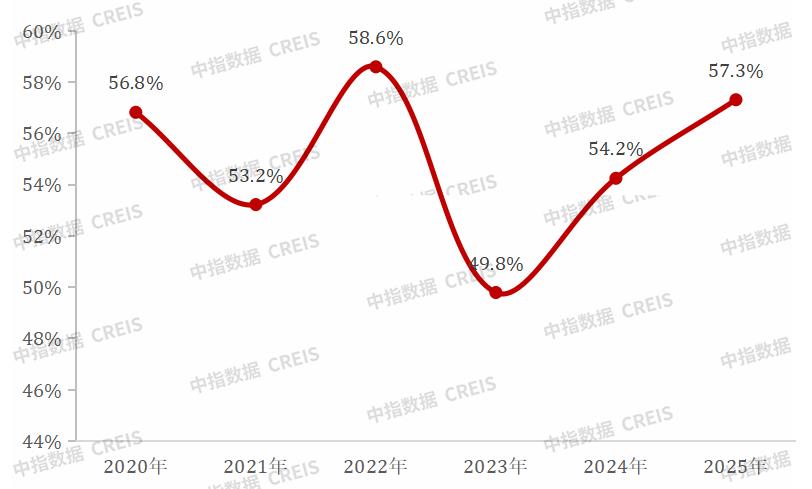
The concentration ratio of agency construction enterprises has always remained at a high level. From the perspective of the construction area of newly signed agency construction projects, in recent years, although the market share of the top 5 enterprises has fluctuated, it is all higher than 50%. The market concentration of leading agency construction enterprises has always remained at a high level, and their project expansion capabilities are still outstanding.
Figure: Proportion of newly signed planned construction area of top 5 enterprises from 2020 to 2025
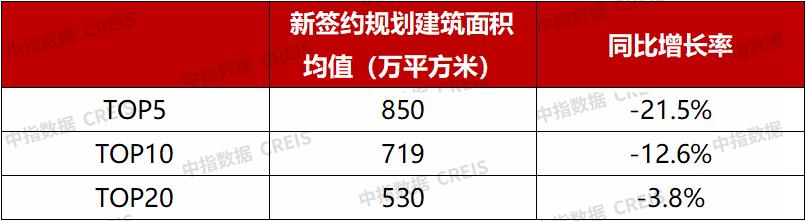
According to the "2026 H1 Ranking of China's Real Estate Agency Construction Enterprises", with the increase of enterprises entering the real estate agency construction sector, the competition is fierce, and the newly signed planned construction area of agency construction of enterprises in all camps has decreased. Among them, the newly signed planned construction area of the top 5 enterprises decreased by 21.5% year-on-year, with the largest decline. The newly signed planned construction area of the top 10 enterprises decreased by 12.6% year-on-year, and that of the top 20 enterprises decreased by 3.8% year-on-year. In recent years, real estate agency construction has gradually shifted from scale competition to value enhancement that "emphasizes service and delivery". Some enterprises have voluntarily given up scale expansion, and focused more on improving the quality of products and services, improving management efficiency, and ensuring the successful delivery of each project. These changes also help promote the industry to develop in the direction of high quality.
Table: Average value and growth rate of newly signed planned construction area of enterprises in all camps
It is worth noting that central and local SOEs are accelerating their entry into the agency construction track, which is expected to change the industry competition pattern. According to statistics, 12 of the 16 central real estate SOEs have carried out agency construction business, and 4 of them have established independent agency construction companies. Among the top 50 enterprises by sales volume, more than 90% have carried out agency construction business. With strong capital strength, resource integration capability and credit endorsement, central and local SOEs have obvious advantages in government agency construction, indemnificatory housing, urban renewal and other fields. Their large-scale entry will reshape the industry competition pattern, and promote the agency construction industry to evolve from being dominated by private enterprises to diversified competition.
Analysis of Land Acquisition Situation of Enterprises in Each Urban Agglomeration
(I) Analysis on the Proportion of Land Acquisition by Enterprise Nature in Each Urban Agglomeration
The clients of commercial agency construction are mainly various land holders, among which local SOEs and small and medium-sized private real estate enterprises are important sources of demand for commercial agency construction projects. To gain an in-depth understanding of the market foundation of commercial agency construction in each urban agglomeration, we take the transaction data of residential land, comprehensive land (including residential), commercial and office land from 2023 to 2025 as samples, and calculate and analyze the proportion of land acquisition by enterprise nature in each urban agglomeration.
From the perspective of the proportion of land parcels acquired by enterprises of different natures in each urban agglomeration, there are significant regional differentiation characteristics. The details are shown in the following table:
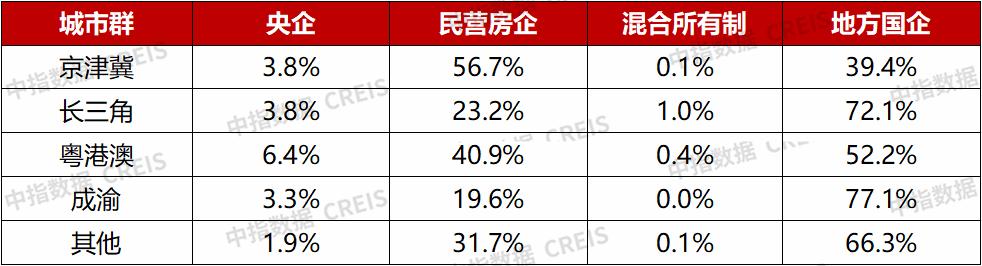
According to the data, except for the Beijing-Tianjin-Hebei region, the proportion of land acquired by local SOEs is at a relatively high level. Specifically, the proportion is 72.1% in the Yangtze River Delta, 52.2% in the Guangdong-Hong Kong-Macao Greater Bay Area, and as high as 77.1% in the Chengdu-Chongqing region. The high proportion of land acquired by local SOEs means that a large number of newly added land will be developed led by state-owned enterprises. However, most local SOEs, especially urban investment platforms, have relatively limited professional capabilities in residential development and commercial operation, which provides a broad market space for professional agency construction enterprises. In particular, in the Yangtze River Delta and Chengdu-Chongqing urban agglomerations, the proportion of land acquired by local SOEs exceeds 70%, and their dilemma of "owning land but lacking professional capabilities" is particularly prominent, with huge potential demand for agency construction.
The Beijing-Tianjin-Hebei urban agglomeration is dominated by private real estate enterprises in land acquisition. At the same time, small and medium-sized private real estate enterprises are also an important force for agency construction demand. According to the data, the Beijing-Tianjin-Hebei region is dominated by private real estate enterprises, accounting for 56.7%; the proportion of land acquired by private real estate enterprises in the Guangdong-Hong Kong-Macao Greater Bay Area also reaches 40.9%. However, compared with local state-owned assets, private real estate enterprises as clients also have certain risks. For example, once the client's capital chain breaks and the project is shut down and left unfinished, the agency construction party's brand will be regarded as the developer by homebuyers and face collective rights protection, resulting in credit damage; some clients over-intervene, only requiring the agency construction party to provide "brand licensing" for the project, or give up management completely, leading to repeated decision-making that makes the agency construction team bear the responsibility for schedule and quality issues.
It should be noted that not all local SOEs and private real estate enterprises with land resources will be converted into effective agency construction demand. Some local state-owned assets and private real estate enterprises have deep roots in the region for a long time, not only have mature development systems and brand accumulation, but their projects even have higher recognition in the local market than external central SOEs, with independent project operation capabilities, so they have no motivation to introduce agency construction; while another type of local state-owned assets acquire land with clear public welfare attributes, whose core demands are to improve infrastructure and ensure people's livelihood supporting facilities, and the projects themselves are not oriented to market-oriented sales or profit returns, so there is no agency construction demand either.
The Guangdong-Hong Kong-Macao Greater Bay Area urban agglomeration has the highest proportion of land acquired by central SOEs. The proportion of land acquired by central SOEs can reflect the activity of the regional real estate market. At present, real estate enterprises, especially central SOEs, generally focus their land acquisition and investment on regions with good economic foundation, net population inflow and strong industrial resource advantages. Therefore, regions with a high proportion of land acquired by central SOEs usually have relatively strong real estate market demand. The core of commercial agency construction still lies in sales and de-stocking, so regions with a better real estate market also have better sales performance. According to the data, the proportion of land acquired by central SOEs in the Guangdong-Hong Kong-Macao Greater Bay Area is 6.4%, significantly higher than other regions. The proportion of land acquired by central SOEs in other regions outside the four major urban agglomerations is only 1.9%, which fully shows that central SOEs' land acquisition is more focused on core urban agglomerations where the economy is more active.
(II) Analysis on the Start Construction Rate of Land Acquired by Local SOEs in Each Urban Agglomeration
Whether local SOEs start construction in time after acquiring land directly affects the supply rhythm and market opportunities of commercial agency construction projects. By analyzing the construction progress data of the land parcels that have been transacted by local SOEs in representative cities of each urban agglomeration from 2023 to 2025, we calculate the unstarted rate of land acquired by local SOEs in each urban agglomeration, and the specific situation is shown in the following table:
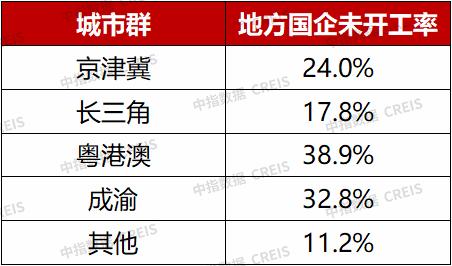
Note: Unstarted rate = Number of unstarted land parcels of local SOEs / Total number of land parcels acquired by local SOEs, calculated based on sampling of representative cities.
The high unstarted rate reflects that there is an obvious rhythm mismatch between local SOEs' land acquisition and project development. On the one hand, local SOEs acquire a large amount of land based on land reserve and strategic layout, but restricted by factors such as weak market demand, capital pressure and project decision-making process, the actual construction progress of projects lags behind; on the other hand, it also means that a large number of stock land parcels are in urgent need of professional development, providing huge intervention space for commercial agency construction enterprises.
According to the data, the unstarted rate of land acquired by local SOEs in each urban agglomeration shows significant differences. The Guangdong-Hong Kong-Macao Greater Bay Area urban agglomeration has the highest unstarted rate of local SOEs, reaching 38.9%, which means that nearly 40% of the land acquired by local SOEs has not started construction. The Chengdu-Chongqing urban agglomeration ranks second, with an unstarted rate of 32.8%. The Beijing-Tianjin-Hebei region is 24.0%, the Yangtze River Delta is 17.8%, and other regions have the lowest rate of only 11.2%. The highest unstarted rate of local SOEs in the Guangdong-Hong Kong-Macao Greater Bay Area urban agglomeration is closely related to the high proportion of high-priced land parcels and high market adjustment pressure. After acquiring high-priced land parcels, local SOEs are faced with the development dilemma of "high cost and low return", and promote projects more prudently. The second highest unstarted rate in the Chengdu-Chongqing urban agglomeration reflects that the core cities in western China are still in the market adjustment cycle, and local SOEs lack the motivation to start construction of projects. In contrast, the unstarted rate of local SOEs in the Yangtze River Delta urban agglomeration is relatively low, indicating that the Yangtze River Delta market is relatively active, and the project promotion efficiency is high.
(III) Analysis on the Change of the Number of Land Parcels Acquired by Local SOEs in Each Urban Agglomeration
To evaluate the long-term trend of the commercial agency construction market in each urban agglomeration, we compare and analyze the change of the average annual number of land parcels acquired by local SOEs in the two periods of 2021-2022 and 2023-2025. The growth rate reflects the dynamic change of the scale of land acquisition by local SOEs, which is directly related to the supply trend of commercial agency construction projects in the future.
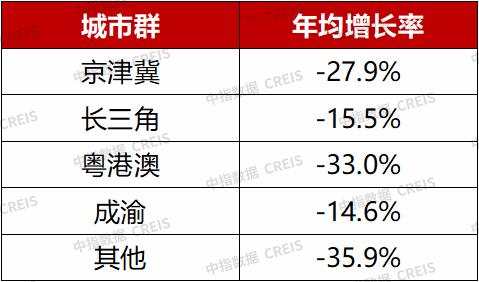
The number of land parcels acquired by local SOEs in all urban agglomerations has generally decreased, reflecting the contraction of local SOEs' investment willingness under the real estate market adjustment period. According to the data, the average annual number of land parcels acquired by local SOEs in all major urban agglomerations has decreased, but the decline varies significantly. The Guangdong-Hong Kong-Macao Greater Bay Area urban agglomeration has the largest decline of 33.0%; Beijing-Tianjin-Hebei decreased by 27.9%; the Yangtze River Delta and Chengdu-Chongqing have relatively moderate declines of 15.5% and 14.6% respectively. Although local SOEs' investment willingness has contracted under the real estate market adjustment period, the development demand for stock projects is still huge. Combined with the unstarted rate data, the Guangdong-Hong Kong-Macao Greater Bay Area and Chengdu-Chongqing have high unstarted rates, and the stock land development space is more abundant. Agency construction enterprises need to find a strategic balance between the reduction of incremental resources and the revitalization of stock resources.
Analysis on Commercial Agency Construction Opportunities in Each Urban Agglomeration
The Beijing-Tianjin-Hebei urban agglomeration has obvious urban differentiation, and different cities have different opportunities. The Beijing market is dominated by central and local SOEs in land acquisition, with scarce land parcels in core areas. They usually develop independently after acquiring land, and the demand for commercial agency construction is weak; but government public construction, relocation of universities, non-real estate enterprises' land acquisition such as science and technology parks, and Zhongguancun-style stock building renewal have become the main battlefield. The agency construction direction should focus on public construction, science and innovation parks, pre-operation renewal of old buildings, etc. Most of the land acquired by central and local SOEs in Tianjin is developed independently, and private enterprises are mostly