Is it credible that Agibot has overtaken Unitree?
With shipments of 19,100 units, a 272% year-on-year growth rate, and a 70% share in industrial and commercial scenarios, Chinese manufacturers account for over 97% of the global total. Recently, the first-half 2026 report released by US market research institution SAG shows that humanoid robots are accelerating their transition from "PPT concepts" to real-world applications. The report forecasts that global shipments will approach 60,000 units in 2026, and are expected to exceed the 500,000-unit mark by 2030.
But what deserves more attention than the figures is the ranking: with its shipments surging 562% year-on-year to 8,400 units, Agibot ranks first in the world, pushing Unitree to second place, with a gap of 2,500 units between the two. In the same period last year, Unitree was still sitting in the top spot.
As soon as this overtaking came out, the public immediately split into two camps. One side argues that the overtaking is well-deserved: the share of shipments in overall industrial and commercial scenarios has risen from 50% to 70%, which means the industry inflection point has arrived. Agibot's products cover factories, supermarkets, and logistics, and it is exactly reaping the dividends of this trend. The other side questions SAG's statistical caliber, saying that it counts wheeled, half-size and full-size products together, which amplifies Agibot's advantage of a complete product line, and a good ranking does not necessarily mean leading technology.
Both arguments hold water, but to truly see the value of this "first place", it is not enough to only look at the numbers on the ranking list. We break it down from three dimensions: Is the statistical caliber of this list fair? How did the overtaking happen? And how long can Agibot hold onto this first place position?
01. Agibot overtook Unitree, the result is credible
When seeing "Agibot overtook Unitree", many people's first reaction is: Does this contradict the "Unitree ranks first" statistics from CCID before?
In fact, there is no contradiction. This is exactly the current state of the humanoid robot industry: due to inconsistent statistical calibers, the "first place" in rankings from different institutions is often different. So to judge whether SAG's overtaking this time is valid, we must first clarify the differences between these rankings.
According to industry practitioners, the four most reference-worthy rankings in the world currently are IDC, SAG, CCID and Omdia. Their common point is that they do not evaluate technical pros and cons, only count shipment volumes, and the difference lies in their statistical calibers.
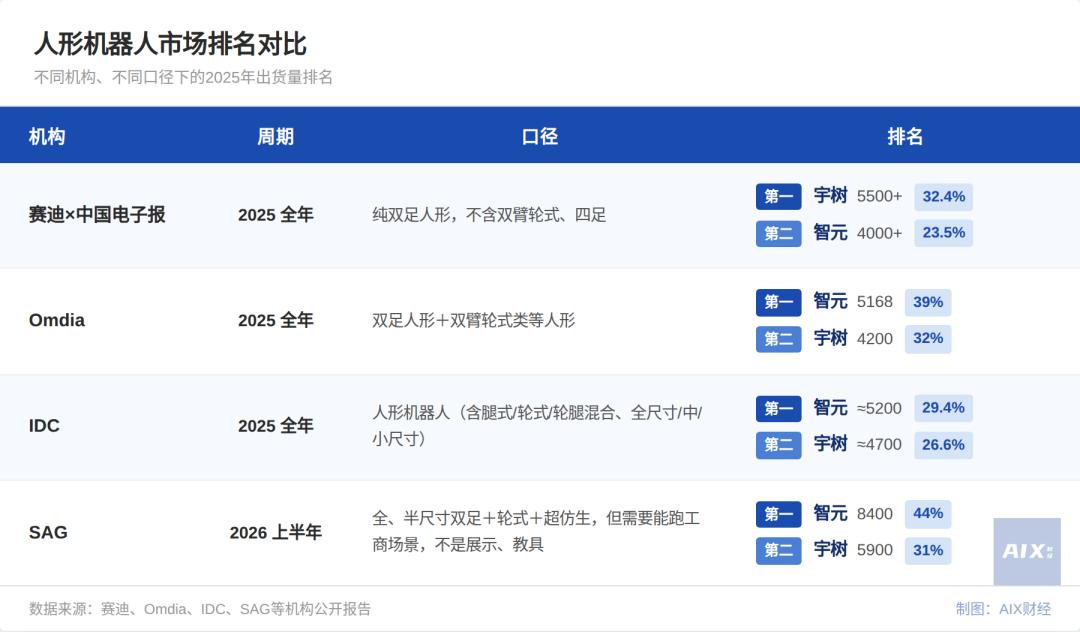
CCID's statistics use a narrow caliber of "pure bipedal humanoid robots", Omdia includes "dual-arm wheeled humanoid-like robots", IDC is also relatively broad, covering all kinds of humanoid-like robots of different sizes. SAG is characterized by covering four categories: full-size bipedal, half-size bipedal, wheeled, and super bionic, but excluding "non-functional embodied humanoid robots" (robots that do not perform clear tasks and have no ability to work in structured scenarios such as industrial and commercial environments), which directly leads to different conclusions of "annual first place".
Taking the full-year data of 2025 as an example, CCID's *2025 Humanoid Robot Market Research Report* shows that Unitree ranks first with more than 5,500 units, and Agibot ranks second with more than 4,000 units; Omdia's *General Embodied Robot Market Radar* shows the opposite result, with Agibot taking the first place with 5,168 units, followed by Unitree with about 4,200 units.
Due to inconsistent calibers, the four rankings cannot be directly compared horizontally, but the industry consensus is that Unitree and Agibot are firmly in the top two, the two have a very close share, and "who ranks first in shipments" has always been the focus of the market.
Back to SAG's latest half-year ranking, its special value lies in "timeliness" and "trend orientation", which can reflect the latest developments in the first half of 2026.
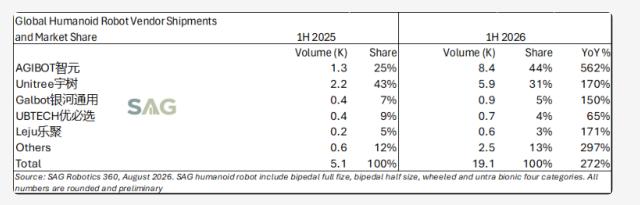
The report shows that in the first half of 2026, Agibot's shipments reached 8,400 units, a year-on-year increase of 562%, topping the list with a 44% share, while Unitree shipped 5,900 units, a 170% year-on-year increase, ranking second with a 31% share. In the same period last year, Unitree topped the list with 2,200 units, while Agibot shipped 1,300 units. In just one year, the "first place" has changed hands.
Source / SAG official website
In the following mid-tier camp, Galaxy Universal surpassed Ubtech with 900 units to 700 units; Leju Robotics only counted the KUAVO Kuafu operation series, excluding Aelos and Roban educational models, ranking fifth with 600 units.
The gap between mid-tier manufacturers is only at the level of hundreds of units. Agibot and Unitree, the two leading players, have obvious advantages, and the industry pattern has not yet been solidified.
Back to SAG's own accounting rules, does this wide-caliber standard itself favor Agibot?
In fact, the two are on the same starting line: Agibot's three product lines, Yuanzheng, Lingxi and Jingling, all meet the access standards, and Unitree's H1, H2, G1 and R1 are all included in the statistics. The rules do not miss the humanoid robot shipments of either side. Of course, the wide caliber is naturally more friendly to the party with a more complete product line: Agibot's wheeled Jingling series cannot enter the list under CCID's narrow caliber. Under SAG's standard, this ranking still reflects the real difference in the current shipment volume between the two companies.
02. How did the reversal happen?
The answer to the overtaking lies in the product structure and application scenarios of the two companies.
First look at Unitree. Its product line is roughly divided into two parts: the first is the humanoid line, which mainly includes full-size H1 and H2, medium and small size bipedal G1 and R1; the second is the quadruped line, which mainly includes consumer-level Go1 and Go2, and industry-level B1, B2 and A2. Its prospectus shows that although humanoid business revenue has accounted for more than half of Unitree's total revenue in the first three quarters of 2025, quadruped robots are still an important pillar of its revenue, and this part of the data is not included in SAG's humanoid shipment statistics.
Agibot is the opposite. Its humanoid business accounts for a very high proportion, which is its absolute core business, and its humanoid shipments within the statistical caliber are more concentrated. In April this year, Agibot has spun off its quadruped robot business into a wholly-owned subsidiary, Agibot Kuto.
What widens the gap is also the scenario layout.
Source / Agibot official website
The reply to the inquiry submitted by Unitree to the Shanghai Stock Exchange shows that of the 595 million yuan humanoid revenue in the first three quarters of 2025, scientific research and education accounted for as high as 73.6%, commercial consumption accounted for 17.4%, and applications for real industries such as industry only accounted for 9.01%.
This base did not form by accident. The low price of G1 at 99,000 yuan is essentially an "entry ticket" for the scientific research market. University laboratories and developer teams can afford it and modify it, and Unitree has accordingly built a channel network centered on universities and secondary developers. Product definition determines the shipment structure, and a product designed for scientific research is naturally adapted to scientific research scenarios.
Agibot is different. Its Yuanzheng, Lingxi and Jingling series target industrial manufacturing, commercial service guidance, and warehousing logistics respectively, and the scenario definition of the three lines is written into the product genes.
Putting the choices of the two companies into SAG's industry data, the overtaking is almost inevitable. SAG shows that global shipments in the first half of 2026 increased from about 5,100 units in the same period last year to 19,100 units. Of the 14,000 units of new increment, industrial and commercial scenarios contributed about 10,800 units. The direction where the industry's capital flows is exactly the layout direction of Agibot's products. While Unitree's humanoid products are still selling in large quantities in scientific research and commercial performance tracks, Agibot has taken most of the increment with its full matrix of industrial and commercial products, and finally achieved overtaking.
Then, Unitree's quadruped shipment volume is not small, but it is not included in SAG's humanoid caliber, does this mean that Unitree is at a disadvantage? It can only be said that the two companies have placed their bets on different tracks, and the trend in the past six months has just blown in Agibot's favor. Unitree falling behind in the humanoid caliber does not mean its business base is unstable.
03. How long can Agibot keep its first place?
Next, whether Agibot can stay ahead all the time depends on three key indicators: the ability of mass delivery, the penetration of industrial and commercial scenarios, and the iteration of data closed loop, which are also the main battlefield of current humanoid robot competition.
The first is to compete for faster production and sufficient supply.
SAG's semi-annual report shows that the core of the current humanoid robot industry competition, compared with technical parameters such as "how fast it can run" and "how high it can jump", pays more attention to the ability to achieve stable mass supply. Enterprises buy robots to work, not to display, and the first requirement is "being able to get the goods in batches on time".
This is Agibot's current advantage. It relies on the simultaneous production of three product lines, with a high localization rate of core components, and has cumulatively produced 15,000 units since mass production up to June 2026. This production scheduling rhythm can just meet the demand for large-scale deployment in factories and supermarkets. In contrast, Unitree's H series has a relatively slow industrial mass production speed and few layouts of wheeled humanoid robots, so its delivery capacity is relatively weak when facing orders that require large batches of goods.
But this gap is the easiest to catch up with among the three indicators. What Unitree lacks is not the ability to make robots, but the determination to shift its production capacity from the scientific research line to the industrial and commercial line. It has already formed a mature supply chain and mass production experience in quadruped robots. Once it changes its direction and accelerates the mass production speed of H series and wheeled products, the delivery gap between the two may narrow quickly.
Going deeper, the second indicator is scenario layout.
SAG's data shows that in the first half of 2026, more than 70% of humanoid robots were sold to working scenarios with fixed processes such as factories, warehouses and supermarkets, which are exactly Agibot's advantageous scenarios.
Unitree is not completely absent from industrial scenarios. Its H1-2 bipedal robot can carry 21kg of heavy objects, and with dexterous hands, it can already meet the requirements of factory operations; the B2 and H2 series have also achieved good efficiency data in power inspection and warehouse sorting tests. It has a solid technical foundation. If it launches modified models adapted to industrial scenarios later and opens up customer channels in factories and warehouses, it will be fully capable of seizing the incremental market share.
However, scenario gap is harder to catch up with than delivery gap, because it is not just a matter of a production line. What Agibot has accumulated in factories and supermarkets, in addition to orders, also includes customer relationships, on-site debugging experience and so on. Even if Unitree switches its production lines, it cannot replicate all these in a short period of time. Therefore, Agibot's scenario advantage will eventually be diluted, but the dilution speed will be slower than that of the delivery advantage.
The last indicator is to compete for a smarter "brain".

Source / Agibot official website
SAG pointed out in the report the key bottleneck of the humanoid robot industry: hardware production capacity is expanding rapidly, but the maturity speed of underlying technologies such as AI models and data closed loops is significantly lagging behind, leading to a technical gap between "demonstration-level products" and "operation-level products". At present, most industrial applications are limited to fixed routes and simple repetitive tasks. Once encountering complex scenarios that have never been seen before, the robots will be at a loss. This is the variable that determines long-term competitiveness.
At present, Agibot has achieved phased leadership in this link.
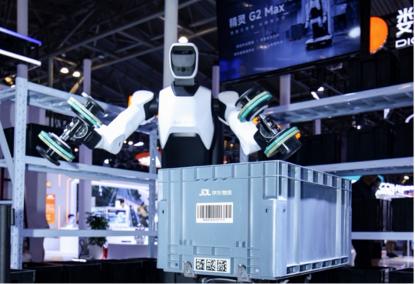
In April 2026, its Jingling G2 completed an 8-hour continuous operation live broadcast at the Longcheer Technology Nanchang Factory, with a success rate of 99.5%. These high-quality data from real scenarios in turn train Agibot's embodied large model, forming an initial data closed loop. As for Unitree, although the cumulative production volume of G1 has reached about 11,000 units as of June 2026, the real machine data obtained is more biased towards motion control display and secondary development operations, which is further away from a complete data closed loop. This is also the hardest part for Unitree to catch up.
However, there are variables for both sides in this link, because the technical route has not yet been determined. If VLA and world models make breakthroughs in the generalization path in the future, the entire rule of the data competition game will be rewritten. At that time, the competition will be about who can embrace the new technical route first, rather than who has more stock data.
Finally, back to the ranking list, Agibot's first place has real value, but its moat is not deep.
Its current lead is a phased achievement of mass delivery, industrial and commercial scenario positioning, and the initial operation of data closed loop. The core is not a technical gap. Unitree still has deep accumulation in profitability, quadruped supply chain and scientific research channels. If the statistical caliber is changed, the ranking may change drastically. So this overtaking proves that "whoever can get robots into factories first can get orders first". But orders are not a moat. The end point of humanoid robot development is not to compete who can sell 10,000 units first, but to compete who can make robots work smartly in the real world first.
This article is from WeChat official account "AIX Finance"