Earning 100 million U.S. dollars this year, it is better to be a top influencer than a "big short".
Heavily losing money on shorting AI stocks but likely raking in huge profits from selling subscriptions — Michael Burry’s most profitable business this year may not be stock trading, but running a blog.
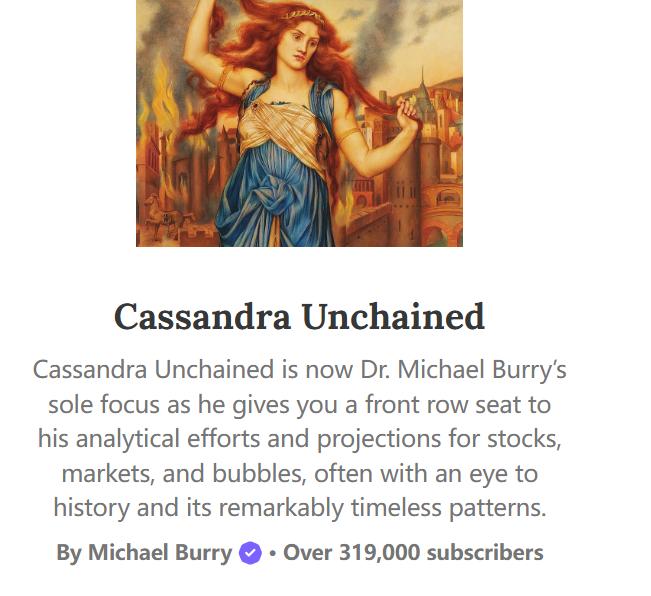
The "Big Short" Michael Burry's Substack investment newsletter "Cassandra Unchained" surpassed 300,000 subscribers only 231 days after its launch. Calculated at an annual fee of $379, the theoretical annual revenue is approximately $113.7 million.
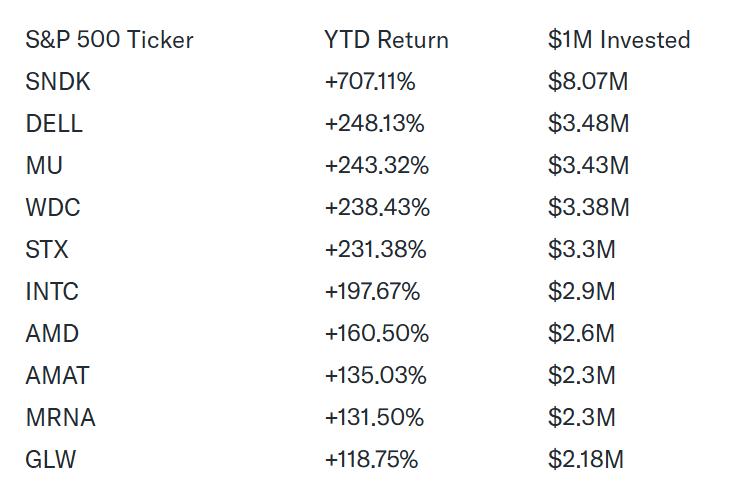
How intuitive is this number? According to Stocktwits, if you invest $1 million in each of the 10 best-performing stocks in the S&P 500 this year, the total return is about $34 million — less than a third of Burry's newsletter's theoretical revenue.
01
231 Days, 300,000 Subscribers
Burry revealed in a post titled "Short & Thankful: 300" that "Cassandra Unchained" has reached 300,044 subscribers and 346,680 followers, with subscribers coming from all 50 U.S. states and 212 countries, 52% of whom are outside the United States.
According to the data, the "Cassandra Unchained" newsletter had about 218,000 followers in January this year, and it has approached 347,000 by July, with a continuously upward growth curve.
The newsletter is priced at $39 per month or $379 per year, with an additional free tier. Burry has not disclosed the specific proportion of paid subscribers, and Substack's subscriber statistics include both free and paid readers, and the above calculation does not deduct the Substack platform's commission. Therefore, $113.7 million is the theoretical upper limit, not the actual income received.
Burry founded the newsletter in November 2025, shortly after he deregistered his hedge fund with the SEC, returned to social media, and restarted his criticism of the AI boom. The newsletter attracted more than 60,000 subscribers immediately after launch, and has since gradually evolved into his main platform for releasing real-time position updates, valuation analyses and detailed transaction records.
02
Long on Value Stocks: PayPal, Lululemon, Alibaba
In the newsletter, Burry continues to disclose specific transactions.
In April this year, he publicly disclosed his large-scale positions for the first time, building a position in PayPal Holdings (PYPL) at about $49, accounting for 3.5% of his portfolio, and listed it as his preferred target in the software and payment sector, prioritizing it over Fiserv (FI) and Adobe (ADBE). Later, he continued to add positions in PayPal at around $45, and bought Fiserv at the same time. In the same month, he also built positions in Adobe, Autodesk (ADSK) and Veeva Systems (VEEV), on the grounds that "the panic of AI disruption has pushed software valuations below their intrinsic value".
In April, he also reaffirmed his confidence in Molina Healthcare (MOH), saying that market expectations have "hit rock bottom", and that he will continue to add positions, as the investment logic is based on normalized earnings in the coming years.
In June, Burry turned his attention to Lululemon Athletica (LULU) and added positions multiple times. He said bluntly: "Bad management is the best friend of value investors." He believes that Wall Street has overly focused on management missteps, tariffs and slowing growth, while ignoring its long-term value.
Regarding Chinese assets, Burry disclosed in April that he holds more than 6% of the shares of Alibaba, and continues to add positions in JD.com (JD). Last week, he said that JD.com is one of his top three positions, and that "as enthusiasm for AI and memory chips fades, capital will rotate to Hong Kong and Chinese stocks".
03
Shorting AI Stocks: NVIDIA, Micron, Palantir
At the same time, Burry is also continuously expanding his short positions in AI and semiconductor stocks.
In April, he disclosed that he held additional put options on NVIDIA (NVDA), including contracts with a strike price of $115 expiring in January 2027, while retaining the previous $100 put options. On June 30, he upgraded the trade to directly short NVIDIA, with an entry price of $198.09. The same update also disclosed new short positions on Applied Materials (AMAT), iShares Semiconductor ETF (SOXX), Tesla (TSLA) and Caterpillar (CAT), and he compared the current semiconductor boom to the dot-com bubble.
"The immediate trigger for today's rally is the large-scale spending announced by South Korea. I think this is the beginning of the end," Burry said.
Earlier this month, he disclosed that he directly shorted Micron Technology (MU), saying that the memory chip maker's deviation from its 200-day moving average has exceeded any point since 1984.
On Palantir Technologies (PLTR), Burry has maintained one of Wall Street's most closely watched bearish positions since he first disclosed his short position last November. Although he partially closed the position, he still reaffirmed in June that "there are no signs of seller capitulation or exhaustion".
04
The Cost of Being a Bear: Getting "Slapped in the Face" by the Market
However, reality is not on Burry's side.
Since the beginning of this year, many of the stocks he shorted have significantly outperformed the broader market. The S&P 500 ETF (SPY) is up 22% year to date, the Nasdaq 100 ETF (QQQ) is up 31%, while NVIDIA is up 29%, AMAT has skyrocketed 206%, and Micron has even surged 697%.
Shorting these stocks means that Burry has suffered considerable book losses on these positions.
This is precisely why his newsletter income is particularly remarkable — while facing pressure at the trading level, the "Big Short's" another business may quietly become his largest source of income this year.
This article is from the WeChat official account "Wall Street CN Max", author: Long Yue, published with authorization from 36Kr.