Tencent AI no longer remains on the sidelines.
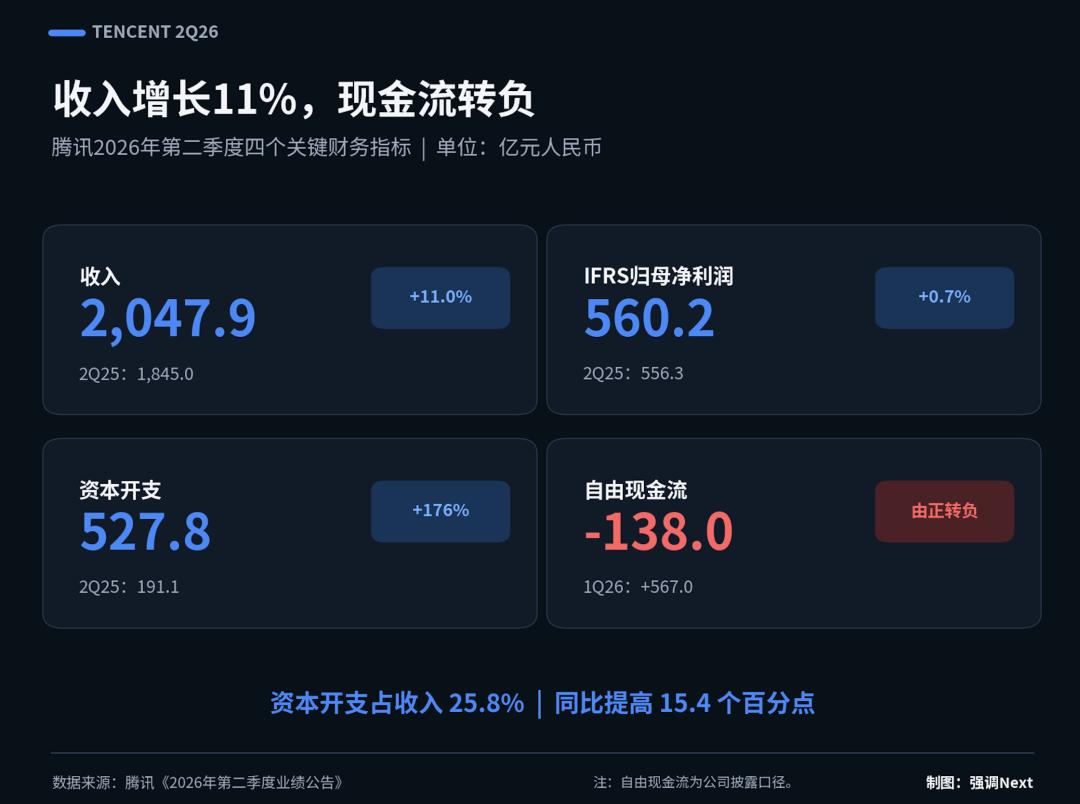
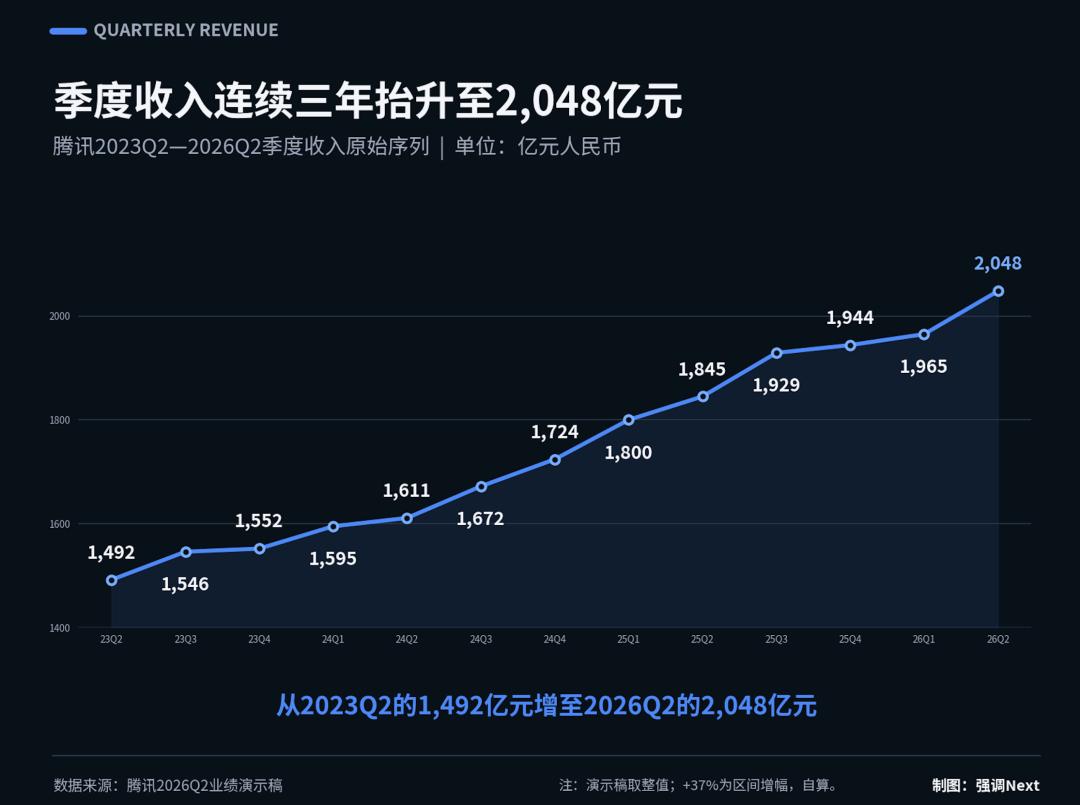
On August 12, Tencent released its Q2 financial report, recording revenue of 2,048 billion yuan, a year-on-year increase of 11%, slightly exceeding market expectations; net profit attributable to shareholders was 560 billion yuan, up 0.7% year-on-year, almost stagnant, lower than the expected 584 billion yuan; capital expenditure reached 528 billion yuan, a year-on-year increase of 176%, 1.6 times the market expectation of 321 billion yuan; free cash flow stood at -138 billion yuan, turning negative for the first time in a single quarter in recent years, compared with +567 billion yuan a quarter ago.
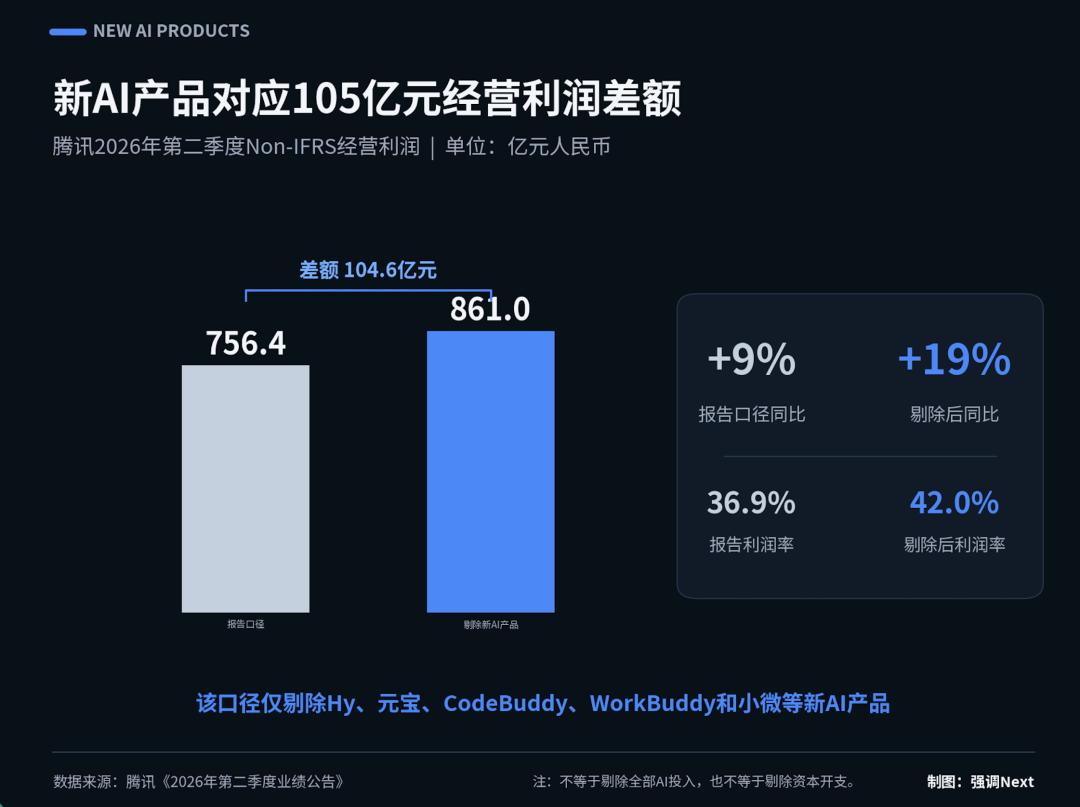
Revenue growth is accelerating, but profits are suppressed by capital expenditure. Tencent itself provided a comparison: excluding the impact of new AI products, Non-IFRS operating profit reached 861 billion yuan, a year-on-year increase of 19%, with a profit margin of 42%. The profit-making capability of its core business has not deteriorated, but has continued to strengthen. The money is spent on investing in the future.
The significance of this financial report does not lie in the single-quarter figures, but in the strategic posture. It announces that Tencent has ended its two-year wait-and-see period and stepped on the accelerator in the collective race of China's internet industry to "exchange profits for AI admission tickets".
01
AI has already started generating revenue for Tencent
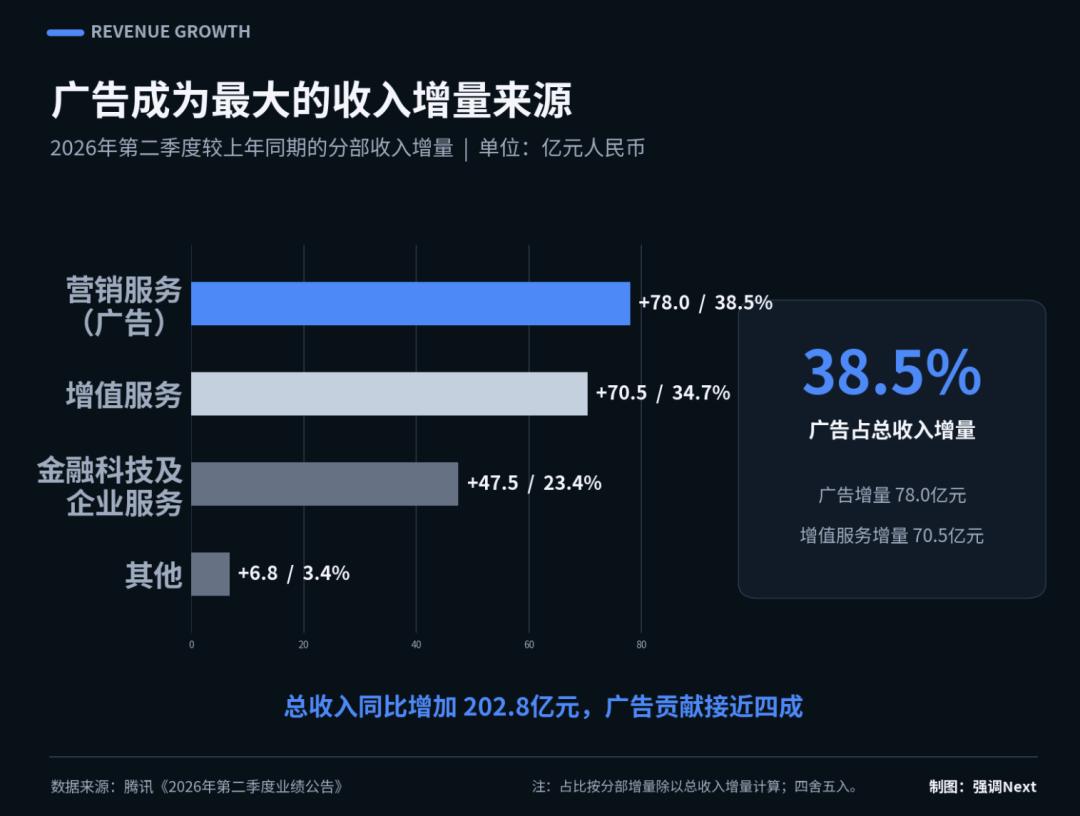
Let's first look at where the revenue increment comes from. Compared with the same period last year, marketing services (advertising) contributed an increment of 7.8 billion yuan; value-added services (games + social networking) contributed an increment of 7 billion yuan; fintech and enterprise services contributed an increment of 4.75 billion yuan.
The three segments added up to approximately 19.6 billion yuan in total, with advertising accounting for about 40%, value-added services about 36%, and fintech and enterprise services about 24%. Advertising contributed nearly 40% of the revenue increment, surpassing value-added services for the first time in history. Tencent's growth engine has switched, and AI is the exact driving force behind this shift.
Tencent attributes its advertising growth to three factors, two of which are directly related to AI: the AI-driven advertising recommendation model determines what ads to display to users at each exposure; Tencent Marketing AIM+ helps advertisers purchase high-quality exposures, plus closed-loop marketing in the WeChat ecosystem. Another indirect reason is that the total usage duration of Channels has increased by more than 20% year-on-year, and the supply side is still expanding. The extra money spent by advertisers is absorbed by Tencent's model accuracy and WeChat's closed-loop efficiency.
The cloud business is also receiving more orders. Revenue from fintech and enterprise services reached 603 billion yuan, up +9% year-on-year, mainly driven by enterprise services, rising AI-related demand, expansion in international markets, and improved pricing environment. The revenue growth rate of enterprise services in the previous quarter was already close to 20%.
Feeding funds to the advertising system and cloud first are the two channels with the fastest return in this round of AI investment: advertising improves targeting and click-through rate, directly increasing revenue; the cloud sells reasoning capabilities externally and gets paid by customers. Tencent's AI ledger is not all about expenditure, and the first part has already been recorded in revenue.
02
From "unable to purchase GPUs" to full-speed catch-up
For the full year of 2025, Tencent's capital expenditure was 792 billion yuan, with a year-on-year increase of only 3%. Martin Lau, President of Tencent, explained on the earnings call at that time: "We also wanted to purchase GPUs, but we faced a situation where we could not get supplies for a very long time." GPU supply was the money Tencent wanted to spend but could not spend last year.
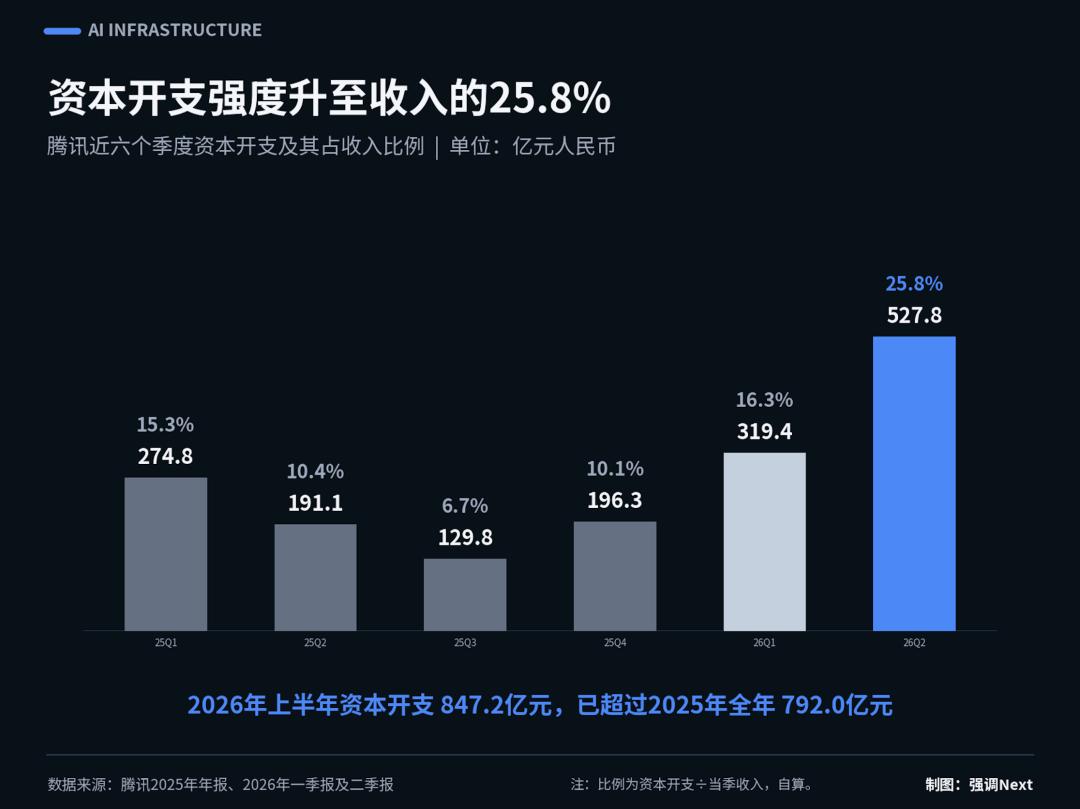
This year is different. Tencent's total capital expenditure in the first half of 2026 is approximately 847 billion yuan, which has exceeded the full-year figure of 2025. The proportion of single-quarter capital expenditure in revenue has risen from about 10.4% in Q2 2025 to 16.2% in Q1 2026, and 25.8% in Q2 2026.
Domestic ASIC chips are being delivered in increasing volumes month by month, and the ceiling is opened, so Tencent has stepped on the gas pedal to the fullest. Institutions' forecasts for Tencent's full-year capital expenditure fall between 1,300 billion yuan and 2,000 billion yuan.
How to earn back the money after it is spent? Martin Lau explained the return path on the earnings call: computing power is not only for self-built models for internal use, but also for external lease, and cloud lease "is expected to bring considerable revenue growth"; for some existing computing power orders, if sold, "the profit can be more than 30% higher than the purchase price a few months ago".
The sequence is three steps: build self-developed models first, then develop applications, and finally lease computing power externally. Tencent Cloud is expected to deploy supercomputing nodes based on Near-packaged Optics (NPO) technology in the fourth quarter, and industry estimates show that the quarterly domestic computing power procurement volume can reach the level of 100,000 cards. Last year it was "unable to purchase GPUs", but this year the cards have become production capacity that can be sold for profit.
Tencent's investment intensity is not the highest among leading large tech companies, but its strategic posture is transformative: from "following" to "full-speed advancement". Its chosen technical positioning is very clear: models are sufficient as long as they meet requirements, and scenarios take priority.
In third-party evaluations (Artificial Analysis), Alibaba's model scored 52, Tencent's 42, ByteDance's 34, and Baidu's 29. However, Hy3 follows the cost-performance route. After it was officially released in July, the call volume in one week increased by 68 times compared with the previous generation, and it was listed as one of the top three models on OpenRouter by CLSA.
One mechanism is worth pointing out: AI investment is classified as capital expenditure, which goes into the balance sheet instead of being recorded as current expenses. As a result, the profit statement looks "good" for the time being, with operating profit up 19% after excluding AI related items; but the cash flow immediately deteriorates, and free cash flow turns negative. Capital expenditure will gradually be converted into depreciation in the next 1-2 years and be amortized into the profit statement.
In other words, Tencent uses cash flow to buy itself a window of 1-2 years: before the large-scale depreciation comes, it will scale up the AI revenue of advertising, cloud and applications. The market's hesitation towards this financial report is essentially pricing this window period.
The management also defined the boundary for this window period. They clearly stated on the earnings call that this round of investment in AI-native business is "mainly one-off", which will continue from the end of this year to the beginning of next year, but the high investment scale will not be maintained continuously in the future. That means the peak of capital expenditure will be from the second half of 2026 to the beginning of 2027, then it will fall back, and the depreciation pressure will rise first and then fall. The profit elasticity in 2027 is the foreshadowing the management leaves for the market.
03
Battle for entry: WorkBuddy takes the lead, Xiaowei is the real trump card
Another direction for the spent money is to seize the AI entry. The widely recognized judgment in the industry is that AI competition has shifted from model capability to entry contention.
AI office is the most intense front battlefield at present. Tencent WorkBuddy was still a branch product with a team of more than ten people in Tencent Cloud in March this year. A few months later, Pony Ma personally followed up the project, the team expanded to hundreds of people, it was upgraded to the sixth cloud product division, and it is internally called "the third strategic product after QQ and WeChat".
Data from Analysys shows that WorkBuddy had 20.97 million monthly visits in June, leading the market by a large margin; ByteDance's TRAEWork ranked second with 12.79 million visits. Tencent has placed subway advertisements for it in Beijing, Shanghai, Guangzhou and Shenzhen, and media reports say that the offline investment alone is nearly 100 million yuan.
The competitors' formations have also been fully reorganized. Alibaba has integrated three products into "Tongyi Office", which is led by Chen Yusen, CEO of DingTalk, relying on 25 million enterprise organizations and the industry processes accumulated by DingTalk; ByteDance has merged the Feishu product team into the Doubao system, using Feishu's structured data to support organizational collaboration.
The logic of the three companies is respectively: Tencent bets on the "reach gap" of individual C-end users; Alibaba bets on industrial processes; ByteDance bets on organizational data.
WorkBuddy leads in user volume, but Tencent insiders admit that its focus is still on individual C-end efficiency, and its B-end compliance capability is still under construction; its relationship with WeCom has not been clarified so far, and WeCom itself has an agent named "Dayuan". The industry estimates that the window period is 6-12 months. During this period, whoever turns their AI from a "novelty tool" into a "work habit" will get the control of the next-generation computer desktop.
A bigger card than AI office is "Xiaowei" in WeChat. The financial report discloses that "Xiaowei", the AI agent in WeChat, has started small-scale gray test, driven by the customized model WeLM. 1.439 billion monthly active users of this super app have an AI assistant growing inside it, which is the window closest to the "national AI entry" in China's internet. ByteDance cannot buy this even with 200 billion yuan of capital expenditure, and DingTalk of Alibaba has 200 million monthly active users, which is an order of magnitude lower than 1.4 billion.
Tencent's current cards on hand are: WorkBuddy takes the lead in the office entry, Xiaowei is to be launched in the social entry, and Channels supports the advertising entry. The cards are all ready, but "the entry layout has been expanded, while AI has not truly been deeply integrated into them". The gray-tested "Xiaowei" and WorkBuddy whose paid business has just started have not reached the moment of commercial realization.
04
Prioritize computing power, and slow down shareholder returns temporarily
Back to the number at the beginning: -138 billion yuan. Net cash stood at 582 billion yuan, down 22% year-on-year; in the first half of the year, Tencent completed repurchases of 244 billion Hong Kong dollars and distributed dividends of 479 billion Hong Kong dollars, and shareholder returns did not stop.
But on the earnings call, the management made it clear: "The company will increase the scale of capital expenditure, and the corresponding cash flow for share repurchases may decrease accordingly." In the second quarter, the single-quarter repurchase reached 16.9 billion Hong Kong dollars, no interim dividend was distributed, and the priority of shareholder returns officially gave way to computing power investment.
The market has given Tencent a "wait-and-see valuation". Roughly calculated based on the current stock price, the price-earnings ratio is about 16 times. For a company with 11% revenue growth and 19% operating profit growth after excluding AI related items, this valuation is not expensive, and what the market is pricing is "when this money can be earned back".
Tencent's AI revenue is layered: advertising and cloud revenue have been realized this quarter; subscription and token payment of WorkBuddy and CodeBuddy are visible in the medium term; Xiaowei and model capabilities are long-term options. The management's own caliber is "measuring returns not by quarterly or 12-month cycles, but calculating accounts based on the full life cycle of products".
China's internet industry is collectively calculating a similar account. Liang Rubo of ByteDance said "Profit is not the first priority, grabbing the ticket for the AI era is"; in order to support 3800 billion yuan of computing power investment, Alibaba's adjusted EBITA in the first quarter fell by 84% year-on-year, and operating profit turned to loss; Baidu's full-year net profit in 2025 fell by 76%. In contrast, Tencent's Non-IFRS profit is still growing at a rate of 9%, and it still has 5,112 billion yuan of cash on its books. It is the most "calm" player in this round of competition.
But "calm" does not mean "guaranteed to win". Tencent's AI story is currently more about "narrative + infrastructure" rather than "revenue + profit". The most valuable signal of this financial report is that it confirms: Tencent has replaced the priority of shareholder returns with the priority of growth, and the direction of its bet is the entry. The answer to this competition will not be revealed until depreciation rises, Xiaowei is widely launched, and WorkBuddy starts to generate considerable revenue.
Note: The segmented revenue increment split, capital expenditure to revenue ratio, and implied P/E ratio are self-calculated calibers based on public financial report data. The data in this article comes from public sources and does not constitute investment advice.