Equip your car with an "external add-on" for as low as around 1,000 yuan? The "Tiangong 100" chip from Xinqing has officially started supply.
On August 12, CoreChips Technology released an announcement to the public: "Tiangong 100" has entered full mass production and started batch delivery to OEMs and Tier 1 suppliers.
This is not an unexpected announcement. As early as during this year's Beijing Auto Show in April, CoreChips had already announced the mass production schedule for this product. The fact that it was delivered on schedule marks a milestone event.
As an AI acceleration chip, "Tiangong 100" adopts 7nm process, delivers 96 TOPS of INT8 computing power, and is equipped with 102GB/s of independent memory bandwidth. Its design logic is very straightforward: it does not replace the existing cockpit main control chip, but connects via PCIe external interface to take charge of large model inference tasks exclusively.
It is like installing an independent external "intelligent computing brain" for automobiles. With a hardware cost of about 1000 RMB, new vehicles and even existing in-use models can realize AI computing power upgrade through extremely simple deployment, supporting the operation of 3B-7B large models.
CoreChips was founded in 2018. It took the company seven years from the mass production of "Dragon Eagle No.1" to the launch of "Tiangong 100".
01
Founded in 2018, Targeting 7nm Directly
In 2018, Li Shufu, founder of Geely Group, and Shen Ziyu, CEO of Ecarx Technology, jointly with Arm China, registered CoreChips Technology in Wuhan. At that time, most domestic automotive-grade chip companies focused on fields such as MCUs and power semiconductors, and high-performance cockpit SoCs were almost monopolized by overseas giants.
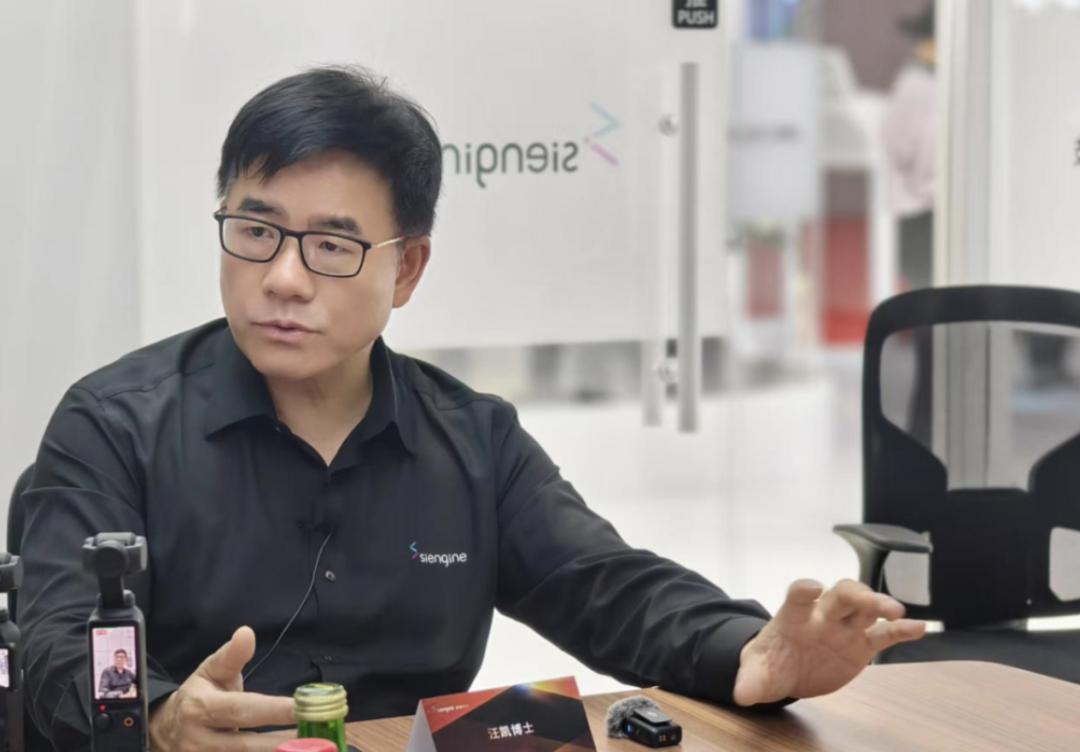
Wang Kai, Founder, Director and CEO of CoreChips Technology
A year later, Wang Kai joined CoreChips as CEO. Wang Kai received his bachelor's degree from the University of Electronic Science and Technology of China, and his doctorate in electrical engineering from the University of Illinois, USA. He previously served as a senior executive at companies including Broadcom and NXP Semiconductors. He is well aware that the only thing worth doing is to develop products that can gain a firm foothold in the market.
Therefore, while peers were still working on 28nm and 12nm processes, CoreChips directly targeted 7nm automotive-grade smart cockpit chips.
This was a bold decision. There was no precedent for developing automotive-grade 7nm chips in China before. The tapeout cost of 7nm chips is at the level of tens of millions of US dollars, and the automotive-grade certification cycle usually lasts more than two years, including AEC-Q100 reliability test and ISO 26262 functional safety certification. If it failed, the company might face survival crisis. Wang Kai judged that the mainstream international cockpit chips had already started the transition to 7nm. If the company started with 28nm or 12nm processes, its products would be two generations behind in process when mass production is realized, and would have no competitiveness at all.
After the direction was determined, CoreChips started to push forward the R&D process.
In June 2021, the tapeout of "Dragon Eagle No.1" was successful. This chip integrates 8.8 billion transistors, making it the automotive-grade SoC with the largest number of transistors in China at that time. At the end of 2021, CoreChips officially released this chip.
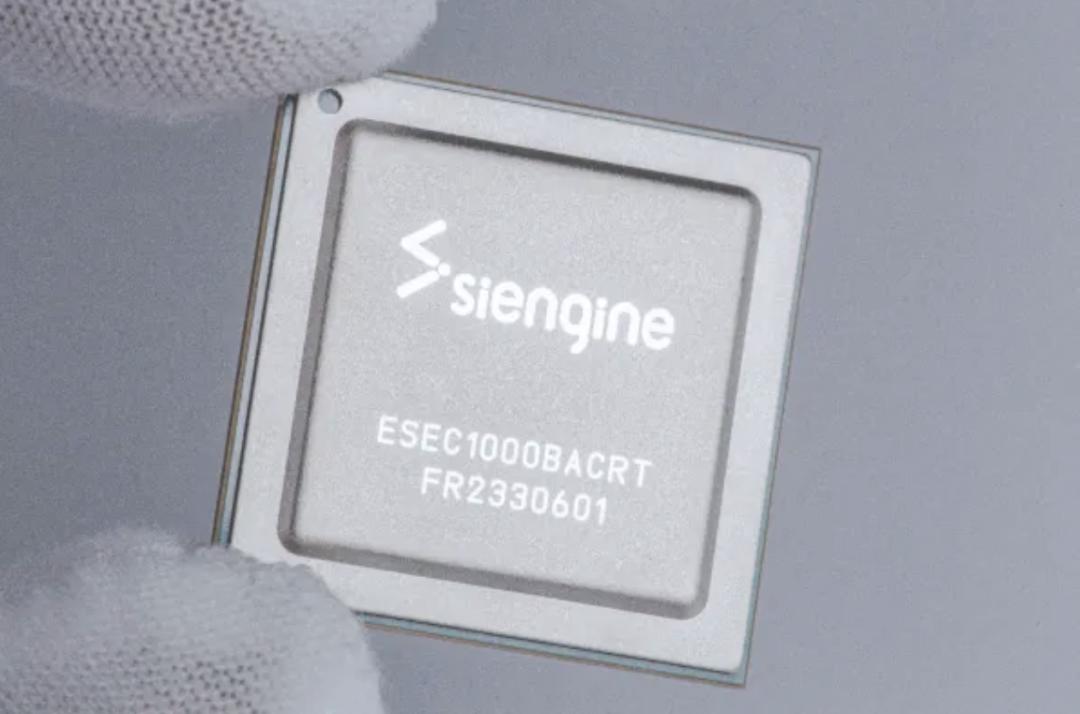
"Dragon Eagle No.1"
It took nearly two years from the release to large-scale installation in vehicles. After the successful tapeout in June 2021, CoreChips successively completed the AEC-Q100 reliability test, ISO 26262 functional safety certification, and the adaptation for the electronic and electrical architectures of different automakers.
There are differences in the number of cockpit screens, resolution and interaction logic among different automakers, and the chip needs to be calibrated for each specific model. The adaptation cycle for some automakers exceeds one year. As a result, the original mass production schedule set internally by CoreChips has been adjusted for many times.
Since 2023, "Dragon Eagle No.1" has been successively installed in models of Geely's brands including LYNK & Co, Galaxy and ZEEKR, and then expanded to FAW Hongqi and Changan Qiyuan. In 2024, CoreChips obtained a long-term order for overseas models from Volkswagen of Germany. By 2025, according to the statistics of the installation volume of passenger cars priced below 400,000 RMB in China, "Dragon Eagle No.1" ranks first in the market, with cumulative shipments exceeding 1 million units.
This is also the only 7nm automotive-grade cockpit chip in China that has achieved mass production and installation of millions of units so far.
02
"Tiangong 100": Another 7nm Chip
CoreChips previously disclosed that it has three main product lines:
The first one is "Dragon Eagle No.1", oriented to smart cockpit. During its mass production process, CoreChips also launched an industrial-grade AIoT version based on the same 7nm process, targeting robotics and industrial edge computing scenarios. That chip is not a brand-new design, but an extension of the same core for different markets.
The second one is "Xingchen No.1", released in 2024, oriented to advanced assisted driving, with a single-chip NPU computing power of 512 TOPS and supporting multi-chip cascade connection. This chip has entered mass production, but its public exposure is relatively low, which is more of a strategic layout to secure market position.
The third one is "Dragon Eagle No.2", released at the 2026 Beijing Auto Show, with 5nm process, 200 TOPS of AI computing power, and 360K DMIPS of CPU computing power, which is about 4 times that of "Dragon Eagle No.1". The official said it supports the end-side operation of multi-modal large models with 7B+ parameters, and is scheduled to start adaptation in Q1 2027.
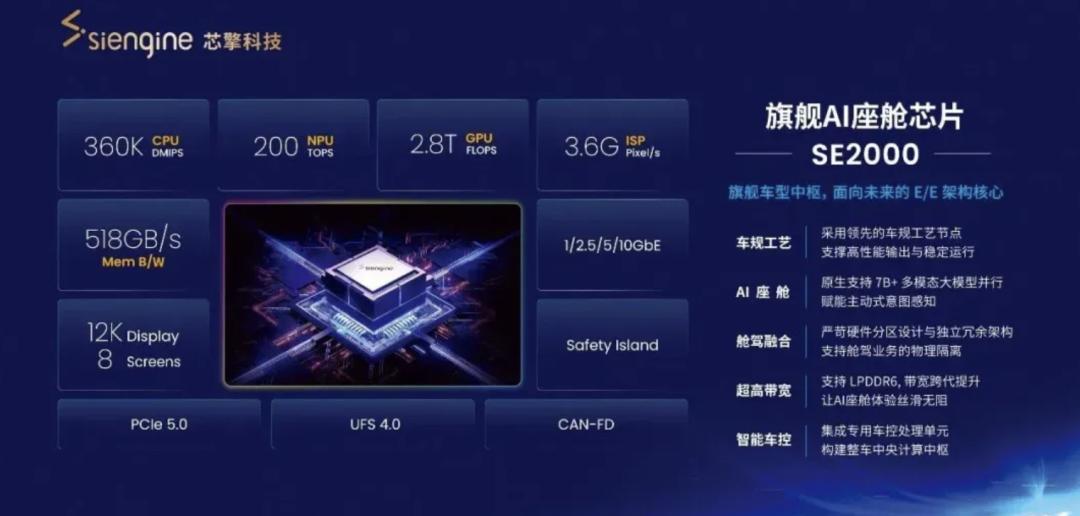
"Dragon Eagle No.2"
If "Dragon Eagle No.1" solves the problem of cockpit experience, then "Dragon Eagle No.2" targets the central computing of the whole vehicle. "Tiangong 100" is positioned between the two, providing a more pragmatic gradual path.
"Tiangong 100" is not a cockpit main control chip, and does not replace "Dragon Eagle No.1". Instead, it is connected via an external PCIe interface, and is exclusively responsible for large model inference tasks. It delivers 96 TOPS of INT8 computing power, 102GB/s of independent memory bandwidth, supports local operation of end-side large models with 3B to 7B parameters without connecting to the internet.
This solution targets the practical problem that there are already a large number of models equipped with "Dragon Eagle No.1" or other cockpit chips on the market, whose electronic and electrical architectures have been fixed. If automakers reconstruct the architecture to deploy large models, the cycle and cost will be too high. "Tiangong 100" provides an end-side AI computing power upgrade path for existing models with a hardware cost of about 1000 RMB and no need to modify the architecture.
According to CoreChips, compared with the high-computing dual-control AI BOX solution, the vehicle-wide deployment cost can be reduced by at least half. Domestic and overseas mainstream chips including CoreChips' "Dragon Eagle No.1" cockpit chip and "Xingchen No.1" autonomous driving chip can be seamlessly connected.
From the perspective of technical implementation, the mass production experience of "Dragon Eagle No.1" laid the foundation for "Tiangong 100". With the same process and the same foundry, the whole process from tapeout to verification to mass production ramp-up has been completed once, which reduces the development risk of the new product. This chip has passed the dual automotive-grade certifications of AEC-Q100 Grade3 and ISO 26262 ASIL-B, and has a built-in hardware HSM security encryption module, which protects users' personal data privacy such as voice and image through hardware isolation.
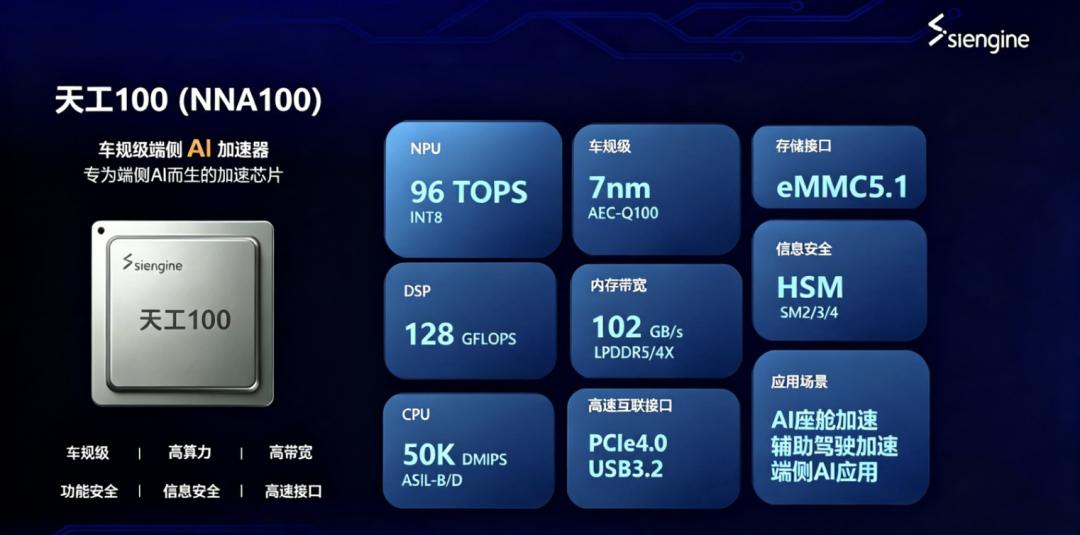
"Tiangong 100"
96 TOPS is not a top-tier figure in the current market. The advantage of "Tiangong 100" does not lie in the absolute value of computing power, but in its flexibility and pertinence, which uses a relatively cost-effective solution to solve the most urgent problem in the current deployment of end-side large models.
03
After Mass Production: Clients, Competition and Capital
After "Tiangong 100" enters mass production, the challenges facing CoreChips do not decrease.
In terms of customer structure, the volume growth of "Dragon Eagle No.1" is backed by the internal demand of the Geely system. Although it has gradually expanded to brands such as FAW Hongqi and Changan Qiyuan, and obtained overseas model orders from Volkswagen of Germany, it still needs to continue to prove its ability to continuously acquire customers outside the Geely system.
As for "Tiangong 100", the official announced that it has started batch delivery to OEMs and Tier 1 suppliers, but the specific customer list and installed models have not been publicly disclosed yet.
In terms of market competition, since 2025, Qualcomm's Snapdragon Ride Flex and NVIDIA's Thor have been gradually put on the market. The two companies have strong accumulation in computing power, ecosystem and customer relationship. CoreChips' next-generation product, the 5nm "Dragon Eagle No.2", is scheduled to complete adaptation and installation in vehicles in the first quarter of 2027, targeting the central computing market of integrated cockpit and autonomous driving.
During the window period before the mass production of "Dragon Eagle No.2", "Tiangong 100" needs to undertake the task of maintaining customer relationships and market share. However, the life cycle of the external acceleration solution is limited. Once the AI computing power of the cockpit main control chip is sufficient to support large model deployment, the demand for independent acceleration cards may decline.
In terms of capital, "Dragon Eagle No.1" has generated revenue, but has not yet covered all R&D investment. CoreChips is currently pushing forward three product lines at the same time: cockpit chip iteration, AI acceleration chip and 5nm integrated cockpit and autonomous driving chip, and its R&D expenditure remains at a high level.
However, on the eve of the mass production of "Tiangong 100", CoreChips just announced that it had completed a financing of over 200 million US dollars in the first half of 2026, led by Jingming Capital, with participation from Shandong Hi-Speed Group, Longding Investment, Zhuoyuan Asia, Qingdao Urban Construction Investment and other institutions. Previously, Series A investors included HSG and Boyuan Capital under Bosch, and Series B investors included Chengtong Fund, Capital Estate, CICC Capital. FAW Group also made a strategic investment in the early stage.
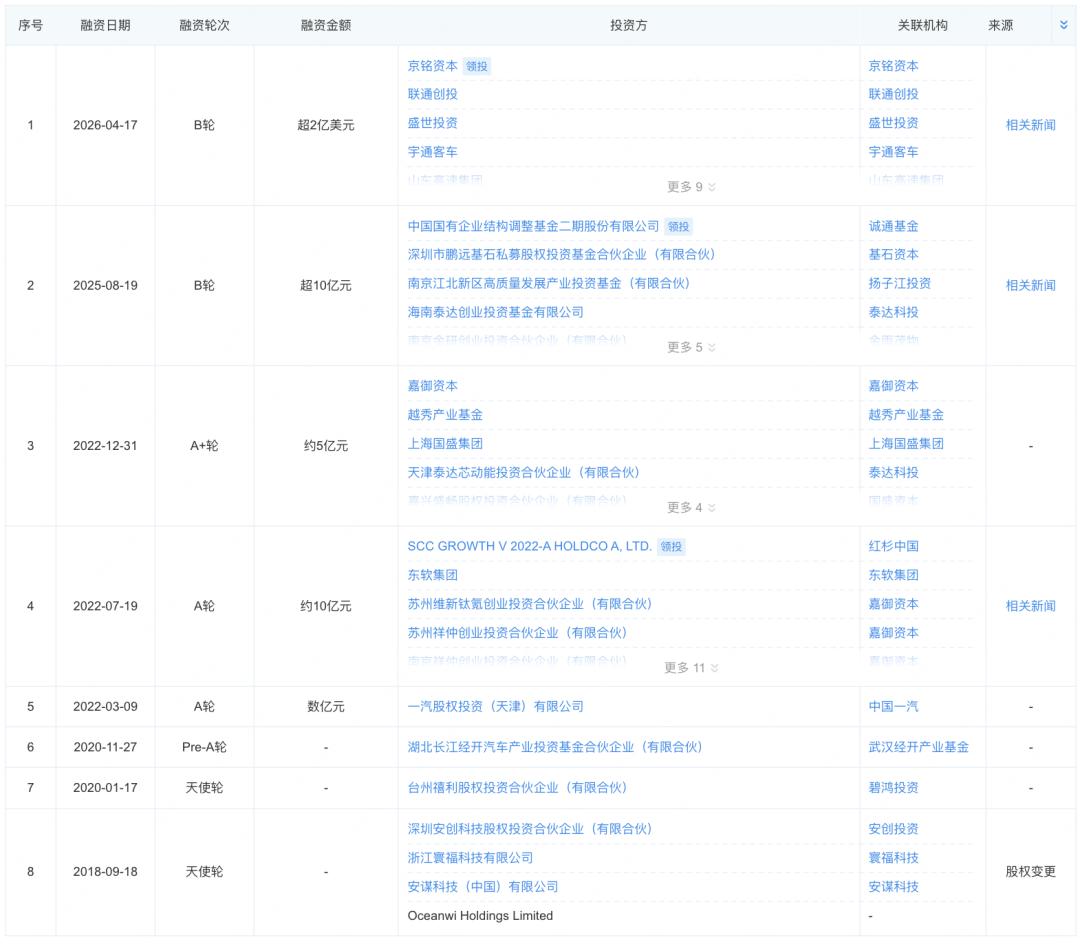
Financing history of CoreChips Technology. Source: Qichacha
However, no amount of capital can sustain endless burning. The tapeout cost of 5nm chips is higher than that of 7nm chips, the team has expanded from dozens of people to nearly a thousand people, and the labor cost is very high. Wang Kai once said that a chip company should be prepared for not making profits for a long time. This is not modesty, but the reality.
Previously, Wang Kai disclosed that CoreChips Technology planned to go public in 2025. But as of now, there is no further update.
Over the past seven years, CoreChips has completed the mass production and installation of 1 million units of a cockpit chip, and launched the second 7nm chip.
In terms of market share, CoreChips has laid a certain foundation in the domestic cockpit chip market, but its share in the global market is still small. NVIDIA and Qualcomm still dominate the high-end automotive-grade chip field, and domestic companies including Horizon Robotics and Black Sesame Technologies are also making progress in their respective market segments.
The key milestones for CoreChips in the next stage include: whether "Dragon Eagle No.2" can complete adaptation and installation in vehicles in the first quarter of 2027 as planned, whether "Tiangong 100" can obtain large-scale orders outside the Geely system, and the progress of ecological construction in the AI acceleration direction.
There is no shortcut in the chip industry. Every chip, from design to mass production, has to go through the complete cycle of tapeout, verification, adaptation and ramp-up. CoreChips has gone through the cycle once, and it needs to go through it the second and third time.
This article is from WeChat official account "Cyber Car" (ID: Cyber-car), Author: Ye Tingting, Editor: Zhang Lianyi, published with authorization from 36Kr.