40 days, 33 videos, a luxury mansion blogger from Hangzhou takes on Boloni single-handedly
Over 40 days, 33 on-site shot videos. A luxury home blogger in Hangzhou has shared the entire process of his million-yuan home decoration going wrong, which has continuously put Boloni, the brand responsible for the full-case design and construction, under the spotlight of public scrutiny.
Boloni, which has long been promoting "master design and German quality", has thus fallen into delivery disputes. However, after more than a month of public opinion fermentation, Boloni's brand headquarters has never made a public response.
The blogger's video documentary exposes the pain points of the light high-end customized home decoration industry: the brand's high-end positioning only stays at the marketing level, and the shortcomings in terminal delivery management and control have never been truly remedied.
Batch Failures in Million-Yuan Full Home Decoration
A 40,000-yuan faucet, a 50,000-yuan armored gate, a 200,000-yuan cabinet... Just looking at the unit price of these products, it is enough to see that this blogger has spared no expense on the decoration of his apartment.
Lao Zhang is a real estate blogger in Hangzhou who focuses on luxury properties. In 2021, he bought a large river-view flat in Hangzhou, and entrusted the full-case design and construction to Boloni, a mid-to-high-end home furnishing brand.
This choice led to repeated failures throughout the entire decoration process of Lao Zhang's home, and the decoration lasted for two years, yet he still cannot move in.
Starting from June 30, he specially opened the account "Lao Zhang's Decoration Diary" to update all kinds of pitfalls he encountered during the decoration process. 40 days and 33 videos (some videos have been hidden at present) have become a hot topic in the real estate and decoration circles, and also pushed Boloni to the cusp of public controversy.
The faucet that Lao Zhang was most satisfied with has also become the biggest complaint point in the decoration. This 40,000-yuan faucet was ordered two years in advance, and he waited for half a year for it to be delivered across the ocean. Unexpectedly, the basin configured by Boloni cannot hold water at all, turning this expensive sink into a "thunder urinal".
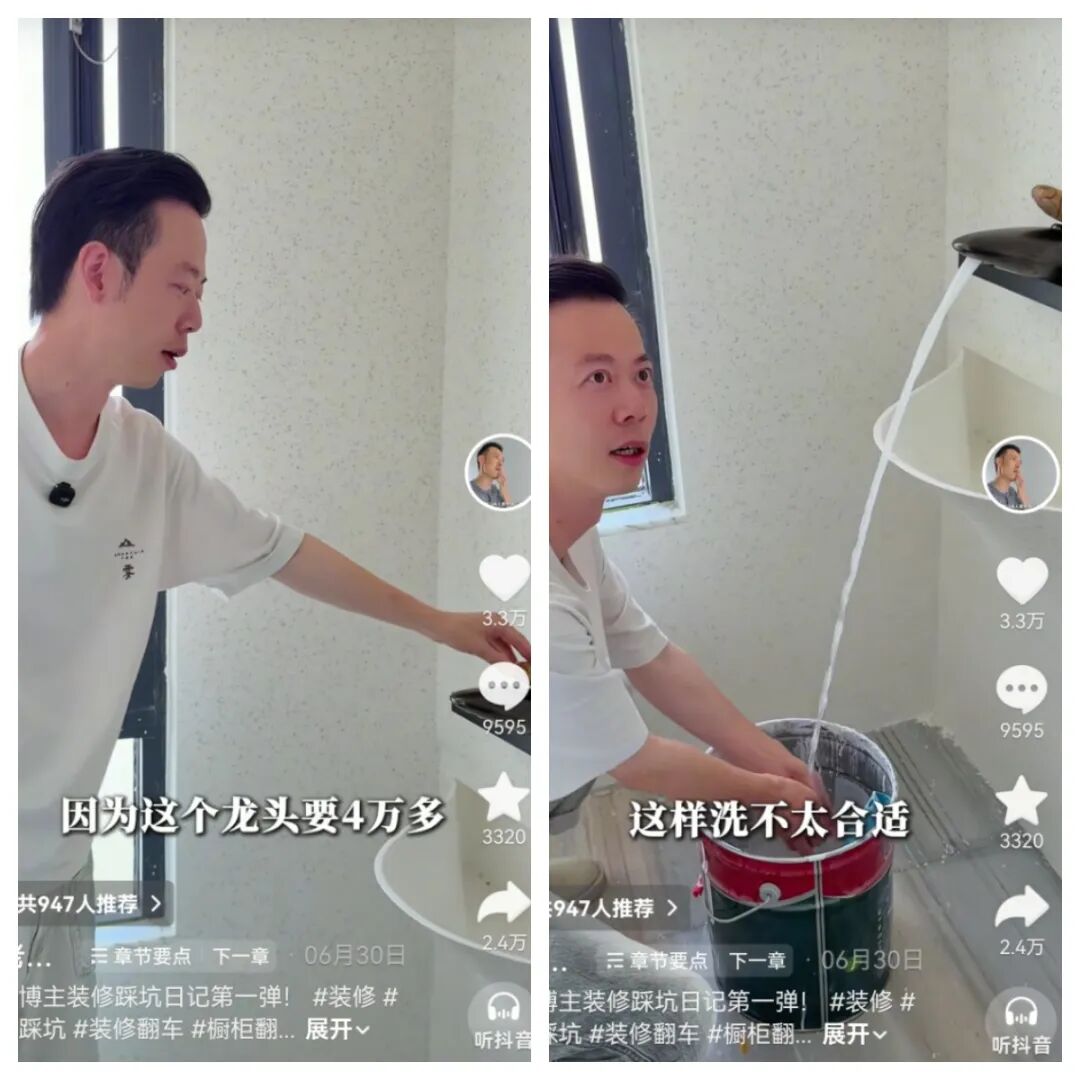
Moreover, during the daily decoration inspection, Lao Zhang found that many designs of Boloni's designers generally have implementation deviations and detail defects.
For the cabinet doors alone, there are all kinds of weird designs and problems, such as "cabinet doors that need extra force to open", "refrigerator cabinet doors that attack the sprinkler", "interlocking drawer doors that collide with each other", "vanity cabinet doors that you have to kneel to open", "kitchen cabinet doors that you have to jump to close", "kitchen cabinet doors that you have to stand on a bucket to close", "stubborn folding doors that are hard to operate", "wardrobe doors with hidden rebound devices that cannot be found", and "cabinet doors with uneven gaps".
Not only that, the openings for the gas pipes and exhaust pipes in the kitchen and bathroom are rough and random, without reserving necessary maintenance space, making it impossible to carry out pipeline inspection and maintenance in the later stage; sockets are arranged in the water-adjacent area of the kitchen island, which violates the basic water and electricity construction specifications and poses great safety hazards.
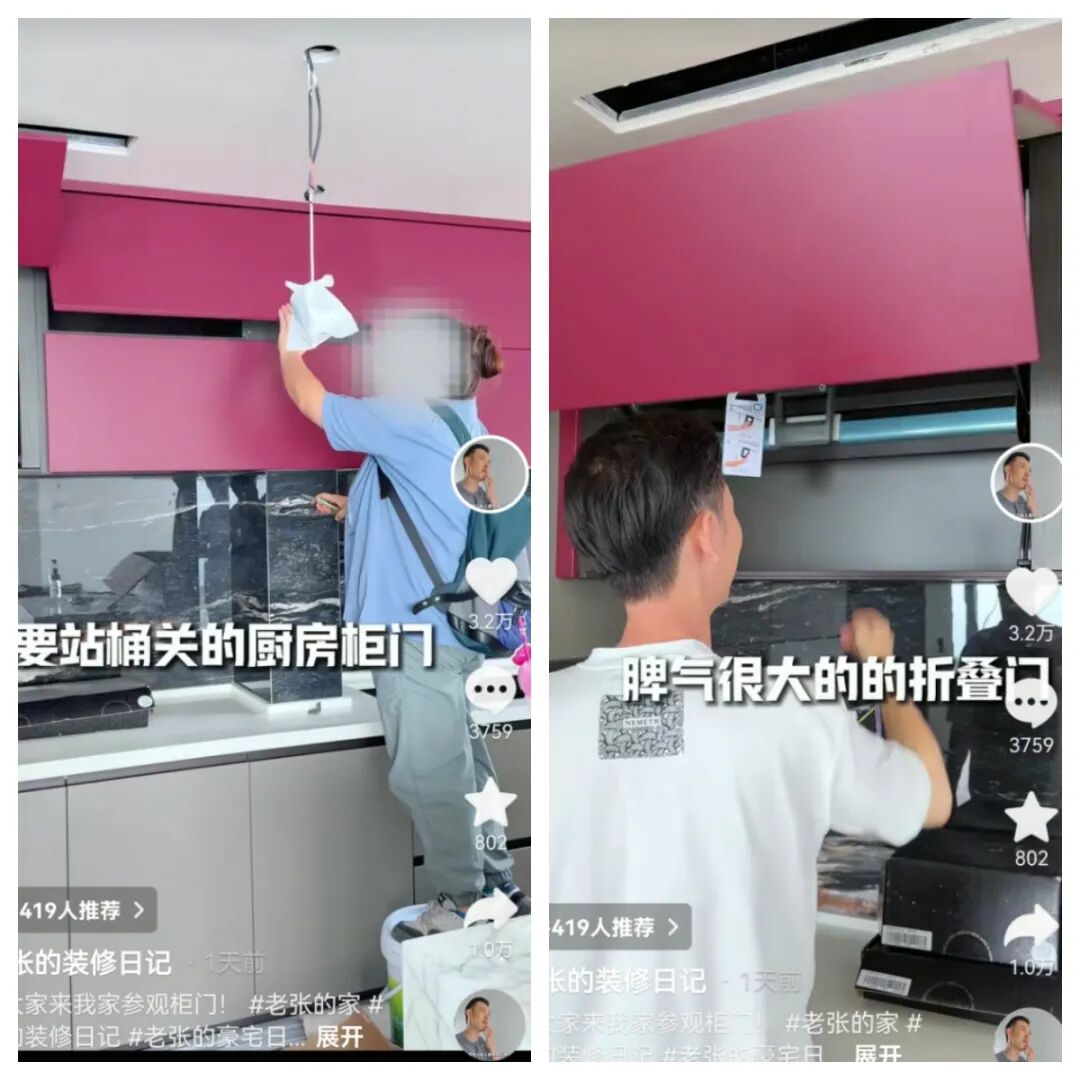
Judging from the content presented on Lao Zhang's account, various problems are too numerous to list. During this period, repeated demolition and rework have infinitely extended the entire decoration schedule.
As we all know, home decoration is a complex process, and there is no absolute perfection. The reason why Lao Zhang's decoration diary has attracted attention is that there is a sharp contrast between his million-yuan expenditure and the final effect presented.
More importantly, the full-case design he chose was provided by Boloni, an industry player that takes "master design" and "German quality" as its core competitiveness.
Hidden Risks Brought by the Franchise Model
Cai Ming, the founder of Boloni, worked at the Institute of Mechanics of the Chinese Academy of Sciences after graduating from university. He resigned to go into business in 1992, founded the Kebao company, and started his continuous entrepreneurial journey. After that, he founded three world top home furnishing brands: Kebao, Boloni, and Tillmaher.
Cai Ming's entry into the home furnishing industry originated from a visit to the Cologne Home Furnishing Exhibition in Germany in 1996. At that time, he was shocked by the Italian design at the exhibition. After returning to China, he founded Kebao Boloni, introducing Italian minimalist aesthetics into the Chinese market.
In 2005, Boloni did something that shocked the entire home furnishing industry, launching the "Mario" cabinet with a price tag of one million yuan. At that time, this price was enough to buy several apartments in Beijing.
According to Boloni's official website, Cai Ming loves Italian design and respects German quality, and is known as "the first person in China's home decoration industry". He was the first in China to introduce full cooperation with Italian design firms, and the only one to carry out overall cooperation covering from spatial lifestyle design to full-series product design; he is also the first person to fully introduce German production directors and construction general managers.
Another well-known identity of Cai Ming is that he is the prototype of Lu Tao in the TV drama *Struggle*. Shi Kang, the screenwriter of *Struggle*, is Cai Ming's middle school classmate, who got the creative inspiration for the character Lu Tao from Cai Ming's entrepreneurial experience.
From the very beginning, Boloni has been positioned as a high-end player in the whole-house customization field. Many celebrities, business tycoons and other high-net-worth individuals are customers of Boloni.
There is no doubt that Boloni, which is positioned at the high end, has higher requirements for product design, quality and construction implementation than other mass-market brands.
This time, the total failure of the decoration of Lao Zhang's home in Hangzhou may be related to Boloni's operation model.
At present, Boloni has more than 800 stores in more than 500 cities, but except for a small number of directly operated stores under the headquarters in super-first-tier cities such as Beijing and Shanghai, the vast majority of other stores are dealer franchise stores.
The franchise model allows brands to achieve rapid expansion, and the brand will provide franchisees with full-link support including store opening, operation, marketing and services. However, under this model, the brand cannot deeply intervene in the management of terminal construction sites and delivery acceptance. Driven by profit, dealers may compress labor costs and outsource construction teams, leading to uneven quality of design and construction delivery.
Although the local store in Hangzhou has taken active remedial measures for various problems existing in Lao Zhang's home during the decoration process, the delivery defects caused by disjointed pre-design and non-standard construction are almost impossible to reverse.
The continuous update of videos on "Lao Zhang's Decoration Diary" has led to continuous fermentation of public opinion, but Boloni's official side has never made a public statement on this. The latest news shows that relevant personnel from Boloni's headquarters have rushed to Hangzhou in the past two days to negotiate with the blogger on relevant issues.
The Whole Industry Is Pursuing High-end Transformation for Self-rescue
Home decoration is an industry strongly correlated with the real estate market. In recent years, with the in-depth adjustment of China's real estate market, the overall home decoration industry is under great pressure.
The performance of two leading customized home furnishing enterprises can reflect the current situation of the industry.
Oppein Home and Sofia both reached their peak performance in 2023, and then continued to decline for two consecutive years. Since the beginning of this year, the market has become more sluggish: Sofia recorded a loss of 38.43 million yuan in a single quarter; Oppein Home's attributable net profit has almost halved year on year.
In June this year, an internal letter of Oppein Home was leaked. In the letter, the company stated that "the current difficulties are unprecedented" — the market size has shrunk sharply, industry involution has intensified rapidly, price wars are unprecedentedly fierce, and the company's turnover and profit have both plummeted sharply... The market is full of severe storms and huge waves. To prevent the big ship from capsizing and ensure the survival of most employees, the company can only reluctantly lay off some staff.
Even the industry leaders are in such a difficult situation, so the pressure on small and medium-sized enterprises in the industry is undoubtedly even greater.
With low-price involution and continuously shrinking profits, the traditional volume-driven model of the customized home furnishing industry has completely lost room for growth. Against this background, light high-end customization and full-case home decoration, which have higher customer unit price and gross profit margin, have become one of the few incremental tracks. Mass-market brands such as Oppein and Sofia have intensively laid out high-end full-home decoration product lines, collectively moving towards high-end positioning to survive.
However, the high-end upgrading of most brands only stays at the levels of exhibition hall packaging, product iteration and marketing. Under the dealer system, high turnover of designers and replacement of project managers halfway through projects have become the norm. The front-end renderings design focuses on visual effects to facilitate quick order signing, while back-end work such as construction site inspection, detail implementation and long-term quality control has not been raised to the same level of importance, leading to frequent occurrence of decoration failures.
In the period of rapid market growth in previous years, customized home furnishing brands could share the growth dividends in markets of different tiers with their respective advantages. But when the market enters the stock era, only brands with real good reputation can win in the zero-sum game.
This article is from the WeChat official account "Zebra Consumption" (ID: banmaxiaofei), written by Fan Jian, and published with authorization from 36Kr.