WorkBuddy has an extremely strong presence — 10 Observations and Thoughts from Tencent's Q2 Earnings Conference Call
On August 12, Tencent released its 2026 Q2 earnings report, and held the routine earnings call at 8 p.m. local time.
This call still contained a huge amount of information. Tencent remained as stable as ever on key metrics such as revenue growth, but what the market really cares about is —
How will Tencent fight the AI war?
I went through the full transcript of the call and sorted out 10 of my observations and thoughts as usual, hoping to bring some incremental insights —
1. WorkBuddy has an extremely prominent presence
When Pony mentioned WorkBuddy in his opening remarks, he stated —
"WorkBuddy recently ranked first among AI productivity services in China in terms of monthly interaction volume."
Last quarter, the description was that it was the most widely used service measured by daily active users, and this quarter the measurement was changed to interaction volume.
Well, it's more AI-Native oriented.
Tencent has never disclosed specific user data of WorkBuddy officially, and this time it is the same. It only vaguely stated that it ranks first in interaction volume, which confirms my unpublicized speculation last week.
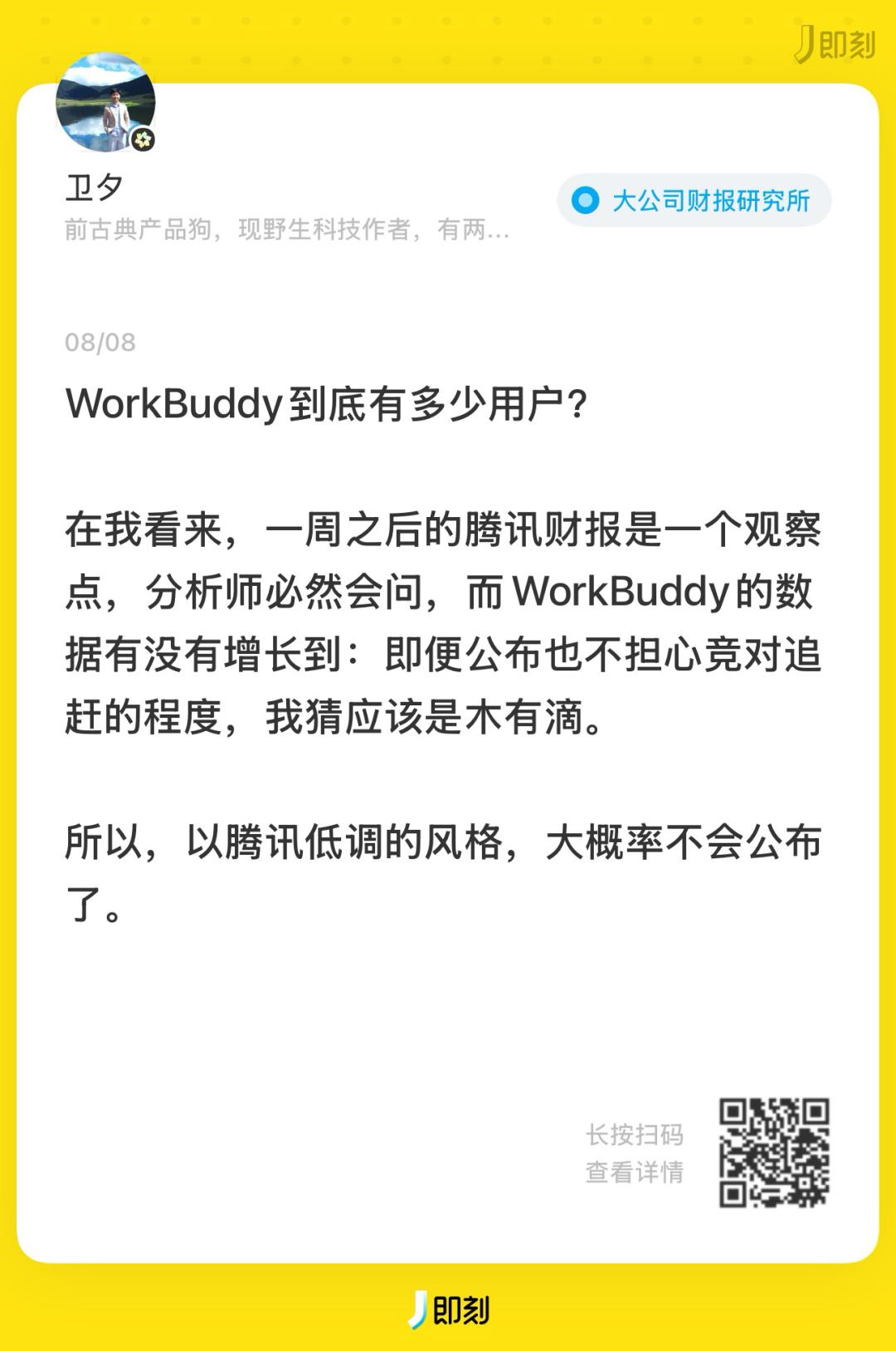
Nevertheless, the management's attitude has been fully laid out on the table.
James Mitchell said when answering a JPMorgan Chase analyst's question —
"After we confirmed that WorkBuddy is breaking out, we decisively tilted resources to it, and meanwhile lowered the priority of some other new AI products in our portfolio."
This statement is very clear: inside Tencent, different products have different priority levels.
Obviously, the priority of Yuanbao is declining, and WorkBuddy is the core bet at present.
Another supporting evidence is the ranking of capital expenditure, the management stated —
"The primary use of current capital expenditure is to train larger and better Hunyuan models in the coming months; the important secondary use is to provide inference computing power for the Hunyuan, DeepSeek and other models behind WorkBuddy."
Models come first, WorkBuddy second, and cloud business third.
This ranking conveys a huge amount of information.
2. Why is Tencent so willing to spend money on WorkBuddy?
The earnings report discloses that sales and marketing expenses in this quarter reached 11.9 billion yuan, a year-on-year increase of 26%.
This growth rate is quite notable, and the official also clarified that it is mainly used for the promotion of games and AI-native products.
I believe WorkBuddy accounts for a large share of this expense. After all, few of Tencent's previous products had advertisements placed in Focus Media elevators (I recently also saw WorkBuddy's advertisements on CCTV).
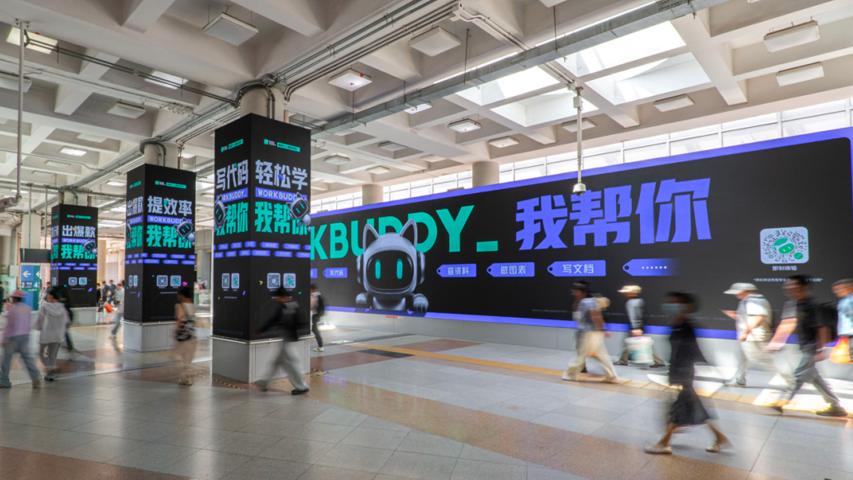
Among all these points, I think there is one point that the industry tends to overlook —
The reason why Tencent spends so much energy promoting WorkBuddy, besides the data level and future strategic significance, also lies in the fact that Yao Shunyus core work at OpenAI was reinforcement learning.
Reinforcement learning is the key to post-training of models, and reinforcement learning requires an execution environment.
C-end products like WorkBuddy can perfectly support the post-training of models.
The statement from Martin Lau in the call also verified this flywheel —
"By continuously injecting real product usage and domain feedback into model training, our 'model-product co-design' approach enables Hunyuan to verify model accuracy, identify and solve edge scenarios, and achieve faster model iteration."
Exactly, models and products can achieve mutual promotion in the post-training stage.
3. WorkBuddy has already considered how to achieve commercialization
Facing the follow-up question of "whether WorkBuddy is an enterprise software or a new platform", Martin Lau said —
"It is a flexible workspace oriented to agentic AI, with the core goal of meeting all productivity needs of office workers and various independent operators including one-person companies... Tencent plays the role of an orchestrator. Hunyuan will be one of the models provided by WorkBuddy. If it can solve a large number of user problems with high cost-effectiveness, it will become the main model, but it will not be the only model."
There is also this statement —
"We have embedded a skill payment and revenue sharing mechanism in the task flow of the developer community, so developers can get revenue when their skills are called."
This shows that WorkBuddy has begun to seriously consider commercialization.
"Given that Tencent's applications such as WeChat, WeCom, and Tencent Meeting are widely used by enterprises, WorkBuddy provides us with a new way to monetize enterprise customer relationships."
From this statement, it is clear that WorkBuddy will most likely integrate with Tencent Meeting and WeCom to a certain extent in the future.
Another incremental information from the call is that the gross margin of WorkBuddy's paying users is already close to the overall gross margin of Tencent Cloud, but since the company is still subsidizing free users, its overall gross margin is relatively low.
The management also specifically explained an accounting detail:
"Users' spending on WorkBuddy is mainly subscription-based, and there is a long time lag from cash collection to recognition as reported revenue. At present, cash collection is growing rapidly, and will be gradually converted into Tencent Cloud's reported revenue within the year."
In other words, WorkBuddy has actually started to generate cash inflow, but it is not yet very visible on the financial statements.
It is a bit of a pity that when an analyst asked a follow-up question —
Every AI lab is developing its own first-party Harness (Agent framework), how will WorkBuddy compete with the first-party products of model vendors?
This question is very insightful in my opinion.
But unfortunately, Martin Lau did not give a direct answer on his view of the market pattern of first-party and third-party Harness.
4. Hunyuan Hy4 will be released at the end of the year, and this pace is not fast
First of all, the official version of Hunyuan Hy3 is still very competitive for models of the same size.
The average daily token consumption across all channels during the paid period increased by about 6 times compared with the preview version, and it has remained among the top 3 in the world on OpenRouter in terms of token consumption.
Martin Lau's evaluation of it is —
"The official version of Hunyuan Hy3 performs well, and will become a springboard for the Hunyuan model family to reach state-of-the-art (SOTA) capabilities in the future."
At present, Tencent's management has affirmed the performance of Hunyuan 3, and clearly stated that the future goal is to reach the industry's SOTA level.
When answering a Goldman Sachs analyst's question, Martin Lau further explained the strategy of Hunyuan 3 —
"Hy3 is a very small model by today's standards, but it can match or even outperform much larger models; it is built for real usage scenarios, and we have no interest in simply chasing benchmark scores."
And he gave the roadmap —
"Hy4 is just a stop along the path, and Hy5 will come after it; with continuous iteration, we will keep approaching SOTA, and eventually reach SOTA."
Throughout the call, the word SOTA was emphasized at least three times.
Does Shuny u have pressure?
The real incremental information is this statement —
"We are training the Hunyuan Hy4 with larger parameters, which is expected to be released later this year."
This is a very important piece of incremental information in the call, which announces the release time of Hunyuan 4, but this time point is a bit later than I expected.
At a time when various model vendors have compressed the release cycle to 2 months or even 1 month, Tencent's next-generation model will not be released until the end of the year, which is not a fast pace at least from the perspective of timeline.
Do you remember what Pony said in Q1: "We have stood up, but we can't sit down yet, and we still hope the ship can speed up a little bit"?
Now it seems that the ship speed is indeed increasing, but it can still be faster.
5. Xiaowei is still in the controlled release stage
This call also devoted a lot of space to WeChat's Xiaowei AI assistant.
The official statement is: Xiaowei has launched a small-scale gray test, driven by the customized model WeLM, which focuses on user privacy, WeChat scenarios and inference efficiency.
Martin Lau specifically emphasized that —
"Although the prototype is technically capable of handling advanced agent workflows, we are currently configured to require user intervention and multi-step confirmation as a security measure."
This shows that many of Xiaowei's capabilities are still under control, and the company is not taking overly aggressive steps.
The official also announced the next upgrade direction: upgrade conversational memory and recommendation capabilities, expand service and content integration, and scale up the rollout.
This upgrade direction is in line with my personal experience:
I use Xiaowei very frequently now, but I mostly use it as a very convenient simple AI, holding down to speak and ask questions at any time, and I don't feel that it makes good use of my private data.
Therefore, the memory function and actively recommending relevant content to me will most likely be the key upgrade priorities for Xiaowei next.
In addition, from the official statement, the customized model WeLM has a targeted performance focus. I understand that there should be models of different sizes inside Xiaowei for routing allocation, so as to achieve higher efficiency.
At present, Xiaowei's token consumption should not be too large. The management also said in a subsequent answer that the cost investment in Xiaowei will be less than the investment in Yuanbao in the past year.
6. What if users get used to Xiaowei and stop watching advertisements?
Kenneth Fong from UBS raised my favorite question throughout the whole call —
"After the agent simplifies the transaction path, it may only transfer the transaction volume that users originally completed self-service in mini-programs to agents with higher computing costs, and the net increase in GTV is limited; moreover, once the transaction path is shortened, high-margin ad impressions may decrease."
This question is very tricky, and its implication is: What if users get a great experience with Xiaowei and stop watching advertisements?
Martin Lau used an analogy in his answer —
"QQ was the communication and social tool in the PC era. After entering the mobile era, WeChat came out, and its ecosystem amplified the value of QQ by more than 10 times because it was mobile-first. In the AI era, there are also huge opportunities in the WeChat ecosystem: it will first be empowered by AI, and over time become an AI-first application and ecosystem."
He added another sentence:
"Now users need to type and complete operations by clicking navigation. In the future, they only need to give Xiaowei an instruction, and it will execute transactions and complete tasks — as long as we can deliver this experience and control the delivery cost, the WeChat ecosystem will expand, and generate a lot of value based on the existing monetization mechanism."
I think this answer is quite logically reliable, and the comparison between QQ and WeChat to illustrate mobile-first and AI-first is also very meaningful.
Surely the priority is to make users have a good experience first. As for how to make money, Tencent has plenty of solutions.
This question and answer, well, is a contest between masters.
7. Yuanbao may become Tencent's experimental field
At the end of Martin Lau's statement in the call, he mentioned —
"User feedback from Yuanbao is a valuable input for improving the Hunyuan series of models; over time, the features polished by Yuanbao can become atomic capabilities, which can be reused in other Tencent products such as WorkBuddy, CodeBuddy, WeChat, and QQ Browser."
The importance of Yuanbao is indeed declining objectively. I understand that it may serve as an experimental ground for Tencent's C-end AI in the future, and the individual capabilities polished through C-end scenarios can feed other products.
I wrote in my Q1 observation that the importance of Yuanbao may decline, and the strategic value of productivity tools is expected to increase.
This quarter, this judgment has been verified by the management's statement.
In fact, in a sense, the change of Yuanbao's role in this year is also a microcosm of Tencent's changing perception of AI.
8. Advertising business remains very stable
Marketing service revenue reached 43.565 billion yuan, a year-on-year increase of 22%.
Looking back at this growth curve: it increased by 17% in Q4 last year, 20% in Q1 this year, and 22% in Q2, three consecutive quarters of acceleration.
It is quite impressive that the business can continue to accelerate on an annualized volume of over 170 billion yuan.
The official disclosed a number of driving factors —
The parameter size of the AI advertising recommendation system has expanded significantly, the ad impressions of Channels are growing rapidly (both playback volume and loading rate are increasing, and the loading rate is still far below the average level of the short video industry), the investment of short drama and mini-game studios in mini-programs continues to increase, AIM+ continues to iterate and upgrade...
Among all the driving factors, I think the efficiency improvement of the AI recommendation system and the expansion of Channels' ad inventory are the two main ones.
The total user usage time of Channels in the second quarter increased by more than 20% year-on-year.
This growth is very notable.
A 20% increase in user usage time means that even if the ad loading rate does not increase, there will be 20% more ad inventory, which leaves enough room for subsequent advertising growth.
This is also in line with my personal experience:
In the past year, videos in Moments, WeChat groups and Channels have increased significantly, and the situation of caching Douyin videos and forwarding them to WeChat has become less and less.
Interestingly, facing the 22% growth rate, James poured some cold water on the market —
"Ad revenue growth rates have historically fluctuated up and down, and will do so in the future. It is not recommended to make linear extrapolations based on any single quarter's growth rate."
He further explained:
IAA (In-App Advertising) games contributed about 2 percentage points to the marketing service revenue growth rate this quarter. This type of product is relatively new for the whole industry, and the predictability of its growth trajectory is relatively low.
Indeed, there are many factors affecting advertising, such as the external macro environment and the budget changes of customers in different industries, which will affect the advertising growth rate.
But in my opinion, Tencent's toolbox for adjusting ad revenue is still very strong — loading rate, user usage time, recommendation efficiency, eCPM, and closed-loop transactions, each of these leeway has sufficient room to adjust.
So I think the advertising business will remain relatively stable in the future.
9. Free cash flow turned negative: How much money did Tencent burn this quarter?
Let's look at the numbers clearly —
Capital expenditure reached 52.784 billion yuan, about 2.8 times that of the same period last year, with an annualized volume of over 200 billion yuan;
R&D expenditure reached 27.28 billion yuan, a year-on