With a whopping 51.4 billion yuan invested, Pony Ma announced that Tencent has significantly increased its computing power procurement.
According to reports from Zhidx on August 12, Tencent's financial report for the second quarter (Q2) of 2026 has just been released. Pony Ma, founder, Chairman and CEO of Tencent, stated during the earnings call that Tencent has significantly increased its computing power procurement this quarter.
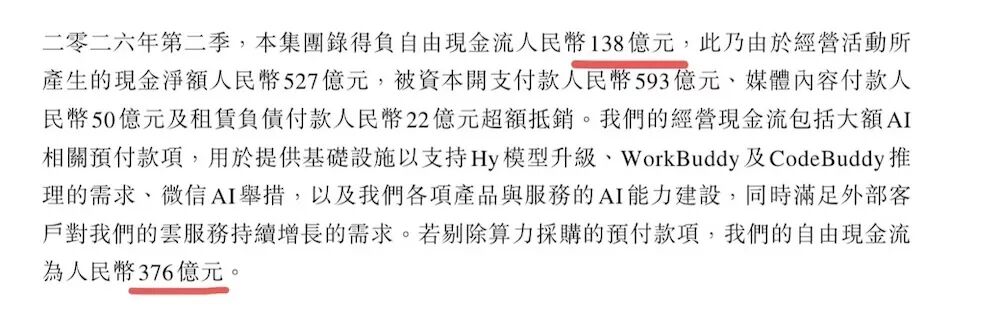
The financial report shows that Tencent recorded a free cash flow of -138 billion yuan in Q2. Excluding the prepayment for computing power procurement, the free cash flow was 376 billion yuan, which means the total prepayment for computing power in Q2 reached 514 billion yuan.
Regarding computing power, Martin Lau, President of Tencent, further added that the current computing power leasing market has strong demand, and some cloud service providers can recover depreciation costs in the short term through external leasing. However, Tencent has adopted a different strategy: the newly added computing power will be prioritized for self-developed large model training and market expansion of AI applications, taking into account both internal model development and external leasing needs.
By the end of this year and next year, Tencent will have sufficient GPU capacity to strengthen its cloud services, including bare-metal GPU leasing and MaaS (Model as a Service).
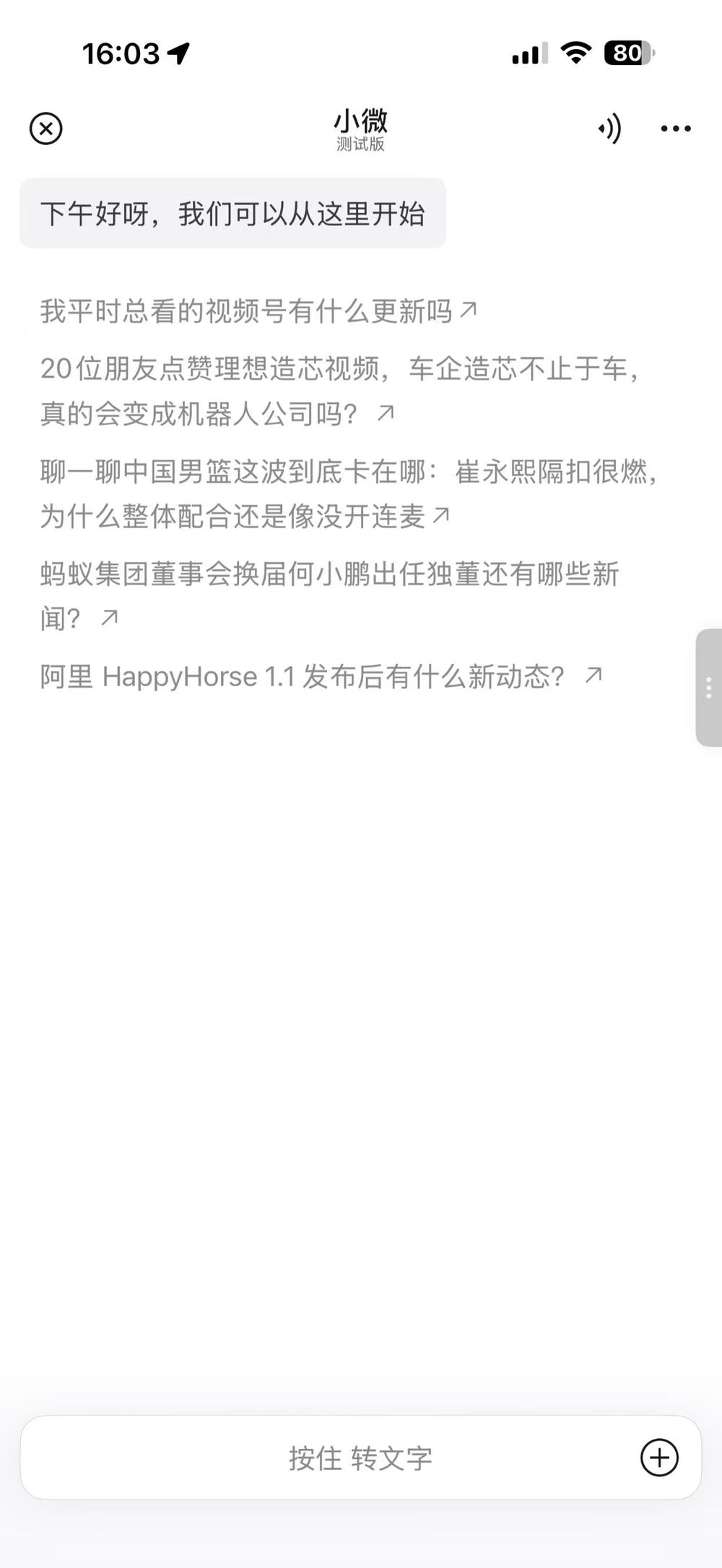
AI has become the core theme of Tencent this quarter: Hy3 has been officially released and open-sourced, with the agent and code capabilities improved by 20-30% compared with the preview version; Xiaowei, the native AI assistant of WeChat, has launched gray-scale testing, covering 16 entry points in WeChat from chat pages to Moments; the office agent application Workbuddy has exceeded 20 million monthly visits, maintaining the first position in the market.
Martin Lau, President of Tencent, revealed at the earnings conference that Hy4 is planned to be launched in the near future, with its model scale further expanded on the basis of Hy3, and its model performance and multi-modal capabilities will also be improved.
Turning to business performance, as of June 30, 2026, Tencent's total revenue in Q2 was 2047.85 billion yuan, a year-on-year increase of 11%; net profit was 579.77 billion yuan, up 3% year-on-year and down 2% month-on-month.
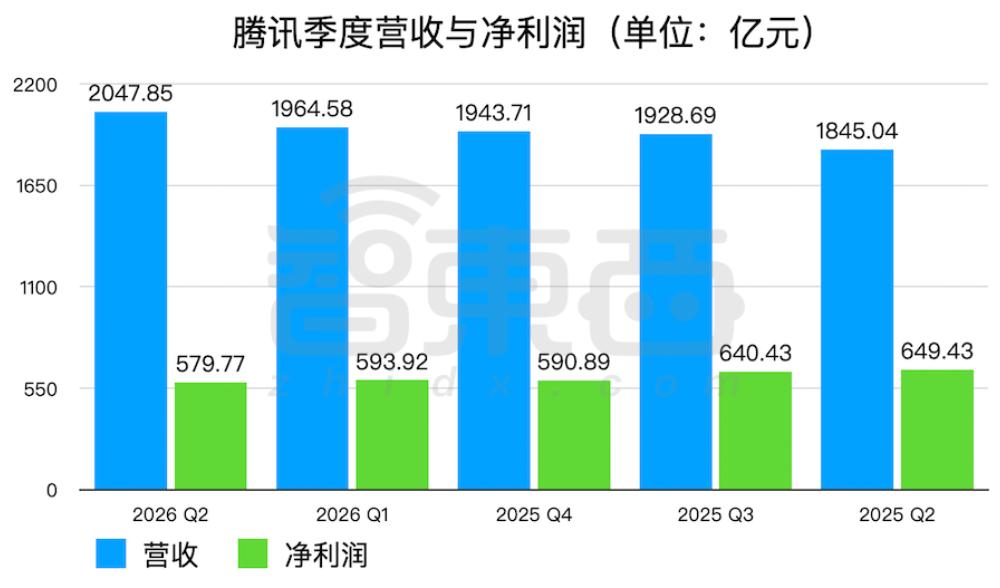
▲ Tencent's quarterly revenue and net profit (Chart by Zhidx)
In the total revenue, the revenue of ToB business (financial technology and enterprise services) was 602.86 billion yuan, a year-on-year increase of 9%. The growth of enterprise service revenue is mainly driven by the growth of Tencent's cloud service revenue, benefiting from the rising demand for AI-related services, continuous expansion of the international market and a more favorable pricing environment.
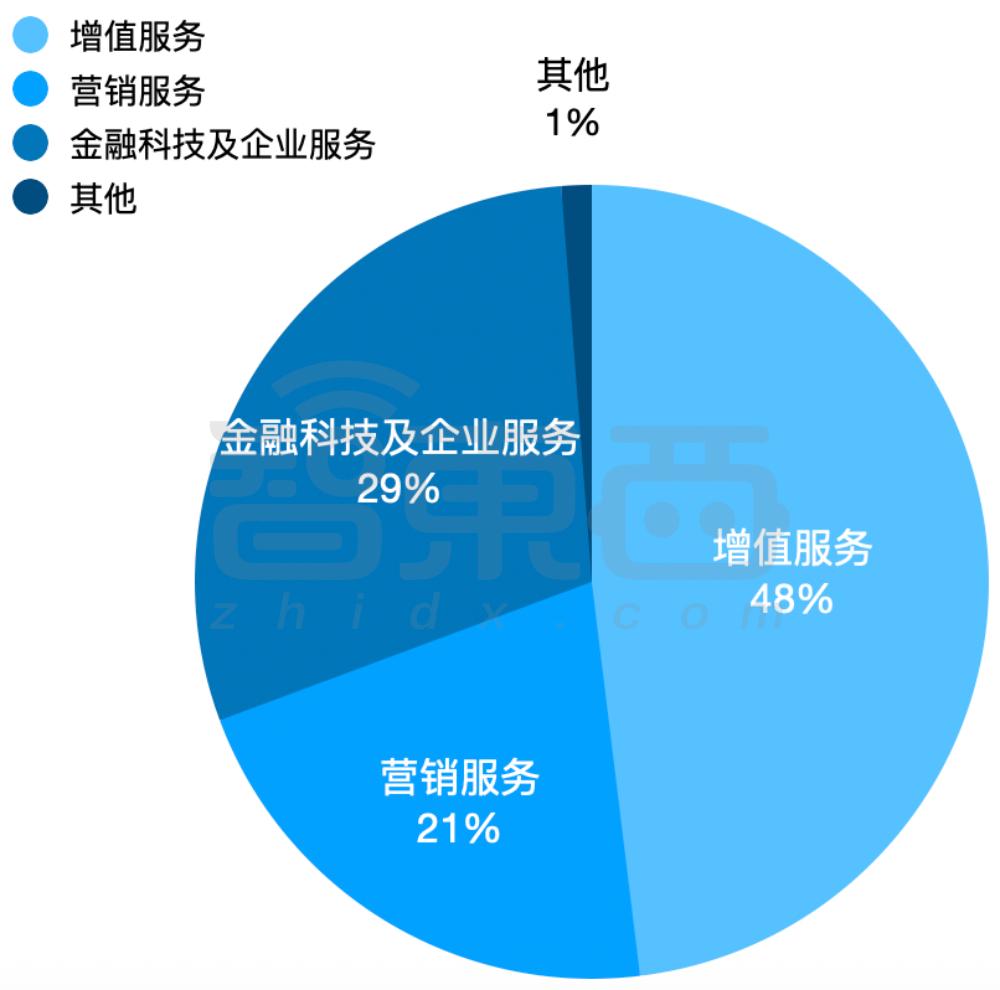
▲ Proportion of revenue of Tencent's various businesses (Chart by Zhidx)
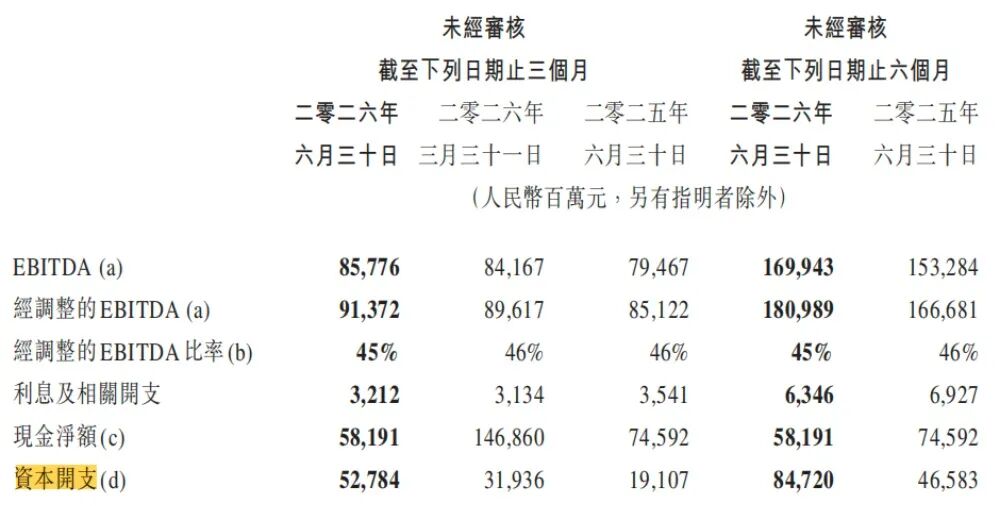
In terms of capital expenditure, Tencent's capital expenditure in Q2 was 527.84 billion yuan, an increase of 208.48 billion yuan over the previous quarter; R&D expenditure was 27.28 billion yuan, a year-on-year increase of 35% to support the upgrade of Hy models, WeChat AI initiatives and the AI capability building of Tencent's various products and services.
It is worth noting that Tencent's non-IFRS operating profit in Q2 increased by 9% year-on-year to 756 billion yuan. Excluding "new AI products", namely Hy, Yuanbao, CodeBuddy, WorkBuddy and Xiaowei, its non-IFRS operating profit was 861 billion yuan, a year-on-year increase of 19%. This shows that in the second quarter, "new AI products" brought Tencent an operating loss of 10.5 billion yuan.
01.
Tencent's three-layer AI architecture is laid out:
Hy4 to be launched soon, Xiaowei starts gray-scale testing
Looking at the entire Tencent's Q2 2026 financial report and earnings conference, AI is an unavoidable topic all the time.
In the financial report, Tencent's AI products, namely Hy large model, Yuanbao, CodeBuddy, WorkBuddy and Xiaowei, brought Tencent an operating loss of 10.5 billion yuan. But at the same time, Tencent's R&D investment this quarter was 27.28 billion yuan, up 35% year-on-year.
Behind this set of figures is Tencent's all-round advancement of AI in model development, application and scenario penetration.
Previously, in Tencent's 2025 Sustainable Social Value Report, Pony Ma proposed that Tencent should focus on four key points when developing AI: engineering implementation, scenario entry, low-threshold use, and safety and controllability. The overall layout is divided into three-layer architecture:
The bottom layer is the Hunyuan large model, which builds a full-coverage model spectrum from large to small sizes;
The middle layer is WorkBuddy, positioned as the "scaffolding" of Tencent's AI system;
The top layer is the super ecological entrances such as WeChat, QQ, WeCom, and Tencent Meeting. In the future, all mini-programs will be fully agent-enabled.
In terms of basic models, in early July, Hy3 was officially released and open-sourced, with 20-30% improvement in agent and code capabilities compared with the preview version released in April; it leads in performance evaluation under the same parameter scale, and is comparable to flagship models with 2 to 5 times its parameter scale.
Calculated by the Token consumption of OpenRouter, Hy3 has been ranked top 3 in the world since its launch. In addition, the average daily Token usage of Hy3 is 7 times that of the preview version.
In the past, the market generally believed that Tencent's AI pace was slightly slower than that of its peers. Before the earnings conference of the last quarter, Pony Ma once compared AI to "a leaking ship".
However, in the second quarter, the performance of Tencent's AI office agent application Workbuddy helped Tencent achieve a turnaround.
According to the "2026 Q2 China Office Agent Platform Market Insight Report" by Analysys, in June 2026, WorkBuddy's monthly visits in the domestic PC-side AI-native office agent market exceeded 20 million, maintaining the first place in the market, exceeding the sum of the second and third places. In the top 10 list of monthly visits, Tencent occupies 4 positions, including WorkBuddy, CodeBuddy, QClaw, and Marvis.
As Tencent's super apps, WeChat and WeCom have also gradually started to become "AI-enabled".
In the second quarter of 2026, WeCom successively launched multiple AI functions such as face-to-face meeting recording and intelligent documents, and launched intelligent assistant "Dayuan", which is directly embedded in the workflow, covering multiple scenarios such as group chat, to-do items, and emails.
In June, Xiaowei, the native AI assistant of WeChat, is launching gray-scale testing. (After sorting out 16 AI entrances of WeChat, we found that "Xiaowei" is everywhere) Its main model is WeLM (a Well-read Pre-trained Language Model) self-developed by the WeChat team, and some of its responses are generated with the support of DeepSeek. Xiaowei can truly access the information and native functions within the WeChat ecosystem. Content such as chat records, group chats, official account articles, video accounts, pictures, PDFs, and Office documents can all be directly queried through Xiaowei.
At the earnings conference, Martin Lau, President of Tencent, said that Tencent believes that over time, the WeChat ecosystem will become an AI-first application and ecosystem.
In terms of infrastructure, this quarter, Tencent Cloud assisted Indonesian operator XLSMART in completing large-scale public cloud migration, and WorkBuddy and CodeBuddy were embedded in the migration process to improve efficiency.
02.
AI penetrates core businesses:
The Token quota for mini-programs reaches 1 billion
The computing load of AI recommendation model increases by 24 times
In addition to the above products, AI is also expanding to more business scenarios of Tencent.
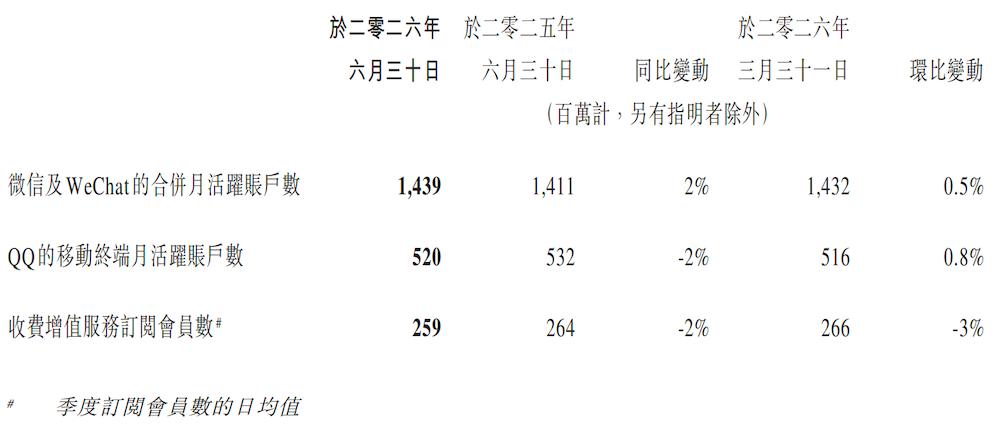
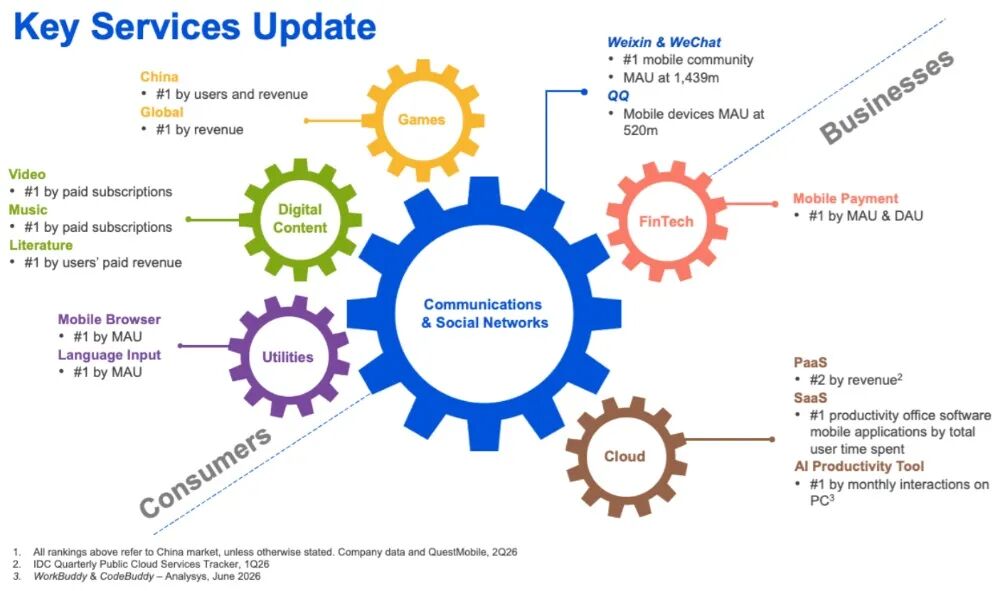
Benefiting from the support of AI, as of the second quarter of 2026, the combined monthly active accounts of WeChat and its overseas version WeChat have reached 1.439 billion, and the total user usage time of Video Accounts increased by more than 20% year-on-year.
In addition to launching the AI assistant Xiaowei, the "WeChat Mini-program Growth Plan" has increased the large model Token quota to 1 billion, which has now attracted 63,000 mini-programs to participate, of which more than 60% are submitted by individual developers, and the number of AI application mini-programs increased by nearly 40% within half a year.
In terms of games, the cumulative number of users who have experienced the AI NPC gameplay of "Peacekeeper Elite" reached 167 million, with the highest daily active users reaching 17.7 million. The new game "Roco Kingdom: World" also launched the native Coach Agent "Scarlett".
In terms of marketing services, Tencent's marketing service revenue reached 435.7 billion yuan this quarter, a year-on-year increase of 22%. The customer coverage of the intelligent delivery product matrix "Tencent Marketing AIM+" has remained stably above 80%.
03.
Conclusion: Starting from scenarios
Tencent's AI has initially formed a positive cycle
Tencent's three-layer AI strategy reflects a distinct "scenario-led" feature. Different from simply pursuing parameter scale or single-point technological breakthroughs, Tencent binds AI capabilities with existing businesses such as WeChat, games, advertising, and enterprise services, so that every technology investment has a clear application outlet and user reach path.
From the industrial perspective, Tencent's AI system has initially formed a positive cycle of "technology-product-user". This AI diffusion model relying on super application scenarios may be more sustainable than the pure technology-driven route.
This article is from the WeChat public account "Zhidx" (ID: zhidxcom), author: Wang Han, editor: Xinyuan, released with authorization from 36Kr.