Why have coal prices dropped by 70%, yet coal stocks still managed to hit record highs?
Since July, the coal sector of the A-share market has rebounded by nearly 20% cumulatively, leading the broader market gains and approaching its historical high, which forms a sharp contrast with the "sunset industry" label the market has long attached to it.
More notably, coal prices have dropped by 70% cumulatively since peaking in 2021 and are still hovering at multi-year lows. So why has such a severe divergence emerged between coal stocks and coal prices?
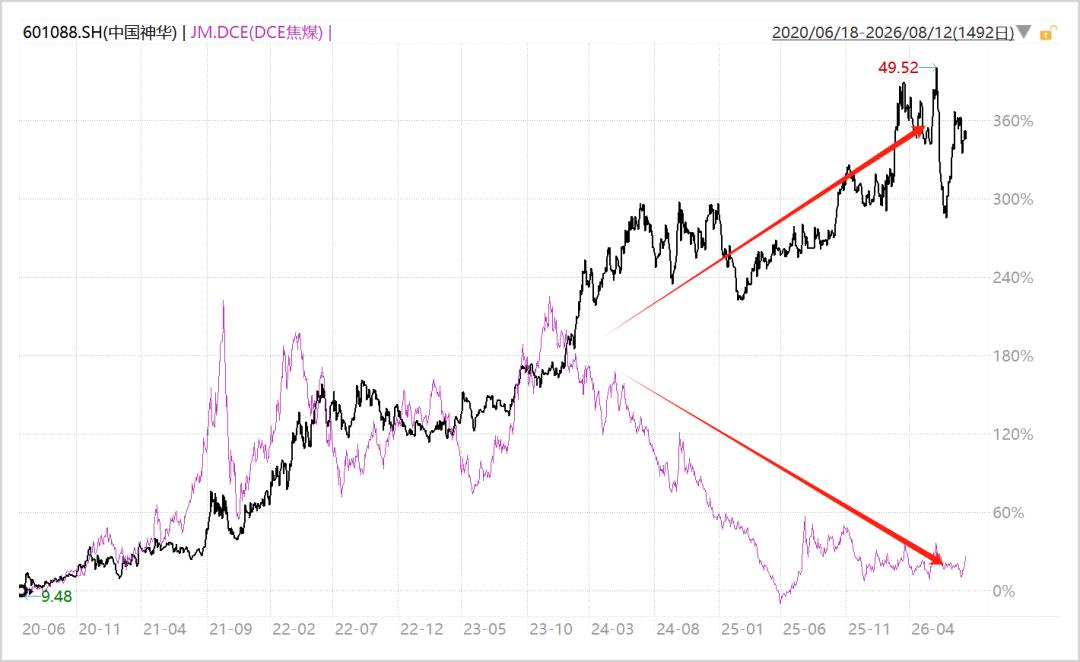
▲ China Shenhua vs. Coking Coal Price Trend Chart, Source: Wind
A Major Step Forward in Performance
In early June this year, the coal sector just refreshed its all-time high, but then quickly corrected by more than 20%, and soon ushered in a rebound in July.
The reason is that the decline of the technology sector in July dragged down the overall performance of the A-share market, the balance of margin trading and securities lending and trading volume also contracted significantly, and risk appetite declined. In this context, the market style shifted from the previous growth-oriented offensive mode to a defensive and conservative mode, and coal benefited as a widely recognized dividend asset in the market.
Of course, the change in broad market risk appetite is only the catalyst for the coal rebound. In fact, the coal sector had already bottomed out and reversed as early as 2020, and outstanding leading enterprises represented by China Shenhua and Shaanxi Coal Industry had embarked on a trend upward channel back in 2016.
As a traditional "sunset" industry, what supports coal to have such continuous explosive momentum?
At the end of 2015, the supply-side reform kicked off, and the coal industry launched the campaign of cutting overcapacity. From 2016 to 2020, the coal industry eliminated about 1 billion tons of backward production capacity in total, and the supply-demand pattern was greatly optimized.
The most direct result is the overall rise of the central level of coal prices. Taking coking coal futures prices as an example, the price soared from less than 500 yuan in the previous cycle to nearly 3,900 yuan in 2021. Although it has now fallen to around 1,300 yuan, the annual average price central level is far higher than that of the previous cycle.
The rise in prices will naturally drive the improvement of performance and profitability. In 2025, the return on equity (ROE) of the coal sector reached 8.45%, ranking 9th among all sectors in the A-share market, while in 2015, this figure was only -0.6%.
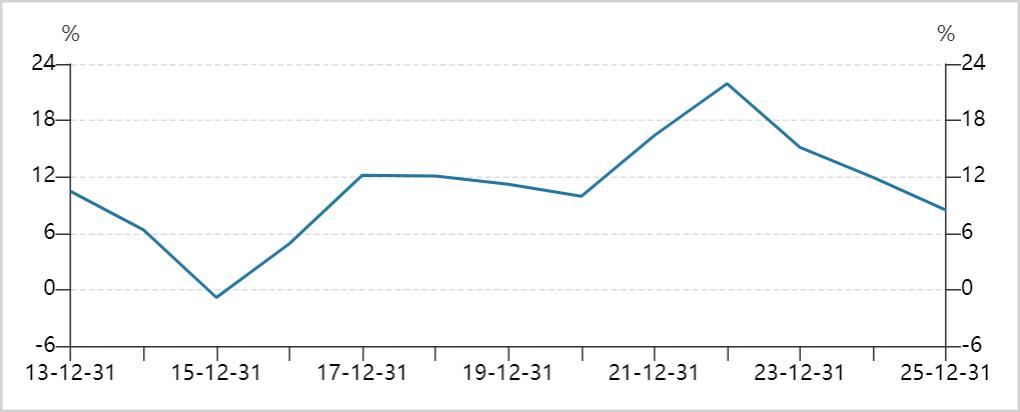
▲ ROE Trend Chart of the Coal Sector, Source: Wind
At the enterprise level, taking China Shenhua as an example, from 2022 to 2025, the company's net profit attributable to shareholders remained stable between 52.8 billion yuan and 69.6 billion yuan, significantly higher than the average level of 50 billion yuan from 2017 to 2021, and far exceeding the performance of less than 30 billion yuan from 2015 to 2016.
It can be seen that after the supply-side reform, although coal prices still fluctuate, the overall central level has moved up. This is the core factor for the steady performance of coal enterprises and one of the important supports for the rise of the coal sector.
However, the increase of coal sector in the past few years far exceeded expectations, which cannot be fully explained only by the upward shift of the performance central level. From the perspective of Market Value Observation, the deeper reason lies in the fundamental change of the market trading logic.
Major Transformation of Cyclical Attributes
Since 2016, China Shenhua has risen continuously for more than 10 years (only a small correction in 2018), with a cumulative maximum increase of more than 700%. In the same period, the increase of Shaanxi Coal Industry even exceeded 10 times.
Such a sustained and sharp rise is not driven by market sentiment, nor is it a simple valuation repair. Instead, the market has begun to truly price in a paradigm shift — Coal is transforming from a strong cyclical sector to a value dividend sector.
What is the trigger behind this accelerated transformation?
In September 2020, China officially announced the "dual carbon" goals — striving to achieve carbon peaking by 2030 and carbon neutrality by 2060.
This has had a fundamental, systematic and far-reaching impact on the coal industry, a sector with high carbon emissions, reshaping its development model and industry positioning. The core change is that capital expenditure has declined irreversibly, and the dividend payout ratio has increased substantially.
An obvious signal is that although the industry's profit hit a record high from 2021 to 2022, enterprises did not expand production capacity on a large scale as in previous cycles, but significantly reduced capital expenditure on traditional coal business, using the funds for dividends and shifting to clean energy.
Before 2016, the capital expenditure ratio (capital expenditure / net cash flow from operating activities) of China Shenhua remained above 50% all year round, and even close to 100% in some years. After that, this ratio was compressed to more than 20%. Although it has rebounded to above 40% in the past two or three years, the main reason is that the funds are invested in power generation, transportation, coal chemical and other businesses, and the investment in traditional coal business is still shrinking.
The flip side of the compression of capital expenditure is the substantial increase in the dividend payout ratio.
In 2016 and before, the dividend payout ratio of China Shenhua was basically below 40%. After that, it rose sharply, exceeding 70% in the past five years. In 2021, it made a large-scale dividend distribution with the total dividend amount exceeding 50 billion yuan, and the dividend payout ratio directly reached 100%.
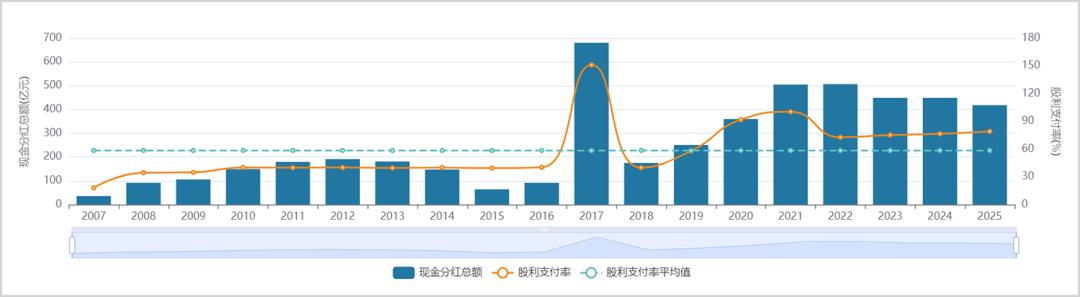
▲ Dividend Distribution of China Shenhua, Source: Wind
The significance of the increase in dividend payout ratio is not only the higher dividend yield. From the market's perspective, it is also a signal that the interests of majority and minority shareholders are converging.
At the same time, the continuous decline of domestic interest rates is also driving capital to flow to dividend assets such as coal. Since 2020, affected by factors such as the central bank's multiple RRR cuts and interest rate cuts, the yield of China's 10-year government bond has dropped from above 3.2% to around 1% all the way.
The 10-year government bond yield is often regarded as the risk-free rate. Its sharp decline means that the equity operating cost of enterprises is lowered, which is conducive to the return of existing value.
As early as more than 50 years ago, Warren Buffett put forward in *The Theory of Investment Value* that the existing value of an enterprise is equal to the sum of the free cash flow generated during its duration, discounted at an appropriate interest rate. This is the classic DCF valuation model.
From this perspective, after the supply-side reform and the "dual carbon" commitment, the net profit of coal enterprises has risen to a new level, coupled with the increase in dividend payout ratio, which means that the future free cash flow has increased. Looking at the denominator, the discount rate is equal to the cost of equity minus the long-term growth rate, and the cost of equity is decreasing along with the decline of interest rates.
With the combined effect of the numerator and the denominator, the existing value of coal naturally continues to expand. The deep-seated change of all this stems from the "dual carbon" policy, which makes the market believe that the decline of capital expenditure of coal enterprises is an irreversible trend, the cyclical nature of coal has been greatly weakened, and its dividend attribute has returned rapidly.
This is also the core reason why coal stocks no longer fluctuate with the coal price cycle.
Low Cost Equals High Barrier
China Shenhua is the largest listed coal enterprise in China. It has continuously outperformed the coal sector and is known as one of the leading enterprises with the most prominent Alpha in the industry.
For commodity enterprises, the terminal selling price of products is determined by market supply and demand, and enterprises cannot set the price on their own. Therefore, the core competitiveness lies in the cost side. The one with lower cost will achieve better operating results.
Taking the 2023 data counted by Huayuan Securities as an example, the mining cost of China Shenhua is only 179 yuan per ton, which is only higher than that of SPIC Energy among major coal enterprises. However, the scale of the two is not at the same level at all — China Shenhua's coal production capacity in that year was 324 million tons, while SPIC Energy's was only 46.55 million tons.
In addition, the cost of China Shenhua is significantly lower than that of competitors such as Shaanxi Coal Industry, China Coal Energy, and Yankuang Energy.
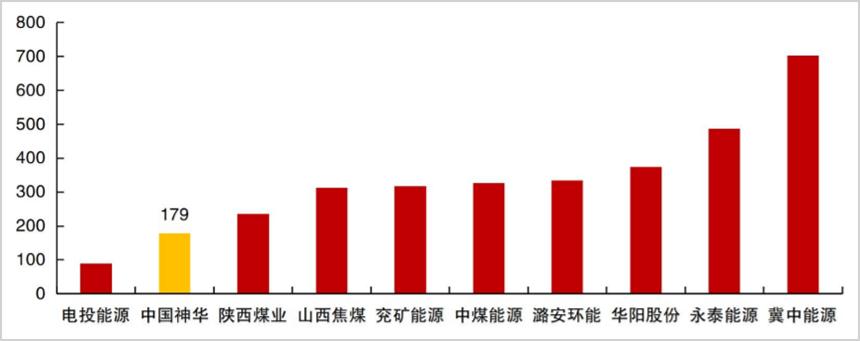
▲ Comparison of Mining Costs of Major Coal Enterprises, Source: Huayuan Securities
The low mining cost of coal enterprises is directly related to resource endowment. China Shenhua's coal resources are distributed in Western Shanxi, Northern Shaanxi and Southern Inner Mongolia — the highest-quality coal producing areas in China, among which open-pit mines account for more than 40%. Such resource endowment is unmatched by the vast majority of coal enterprises.
Around the core business of coal mining, China Shenhua has also built an integrated layout of "coal, power, transportation, port, shipping and chemical industry", which further widens its transportation cost advantage and makes its overall competitiveness stronger.
The core reason why China Shenhua can carry out integrated business is that its coal mines are highly concentrated in distribution. Specifically, the company's largest resource mine is the Shendong Mining Area, with an annual production capacity of nearly 200 million tons, accounting for more than 55% of the company's total production capacity. Next to it is the second largest mining area, Zhungeer, which is exactly the channel for transporting coal to coastal areas. Such geographical conditions are difficult for other coal enterprises to replicate.
Of course, coal enterprises including China Shenhua may not avoid the potential threat of shrinking demand in the future. At present, new energy cannot replace traditional energy on a large scale for the time being, and the core bottleneck lies in the maturity and large-scale application of energy storage technology.
If there is a revolutionary breakthrough in energy storage technology in the future, the transformation of clean energy will be greatly accelerated, and thermal power generation, which accounts for more than 50% of coal consumption, may face the risk of sharply shrinking demand or even shutdown.
However, for this threat, as China Shenhua is one of the few low-cost suppliers in the homogeneous commodity sector, the duration of its coal and coal power assets is destined to be far longer than the industry average and the vast majority of its peers. Of course, this day is far from coming, and the market has not priced it in yet.
Overall, the deep-seated driving force behind this multi-year trend market of the coal sector comes from the re-evaluation of the industry's underlying logic by the capital market. The supply-side reform optimizes the supply pattern, the "dual carbon" policy locks in capital expenditure, and the decline of interest rates boosts the existing value. In this wave, when the cyclical attributes fade and dividend attributes emerge, those leading enterprises with real cost barriers have become the winners of the market.
This article is from the WeChat official account "Market Value Observation", Author: Li Xiaofeidao, published by 36Kr with authorization.