Lin Junyang and Manus have both returned to the starting point.
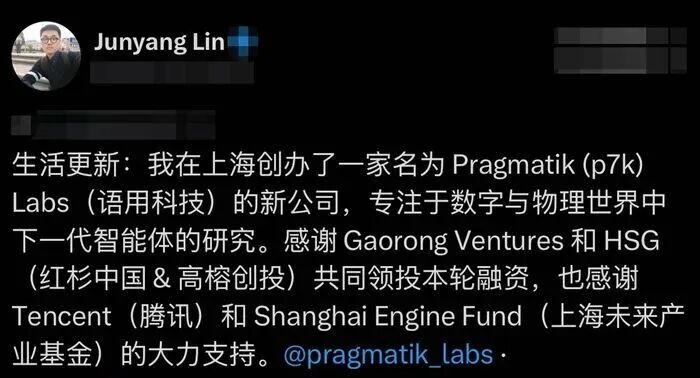
In the early hours of August 12, Lin Junyang announced the name of his new company on social platforms — Pragmatik Labs, whose Chinese name is Yuyong Technology, internally referred to as p7k.
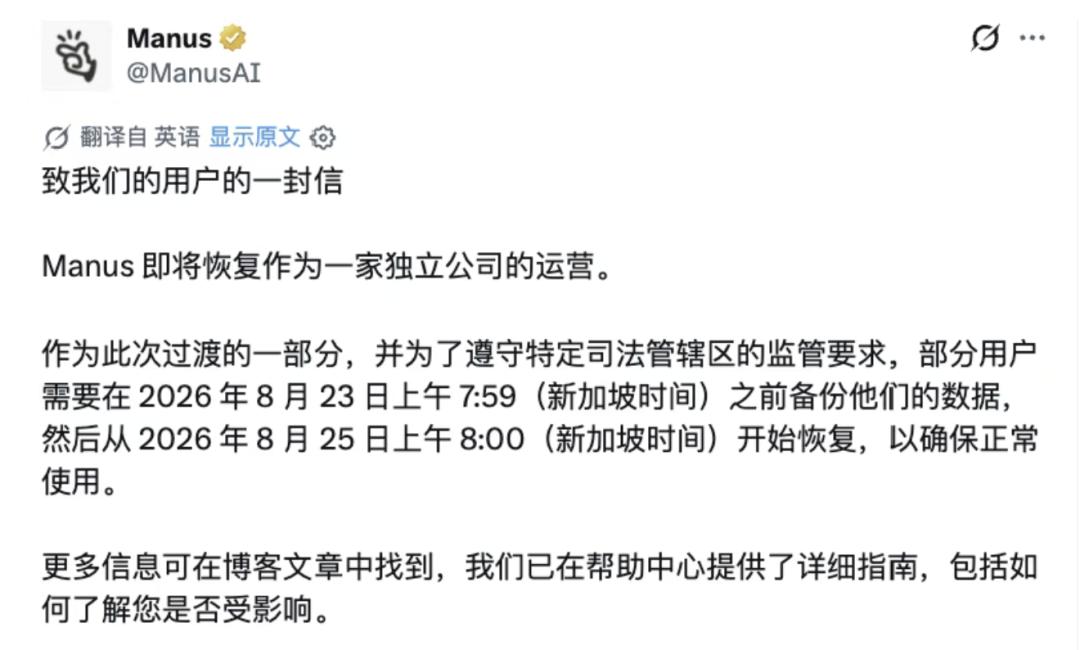
A few hours earlier, Manus released its "Letter to Users", announcing that the AI agent company acquired by Meta more than seven months ago "will soon resume operations as an independent company".
One is a technical leader with one of the highest reputations in China's large model circle over the past two years, and the other is a global star general-purpose AI agent enterprise that rose to fame worldwide in 2025. On the same early morning, they moved in the same direction in different ways: independence.
These two incidents seem to be independent of each other. But upon in-depth analysis, the underlying logic of the two stories is very similar — both were once lifted to the spotlight by top-tier resources, with one backed by one of China's largest commercial entities, and the other favored by one of the world's most valuable technology companies. Both have tasted the benefits of "concentrating resources to achieve explosive breakthroughs", and at a certain moment, they both realized that the hands that hold them up are also the hands that bind them.
In the AI era, the resources and attention of large companies can create a star overnight, but when it comes to actual execution, the agility and quick pivoting capability of small companies may be the more scarce asset.
Two "Stars" Under the Spotlight
Let's turn the clock back to March 6, 2025.
On that day, a company named Butterfly Effect launched a product called Manus. It is not just another chatbot, but a general-purpose AI agent that can run virtual machines on the cloud, look up information by itself, write code, and make PPTs. After its release, the invitation code was in extremely short supply, and the entire tech circle was discussing the "Manus Moment".

Capital followed quickly. In the following months, Benchmark led a $75 million financing round for Manus, with a post-money valuation of approximately $500 million. By December 2025, Manus disclosed that its annualized recurring revenue (ARR) eight months after the product launch had exceeded $100 million, the platform had processed more than 147 trillion tokens in total, and created over 80 million virtual computers. A young entrepreneur from Wuhan who had accumulated his first pot of gold with the WeChat plugin "Yiban Assistant" before, stood at the center of the global AI industry in less than a year. Xiao Hong and his team also traveled around the world, meeting top tech company leaders such as the CEO of Microsoft.
The real climax came on December 29, 2025. Meta announced the acquisition of Manus with a transaction size of about $2 billion, and the total potential value including employee retention arrangements is rumored to reach $2.5 billion. This is another heavyweight acquisition of Mark Zuckerberg following WhatsApp and Scale AI. For founder Xiao Hong and his team, this is almost the best outcome an entrepreneur can imagine — the product is validated, the company is taken over by a top global platform, and the technology will be embedded in products used by billions of users.
Lin Junyang's "rise to the top" took a different path.
Born in 1993, Lin graduated from the English Department of University of International Relations and the School of Foreign Languages of Peking University. He started his career from linguistics, then shifted to computational linguistics and natural language processing. After graduating with a master's degree in 2019, he joined Alibaba Damo Academy and participated in early large model projects such as M6. At the end of 2022, he was appointed as the technical lead of the Tongyi Qianwen series of large models. In 2024, he led the team to open-source the Qwen series of models, competing head-to-head with GPT and Claude on the global open-source leaderboards, becoming the most well-known name representing Chinese large models going global. In May 2025, 32-year-old Lin Junyang was promoted to P10, making him the youngest P10-level technical expert in the history of Alibaba.
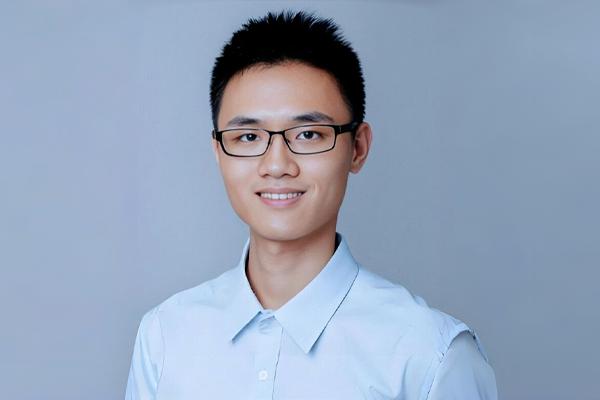
He is not the kind of star manager who is good at socializing under the spotlight, but a technical person who built his reputation through code and models. How influential is he in the industry? In the early hours of March 4, 2026, he posted a line on X saying "me stepping down. bye my beloved qwen." which got more than 10,000 likes in a very short time. After that, core Qwen members including Yu Bowen and Kaixin Li left one after another. The resignation of a technical lead triggered a "collective exodus" of open-source large model talents, which is rare in China's AI history.
One project and one person were both pushed by the times and capital to a height that does not belong to "ordinary entrepreneurs". When the spotlight falls, everything seems like the final outcome.
The Cost of Being Lifted Up
But the spotlight also has its weight.
Manus soon found out that being favored by Meta does not equal the happy ending of a fairy tale. After the transaction was announced, geopolitical and regulatory issues emerged. On April 27, 2026, the National Development and Reform Commission disclosed that the Office of the Foreign Investment Security Review Working Mechanism legally made a decision to prohibit the investment in Manus' acquisition by foreign parties, requiring the parties to cancel the transaction.
A commercial acquisition took an unexpected turn. Then came the long "separation" process: data sharing was suspended, operations were split, and user data was migrated. The "Letter to Users" released on August 11 is full of trivial and specific arrangements — data generated on and after December 29, 2025 (the day of Meta's acquisition) will be deleted, affected users need to complete backup before 7:59 on August 23 (Singapore time), access will be restored on August 25, the transition period is free of charge, and there is a "return welcome reward". This open letter, which has been viewed 5.6 million times, is filled with the cost of a company being acquired and then "returned" due to external factors.
According to a report by the Financial Times, Tencent, together with existing investors including ZhenFund and HSG, is negotiating to repurchase Manus' equity from Meta at an estimated valuation of about $2 billion. If the transaction is completed, Tencent, as the largest single shareholder, will hold no more than 50% of the shares and will not seek controlling stake. The company will continue to operate independently in Singapore, with a future goal of listing in Hong Kong. After all the twists and turns, Manus is back to the state before the acquisition, except that it has an extra scar and a shareholder list far more complex than before.
What Lin Junyang faced was another kind of "unbearable weight".
The large company provided him with computing power, data, engineering teams and a global open-source stage, but the organizational logic of the large company eventually clashed with his technical judgment. According to a report by LatePost, the Tongyi Lab planned to split the Qwen team from "vertical integration" to "horizontal division of labor", an adjustment that ran counter to Lin Junyang's technical philosophy. Phoenix Tech learned at that time that he formally submitted his resignation to Alibaba the afternoon before posting on social media, and left the company immediately.

"I've done all I can for Qianwen," he wrote in his WeChat Moments. He also recalled that on his last day, when everyone applauded for him, "I was holding back tears." This sentence contains exhaustion, as well as the sense of powerlessness of a technical leader in front of a huge organization — large companies can concentrate resources to achieve explosive breakthroughs, but what happens after the breakthrough? When the strategy needs to shift, the organization needs to adjust, and resources need to be reallocated, the personal technical ideal often has to give way to the will of the system.
One was forced to split up by external forces, the other left voluntarily. But they are facing the same proposition: when the resources of large companies change from a boost to a shackle, independence is no longer a fallback option, but the only way out.
This may be a unique dilemma in the AI industry. The resource advantage of large companies was decisive in the traditional industrial era — as long as you have factories, channels and licenses, small companies cannot compete. But in the AI era, the technical paradigm shifts on a monthly basis. The correct route today may need to be completely overturned tomorrow. Large ships have strong endurance, but they also have a large turning radius. Small companies lack ammunition, but they can change direction overnight.
Return to Where Things Happen
Lin Junyang named his new company Pragmatik Labs. The word Pragmatik comes from "Pragmatics" in linguistics. He explained that this word means "return to where things happen", and also represents a pragmatism — AGI will eventually solve practical problems in the real world.
This is not just another large model story. The direction of p7k is "next-generation Agent that spans the digital world and the physical world": in the digital world, it will build general-purpose agents for knowledge work and enterprise processes; in the physical world, it will explore embodied intelligent systems that can enter the real environment and perform long-term tasks. Gaorong Ventures and HSG co-led the investment, with Tencent and Shanghai Future Industry Fund participating. Phoenix Tech learned from people familiar with the matter that the company's post-money valuation is about $2 billion, and it has launched a new round of financing, with a potential valuation of up to $5 billion.
At the same time, Lin Junyang's new company is based in Shanghai, and the investors in this round of financing include capital supported by Shanghai's state-owned assets.
Capital's trust in "star technical talents" has not diminished. But this time, Lin Junyang is no longer the P10 who holds Alibaba's resources. He has to rent the office by himself, build the team by himself, decide how to spend every penny by himself, and take responsibility for the consequences at every technical fork in the road. All the things that the large company used to shield him from — computing power procurement, organization coordination, business implementation, cash flow — are now all on his plate.
The real meaning of "return to where things happen" may lie right here: not to return to the spotlight, but to return to the problem itself.
The same is true for Manus. Independent operation means regaining control of product roadmap and financing rhythm, no longer making way for Meta's global strategy, and iterating Agents at its own pace. But it also has to face a much more crowded track by itself: the window of being the "world's first general-purpose AI agent" in 2025 has passed. OpenAI, Google, ByteDance, and DeepSeek are all embedding Agent capabilities into their own products, and the dividend of the "Manus Moment" is being diluted. Xiao Hong and his team need to prove that Manus can still perform well even without the aura of Meta.
It is thought-provoking that Tencent appears in both stories. It participated in Lin Junyang's first round of financing, and also participated in the repurchase plan of Manus. But Tencent deliberately maintained a "non-controlling" distance in the arrangement of Manus — this in itself is an attitude: at this stage of the AI industry, even giants understand that some things are more efficient when done by small companies than being held tightly in their hands.
The return of Lin Junyang and Manus is not a simple narrative of "large companies failed and small companies won". Without Alibaba, Qwen would not have its status in the global open-source community; without Meta's acquisition offer, Manus' value would not have been confirmed so dramatically. The resources of large companies can indeed create stars, but the cruelty of the AI industry is that it changes too fast. The paradigm of models is shifting, and the focus of competition has shifted from "whose model is smarter" to "whose agent can do more practical work". After concentrating resources to achieve an explosive breakthrough at one point, you often need to quickly pivot to the next point. And pivoting is exactly the hardest thing for large companies to do.
Returning to the starting point does not mean returning to nothing. Lin Junyang brings his experience of leading a world-class open-source model, and a group of people who are willing to follow him; Manus brings millions of global users and proven product capabilities. What they return to is the most authentic state of an entrepreneur: facing uncertainty alone, making rapid trial and error, and taking responsibility for their own judgments.
On August 12, one person announced the name of his new company, and one company announced its re-independence. They both returned to the starting point.
And the starting point is often where the story really begins.
This article is from the WeChat official account "Phoenix Tech", author: Phoenix Tech, published with authorization from 36Kr.