The "Han Hong" counterparts in the United States are scrambling to grab the charity dividend of OA's listing ahead of time.
Someday in the future, a farmed shrimp in a pond suddenly loses consciousness, and it will never know it has been electrocuted. Nor will it know that humans use electric shocks to knock it unconscious so that its subsequent death can be less painful.
What it will never even know is that its luck of getting this "privilege" today comes from the successful IPO of an AI tech company.
At the moment, the IPO has not happened yet, and charities are working hard to secure a painless death for this shrimp.
OpenAI and Anthropic have not gone public, but some people have already set their sights on the wealth of the upcoming new billionaires.
Employees can receive up to 20 fundraising emails a week, people pitching charitable visions pop up at tech gatherings at any time, and job postings of charities explicitly write "being familiar with Anthropic employees" as a requirement.
Charities are rushing to build familiarity with these employees before the IPO, because once the two companies go public, tens of billions of dollars of charitable assets may be unlocked.
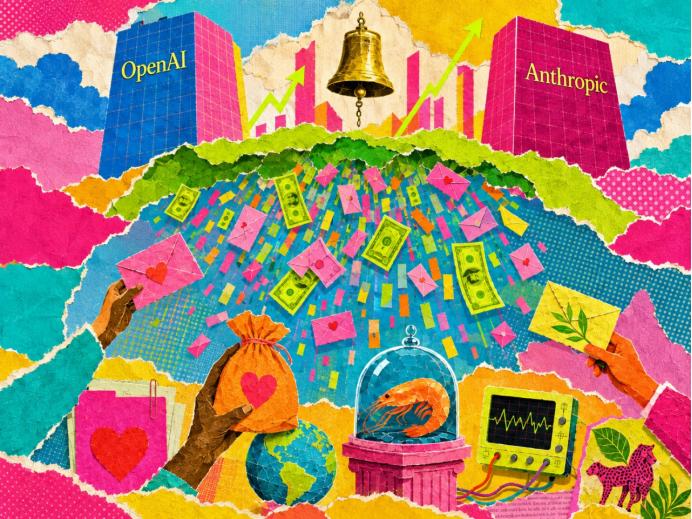
This sum of money has not yet landed, but preparations around it have already begun — expand the team when needed, upgrade financial and HR systems, otherwise when the time comes, there will not be enough staff and the systems will not be able to support the huge workload.
Moreover, since "Effective Altruism" is prevalent in the AI circle represented by Anthropic, which pays special attention to long-neglected issues, those "niche" charitable causes are very likely to get a large share of the funding. For example, relevant organizations expect that hundreds of billions of farmed shrimp may get a less painful death every year in the future.
The "money-grabbing" war among charities has already kicked off in advance.
01
Charities Come Knocking
If you are an employee of OpenAI or Anthropic right now, the person who has been paying the most attention to your mailbox recently may have changed from headhunters to charities.
Jack Lewars, who provides charitable consulting services specifically for tech and finance billionaires, heard that employees at AI labs such as OpenAI and Anthropic now receive up to 20 unsolicited fundraising emails from charities every week.
The reason is simple: both OpenAI and Anthropic are about to go public, and a large number of equity shares held by employees are about to turn into real money. Charities have already started to "snatch" potential donors in advance.
Sending emails is just the simplest first step.
Many charity staff members even show up in person, trying every means to mix into the social circles of OpenAI and Anthropic employees.
They attend tech events, cocktail parties and dinners in San Francisco, hoping to build connections with these employees before they get rich.
Ryan Carrier, founder of the AI governance organization ForHumanity, is one of them. Founded many years ago, the organization has not raised a lot of money in the past. Now Carrier is seriously thinking about how to get into those social events in San Francisco that pop up around tech company IPOs.
Every time a popular company in Silicon Valley prepares to go public, investors, entrepreneurs, company employees and various organizations will attend a large number of dinners, cocktail parties and private events.
That's exactly the kind of place Carrier wants to go, because the future billionaires are very likely to be in the room.
"I have to get into that room."
Imagine: you strike up a conversation with someone at a party, he hands you his business card and introduces the charity cause he is working on. One day when you make a huge fortune from your company's IPO and want to donate money to do good, won't you be more likely to remember that person who once handed you a business card?
Building familiarity is simple but effective.
The AI education organization AI4ALL takes a more aggressive approach to "constantly boost its presence".
CEO Bo Young Lee started attending more events to raise the organization's exposure, and asked board members to help introduce employees at AI companies. One of the co-founders of AI4ALL is Li Feifei, and this relationship has naturally become an important resource. Lee hopes to meet potential donors from companies such as OpenAI and Anthropic through this connection.
Some charities have even written this requirement directly into their job postings.
One education-focused non-profit organization explicitly lists "building relationships with Anthropic employees" as one of the job responsibilities when recruiting new staff.
Many other non-profit organizations have also started to expand their teams in advance. For example, they hire more fundraising and communication staff, or train existing employees, hoping to get enough manpower in place to compete for donors before this batch of AI billionaires truly emerge.
After all, when everyone starts "grabbing money", it will be too late to recruit people temporarily.
02
A Trillion-Dollar Rain of Wealth
The reason why these charities are acting so fast is that what is in front of them may be a super wealth creation wave that Silicon Valley has not seen for many years.
Worse still, the United States has no shortage of charities at all, which means extremely fierce competition.
There are nearly 2 million registered non-profit organizations across the United States, raising funds for almost every cause you can think of, from cancer treatment, child rescue, forest protection to animal welfare, nuclear war prevention and AI safety. In 2025, Americans donated a total of 6172 billion US dollars, nearly two-thirds of which came from individuals.
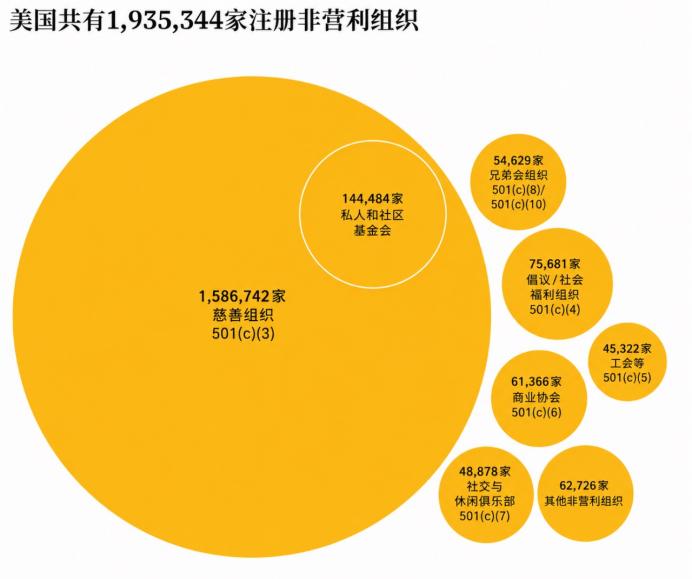
And there is a very special point about the competition between charities: their competitors are far more than those in the same track.
An organization that protects wild animals certainly needs to compete with other wild animal protection organizations, but it is also competing with universities, hospitals, poverty alleviation organizations, climate agencies and even AI governance organizations for the money of the same billionaire.
For donors, spending 1 million US dollars on malaria nets is doing good, spending it on wildlife protection is also doing good, and researching how to prevent AI from destroying humanity is doing good too.
But one dollar can only be donated once.
Usually, this competition spreads across countless donors across the United States, with each organization promoting its own ideas and maintaining long-term relationships. But now, hope is suddenly concentrated in two companies, where the relevant personnel are generally young, their wealth may skyrocket in a short period of time, and many of them already have a strong willingness to donate.
A "rain of money" is coming, how big will it be?
Both OpenAI and Anthropic are now approaching a trillion-dollar valuation. Once they go public, hundreds of employees and former employees will directly become billionaires.
Many of them joined the companies before the AI boom started, and the equity they got back then has now expanded to a completely different magnitude. The IPO is equivalent to opening the door for these paper wealth to be cashed out.
But the money that the charity circle is eyeing is far more than the part that employees can cash out.
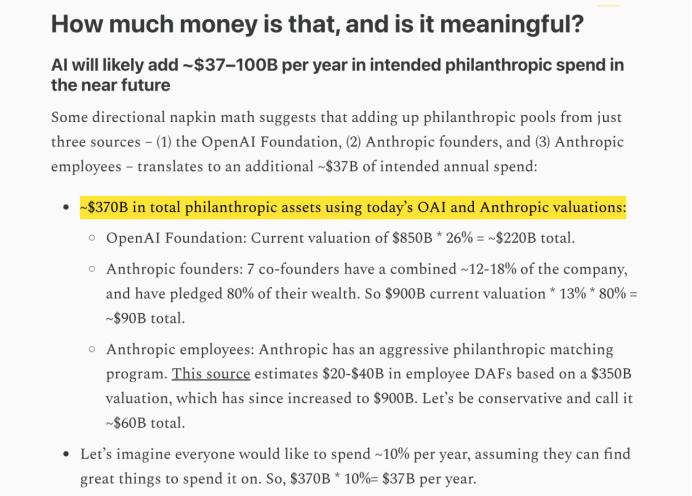
This spring, Nan Ransohoff, head of the Stripe Philanthropy Program, did a special calculation. According to her rough estimate, after OpenAI and Anthropic go public, about 3700 billion US dollars of new charitable assets may be generated in one go. 3700 billion US dollars is equivalent to about 60% of the total annual charitable donations in the United States, almost catching up with the total amount donated by individuals across the country in a year.
OpenAI has a super variable that is rarely seen in other tech companies: it itself comes with a giant charity organization.
OpenAI currently consists of two parts: OpenAI Group, which is responsible for commercial operations, and the non-profit OpenAI Foundation. The latter is not only responsible for public welfare projects, but also the major shareholder of OpenAI Group, holding about 26% of the shares.
The more money OpenAI makes and the higher its valuation, the more valuable the assets owned by this foundation, and the more money it can invest in public welfare causes in the future. OpenAI officials even call it "one of the best-resourced charitable organizations in history".
The situation on the Anthropic side is even more special.
Its seven co-founders have long promised to donate 80% of their personal wealth.
And this donation culture has been directly written into the company's equity incentive mechanism: if employees promise to donate their Anthropic shares to charities, the company will match the donation with additional stocks.
The current policy is 1:1 matching, up to 25% of the employee's held equity. A group of employees who joined earlier even enjoyed 3:1 matching, up to 50% of their shareholding.
In other words, for the same amount of employee wealth that skyrockets due to IPO, there is naturally a higher probability of entering the charitable system inside Anthropic.
Anthropic's IPO alone may bring an additional 150 billion US dollars in charitable donations every year, which is equivalent to suddenly adding "four Bill Gates" to the US charity circle.
For charities, the upcoming IPO of OpenAI and Anthropic is like a weather forecast — a "rain of money" worth hundreds of billions of dollars is about to fall.
03
Who Will Get the Money?
However, this "rain of money" currently only exists in the weather forecast.
There are variables as to whether OpenAI and Anthropic can go public as expected, whether they can maintain their current high valuations when they go public, and when employees can cash out their shares.
Even if the wealth is truly realized, it does not mean that every promised dollar will enter the charity industry. Research from the Bridgespan Group shows that American families with assets exceeding 500 million US dollars actually donate only about 1.2% of their wealth on average every year.
Even if they have the money, they may not be willing to give it to you.
Judging from public discussions about this matter on social media, many people hold negative views. They believe that the fulfillment rate of donation promises is not high in the first place, and it is too naive to think that the new AI rich will be different.
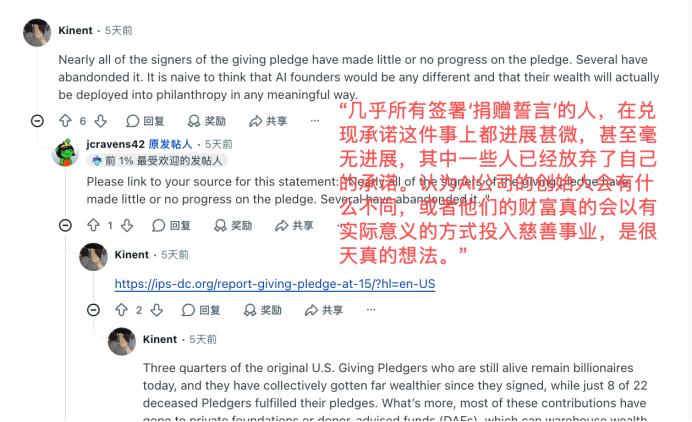
But the charity circle has already started to arrange their current work under the assumption that "this sum of money will arrive".
In July this year, Coefficient Giving, an important funding organization in the Effective Altruism circle, announced that it will invest 1 billion US dollars in public welfare organizations recommended by GiveWell this year. This is almost twice the total amount of donations the organization has made in the past ten years.
It also admitted itself that this sudden increase is a one-time surge, and one of the driving factors is "the continuously rising expectation for future donations".
The companies have not gone public yet, but the future money has already started to change how today's money is spent.
Another very special point of this AI wealth wave is that it may send a large amount of funds to some extremely niche charitable causes that were rarely noticed in the past.
This is related to the Effective Altruism that prevails in the AI circle represented by Anthropic. This circle likes to find problems that meet three criteria at the same time: large enough scale, improvable solutions, and long-term neglect.
As a result, the charitable projects they focus on are often very "niche".
For example, "shrimp welfare".
The Shrimp Welfare Project, founded in 2021, is dedicated to researching how to make farmed shrimp die with less pain.
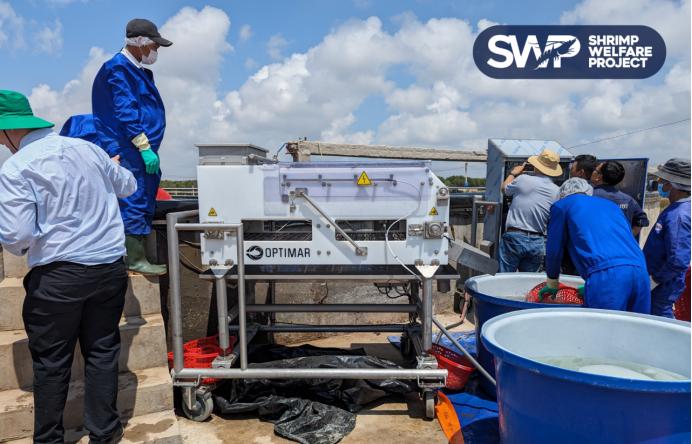
Around 440 billion shrimp are farmed globally every year, many of which are left to suffocate slowly in the open air. This organization provides electric shock equipment to seafood suppliers to make shrimp lose consciousness before slaughter.
Few people care about this, which means that every dollar invested can have a greater impact — which exactly fits the appetite of Effective Altruism.
The Shrimp Welfare Project currently has an annual budget of about 3 million US dollars. If funding increases suddenly, they can effectively absorb 5 million to 10 million US dollars. Their long-term goal is even to "help 100 billion shrimp every year". According to their own estimates, every 1 dollar invested can help about 1500 shrimp every year.
There is also Wild Animal Initiative.
This organization cares about the well-being of wild animals. It has funded research on the social life of mice, the relationship between frog calls and health status, and stress indicators of wild insects. It also hopes to develop methods to control rodent fertility on islands to reduce bird extinction.
It has already witnessed the financial strength of the AI circle. The organization's current annual budget is only about 4 million US dollars, but it has already received several five-figure donations from Anthropic researchers, and is negotiating a 1 million to 3 million US dollar donation with another donor.
The entire farmed animal welfare field currently receives only about 300 million US dollars in funding every year. Some insiders have predicted that after OpenAI and Anthropic go public, this number may double, or even triple.
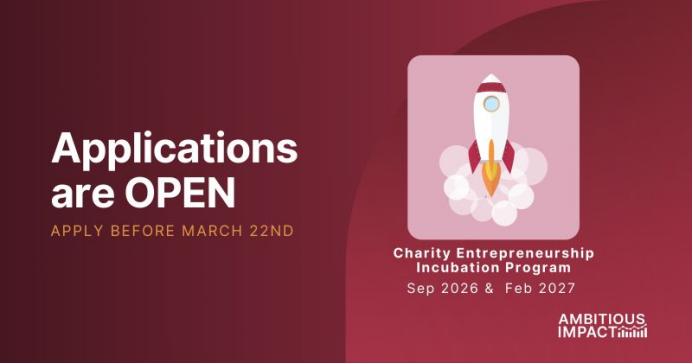
Charities have taken action, for fear of missing the opportunity when the wealth arrives. They upgrade their financial and HR systems, train management staff, and design larger-scale projects in advance. Ambitious Impact, which incubated the Shrimp Welfare Project, has even prepared to launch the first incubation program specifically for animal welfare, hoping to create more new projects that can absorb funds in